Unscheduled Treatment Follow Up Software (2026 Guide)
How unscheduled treatment follow up software converts pending dental plans into booked appointments, recovers lost revenue, and stays HIPAA compliant.
Share:
Table of contents
There's a number in your practice management system right now that most dentists don't think about often enough. It's your unscheduled treatment list. Pending crowns. Recommended implants. Root canals that patients said they'd think about. All of it diagnosed, none of it scheduled, growing a little longer every week you don't work it. This is where unscheduled treatment follow up software earns its place, and why AI follow-up for dental treatment matters.
For most practices, that list is longer than it should be. The gap between what was treatment planned and what was actually scheduled is one of the cleanest revenue recovery opportunities in dentistry. The problem is rarely diagnosis. It's follow-up. Specifically, the absence of a consistent, systematic process to contact patients who left without booking.
The cost is real. According to the American Dental Association, 20-30% of patients become inactive within 18 months without follow-up. Every uncontacted treatment plan is a slow leak in production.
The Treatment Plan Problem Every Practice Knows
The unscheduled treatment problem is a systems failure, not a team failure. You present a case, the patient nods, and then they never call back. Manual follow-up doesn't scale, which is exactly the gap this software is built to close.
You present a case. The patient listens. They nod. They say something like "let me check my schedule" or "I need to talk to my spouse." And then they don't call back.
Your front desk has twenty other things happening at that moment. Maybe someone writes a note to follow up. Maybe they set a reminder. But two days later, a patient no-shows, the phones are backed up, and that follow-up call for the person with the pending crown prep didn't happen.
This is not a team failure. It's a systems failure. Manual follow-up on unscheduled dental treatment does not scale.
The deeper problem is that waiting kills treatment plan conversion. The longer a patient goes without hearing from you after a treatment plan, the harder it becomes to book them. According to the American Dental Association, 20-30% of patients become inactive within 18 months without follow-up. The urgency you communicated in that appointment fades. Cost concerns harden. Anxiety sets in. What was convertible at 72 hours becomes genuinely difficult at 60 days.
Stop letting diagnosed cases go cold
DentalBase runs systematic, channel-matched follow-up on every unscheduled treatment plan so nothing depends on a busy front desk.
See how DentalBase works →What Does AI Follow-Up Software for Dental Treatment Plans Do?
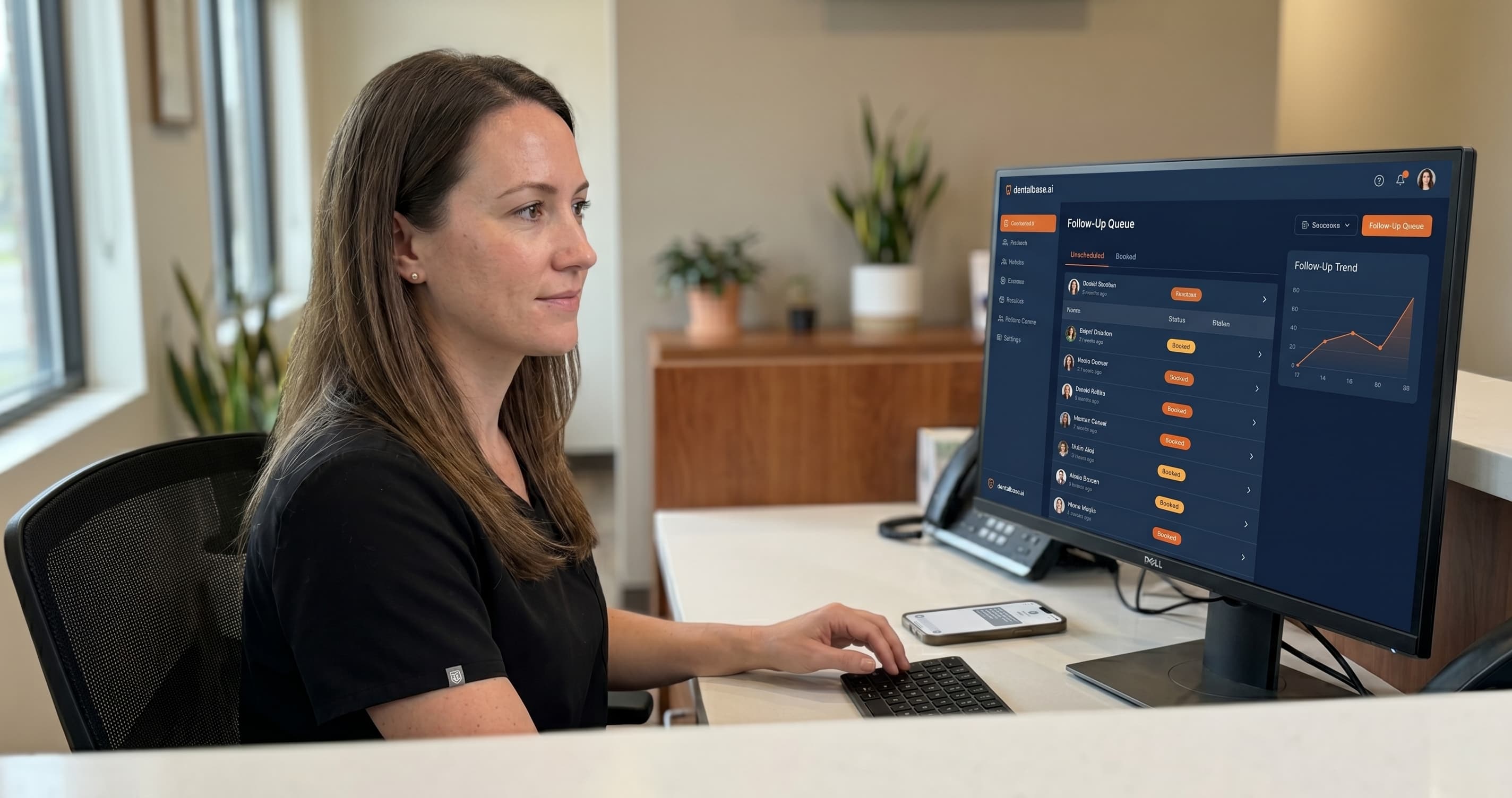
Unscheduled treatment follow up software automates patient outreach that your team can't run consistently by hand. It reads unscheduled cases from your PMS, triggers personalized messages on a set schedule, and tracks every reply, booking, and opt-out automatically.
AI follow-up tools are not magic. They're automation. The value is in what they do consistently that your team cannot do consistently.
The mechanics are straightforward. The software integrates with your practice management system, reads patients with unscheduled treatment plans, and starts outreach when a case sits unscheduled past a defined threshold. That outreach might be a text, an email, or a phone call, depending on documented patient preferences and response history. The message is personalized, uses the patient's name, and references the treatment discussed without loading clinical detail into a text or email.
Here's what a real week looks like inside the system:
| Step | What the software does |
|---|---|
| 1 | Case sits unscheduled for 48 to 72 hours |
| 2 | Personalized outreach goes out in the right channel |
| 3 | Replies route to your team, or booking happens automatically |
| 4 | Follow-up sequence continues until resolved or opted out |
If there's no response, it follows up. If a patient replies with a question, it routes that conversation to your team. If they're ready to book, it can handle scheduling directly back in your PMS.
What makes this useful isn't the technology specifically. It's that every patient with an unscheduled treatment plan gets worked, on a consistent schedule, through the right channel. Not just the ones your coordinator had time for on a Tuesday afternoon.
For practices also dealing with a significant lapsed patient backlog, pairing treatment plan follow-up with a broader patient outreach strategy addresses both problems from the same infrastructure. The same logic applies to long-term patient retention, where structured follow-up keeps active patients from quietly going dark.
Why Don't Patients Schedule, and Why Is That Fixable?
Most patients who leave without booking aren't lost. They hit a friction point that no one removed before they walked out the door. Good follow-up software removes those frictions one message at a time.
There are three main reasons cases go cold, and each one responds to a different message:
- Cost uncertainty. A patient hears "you need a crown" and what they're actually processing is how much this will cost, when, whether insurance covers it, and what happens if it doesn't. A follow-up message that offers a clear path to a financing conversation or links to your payment options removes a lot of that friction before it becomes permanent resistance. Cost is the single biggest blocker, and it's the most fixable.
- Anxiety. Some patients who seem calm in the chair are quietly relieved to leave without committing. They know the treatment is necessary. They're just not sure they can face it. Warm, non-pressuring follow-up that stays supportive, not urgent or sales-driven, reaches these patients better than a coordinator working a call list at speed.
- They got busy and forgot. This is the largest group. It's not a motivation problem. It's a memory and priority problem. Your practice got pushed down the list by a work deadline, a sick kid, a home repair. A well-timed reactivation message pulls that patient right back into the decision.
None of these people are resistant to treatment. They're waiting for the right prompt. Untreated dental conditions tend to worsen and cost more over time, a pattern documented by the Centers for Disease Control and Prevention, which is exactly why prompt follow-up protects both the patient and your production. The same friction shows up in periodontal case acceptance and implant case acceptance, where the diagnosis is sound but the booking stalls.
How Important Is the 72-Hour Window in Treatment Plan Conversion?
The first follow-up matters most. If you're going to move a patient from unscheduled to booked, the highest-yield window is within 48 to 72 hours of the original appointment. The patient still remembers the conversation. The diagnosis still feels relevant. The question of whether to do the treatment hasn't fully resolved into "not right now."
A message in this window, through a channel the patient actually uses, converts better than later follow-ups. After that, a sensible sequence looks like this:
- 48 to 72 hours: first touch, while the conversation is fresh.
- 7 to 10 days: second touch for patients who were genuinely thinking it over.
- 30 days: a recovery message for the ones who got distracted.
Follow-up software handles the entire sequence automatically. Your team doesn't track who received which message on which day. The sequence runs itself, and the analytics show you what converted. Automated recall and reminder systems increase patient return rates by 25-40%, according to Dental Economics, and SMS appointment reminders reduce no-show rates by 38%, per research summarized by the National Institute of Dental and Craniofacial Research.
Your 72-hour window shouldn't depend on a sticky note
DentiVoice triggers the first follow-up automatically the moment a case sits unscheduled, then runs the full sequence without staff effort.
Meet DentiVoice →What Does Good Automated Follow-Up Look Like from the Patient Side?
Good follow-up reads like a message from a real person on your team, not a bot. It uses the patient's name, references their actual situation in plain language, and gives one clear action. The patient shouldn't be able to tell software sent it.
Here's where some practice owners push back: "My patients want to hear from a person, not a bot." That concern is worth taking seriously, because it's sometimes true. It's also mostly addressed by how the software is configured, not whether AI is involved at all.
A well-designed message has three traits:
- It uses the patient's name and references their situation in plain language.
- It has a single clear action: tap to book, reply to this text, call us.
- It doesn't read like a mass marketing blast, because it isn't one.
Where this breaks down is when practices use generic templates and skip configuration. A message that reads "Hi [FirstName], we noticed you have a pending treatment plan" signals automation immediately. A message that references the specific appointment context, pulled from your PMS, does not feel that way to the recipient.
The other variable is channel matching. Patients under 40 often prefer text or email over phone calls. Older patients may respond better to voice contact. Personalized, well-segmented messaging outperforms generic blasts, a point backed by HubSpot email marketing data. Software that adapts outreach based on documented preferences and response history consistently outperforms systems that default everyone to the same channel and hope for the best. If you're weighing automation against a live answering option, our guide to the dental virtual receptionist walks through the trade-offs.
What Are the HIPAA Compliance Considerations for Automated Follow-Up?
Automated follow-up software handles protected health information, so HIPAA applies. You need a signed Business Associate Agreement, PHI-minimized messaging, encrypted transmission, and a clear opt-out path on every message. Verify all four before you deploy any vendor.
Let's talk about HIPAA, because it comes up every time this conversation happens with a practice owner. Any system that knows a patient has an unscheduled crown is working with PHI. That creates specific obligations:
- Business Associate Agreement. A BAA is required with any vendor processing patient information on your behalf. If a follow-up vendor doesn't offer a BAA, don't use them. Full stop.
- PHI minimization. Your follow-up communications should not read like a clinical summary. The HIPAA "minimum necessary" guidance from the U.S. Department of Health and Human Services (hhs.gov) is a useful reference. "We wanted to follow up on the treatment we discussed at your last visit" carries far less risk than a message listing procedure codes and tooth numbers.
- System safeguards. If your vendor accesses ePHI, Security Rule safeguards and a documented risk analysis matter. HHS publishes Security Rule and risk-analysis guidance (hhs.gov) worth reviewing with your vendor.
- Opt-out on every message. Every automated communication needs a clear opt-out path so patients can stop messages without calling the office.
If you want the full picture on staying compliant across your patient-facing systems, our HIPAA dental website compliance guide covers the same principles for your website and forms.
What Should You Look for in Unscheduled Treatment Follow Up Software?
The best unscheduled treatment follow up software has four traits: deep native PMS integration, true multi-channel outreach, conversion analytics you can actually read, and BAA-backed compliance. A tool missing any one of these creates work instead of removing it.
A lot of tools claim to solve the unscheduled treatment follow-up problem. A few things separate the ones that actually convert cases from the ones that generate activity without results.
- PMS integration depth. If the software can't read your unscheduled treatment data directly and write appointment confirmations back to your PMS, it creates more manual work than it removes. Native integration with your specific platform is not optional. "We support most PMS platforms" is not the same as verified, tested integration with yours.
- Multi-channel capability. Not all patients are reachable the same way. A text-only tool leaves behind the patients who don't respond to texts. You want a system that runs sequenced outreach across SMS, email, and phone, and adjusts based on individual patient history.
- Analytics you can read. Can you see which messages are driving bookings? Which patients engaged? How many unscheduled cases converted in the last 30 days? The ROI of automated patient communication is only visible if your system tracks and reports on it.
- BAA-backed compliance. Covered above, and it's a hard gate. No BAA, no deal.
Watch for the warning signs too. Our breakdown of dental AI receptionist red flags covers the vendor claims that tend not to hold up under a demo.
DentiVoice, DentalBase's AI dental receptionist, handles unscheduled treatment follow-up as part of a broader automated patient communication workflow. It integrates natively with Open Dental, Dentrix, Eaglesoft, and Curve Dental, and manages outreach across channels without requiring a separate platform. You can see the full capability breakdown in the complete guide to AI dental receptionists. Practices that pair treatment follow-up with automated recall reminders and appointment confirmation tend to see the strongest results. Each component reinforces the others.
How Does Follow-Up Software Compare to Working the List by Hand?
Manual follow-up depends on staff time that rarely exists. Software runs every case on schedule, across channels, with full tracking. The difference isn't effort. It's whether the work happens at all, consistently, on every patient.
The honest comparison isn't software versus a perfect front desk. It's software versus what actually happens on a busy Tuesday. Here's how the two stack up:
| Factor | Manual follow-up | Follow-up software |
|---|---|---|
| Consistency | Depends on staff time and memory | Every case worked on schedule |
| Channel matching | Usually phone only | SMS, email, and voice by preference |
| Timing | Often missed at 72 hours | Triggered automatically |
| Tracking | Hard to see what converted | Full conversion analytics |
Reactivating an existing patient costs 5-7x less than acquiring a new one, according to Harvard Business Review research on customer retention, which is why closing the unscheduled gap usually beats spending more on ads. Combined with billing automation and reliable phone infrastructure, follow-up software turns a leaky list into recovered production. Industry reporting from Dental Economics consistently ties structured recall and follow-up to higher patient return rates.
Where Should You Start?
Start by pulling your unscheduled treatment list in your PMS today. Just look at the volume and age of those cases. If you have a meaningful number older than 30 days, you have a follow-up gap worth closing.
If you have cases from a year or more ago that were never contacted again, that represents revenue a systematic follow-up workflow could have recovered.
The honest starting point is assessing whether you have any systematic sequence running at all. Most practices have something. Few have a consistent, channel-appropriate process that works every unscheduled case without depending on a team member to manually trigger each one.
From there, the criteria are simple: PMS integration, multi-channel capability, analytics, and BAA-backed compliance. Apply those four to any unscheduled treatment follow up software you evaluate, and the shortlist gets short fast.
See unscheduled treatment follow-up in a real practice flow
Book a demo and we'll walk through AI follow-up for dental treatment end to end, using your PMS and your unscheduled list as the example.
Book a Demo Now →Want to explore the full platform first?
Browse DentalBase services →Sources & References
Frequently Asked Questions
It's software that automatically contacts patients who received a treatment plan but didn't schedule. It identifies these patients in your PMS, sends personalized text, email, or phone outreach, and tracks responses without manual staff effort on each case.
It reaches patients at the right time through their preferred channel. Most patients delay because they need to process cost, logistics, or urgency. A well-timed message addressing those concerns moves them from considering to scheduled without a cold call.
Yes, when implemented correctly. The software handles protected health information, so it requires a Business Associate Agreement with the vendor, PHI-minimized messaging, encrypted channels, and clear opt-out mechanisms. Verify all four safeguards before deployment.
The best window for a first follow-up is within 48 to 72 hours of the unscheduled plan. The conversation is still fresh and urgency is easiest to convey. Software triggers outreach automatically based on unscheduled status, so nothing slips.
It can include financing or payment plan information in messages, but it isn't built for nuanced financial conversations. The best approach uses software to surface the patient and start contact, then routes interested patients to a treatment coordinator.
Look for native, tested integration with your specific PMS such as Open Dental, Dentrix, Eaglesoft, or Curve Dental. The software must read unscheduled treatment data and write appointment confirmations back, or it adds manual work instead of removing it.
Recall reminders target routine hygiene visits on a fixed schedule. Unscheduled treatment follow up software targets diagnosed-but-unbooked cases like crowns and implants, using sequenced, channel-matched outreach tied to case value and the time since diagnosis.
Was this article helpful?
Written by
Dentalbase Team
The Dentalbase Team is a collective of dental marketing experts, AI developers, and practice management consultants dedicated to helping dental practices thrive in the digital age.