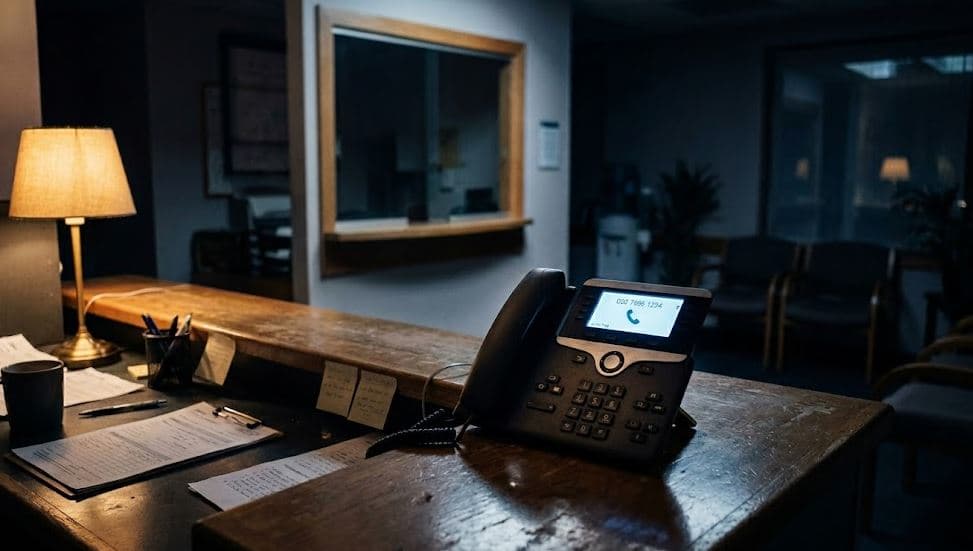
AI Receptionist Dental Emergency Triage: How It Works
AI receptionist dental emergency triage screens caller symptoms, classifies urgency, and routes emergencies 24/7. How it works and how to build it.
Share:
Table of contents
A patient calls your office at 7:42 PM with a knocked-out tooth. Nobody answers. According to Dental Economics, after-hours calls represent 27% of total patient call volume, and many of those involve urgent situations. AI receptionist dental emergency triage is the system that stands between that panicked caller and a lost patient.
Here's the thing. Most front desk teams do a solid job during normal hours. But emergencies don't follow a schedule. And when your phone rings after 5 PM on a Friday with a caller describing severe swelling, the question isn't whether you need a protocol. It's whether your current system can handle the pressure.
This article breaks down how AI triage handles emergency dental calls, what it can and can't do, and how to build a phone system that protects both your patients and your practice.
27%
of patient calls come after hours, where emergencies cluster
90 sec
average hold time before a caller hangs up
80%
of voicemail callers never leave a message or call back
$1,200+
lifetime value lost per missed new patient call
Sources: Dental Economics, Marchex, Forbes.
How Does an AI Receptionist Dental Emergency Triage Work?
AI receptionist dental emergency triage uses conversational AI to ask callers structured questions about their symptoms, assign an urgency level based on the answers, and route the call to the right destination. It works around the clock without breaks, hold times, or human error from a rushed front desk.
The process follows a decision tree similar to what a trained dental receptionist would use, but it's consistent every single time. The AI asks about pain level, bleeding, trauma history, and timing. A caller who says "my crown fell off yesterday and nothing hurts" gets a different path than someone reporting uncontrolled bleeding after an extraction.
The Three-Step Triage Flow
- Symptom collection: The AI gathers details using open-ended and targeted questions. It listens for keywords like "swelling," "knocked out," "bleeding won't stop," and "fever." This takes 60-90 seconds, which matters because, according to Marchex, the average hold time before a patient hangs up is just 90 seconds.
- Urgency classification: Based on collected symptoms, the system categorizes the call as emergent (needs same-day care), urgent (needs care within 24-48 hours), or routine (can wait for a scheduled appointment).
- Routing decision: Emergent calls get forwarded to the on-call provider or an emergency contact. Urgent calls trigger a priority callback or next-available booking. Routine calls enter your normal scheduling queue.
This isn't guesswork. The AI follows clinical protocols your practice defines in advance, which means you control the criteria. DentiVoice AI Receptionist integrates directly with practice management systems like Dentrix, Open Dental, and Eaglesoft, so the routing connects to your actual schedule and on-call roster.
Never Miss an Emergency Call Again
DentiVoice answers every patient call 24/7 and routes emergencies to your on-call provider instantly.
Learn About DentiVoice →What Counts as a Dental Emergency on the Phone?
A true dental emergency involves uncontrolled bleeding, trauma to the teeth or jaw, severe infection with swelling or fever, or a knocked-out permanent tooth. These situations require same-day intervention, and the AI system needs clear rules to distinguish them from urgent but non-emergency concerns like a lost filling or mild sensitivity.
The challenge is that patients don't use clinical language. They say "my face is huge" instead of "I have facial swelling consistent with an abscess." A well-configured AI system accounts for this by mapping common patient descriptions to clinical categories.
Emergency vs. Urgent vs. Routine
| Category | Patient Describes | AI Action |
|---|---|---|
| Emergent | Knocked-out tooth, uncontrolled bleeding, jaw trauma, severe swelling with fever | Immediate forward to the on-call provider or directs to the ER |
| Urgent | Broken tooth with sharp edge, lost crown on front tooth, moderate pain lasting 24+ hours | Priority callback or next-available appointment booking |
| Routine | Mild sensitivity, lost filling with no pain, cosmetic chip | Standard scheduling queue |
A single missed new patient call costs your practice $1,200 or more in lifetime value, according to Dental Economics. Miss an emergency call, and you don't just lose revenue. You lose trust. That patient tells friends, leaves a review, and finds a practice that picked up the phone. According to BrightLocal, 98% of people read local reviews before choosing a business, so one bad emergency experience can ripple outward fast.
Related: See how missed calls add up to real revenue loss at your practice. Why Dental Practices Miss Calls →
Can AI Accurately Route Urgent Dental Calls?
Yes, when configured with practice-specific protocols, AI systems route urgent dental calls with high consistency because they follow the same decision logic every time. Unlike a human receptionist juggling three tasks at once, the AI never skips a screening question or misjudges severity because it's distracted by a patient at the front desk.
That said, accuracy depends entirely on setup. A poorly configured system that only checks for the word "pain" will overroute routine calls and underroute genuine emergencies. The best implementations use layered questioning. Pain alone isn't enough. The AI should ask about duration, location, intensity, and associated symptoms like swelling or fever.
Consider a three-provider practice receiving 200 calls per week. According to ADA Practice Transitions, 38% of new patient calls go unanswered during business hours. Scale that to a practice handling emergencies, and you're looking at dozens of callers who never reach a human. An AI triage system doesn't replace your team's clinical judgment. It makes sure urgent callers actually get through to someone who can exercise that judgment.
Where AI Triage Outperforms Manual Handling
- Consistency: The AI asks every screening question in the same order, every time. No shortcuts during busy lunch hours.
- Speed: Callers get immediate engagement instead of hold music. According to Forbes, 80% of callers who reach voicemail don't leave a message and won't call back.
- Documentation: Every call is logged with symptoms reported, urgency level assigned, and routing decision made. That's a record your office manager can review daily.
- Availability: AI doesn't call in sick. Doesn't take lunch. Doesn't leave at 5.
DentalBase pairs AI call handling with dental SEO and Google Ads management, which means the same platform driving new patient calls also makes sure those calls get answered. That's a gap most setups leave open.
See How AI Triage Works in Your Practice
Book a free demo and hear DentiVoice handle a simulated emergency call using your practice's protocols.
Book a Free Demo →How After-Hours Emergency Calls Change the Equation
After-hours calls make up more than a quarter of all patient call volume, and they skew heavily toward urgent and emergencies. Without a system to handle them, your practice is invisible during the exact hours when patients need you most and are most likely to choose a competitor who answers.
Think about the math. Dental Economics reports that the average dental practice misses 15-20 calls per week. A meaningful share of those come outside business hours. If your phone goes to a generic voicemail greeting at 5:01 PM, you're asking a patient with a cracked tooth and throbbing pain to wait until morning. Most won't.
A dental practice emergency phone system built on AI changes that dynamic completely. The AI answers immediately, screens the caller, and takes one of three actions: routes to your on-call dentist, books a priority morning appointment, or provides interim care instructions (like "place the tooth in milk and get to our office by 8 AM"). Each of these reduces the chance that the caller ends up at another practice or an emergency room.
The After-Hours Revenue Impact
According to Dental Economics, the average patient lifetime value for a general dentist runs $12,000-$15,000. If your after-hours system captures just two emergency patients per month who would have gone elsewhere, that's $24,000-$30,000 in lifetime value. Worth noting: 73% of dental practices plan to adopt AI tools by 2027, according to Dental Economics. Practices that adopt after-hours AI early can capture patients that others are still losing.
Related: Learn how 24/7 scheduling keeps your chairs full even when your office is closed. → Best AI Dental Receptionist for 24/7 Scheduling
What Happens When AI Triage Gets It Wrong?
AI triage can misclassify a call, and your practice needs a plan for that. The most common error is over-triage, where a routine call gets flagged as urgent. Under-triage, where a real emergency gets treated as routine, is rarer but carries far higher risk. Both are manageable with proper system design and human oversight.
Over-triage is annoying but not dangerous. Your on-call dentist gets a 10 PM call about a patient whose "emergency" turns out to be mild sensitivity after a filling placed three days ago. Frustrating? Yes. But the alternative, under-triage, is far worse. A patient with a spreading infection who gets told to call back on Monday could end up hospitalized.
The fix isn't perfection. It's layered safety nets.
- Bias toward caution: Configure your AI to over-triage rather than under-triage. A false alarm costs your on-call provider five minutes. A missed emergency costs you a patient and creates liability exposure.
- Human review loop: Every call classified as "routine" during after-hours should be reviewed by a staff member the next morning. If the AI missed something, you catch it within 12 hours.
- Escalation phrases: Program-specific trigger phrases ("I can't breathe," "there's a lot of blood," "my child fell") that bypass the normal triage flow and route directly to a provider or 911 guidance.
- Monthly audits: Review a sample of triaged calls each month. Look for patterns. Are callers describing symptoms the AI doesn't recognize? Update the system.
No system is perfect. Your front desk staff misclassifies calls too. The difference is that AI provides a complete, auditable log of every interaction, which makes it easier to find and fix mistakes. By following guidance on scoring and reviewing patient calls, the audit process becomes a seamless part of your routine quality checks.
Worried About AI Replacing Your Team?
AI triage works best alongside your staff, not instead of them. See how practices introduce AI without disrupting their front desk.
Read the Guide →Building a Dental Practice Emergency Phone System That Works
An effective dental practice emergency phone system combines AI triage with clear clinical protocols, staff training, and regular review cycles. The technology is only one piece. Without defined escalation paths and provider buy-in, even the best AI will route calls into a void.
Step 1: Define Your Emergency Criteria
Work with your clinical team to build a triage matrix. List every scenario you'd consider emergent, urgent, or routine. Be specific. "Tooth pain" isn't a category. "Spontaneous, severe tooth pain lasting more than four hours with visible swelling" is. The more precise your definitions, the better the AI performs.
Step 2: Set Up Routing Rules
Decide where each category goes. Emergent calls might forward to the on-call provider's cell phone. Urgent calls might trigger a text to your office manager, plus a priority booking for the next morning. Routine calls get standard scheduling. Map every path before you turn the system on.
Step 3: Integrate With Your PMS
Your AI system should connect to your practice management software. That's how it knows your schedule, identifies existing patients, and books appointments in real time. DentiVoice integrates with Dentrix, Open Dental, Eaglesoft, and Curve Dental, which covers the vast majority of practices.
Step 4: Train Your Team
Your staff needs to understand how the AI works, what it does with each call type, and how to review flagged interactions. This isn't a "set it and forget it" tool. According to the BLS, dental employment is projected to increase by 4% through 2032, meaning staffing pressures aren't going away. AI triage helps your existing team work smarter, but they still need to own the clinical decisions. For a full breakdown of what to look for in an AI phone system, check the Virtual Dental Receptionist Buyer's Guide.
Step 5: Review and Refine Monthly
Pull call logs. Check classification accuracy. Look at caller satisfaction signals. Adjust your triage matrix as you learn. Track your dental KPIs to measure whether the system is actually reducing missed emergencies and improving patient retention.
What Should the AI Tell a Patient With a Knocked-Out Tooth?
For a knocked-out permanent tooth, the AI should route the call to your on-call provider and give clear interim steps: handle the tooth by the crown, rinse gently, and keep it moist in milk or saliva until the patient reaches care. The first 30 to 60 minutes matter most for reimplantation. Untreated dental trauma carries real health consequences, which is why the CDC stresses timely oral care.
This is where scripted interim guidance earns its keep. A panicked parent at 9 PM won't recall what to do with an avulsed tooth. The AI reads back short, practice-approved instructions while it forwards the call, so the patient acts correctly in the window that decides whether the tooth survives.
Notice what the AI does and doesn't do. It doesn't diagnose. It doesn't promise the tooth can be saved. It delivers your pre-approved instructions, captures symptoms, and gets a clinician on the line. That keeps the system on the right side of clinical responsibility, and your protocol can point patients to authoritative at-home guidance, such as the National Institute of Dental and Craniofacial Research.
What Should an AI Emergency Triage Script Include?
A complete AI emergency triage script includes symptom-screening questions, urgency-classification rules, escalation trigger phrases, interim care instructions, and a routing map for each category. Every branch should tie back to a destination your practice approved in advance, so no call ends in a dead end.
Most triage failures trace back to a thin script, not bad technology. If the only question is "are you in pain," the system can't tell a cracked filling from an abscess. Build the minimum below with your clinical team.
| Script Component | What It Captures | Why It Matters |
|---|---|---|
| Symptom screening | Pain level, bleeding, swelling, trauma, fever, duration | Separates emergent from routine without clinical jargon |
| Escalation phrases | "Can't breathe," "lots of blood," "my child fell" | Bypasses the tree and routes straight to a human or 911 guidance |
| Interim instructions | Pre-approved steps per scenario (avulsed tooth, abscess) | Protects the patient in the minutes before they reach care |
| Routing map | On-call cell, priority booking, standard queue | Makes sure each urgency level lands somewhere accountable |
| PMS lookup | Existing patient match, real-time schedule, open slots | Lets the AI book, not just message, so the loop closes |
The PMS lookup is the line practices skip most, and it's the one that turns triage into a booking engine. When the AI reads your live schedule, an urgent 6 AM caller walks away with a confirmed 8:15 slot, not a callback promise. That's why AI receptionist PMS integration deserves its own review during vendor selection.
Scale changes the math too. A single location can audit a thin script by hand. A group can't. Multi-location organizations should see how an AI receptionist works for a DSO, where one script has to hold up across dozens of lines. Reactivating an existing patient costs five to seven times less than acquiring a new one, according to Harvard Business Review, so protecting emergency callers you already have is the cheapest growth there is.
The Real Cost of Getting Emergency Calls Wrong
Getting emergency call handling wrong costs your practice in three ways: lost patients, negative reviews, and liability risk. A Google study found that 86% of users contacted a dentist after running a search, which means patients are actively looking. If your emergency handling pushes them away, they'll find someone else within minutes.
Reputation damage compounds quickly. One patient who couldn't reach you during an emergency and left a one-star review doesn't just affect that relationship. According to BrightLocal, 88% of people are likely to use a business if the owner responds to all reviews, but that only works if you have a chance to respond before the damage is done. Prevention beats damage control.
Then there's the clinical side. If a patient calls about post-surgical bleeding and your voicemail greeting says "we'll return your call the next business day," you've created a documentation gap. An AI system that logs the call, provides appropriate guidance, and routes to an on-call provider gives you a defensible record.
The practices that handle emergency calls well don't just keep patients. They build the kind of reputation that generates referrals. And with the average cost to acquire a new dental patient running $150-$300 through digital channels according to WordStream, keeping emergency patients is far cheaper than replacing them through social media or paid ads alone.
AI receptionist dental emergency triage isn't about replacing your clinical team's judgment. It's about making sure urgent callers actually reach someone who can help, whether it's 2 PM on a Tuesday or 11 PM on a Saturday. The practices getting this right are the ones patients remember, recommend, and return to.
Your next step: audit your current after-hours call handling. Pull your phone records from the last 30 days. Count the calls that came in after hours. Then ask yourself how many of those callers got the help they needed. If the answer isn't "all of them," it's time to build a better system.
Ready to Handle Every Emergency Call?
See how DentiVoice AI triages emergency calls, routes to your on-call provider, and keeps every patient from slipping through the cracks.
Book a Free Demo →Want more guides on dental practice growth and AI tools?
Browse Resources →Article by Dr. Muhammad Abdel-rahim, DMD, Dentist & Implantologist at Peterborough Family Dental. Patient-Centered Care | Leadership & Innovation.
Related Articles
Sources & References
Frequently Asked Questions
The AI asks callers about symptoms including pain level, bleeding, trauma, swelling, and fever. It maps responses to predefined clinical categories, classifying each call as emergent, urgent, or routine. Your practice defines the exact criteria, so the system follows your clinical protocols consistently.
Yes. AI receptionists answer calls 24/7 and apply the same triage logic regardless of time. After-hours emergency calls get routed to your on-call provider, while urgent calls trigger priority morning appointments. This captures patients who would otherwise call a competitor.
Misclassification can occur in either direction. Over-triage sends routine calls to the on-call provider unnecessarily. Under-triage is rarer but riskier. Practices manage this by configuring the system to err toward caution, adding escalation trigger phrases, and auditing call logs monthly.
No. AI triage screens and routes calls but doesn't provide clinical care. It ensures the right calls reach your on-call provider quickly while filtering out non-emergencies. The AI handles the intake and routing so your dentist only gets the calls that truly need immediate attention.
The average dental practice misses 15-20 calls per week overall, and 38% of new patient calls go unanswered during business hours according to ADA data. After-hours calls represent 27% of total volume, meaning a significant share of emergency calls go unhandled without an AI system.
Leading AI receptionist platforms integrate with Dentrix, Open Dental, Eaglesoft, and Curve Dental. Integration allows the AI to check your schedule, identify existing patients, and book appointments directly in your PMS without manual data entry by your staff.
A single missed new patient call costs $1,200 or more in lifetime value according to Dental Economics. Emergency callers who can't reach you often leave negative reviews and choose a competitor, compounding the loss through reputation damage and reduced referrals over time.
Was this article helpful?
Written by
Dentalbase Team
The Dentalbase Team is a collective of dental marketing experts, AI developers, and practice management consultants dedicated to helping dental practices thrive in the digital age.