Who Answers at 9 PM? Best AI Receptionists for Dentists
27% of patient calls come after hours and 80% of voicemails never call back. Compare the best AI receptionists for after-hours dental booking.
Share:
Table of contents
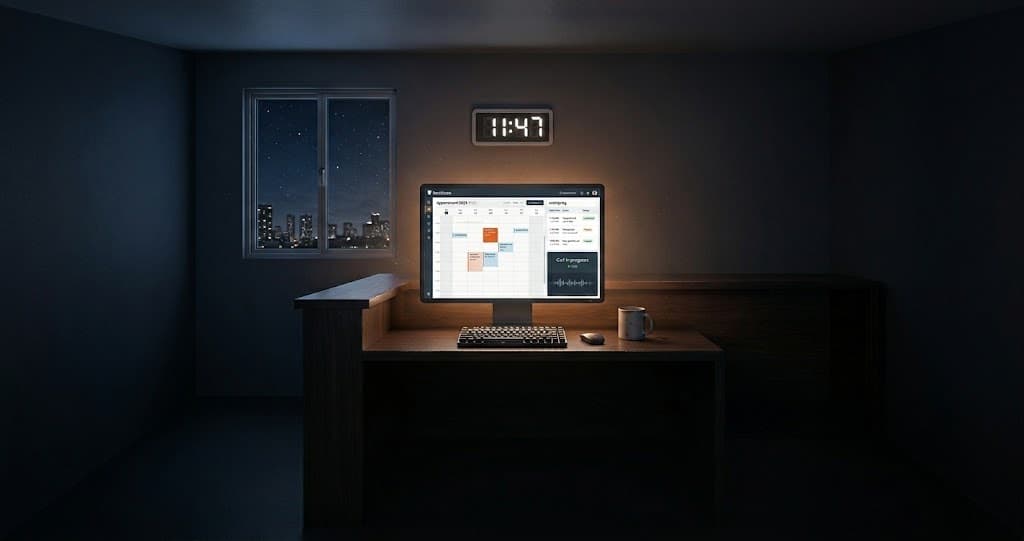
Choosing an AI dental receptionist for after-hours calls comes down to one question: when the phone rings at 7:30 PM and your team is gone, what happens next? Voicemail picks up. The caller hangs up. Your front desk inherits a callback queue Monday morning. That's how most practices handle after-hours, and it's why a quarter of patient call volume gets buried before anyone responds. For more on how this fits a practice's overall front-desk strategy, see our full DentalBase AI receptionist guide.
After-hours calls aren't random. They follow patterns. New patient inquiries spike between 6 and 9 PM. Rescheduling questions land on Sunday nights. Emergencies arrive whenever they arrive. Each type needs a different response, and the system you pick has to recognize the difference and act on it without anyone in the room.
This guide breaks down what to look for in an AI receptionist for after-hours coverage, how the category compares to a traditional answering service, and how to match the right solution to your practice size, call volume, and emergency protocol.
What Types of After-Hours Calls Does an AI Dental Receptionist Handle?
An AI dental receptionist handles four main types of after-hours inbound traffic: new patient inquiries, scheduling changes, dental emergencies, and general questions. Each type needs a different response. The system you choose should recognize the difference and route the call accordingly, not treat them as one bucket.
1. New Patient Inquiries
This is the highest-value call type your practice misses overnight. Someone searches "dentist near me," lands on your listing, and calls at 7:30 PM because that's when they're home from work and finally have time to deal with the toothache they've been ignoring. They're motivated. They're ready to book. And they'll call the next practice on the list if no one answers. Patient lifetime value runs into five figures for a general dentist, per ADA Health Policy Institute data on the dental care market. That's not a $200 cleaning walking away.
2. Scheduling and Rescheduling
Existing patients moving Monday's 9 AM cleaning, confirming next week's hygiene visit, or canceling outright. Not urgent, but time-sensitive. A patient who realizes Sunday night they can't make Monday's appointment has two options: call and hope someone picks up, or just not show. Most pick option two. That's how a simple rescheduling need turns into a no-show that costs $200 in production and an empty chair your hygienist scrambles to fill.
3. Emergencies
Pain that wakes someone at 2 AM. A knocked-out tooth from a kid's basketball game. Post-op bleeding after Friday's extraction. These callers need clinical guidance and a clear next step. Voicemail isn't a next step. A patient with a swollen jaw who hits voicemail ends up at the ER, or at whichever practice's number they find next.
4. General Questions
"Do you take my insurance?" "How much is a crown?" "Where do I park?" Easy answers that get callers comfortable enough to book. An AI system trained on your fee guide, payment options, and policies handles these without escalation. A voicemail can't.
What Should You Look for in an AI Dental Receptionist for After-Hours?
The right AI dental receptionist for after-hours calls connects live to your PMS, books appointments inside the call, follows a documented emergency triage protocol, and meets HIPAA standards. Cost transparency and call recording access matter as much as the core features. Skip any vendor that books only during business hours.
Six evaluation areas separate a useful after-hours system from a marketing-driven message-taker.
Real-time PMS integration. The system should read availability from Open Dental, Eaglesoft, Dentrix, Curve, or whatever you run, and write a confirmed appointment back to the schedule. Anything less is voicemail with a friendlier voice. Ask vendors for a live demo against a sandbox copy of your PMS, not a screenshot.
Live booking, not message-taking. Booking inside the call captures the patient at peak intent. A callback queue captures them after they've already booked elsewhere. This is the single biggest reason AI systems pull ahead of human answering services for after-hours coverage.
Emergency triage built with your clinical team. A generic triage script written by a software vendor isn't enough. Your team should sign off on the decision tree: which symptoms book urgent, which escalate to on-call, which go to the ER. The HIPAA checklist for AI receptionists is a separate review worth running before you sign.
HIPAA, BAA, and access controls. Encrypted transmission. Signed Business Associate Agreement. Role-based access to call recordings and transcripts. Any system that handles patient calls must check these boxes, full stop.
Transparent pricing. Per-call pricing rewards low call volume and punishes growth. Flat monthly pricing is predictable but can hide overage charges. Ask for a 12-month all-in cost projection at your current call volume, not a quote based on a sample week.
Reporting and call recording. You need to hear what your patients heard. A system without recordings, transcripts, and weekly call analytics is a black box you can't manage. An AI receptionist's daily task list shows what reporting should make visible.
See how DentiVoice handles after-hours calls
A look at the AI dental receptionist built for live booking, emergency triage, and PMS-integrated coverage.
Explore DentiVoice →How Does an AI Receptionist Compare to an Answering Service After-Hours?
An AI dental receptionist books appointments directly into your PMS during the call. An answering service takes a message and your front desk calls back the next morning. The gap matters most for new patient calls, where the caller has already moved on by the time anyone returns the call.
Answering services have been the default after-hours option for decades. A live operator picks up, takes a message, and routes it to your office. That sounds reasonable until you trace what actually happens to each call type.
The operator can't see your schedule. They can't quote your fees. They can't read the chart on a returning patient. They take down a number and hope someone responds before the caller finds another practice. According to NIDCR research on dental caries, untreated dental disease in working-age adults remains widespread, so the demand for off-hours care isn't slowing down.
Here's how the two approaches compare across the criteria that actually drive after-hours revenue.
| Criteria | Answering Service | AI Receptionist |
|---|---|---|
| Booking inside the call | No, message only | Yes, live to PMS |
| Typical cost | $300-600/month | $200-1,500/month |
| After-hours coverage | Limited, queues common | 24/7, no queue |
| Emergency triage | Generic script | Custom decision tree |
| HIPAA + BAA | Varies by vendor | Standard with reputable vendors |
| Reporting | Call logs only | Transcripts, recordings, analytics |
Answering services still make sense for niche cases, like high-touch boutique practices that want a specific human voice every time. For everyone else, an AI receptionist that books inside the call is usually the better economic fit. Intake software that reduces front desk workload shows how the same logic applies during business hours.
Why Does Voicemail Fail Compared to an AI Receptionist?
Voicemail fails after-hours dental calls because patients don't leave messages, and your team can't return calls fast enough to win them back when they do. After-hours calls represent 27% of total patient call volume, and most callers move to the next practice if they hit voicemail.
The 27% figure comes from Dental Economics practice management research. For a practice taking 150 calls a week, that's roughly 40 calls landing on your line when no one is there. About 80% of callers who reach voicemail hang up without leaving a message. The math is brutal.
Even the patients who do leave a message create a problem. Monday morning, your front desk walks in to a queue of overnight voicemails on top of the live phones already ringing for 9 AM. They prioritize live calls. Voicemails get returned at 11, 1, 3, sometimes never. By then, the caller has already booked somewhere else or pushed the appointment another month.
A live-answer AI receptionist breaks the cycle by treating after-hours like business hours. The phone never goes to voicemail. The caller hears a real conversation, gets a real answer, and either books or gets routed appropriately. Missed calls and the revenue questions they raise covers the full economic argument.
Related: The full revenue picture on calls that go unanswered → Read about the 38% of calls that go unanswered
How Should an AI Dental Receptionist Handle Emergency Calls?
An AI dental receptionist should screen emergency calls with a triage script your clinical team designed, then route to one of three outcomes: book an urgent morning slot, escalate to the on-call provider, or direct the caller to the nearest ER for severe cases. The script matters more than the technology.
Emergency calls are the highest-stakes after-hours scenario. Get it wrong and a patient suffers longer than needed, or worse, ends up at an emergency room for something you could've handled in chair the next morning. CDC oral health data shows oral conditions still drive substantial ER traffic across the United States, and that's the gap dental practices fill when their after-hours coverage actually works.
A workable triage framework asks four questions:
- Is there swelling or fever?
- Is there active bleeding?
- Is the pain severe or worsening?
- Is there trauma to a tooth or jaw?
Each answer routes the caller to the right outcome. Pain plus swelling escalates. Trauma to a permanent tooth escalates. A lost filling without pain books for the morning.
Post-op complications are their own category. A patient three days out from an extraction calling about bleeding or pain needs to reach the doctor who performed the procedure, not a generic on-call rotation. Your AI system should know which patients are inside post-op windows and route accordingly. Access controls and recording rules built into the system make this kind of patient-specific routing both possible and compliant.
See after-hours triage in action
Walk through a live demo of how an AI dental receptionist handles new patient bookings and emergency triage outside of business hours.
Book a Free Demo →How Do You Match an AI Dental Receptionist to Your Practice Size?
Match an AI dental receptionist to your practice by call volume first, software stack second, and emergency protocol third. A solo practice fielding 15 after-hours calls a week needs different features than a five-location group taking 200. Match the system to the data, not the brand name.
Start with a two-week call log review. Pull the numbers from your phone system or PMS reporting. How many after-hours calls landed? How many were new patients? How many were emergencies? BrightLocal's local consumer research consistently shows that response speed and availability are top factors in how patients pick a practice, so the call volume isn't just a cost variable, it's a growth signal.
Three patterns tend to match three buckets:
- Solo / 1-2 providers, under 50 after-hours calls a week: Mid-tier AI receptionist with native PMS integration and a simple triage script. Flat pricing in the $200-400 range. See how an AI receptionist works in a solo practice for the trade-offs at this scale.
- Small group, 3-5 providers, 50-100 calls a week: AI receptionist with multi-provider routing, recall workflows, and group-level reporting. Pricing typically $400-800/month.
- Multi-location or DSO-scale, 100+ calls a week: Enterprise AI with cross-location call logic, multilingual handling, and roll-up analytics. Pricing usually $600-1,500/month, with deeper integration work.
The math gets clearer once you map a single after-hours booking back to lifetime value. Even three or four bookings a week at $200 in same-day production pays for the system several times over, and that's before counting the lifetime value of patients who would've otherwise gone elsewhere. The full ROI math on an AI dental receptionist spells out the calculation.
Choosing an AI dental receptionist for after-hours calls isn't really about picking a brand. It's about matching a system to how your patients actually call you. Pull the last two weeks of after-hours call data, sort by call type, run any vendor through the criteria above, and skip anyone who can't book live or won't show you their triage script.
Your after-hours phone line is the front door of your practice for half the new patients you'll see next year. Pick the system that opens it.
Cover your after-hours line with an AI receptionist
See a live demo of how DentiVoice books appointments, triages emergencies, and answers your phone 24/7.
Book a Free Demo →Related after-hours reading
More resources for dental practice growth
Browse Resources →Sources & References
Frequently Asked Questions
An AI dental receptionist answers calls 24/7, books appointments directly into your PMS, triages emergencies using a custom script, and answers common questions about insurance, hours, and procedures. It captures the patient inside the call instead of routing to voicemail.
An AI dental receptionist books appointments live to your PMS during the call. An answering service takes a message your front desk returns the next morning. AI captures new patients at peak intent. Answering services create a callback queue that loses callers to other practices.
Reputable AI dental receptionists are HIPAA compliant when configured correctly. The system must offer encrypted transmission, a signed Business Associate Agreement, and role-based access to call recordings and transcripts. Verify all three before signing a contract, regardless of the vendor's marketing claims.
Pricing typically ranges from $200 to $1,500 per month, depending on call volume and feature set. Solo practices land in the $200-400 range. Multi-location groups and DSO-scale practices pay $600-1,500 monthly for enterprise features like cross-location routing and roll-up reporting.
Yes, when configured with a clinical triage script. The system screens for swelling, bleeding, pain severity, and trauma, then routes to one of three outcomes: book an urgent morning slot, escalate to the on-call provider, or direct to the ER. The script must be built with your clinical team.
AI dental receptionists with real-time PMS integration typically book 60-80% of after-hours calls that are bookable. Three or four captured appointments a week at $200 in same-day production pays for the system several times over, before counting lifetime value.
Was this article helpful?
Written by
DentalBase Team
Expert dental industry content from the DentalBase team. We provide insights on practice management, marketing, compliance, and growth strategies for dental professionals.