
How to Improve Dental Case Acceptance (With Benchmarks)
Learn how to improve dental case acceptance with benchmarks, presentation strategies, and follow-up systems that turn treatment plans into visits.
Share:
Table of contents
If you want to improve dental case acceptance, start by measuring it. Most practice owners assume patients schedule recommended treatment. The data tells a different story. Acceptance of elective and major restorative work typically trails preventive care by a wide margin (see Dental Economics on case acceptance). That gap between diagnosed treatment and scheduled treatment can quietly cost a practice six figures a year.
This article breaks down what strong case acceptance looks like by procedure type, why patients say no, and the specific systems that move your numbers. You'll get benchmarks to compare against, presentation frameworks that work, and follow-up protocols that recover unscheduled treatment plans. If you're tracking practice KPIs but not case acceptance, you're missing the metric with the highest revenue impact per percentage point gained.
What Is a Good Case Acceptance Rate for a Dental Practice?
A good case acceptance rate depends on the treatment type, so the practical approach is to set targets by category. Working ranges are roughly 85-95% for preventive care, 70-80% for basic restorative, 50-65% for major restorative, and 30-50% for elective work. A rate far below your range points to a system problem, not a patient problem.
Even a modest gap adds up. Every 10 percentage points of acceptance on $500,000 of presented treatment is $50,000 in scheduled production. That's not hypothetical revenue. Those are treatment plans sitting in your PMS right now, attached to patients who said "let me think about it" and never heard from you again.
The ADA's practice management resources emphasize that case acceptance is one of the most direct indicators of patient trust and communication effectiveness. It's worth tracking separately from production because it isolates the conversion step between diagnosis and treatment.
Benchmarks by Procedure Category
| Procedure Category | Typical Acceptance Range | Stretch Target |
|---|---|---|
| Preventive (cleanings, exams) | 85-95% | 95%+ |
| Basic restorative (fillings, simple extractions) | 70-80% | 85%+ |
| Major restorative (crowns, bridges) | 50-65% | 75%+ |
| Elective/cosmetic (veneers, whitening, implants) | 30-50% | 60%+ |
Treat these as working planning ranges, not published industry standards, and let your own baseline matter more. Don't average all procedure types into one number. A blended 78% acceptance rate can mask a 40% acceptance rate on the high-value work that actually drives your profitability. Break it out by category in your PMS reporting, and you'll see where the real opportunity sits.
Track the Numbers That Actually Move Revenue
Case acceptance is one of 12 KPIs every dental practice owner should review monthly. DentalBase helps you connect marketing, phones, and scheduling into one view.
See the Full Platform →Why Do Patients Decline Recommended Treatment?
Patients decline treatment for four main reasons: cost concerns, lack of perceived urgency, fear or anxiety about the procedure, and poor understanding of what was recommended. Cost and lack of urgency tend to come up most often, which points to communication rather than clinical disagreement.
Consider a hypothetical three-provider practice that presents $900,000 in treatment plans over 12 months but only schedules $495,000. That's a 55% acceptance rate. Where did the other $405,000 go? Some patients genuinely can't afford the work. But a significant portion simply didn't understand why it mattered now, weren't offered a payment path that felt manageable, or left the office without a clear next step. A 48-hour follow-up cadence for unscheduled treatment gives those patients the next step they didn't leave with.
Patients are far more likely to act when the consequence of inaction is specific and time-bound. Telling a patient "you'll need a crown eventually" is clinically accurate but behaviorally useless. Telling them "this tooth has a fracture line that will likely crack within 6-12 months, and a crack means extraction instead of a crown" creates urgency without pressure.
The Urgency Gap Is a Common Leak
Most treatment presentations focus on what needs to happen. Few explain what happens if it doesn't. That distinction matters for dental patient retention strategies because a patient who understands the consequence of delay is far more likely to schedule, show up, and complete the full treatment plan.
Fear is another common barrier. Dental anxiety is widespread, and for these patients, case acceptance isn't about money or understanding. It's about emotional readiness. Acknowledging anxiety directly during the presentation, rather than ignoring it, can shift the conversation entirely.
Related: Case acceptance is one piece of the larger practice management picture. For the full framework covering finance, team, operations, and growth → Dental Practice Business Management: Complete Owner Guide
How Does Treatment Presentation Affect Case Acceptance?
Treatment presentation strongly influences acceptance, because patients decide based on how well they understand the need. Practices that use co-diagnosis, where the patient sees what the dentist sees in real time, tend to see stronger acceptance than practices relying on verbal explanations alone.
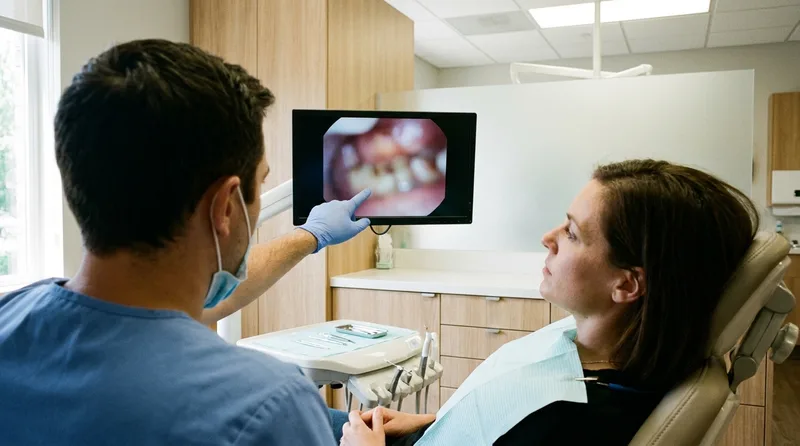
Intraoral cameras changed this equation. When a patient sees a cracked filling or receding gumline on a screen, the dentist doesn't need to "sell" the treatment. The image does the work. But the camera alone isn't enough. What matters is the sequence: show the problem, explain what it means for the patient specifically, present the solution, and then address cost. Reversing that order and leading with price tends to trigger sticker shock and stall the decision, especially on higher-cost procedures.
The treatment coordinator role is another structural factor. In practices where the dentist diagnoses and a trained coordinator handles the financial conversation, scheduling, and follow-up, acceptance rates climb. Why? Because the dentist-patient relationship stays clinical. The money conversation happens in a different context, with someone trained specifically to handle objections and payment options.
High-Acceptance vs. Low-Acceptance Presentation Habits
| Factor | High-Acceptance Practices | Low-Acceptance Practices |
|---|---|---|
| Visual aids | Intraoral photos shown on chairside monitor during every exam | Verbal explanation only, no images shared with patient |
| Who discusses cost | Dedicated treatment coordinator after clinical conversation | Dentist mentions cost mid-exam or front desk quotes at checkout |
| Urgency framing | Explains consequence of delay with specific timeline | Uses vague language like "we should keep an eye on it" |
| Payment options | Presented proactively with monthly breakdown before patient asks | Only mentioned if patient raises cost as a concern |
| Follow-up on undecided | Structured outreach within 48 hours, then at 2 weeks and 6 weeks | No follow-up unless patient calls back |
Your phone scripts matter here too. If a patient calls back with questions about a treatment plan they received, the front desk response either rescues or kills that case. Script the callback. Don't leave it to improvisation.
The written explanation can be scripted the same way. These copy-paste prompts for explaining a treatment plan in plain language turn the dentist's clinical shorthand into a handout or text message the patient can reread at home.
Never Miss a Patient Callback on Treatment Plans
When patients call back about a quote or treatment plan, DentiVoice answers immediately, pulls their record, and books the appointment. No voicemail. No missed opportunity.
See How DentiVoice Works →What Financial Systems Improve Dental Case Acceptance?
Payment flexibility is one of the most practical ways to improve dental case acceptance on higher-cost procedures. When patients hear a total cost without context, sticker shock takes over. When they hear a monthly payment that fits their budget, the conversation shifts from "can I afford this" to "when should we start."
Third-party financing through companies like CareCredit or Sunbit lets you offer 0% or low-interest plans without carrying the risk yourself. In-house membership plans work well for patients without dental insurance. Cost is a real barrier for many households, and the ADA Health Policy Institute reports that US dental care costs exceed $124 billion annually.
The timing of the financial conversation matters as much as the options you offer. Present cost after the patient understands the clinical need, not before. And always present the monthly payment first, then the total. A $3,200 implant sounds like a major expense. A $133/month payment plan over 24 months sounds manageable. Same treatment, different framing, different reaction.
Break Down Cost Before the Patient Has to Ask
Practices that proactively show an insurance breakdown, expected out-of-pocket cost, and available financing at the time of presentation see higher same-day acceptance. Don't make the patient do math in their head. Don't make them call their insurance company. Have the numbers ready. That's what a strong collections process looks like from the front end.
One more thing. Train your team to separate the insurance conversation from the clinical conversation. When a patient hears "your insurance doesn't cover this," they often translate it as "this must not be necessary." That's a dangerous assumption, and it's your team's job to reframe it. Insurance coverage is a financial decision made by an employer, not a clinical recommendation made by a dentist.
Related: Getting patients to say yes is only half the equation. Make sure your checkout process captures payment the same day → Dental Collections Process: Hit 98% Same-Day Payment
How Should You Follow Up on Unscheduled Treatment Plans?
Structured follow-up on unscheduled treatment is one of the lowest-effort ways to recover lost revenue. Diagnosed treatment often sits unscheduled in the PMS for months, and many of those patients never receive a single follow-up contact after they walk out the door.

According to the ADA, 20-30% of patients become inactive within 18 months without follow-up. That inactivity connects directly to dental patient retention strategies because a patient with an unscheduled treatment plan is already at risk of leaving your practice entirely. They've been told they need work, they didn't schedule it, and now every month that passes makes it easier to ignore.
The follow-up cadence that works has three touchpoints:
- Within 48 hours of the appointment: a quick call or text, not a sales pitch.
- At two weeks: a check-in that references the specific treatment.
- At six weeks: a final personal outreach before the patient moves into your standard recall cycle.
Each touchpoint should reference the specific treatment, not a generic "you have outstanding treatment" message. Personalization matters here.
Automate the Follow-Up Without Losing the Personal Touch
This is where technology earns its keep. Manually calling every patient with unscheduled treatment isn't realistic for a front desk team that's already handling check-ins, insurance, and incoming calls. Automated follow-up call systems can handle the first and second touchpoints, flagging patients who respond for a live conversation with your treatment coordinator. According to Dental Economics, automated recall systems increase patient return rates by 25-40%.
The patient reactivation angle is important too. A patient who declined a crown eight months ago might have a different financial situation now. Or a different level of discomfort. The follow-up isn't about pressuring them. It's about giving them an easy path back to the chair when they're ready.
Case Acceptance Readiness Checklist
Check each item your practice currently has in place.
Your score: count your checks out of 8. Six or more means your system is solid. Under four means you're likely leaving significant revenue unscheduled.
Automate Treatment Follow-Up Calls
DentiVoice can call patients with unscheduled treatment plans, answer their questions, and book them directly into your schedule. No extra staff needed.
Learn About Automated Follow-Up →How Do You Measure and Improve Dental Case Acceptance Over Time?
Measuring case acceptance requires a monthly tracking cadence tied to your PMS data, your morning huddle, and your team accountability systems. Pull the numbers by provider and by procedure category every 30 days. Without that granularity, you can't identify which provider needs coaching or which procedure type has a presentation problem.
Your PMS (whether that's Dentrix, Open Dental, or another system) should let you run unscheduled treatment reports. The report itself isn't useful unless someone acts on it. Assign ownership. Your treatment coordinator or office manager should review the unscheduled list weekly and flag patients for follow-up.
The scheduling optimization piece connects here too. If a patient says yes but can't get an appointment for six weeks, the odds of cancellation or no-show climb significantly. Practices with online scheduling see 24% fewer no-shows, according to Dental Economics, and that accessibility matters for treatment plan conversions just as much as it does for new patient bookings.
Connect Case Acceptance to Your Dental Patient Retention Strategies
Case acceptance isn't a standalone metric. It feeds directly into retention. A patient who completes recommended treatment is far more likely to return for recall visits, refer friends, and accept future treatment. A patient who declines and never hears from you again is halfway out the door. That's why dental patient retention strategies should always include a treatment follow-up protocol, not just recall reminders.
Review case acceptance in your monthly KPI review, and compare it against these three numbers:
- Production per visit
- Active patient count
- Recall effectiveness
When all four move together, your practice is growing sustainably. When case acceptance drops while new patient volume stays flat, you've got a presentation or follow-up problem that no amount of marketing can fix.
Track it. Discuss it in your morning huddle. Build systems around it. That's how you move from a 55% acceptance rate to a 75% acceptance rate without adding a single new patient to your schedule.
Ready to Close the Gap Between Diagnosis and Scheduled Treatment?
DentalBase connects your phones, follow-up, and scheduling so fewer treatment plans fall through the cracks. See how it works for your practice.
Book a Free Demo →Want more guides on growing your practice?
Browse Resources →Sources & References
Frequently Asked Questions
There is no single published average, so most practices set targets by category. Common working ranges are 85-95% for preventive care and 50-65% for major restorative work, with high-performing practices aiming above 75% on restorative.
Divide the dollar value of treatment patients scheduled by the dollar value of treatment you presented, then multiply by 100. Run this calculation monthly by procedure category and by provider to identify specific gaps rather than relying on a single blended number.
Use co-diagnosis with intraoral images so patients see the problem themselves. Explain consequences of delay with specific timelines rather than vague warnings. Present payment options proactively. The goal is informed decision-making, not a sales pitch.
A dedicated treatment coordinator typically produces better results. The dentist-patient relationship stays clinical while a trained coordinator handles financial conversations, payment plans, and objection handling in a separate, lower-pressure context.
First follow-up should happen within 48 hours of the appointment. Second contact at two weeks, third at six weeks. After that, the patient enters your standard recall cycle. Each message should reference the specific treatment, not a generic reminder.
Yes. Payment flexibility is one of the most practical ways to improve acceptance on higher-cost procedures. Presenting a monthly amount before the total reframes the decision from affordability to timing, which helps same-day scheduling.
Patients who complete recommended treatment are far more likely to return for recall visits and refer new patients. Dental patient retention strategies should include treatment follow-up protocols, not just recall reminders, because unscheduled treatment is a leading indicator of patient attrition.
Was this article helpful?
Written by
DentalBase Team
Expert dental industry content from the DentalBase team. We provide insights on practice management, marketing, compliance, and growth strategies for dental professionals.