Dental Appointment Scheduling Optimization in 2026
Dental appointment scheduling optimization tips: block scheduling, no-show reduction, buffer slots, and metrics that fill chairs without overbooking.
Share:
Table of contents
Dental appointment scheduling optimization separates practices that consistently hit production targets from ones that scramble to fill chairs by lunch. You've seen the pattern. Monday is packed wall to wall. Wednesday has three open slots nobody noticed until 8 AM. Friday afternoon is a ghost town. And somehow you're turning away an emergency patient on Tuesday because "the schedule is full." That's not a demand problem. It's a design problem, and it's costing you more than you think.
This article covers how to structure your dental office operations around a scheduling system that fills chairs, protects daily production, and gives your team room for emergencies and same-day requests without overbooking or burning out your front desk.
Why Does Dental Appointment Scheduling Optimization Control Your Revenue?
Dental appointment scheduling optimization directly determines your daily production because the schedule dictates which procedures happen, in what order, and with how much dead time between them. A practice can be "fully booked" and still miss its production target by thousands of dollars if the wrong procedures land in the wrong slots.
Here's the math. A general dentist producing $800 per hour across 7 clinical hours has a $5,600 daily target. If scheduling gaps, last-minute cancellations, and mismatched procedure times eat just 45 minutes of productive chair time each day, that's $600 gone. Multiply by 20 working days. That's $12,000 per month per provider lost to scheduling design, not patient demand.
The ADA Health Policy Institute tracks utilization trends across U.S. dental practices, and the pattern is consistent: how you arrange patients on the schedule impacts collections more than how many patients you have. Practices with structured scheduling systems collect more per clinical hour than those filling slots first-come, first-served.
The complete guide to dental practice business management covers how scheduling connects to the broader profitability picture. But the short version is this: your schedule is your revenue engine. Every gap, every mismatched slot, every overbooking cascade is money left on the table.
Your Schedule Is Your Revenue Engine
DentalBase helps practices build scheduling systems that protect production targets and fill gaps automatically through AI-powered call handling and patient follow-up.
See How It Works →How Does Block Scheduling Protect Your Daily Production Target?
Block scheduling assigns specific procedure categories to specific time windows each day, which keeps production predictable and prevents bottlenecks in operatory turnover. Instead of booking slots first-come, you're designing each day around a production blueprint that your front desk follows.
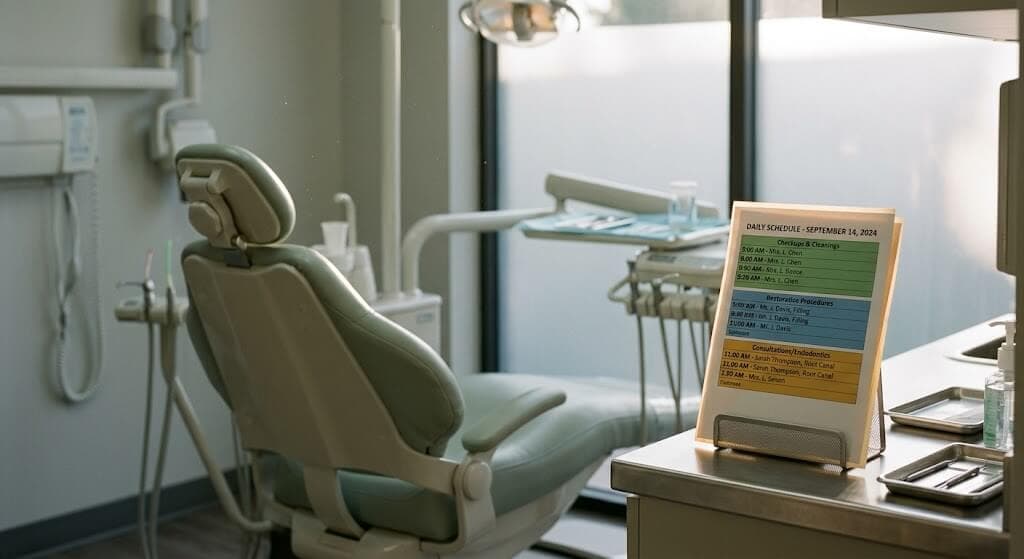
A typical block structure for a general dentist: mornings reserved for high-production restorative work (crowns, bridges, implant restorations), late mornings for mid-value procedures (fillings, simple extractions, buildups), and afternoons for hygiene overflow, new patient exams, consultations, and follow-ups. The reasoning is practical. Your clinical team is sharpest in the morning. Complex restorative cases demand more focus. And stacking two three-hour crown preps back to back overwhelms your assistant's room turnover capacity.
Sample Block Schedule for One Provider
| Time Block | Procedure Type | Typical Production Range |
|---|---|---|
| 8:00 - 10:00 AM | High-value restorative (crowns, bridges, implant restorations) | $1,200 - $2,400 |
| 10:00 - 11:30 AM | Mid-value (fillings, extractions, buildups) | $400 - $800 |
| 11:30 AM - 12:00 PM | Emergency / same-day buffer | Variable |
| 1:00 - 3:00 PM | Hygiene overflow, new patient exams, consultations | $300 - $600 |
| 3:00 - 4:30 PM | Follow-ups, shorter restorative, treatment presentations | $300 - $700 |
The production ranges above are illustrative for a general practice. Your numbers will vary based on fee schedule, payer mix, and case complexity. The principle doesn't change: front-load your highest-production work when energy is high and the day hasn't thrown curveballs yet.
According to Dental Economics, practices using structured block scheduling report more consistent daily production numbers and fewer end-of-day shortfalls compared to practices using open scheduling. The dental front office workflow checklist covers how to build the daily systems that support block scheduling in practice.
How Many Buffer Slots Should You Keep for Same-Day and Emergency Patients?
Keep 1-2 open buffer slots per provider per day for same-day requests and emergencies, placed at mid-morning and mid-afternoon. These slots generate disproportionately high production because emergency exams and acute pain cases convert to same-day treatment at higher acceptance rates than routine scheduled visits.
This feels counterintuitive. Why leave slots empty when you could book them? Because those slots fill themselves. Emergency calls come in every day. Patients call with broken teeth, sudden pain, or "I just need to be seen today." And they accept treatment at higher rates because urgency drives decisions. A same-day emergency exam that converts into a crown prep is worth more than the hygiene recall you would have booked in that slot three weeks ago.
The timing matters. Place buffers at 11:30 AM and 3:00 PM. If they aren't claimed by 10 AM, your front desk should call patients from the short-notice list, a running roster of patients who asked for an earlier opening. The no-show reduction guide covers how to build and manage that list so it actually works when you need it.
What Happens Without Buffers
Without buffer slots, every emergency creates a lose-lose situation. Turn away a patient in pain and they may never come back. Squeeze them in and you push every afternoon appointment 20 minutes behind, frustrating patients and stressing your team. Buffer slots eliminate this dilemma. They're not empty time. They're strategically reserved time that almost always gets used.
Related: Capturing after-hours and overflow calls that feed your same-day slots → After-Hours Dental Revenue: Hidden Opportunities Your Practice Leaves Behind
What's the Right Confirmation Process to Reduce No-Shows?
Use a two-touch confirmation system: first contact 48 hours before the appointment via the patient's preferred channel, second reminder at 24 hours via SMS. This approach reduces no-show rates by up to 38%, according to the Journal of Dental Hygiene, because text reminders reach patients at higher open rates than calls or emails.
Here's the sequence. Your 48-hour touch goes through whatever channel the patient prefers: text, email, or automated voice call. If they confirm, you're done. If they don't respond, the 24-hour SMS goes out regardless. Text has the highest read rate across all patient communication channels. If you still have no confirmation by end of business the day before, a live phone call from your front desk is the final step.
Confirmation Sequence That Works
- 48 hours before: Automated message via patient's preferred channel (text, email, or voice call)
- 24 hours before: SMS reminder with a one-tap confirm link
- End of business, day before: Live phone call for remaining unconfirmed patients
- Morning huddle: Flag any still-unconfirmed patients and activate the short-notice fill list
Practices with online scheduling see 24% fewer no-shows, according to Dental Economics. Why? Patients who book online do it at their peak motivation. They chose the time, entered it in their calendar, and confirmed. That's a different commitment level than when your receptionist picks a slot and the patient says "sure, I guess."
Here's the connecting problem. The average practice misses 15-20 calls per week, according to Dental Economics. Each missed new patient call costs $1,200 or more in lifetime value. Patients who call to reschedule but reach voicemail often don't leave a message. They just don't show up. Your confirmation system only works if your phone system works too.
Never Miss a Reschedule or Confirmation Call
DentiVoice AI Receptionist answers every call 24/7, confirms appointments, handles reschedules, and books directly into your PMS so no-shows don't become lost patients.
See DentiVoice in Action →How Should Online Scheduling Fit Into Your Dental Office Operations?
Online scheduling should cover specific appointment types like hygiene recalls, new patient exams, and consultations, while complex or lengthy procedures still require a phone call for proper slot sizing. This hybrid model captures patient intent when motivation is highest without creating scheduling conflicts your front desk has to untangle.
Only 26% of dental practices offer online scheduling, even though 77% of patients want it. That gap costs real appointments every week. When a patient decides at 9 PM on Sunday that they need to book a cleaning, they can book online right now, or they can try to remember to call Monday morning. Most forget. Or they call during peak hours, sit on hold, and hang up. According to BrightLocal's consumer research, 72% of patients say convenience is a top factor when choosing a dental provider.
What to Enable vs. Restrict for Online Booking
| Enable Online Booking | Require Phone Call |
|---|---|
| Hygiene recalls and prophylaxis | Crown and bridge appointments |
| New patient exams | Surgical extractions |
| Consultations and second opinions | Implant procedures |
| Emergency exam requests | Multi-visit treatment plans |
| Standard follow-up visits | Sedation appointments |
Configuration matters more than the tool itself. Whether you're using Open Dental, Dentrix, or another PMS, set appointment type restrictions, minimum buffer times between online slots, and provider-specific availability windows. A misconfigured online scheduler books the wrong procedures into the wrong slots, which creates more problems than it solves. The front office setup guide walks through how to configure online booking correctly.
Capture After-Hours Patients Who Want to Book Now
DentiVoice answers calls after hours and books appointments directly into your PMS. Patients who call at 9 PM don't have to wait until Monday to get on your schedule.
Learn About DentiVoice →How Do You Measure Whether Your Scheduling System Is Working?
Track three metrics monthly: schedule utilization rate, no-show rate, and same-day cancellation rate. Together, these numbers tell you whether your dental appointment scheduling optimization is producing real results or just rearranging the same problems under new labels.
Key Scheduling Performance Metrics
| Metric | How to Calculate | Healthy Range |
|---|---|---|
| Schedule utilization | Scheduled appointment hours / total available provider hours x 100 | 85 - 92% |
| No-show rate | Missed appointments / total scheduled appointments x 100 | Under 5% |
| Same-day cancellation rate | Day-of cancellations / total scheduled appointments x 100 | Under 3% |
| Production per clinical hour | Total daily production / total clinical hours worked | Varies by specialty and region |
If your utilization sits below 85%, that usually signals one of three things: insufficient patient demand, cancellations not being filled quickly enough, or appointment slots that don't match your actual procedure times. Above 92% and you're likely overbooking, which creates cascading delays, stressed staff, and frustrated patients who wait 30 minutes past their appointment time.
The dental practice KPIs guide shows how scheduling metrics feed into your bigger financial picture. And the Bureau of Labor Statistics projects 4% growth in dental employment through 2032, meaning more providers competing for the same patients. Practices that measure and optimize their scheduling will have a measurable advantage.
Related: Understanding how scheduling performance connects to your bottom line → Dental Practice Profit Margins: What Is Normal and How to Improve Yours
Dental appointment scheduling optimization isn't about packing more patients into the same hours. It's about designing each day so the right procedures land in the right time blocks, buffers exist for the unpredictable, and your front desk has a proven system for filling gaps before they cost you production. Block your mornings for high-value work. Leave room for emergencies. Confirm with two touches. Track utilization monthly.
Here's your first step: pull last month's schedule data and calculate your utilization rate. If you're below 85%, your front desk workflow needs attention. If you're above 92%, you're overbooking. Either number gives you a clear place to start. The dental practice automation guide covers which parts of the scheduling process you can hand off to technology and which still need your team.
Ready to Fill Chairs Without the Chaos?
See how DentalBase automates call answering, appointment booking, and patient follow-ups so your schedule stays full and your team stays focused.
Book a Free Demo →Want more guides and tools for dental practice growth?
Browse Resources →Sources & References
- ADA Health Policy Institute - Dental Practice Utilization and Statistics
- Dental Economics - Front Office Scheduling Systems and Productivity
- Dental Economics - No-Show Reduction and Patient Retention Benchmarks
- BrightLocal - Consumer Review Survey and Booking Behavior
- Bureau of Labor Statistics - Dental Occupations Employment Outlook
- HubSpot - SMS and Reminder Marketing Effectiveness Data
Frequently Asked Questions
Dental appointment scheduling optimization structures your schedule to maximize production per clinical hour while maintaining patient flow. It combines block scheduling by procedure type, cancellation buffers, and appointment slot sizing matched to actual procedure times instead of uniform 60-minute blocks.
Keep 1-2 open buffer slots per provider per day for same-day requests and emergencies. Place them at mid-morning and mid-afternoon. If unfilled by 10 AM, activate your short-notice patient list. These slots often fill with higher-value emergency cases.
Use a two-touch confirmation system: automated contact 48 hours before the visit, then an SMS reminder at 24 hours. SMS reminders reduce no-show rates by up to 38%. Practices with online scheduling also see 24% fewer no-shows because patients commit at their moment of intent.
Block scheduling reserves specific time windows for specific procedure categories. Mornings typically hold high-production restorative work like crowns and bridges, while afternoons cover hygiene, consultations, and follow-ups. This keeps daily production predictable and prevents assistant bottlenecks.
Yes, for appropriate appointment types. Enable online booking for hygiene recalls, new patient exams, consultations, and follow-ups. Require phone calls for complex procedures like crowns, implants, and sedation cases. Practices offering online scheduling see 24% fewer no-shows.
Divide total scheduled appointment hours by total available provider hours, then multiply by 100. A healthy range is 85-92%. Below 85% signals a demand or cancellation-fill problem. Above 92% usually means overbooking, which creates delays and hurts patient experience.
Contact patients 48 hours before their visit via their preferred channel. Send a second SMS reminder at 24 hours with a one-tap confirm link. If unconfirmed by end of business the day before, make a live phone call. Flag remaining unconfirmed patients at your morning huddle.
Was this article helpful?
Written by
DentalBase Team
Expert dental industry content from the DentalBase team. We provide insights on practice management, marketing, compliance, and growth strategies for dental professionals.