Virtual Receptionist for Specialty Dental Practices (2026)
A virtual receptionist for specialty dental practice work, by specialty: ortho, perio, endo, pedo workflows, costs, and vendor evaluation questions.
Share:
Table of contents
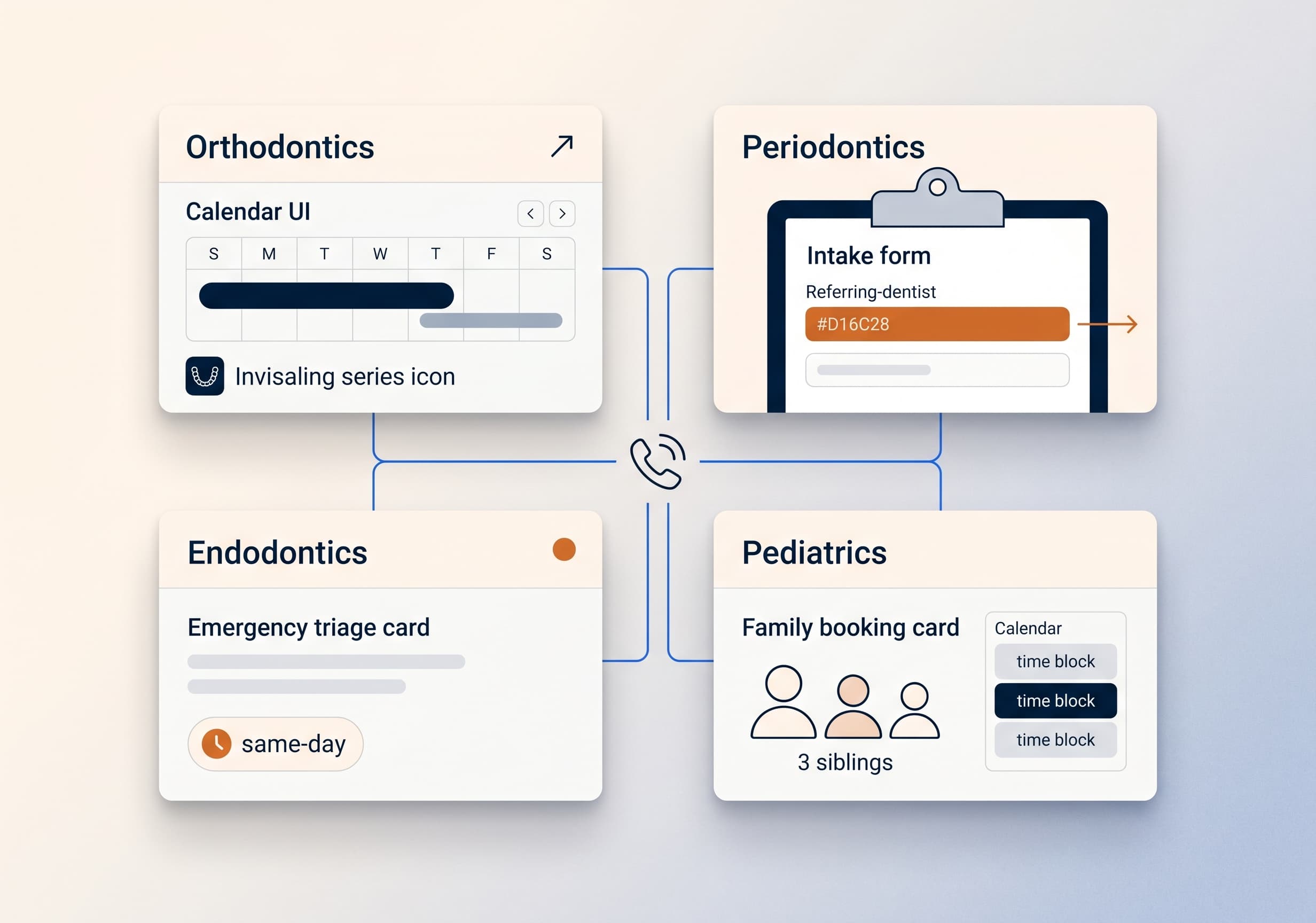
A virtual receptionist for specialty dental practice work is a different product than one built for general dentistry. The calls are longer, the clinical questions are harder, and a single missed consult in ortho or perio can cost more than a month of subscription fees. Generic scripts break the moment a parent asks about pediatric sedation or a referring dentist sends an endo emergency.
This guide breaks down what orthodontic, periodontal, endodontic, and pediatric offices actually need from a virtual receptionist, with workflow specifics for each specialty, real cost ranges, and the five vendor evaluation questions that separate specialty-ready platforms from general dental tools wearing a costume.
Why do specialty dental practices need a different virtual receptionist approach?
A virtual receptionist for specialty dental practice work needs a different approach because calls are longer, more clinically complex, and worth more revenue per patient than general dentistry calls. A generic script that handles "I need a cleaning" falls apart on Invisalign timelines, periodontal surgery recovery, or pediatric sedation questions. Configuration must be specialty-aware.
The numbers prove the gap. General dental calls average three to four minutes. Specialty calls average five to eight minutes because each one involves treatment specifics, multi-visit coordination, or referral information. Dental Economics research on missed calls shows the average dental practice loses thousands per month in unbooked appointments, and specialty offices feel it more because each new patient is worth multiples of a general dental visit.
Three structural differences from general dentistry
- Multi-visit treatment series. Ortho, perio, and endo all schedule patients across weeks or months. The platform must book a treatment series, not a single appointment.
- Referral intake. Perio and endo offices receive 60-80% of new patients through general dentist referrals. The script must capture referring provider, treatment authorization, and clinical urgency.
- Higher case value. The average specialty case is worth several thousand dollars. A 10% lift in consult-to-booking conversion produces significant revenue, which justifies the configuration investment.
For practices comparing platforms, the dental virtual receptionist buyer's guide covers the full feature checklist. Once you understand the structural differences, the specialty-specific requirements become clear.
What does an orthodontic office need from a virtual receptionist?
An orthodontic office needs a virtual receptionist that books and converts initial consultations, explains the multi-visit treatment process at a high level, and handles orthodontic-specific insurance benefits which are structured differently from general dental coverage. The consult is where ortho revenue starts, so consult booking and confirmation accuracy is the single most important metric.
Consult scheduling and conversion tracking
Every orthodontic consult that fails to book or no-shows is a $4,000-$7,000 case walking away. The platform needs to confirm consults 48 hours and 24 hours in advance, send treatment expectation content beforehand, and track which marketing source produced the consult. HubSpot's marketing tracking research consistently shows that businesses with end-to-end source attribution close more deals than those tracking only top-of-funnel metrics. Practices without this tracking cannot tell which channels actually work.
Multi-visit appointment series
Ortho treatment runs 18-24 months on average. The receptionist needs to schedule the entire treatment series at the start, not one visit at a time. A patient who books visits one by one drops out at a higher rate than one whose recurring appointments are already on the calendar.
Payment plans and insurance questions
Orthodontic insurance has lifetime maximums, age cutoffs, and waiting periods that general dental coverage rarely encounters. The platform needs scripted answers to "Will my insurance cover Invisalign?" and "Do you offer payment plans?" without confidently saying the wrong thing. Wrong answers create disputes at the consult.
Referral intake from general dentists
Most orthodontic offices receive a portion of new patients through GP referrals. The receptionist needs a separate intake flow for referred patients that captures the referring practice, the suggested treatment, and any clinical notes the GP sent. That data feeds the case acceptance conversation later.
DentiVoice handles specialty calls correctly.
From ortho consults to endo triage to pediatric sedation questions, DentiVoice books and tracks every specialty call. See it in action with a 15-minute walkthrough.
See DentiVoice →What do perio and endo practices need from a virtual receptionist?
Periodontal and endodontic practices need a virtual receptionist that captures referring provider information, triages urgency for endodontic emergencies, and schedules multi-visit treatment for periodontal procedures. Most new patients arrive through general dentist referrals, so referral intake accuracy directly determines monthly revenue.
Referral intake
When a general dentist refers a patient to your perio or endo office, the call needs to capture the referring practice, the diagnosed condition, the referring dentist's clinical notes, and insurance authorization status. Missing any of these means the patient arrives unprepared and the case acceptance conversation gets harder. ADA Health Policy Institute data consistently shows referral coordination is one of the top reported friction points in specialty referral chains.
Emergency triage for endo
Endodontic offices see same-day emergencies. A patient with acute pulpitis at 8 AM cannot wait three weeks for an opening. The platform needs a clinical triage script that identifies true emergencies (severe pain, swelling, trauma), offers an emergency slot, and routes routine cases to standard scheduling. Without a triage layer, urgent patients get the same Tuesday-at-2pm appointment as a follow-up consult.
Scaling and root planing scheduling for perio
Periodontal therapy requires a sequence: full-mouth or quadrant SRP, six- to eight-week reevaluation, then a maintenance recall cycle. The receptionist needs to book this sequence in one call, not bring the patient back four times to schedule the next step. Patients who feel scheduling friction drop out.
For pricing context on how these workflows affect monthly cost, the virtual receptionist cost breakdown walks through specialty vs. general dental pricing models.
DentalBase Specialty Fit Matrix
What Each Specialty Actually Needs From a Virtual Receptionist
Critical capabilities by specialty, plus the metric that matters most for each.
Orthodontics
CONSULT-DRIVENMust handle: consult booking, Invisalign vs. braces FAQs, treatment series scheduling, ortho insurance
Avg call length: 6-8 minutes
Case value at stake: $4,000-$7,000
North star metric: consult-to-start conversion rate.
Periodontics
REFERRAL-DRIVENMust handle: referral intake, SRP series scheduling, maintenance recall cycle, surgical pre-op questions
Avg call length: 5-7 minutes
% new patients from referrals: 60-80%
North star metric: referral-to-completed-case conversion.
Endodontics
URGENCY-DRIVENMust handle: emergency triage, same-day slot routing, referral capture, post-op questions
Avg call length: 4-6 minutes
% emergency calls: 30-50%
North star metric: emergency-to-same-day booking rate.
Pediatric
PARENT-DRIVENMust handle: parent communication, sibling block scheduling, sedation FAQs, consent for minors
Avg call length: 6-9 minutes
% multi-child bookings: 30-45%
North star metric: parent satisfaction + family LTV.
The specialty cost penalty
5-8 min
avg specialty call length vs. 3-4 min general dental.
2x
the per-call cost on minute-based pricing plans.
$4-7K
avg ortho case value lost per missed consult.
60-80%
of perio/endo new patients arrive through GP referrals.
Sources: Dental Economics, ADA Health Policy Institute, BLS healthcare labor data, BrightLocal.
What does a pediatric dental office need from a virtual receptionist?
A pediatric dental office needs a virtual receptionist that talks to parents, not patients. The caller makes decisions for someone else, often wants to schedule multiple siblings at once, and asks specific questions about consent, sedation, and insurance coverage for minors. The call dynamic is fundamentally different from any other dental specialty.
Parent-focused communication
Every pediatric call starts with a parent who is often worried, sometimes in a hurry, and almost always asking about something on behalf of their child. The platform needs warmth, patience, and the ability to slow down for first-time parents. According to BrightLocal's local consumer research, healthcare reviews mentioning staff warmth correlate with significantly higher conversion among new patient inquiries.
Sibling and family block scheduling
Parents with two or three kids in dental treatment do not want three separate trips. The receptionist needs to find back-to-back operatory slots and book the whole family in one block. Most general dental scripts cannot handle "I have three kids, can we do all of them on Saturday?" Pediatric-aware platforms can and should.
Insurance and consent for minors
Pediatric dental insurance differs from adult coverage on age cutoffs, sealant frequency, and orthodontic riders. Consent for sedation and anesthesia requires the legal guardian's signature. The receptionist needs scripted answers that surface these nuances early in the call, not after the family has driven 25 minutes to the office.
Related: Piloting an AI receptionist for your practice? Read → Pilot AI Receptionist Dental Rollout: 30/60/90 Plan
How much does a virtual receptionist for specialty dental practice work cost?
Specialty pricing follows the same models as general dentistry: AI platforms run $300-$800 per month, live remote agents run $800-$2,500 per month. But per-minute pricing carries a hidden penalty because specialty calls run 5-8 minutes instead of 3-4. Picking the wrong pricing model can double your monthly bill.
The math is brutal on minute-based plans. A general dental practice with 200 monthly calls at 4 minutes each uses 800 minutes. A specialty practice with the same call volume at 7 minutes each uses 1,400 minutes. Same call count, 75% more billable time. Always price specialty receptionists on call volume + average call length, not advertised base rates.
| Pricing model | Fits which specialties | Typical monthly cost |
|---|---|---|
| Flat monthly (AI) | Best for all specialties, predictable cost regardless of call length | $300-$800 |
| Per-minute (live or AI) | Risky for ortho, perio, pedo, call lengths inflate bills | $1.50-$3.50/min |
| Per-call (live) | Reasonable for endo (short, urgent) and perio (medium length) | $5-$15/call |
| Live agent monthly | High-touch ortho and pediatric where warmth matters most | $800-$2,500 |
For most specialty practices, the flat monthly AI model produces the lowest total cost and the most predictable billing. For deeper pricing analysis by structure, the virtual receptionist pricing models guide walks through hybrid and overflow setups too. And for ROI math, the when AI receptionists pay off analysis covers payback windows by practice size.
The Bureau of Labor Statistics dental occupations data shows in-house dental receptionist wages have risen sharply in recent years, which is part of why so many specialty practices are running the AI-vs-live math seriously for the first time.
How do you evaluate an AI virtual receptionist vendor for your specialty?
To evaluate a virtual receptionist vendor for a specialty dental practice, ask five questions before signing. These separate vendors who have actually served specialty offices from those who will promise to "customize it later" and then hand you a generic dental script. The right answers are specific, with proof.
Five vendor questions every specialty practice should ask
- 1. Do you have case studies from practices in my specialty? Ask for ortho, perio, endo, or pedo references specifically. "Yes, we serve all dental practices" is a non-answer. Real specialty experience produces concrete examples.
- 2. How do you handle multi-visit treatment series scheduling? The vendor should describe an actual workflow, not promise to "configure it." If they cannot demo it on the spot, they have not built it.
- 3. What is your average call handle time for specialty calls? Vendors who serve specialty practices will know their data. Vendors who have only handled general dental will quote 3-4 minute averages that do not match your reality.
- 4. How does referral intake work? Perio and endo practices need answers here. Ask for a screenshot or recording of a real referral intake call.
- 5. Can the AI escalate to a human, and how is that priced? Pure AI plans hit edge cases. Pure live plans cost more. The hybrid setup that works for most specialty practices needs clear escalation rules and predictable billing for handoffs.
A vendor who answers all five with specifics and shows working examples is the one to demo seriously. A vendor who answers in marketing language is the one to skip. The AI dental receptionist demo guide covers the demo session itself, including the 7 questions to ask during the call.
Once your vendor is selected, the rollout matters as much as the choice. A poorly executed launch produces patient complaints regardless of how good the technology is. The 30/60/90 pilot plan structures the rollout to catch problems early and document wins.
Specialty-ready AI built for dental.
DentiVoice was built by people who run dental practices. Ortho consults, perio referrals, endo emergencies, and pediatric sedation questions all live inside the configuration.
See DentiVoice for specialty →The specialty rule that decides whether this works
Specialty dental practices succeed with the right virtual receptionist when they pick a platform built for their actual call mix, not one configured for general dentistry with a few extra fields. Ortho needs consult conversion. Perio and endo need referral intake and emergency triage. Pediatric needs parent-centered scripts. Cost models are choice variables. Workflow fit is non-negotiable.
Before signing with any vendor, send them the five questions above and ask for specialty case studies. The right answer comes back inside 48 hours with concrete examples. The wrong answer comes back as marketing copy. That signal alone will save you six to twelve months of friction.
See DentiVoice for your specialty in 15 minutes.
A walkthrough using your specialty's actual call patterns: ortho consults, perio referrals, endo triage, or pediatric scheduling.
Book a Free Demo →Want more specialty practice playbooks?
Browse Resources →Sources & References
Frequently Asked Questions
Yes, but only if the platform is configured for your specialty. A virtual receptionist for specialty dental practice work needs ortho consult flows, perio referral intake, endo emergency triage, or pediatric parent scripts depending on the specialty. Generic dental scripts cannot handle these nuances out of the box.
AI platforms cost $300-$800 per month, live remote agents cost $800-$2,500 per month. Avoid per-minute pricing for specialty practices because longer call lengths (5-8 minutes) inflate bills. Flat monthly AI pricing produces the lowest total cost and most predictable billing for most specialty offices.
Yes, when configured for ortho-specific workflows: consult booking with conversion tracking, treatment series scheduling, Invisalign and braces FAQs, and ortho insurance benefit scripting. Generic dental platforms typically fall short here because they don't understand multi-visit treatment series or lifetime ortho maximums.
Yes, if the platform has a clinical triage layer that identifies true emergencies like acute pulpitis, swelling, or trauma. Same-day routing logic is essential because endo emergencies cannot wait three weeks. Ask vendors for their triage script before signing, not after.
Reputable AI and live virtual receptionist platforms are HIPAA-compliant, with signed BAAs, encrypted call recordings, and audit logs. Always verify the vendor signs a Business Associate Agreement before any patient data flows. The HIPAA rules apply identically to specialty and general dental practices.
Ask five questions: specialty case studies, multi-visit workflow demo, average call handle time for your specialty, referral intake examples, and AI-to-human escalation pricing. Vendors with real specialty experience answer with specifics and proof. Vendors without experience answer in marketing language.
Either works, but the script and tone matter more than the technology. Pediatric calls are parent-driven and need warmth. AI platforms with conversational voice models work well today. Live agents may feel more natural to anxious parents but cost three to five times more per month.
Was this article helpful?
Written by
DentalBase Team
Expert dental industry content from the DentalBase team. We provide insights on practice management, marketing, compliance, and growth strategies for dental professionals.