Dental Patient Referral Rewards Program: A Complete Guide
Learn how to build a dental patient referral rewards program, including reward tiers, budget benchmarks, compliance rules, and tracking that works.
Share:
Table of contents
A dental patient referral rewards program is a structured system that gives current patients a defined incentive for referring someone who books and completes a visit. Done well, it turns everyday patients into an active source of new business, often at a fraction of what paid ads cost per lead. Referred patients also tend to show up loyal from day one, since someone they trust already vouched for the practice.
Most practices ask for referrals informally and leave it there. That approach leaves opportunity on the table. Without a defined reward structure, staff forget to ask, patients forget to follow through, and the front desk never learns which referrals actually convert into booked appointments.
This guide covers reward structures, budget benchmarks, compliance considerations, and the tracking systems that keep a program accountable, all as part of a broader dental marketing strategy. By the end, you will have a framework you can adapt to your own patient base and reward budget.
Related: A referral reminder is one of several low-cost tactics worth trying before building a full rewards program. See 11 low-cost dental marketing ideas for slow months →
What Is a Dental Patient Referral Rewards Program?
A dental patient referral rewards program is a structured system. It gives current patients a defined incentive, such as a credit or gift card, for referring a new patient who books and completes a visit. It replaces a vague "tell your friends" ask with a repeatable process.
The program typically has three moving parts. A trigger prompts the ask, a tracking mechanism ties the new patient back to the referrer, and a reward gets fulfilled once the referred patient completes a qualifying visit. Some practices set the qualifying event at the first exam, others wait until treatment is accepted. Either way, the reward has to be tied to a verifiable outcome, not just a name dropped at check-in.
Structure matters more than generosity here. A modest $25 credit tracked consistently outperforms a generous reward nobody remembers to redeem.
Why Do Reward-Based Referral Programs Work Better Than Passive Word of Mouth?
Reward-based programs work better because they give patients a specific reason to act now instead of mentioning your practice in passing. A defined incentive turns a vague compliment into a concrete referral with a name and a phone number attached.
Passive word of mouth still matters. According to the BrightLocal Local Consumer Review Survey, 98% of people read local reviews before choosing a business, and reviews shape whether a referral turns into a booked visit. But reviews and casual mentions are slow and unpredictable. A rewards program adds urgency. Patients who might have referred someone eventually now have a reason to do it this week, while the experience is still fresh.
The two approaches work together, not against each other. Reviews build the trust that makes a referral credible. The reward is what actually gets the referral made.
Related: If you have not built out the broader referral system yet, including scripts and staff training, start with our guide to word-of-mouth dental marketing systems. Read the full guide →
What Types of Rewards Can Dental Practices Offer for Referrals?
Dental practices typically offer four reward types: account credit, gift cards, service upgrades, or charitable donations made in the patient's name. The right choice depends on your patient mix and how much administrative effort you can commit to fulfillment.
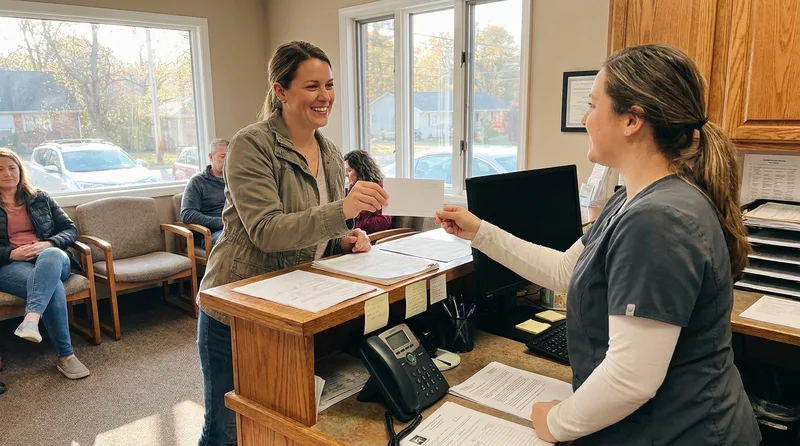
Account credit is the simplest to administer since it lives inside your practice management software and needs no outside vendor. Gift cards feel more like a gift but require someone to purchase, track, and hand them out. Service upgrades, such as a complimentary whitening touch-up, cost the practice less in cash but only appeal to patients who want that specific service. Charitable donation options work well for patient bases that respond poorly to being paid for referrals, which happens more often than you might expect.
- Account credit: applied directly to the referrer's balance, easiest to track internally
- Gift cards: $10 to $50 range is common, requires manual fulfillment
- Service credit: whitening, cleaning upgrade, or product bundle
- Charitable donation: a fixed amount donated on the patient's behalf
Whatever you choose, keep it consistent. Switching reward types every quarter confuses staff and makes it harder to track performance over time. Practices that highlight strong reviews as part of the referral ask often see a lift; see our roundup of 5-star dentist review examples for language that works.
How Much Should a Dental Practice Budget for Referral Rewards?
Most dental practices budget $15 to $50 per successful referral, scaled against the average patient lifetime value of $12,000 to $15,000 for a general dentist. That range keeps the reward meaningful without eating into margin on lower-value visits.
Think of the reward as a fixed customer acquisition cost you control, rather than a variable one set by an ad platform's auction. Digital channels often cost $150 to $300 to acquire a new patient, according to Dental Economics practice management coverage. A $25 to $40 referral reward is a fraction of that, and the new patient arrives with a warmer starting relationship.
Context matters too. The U.S. dental market represents tens of billions of dollars in annual spending, and the ADA Health Policy Institute tracks how that spending shifts by household income and insurance status. Practices serving a higher share of self-pay or out-of-network patients often set rewards toward the premium end of the range. Those patients typically carry a higher lifetime value, so a single referral is worth protecting.
| Reward Tier | Typical Value | Ideal For |
|---|---|---|
| Entry | $15 to $25 | High patient volume, routine cleanings |
| Standard | $25 to $40 | General practices, mixed case types |
| Premium | $50+ | Implant, orthodontic, or specialty practices |
Set the reward once a year and stick with it. Revisiting it every time production dips sends a signal to staff that the program is not a real priority.
What Compliance Rules Apply to Dental Referral Reward Programs?
The main compliance concerns are professional advertising ethics and how you contact people about the reward, not the reward itself. Most states allow dental referral incentives as long as they are transparent and not tied to insurance billing.
Two areas deserve attention. First, check your state dental board's advertising rules and your payer contracts before offering a reward tied to insured treatment. Some contracts restrict inducements when the referred patient is covered by insurance. Second, if you notify patients about the program or remind them to redeem a reward by text message, that message is subject to TCPA consent rules. Our guide to texting patients and HIPAA compliance walks through consent and privacy requirements in detail, and if you send referral alerts via SMS at scale, you likely need 10DLC registration as well.
Keep a written policy for the program. It does not need to be long, but it should state who qualifies, what the reward is, and when it gets fulfilled. That protects you if a patient disputes whether they earned a reward.
How Do You Announce a Referral Rewards Program to Patients?
Announce a referral rewards program through the channels patients already use to interact with your practice: post-visit texts or emails, in-office signage, your patient portal, and social media. Layering two or three channels works better than relying on one.
The moment right after a positive visit is the highest-converting window. A patient who just had a comfortable cleaning or a pain-free filling is primed to talk about it. That is also when a short, specific ask lands most effectively, rather than a generic mention buried in a monthly newsletter. Front desk staff and hygienists are well positioned to make this ask verbally. A follow-up text or email with the actual referral mechanism, a code or a link, seals it.
- Train front desk and clinical staff on a short, specific verbal ask at checkout
- Send a follow-up text or email within 24 hours with the referral code or link
- Post signage in the waiting room describing the reward and how it works
- Mention the program periodically on social channels without over-promoting it
- Add a line about the program to your Google Business Profile description or Q&A section
Avoid announcing the program once and never mentioning it again. Programs fade from memory fast without a light, ongoing cadence. It also helps to keep your online presence consistent with what patients hear in the office. Google's own SEO documentation notes that consistent, accurate business information supports how that information surfaces in search. That matters when a referred patient looks up your practice before calling.
How Do You Track and Redeem Referral Rewards Without Losing Data?
Track referral rewards using a unique code or link per referring patient, logged in your practice management software or CRM at the moment a new patient books. Without that link, you cannot verify who actually referred whom, and rewards get fulfilled on the honor system, which invites errors.

The simplest method assigns each active patient a short referral code tied to their chart number. When a new patient mentions that code, or books through a referral-specific link, staff tag the new patient record accordingly. That tag should carry through to the reward fulfillment step, so nobody has to remember months later who referred whom. Some practices layer this with a dedicated intake question: "How did you hear about us?" as a backup, though self-reported answers are less reliable than a tracked code.
Review the tracked data monthly. Look at referral volume by referring patient and by month, not just a running total. That reveals whether the program is trending up or quietly stalling.
What Mistakes Make Dental Referral Reward Programs Fail?
The most common mistake is a slow or inconsistent reward fulfillment process. If patients wait weeks for a reward, or some referrals get rewarded while others slip through the cracks, word spreads fast that the program is not reliable, and participation drops off.
Other frequent problems pile on fast. A reward too complicated to explain in one sentence, no training for new hires, and an ask that quietly disappears from checkout scripts within a few months of launch. A few practices also make the mistake of only asking their most vocal, already-loyal patients, missing quieter patients who would refer if asked directly.
- Rewards take more than two weeks to fulfill after a qualifying visit
- The ask is inconsistent, some staff mention it, others do not
- No one owns tracking, so redemptions get missed or duplicated
- The program is announced once and then forgotten
Fixing these is usually a matter of assigning one person ownership of fulfillment and reviewing the program at the same cadence you review other marketing metrics. There's also a quieter mistake worth naming: assuming every patient who could refer someone already has regular dental care themselves. NIDCR data shows access to routine care is uneven across income groups. A referral ask paired with a reminder about flexible scheduling or payment options can reach patients who might otherwise sit on a referral instead of acting on it.
Professional referrals deserve a parallel effort. General dentists who do not place implants themselves are often the lowest cost source of large cases, a channel we look at closely in our guide to building referral flow for implant cases.
How Does a Referral Rewards Program Fit Into Overall Practice Growth?
A referral rewards program functions well as one input into a broader patient acquisition and retention strategy, not a standalone tactic. It complements paid search, local SEO, and reputation management rather than replacing any of them.
Where It Fits in the Marketing Mix
Referrals rarely carry a practice on their own. Paid search brings in patients who have no existing connection to you, local SEO keeps you visible when someone searches nearby, and reputation management shapes what a prospective patient sees before they call. A referral rewards program sits alongside those channels, converting the trust your current patients already have into new bookings instead of leaving it unused.
How It Compounds Patient Retention
Referral-driven patients also tend to show fewer no-shows and better long-term retention, since they arrive with a personal recommendation already reinforcing trust. That retention benefit compounds. Automated recall and follow-up systems increase patient return rates by 25% to 40%, and a steady stream of referred patients gives those systems more people worth staying in touch with. If your front desk is already stretched thin managing calls and follow-up, an AI receptionist can help. It captures referral details consistently and logs the source at the point of booking, freeing staff to focus on the in-office experience that generates the next referral.
Treat the reward program as one lever among several, and revisit it alongside your other marketing numbers each quarter.
A referral rewards program and an in-house membership plan compound the same way: both turn a one-time visit into a recurring relationship. Our comparison of Kleer, Membersy, and DentalHQ covers the membership side of that equation.
A dental patient referral rewards program only works when the reward, the tracking, and the ask are all treated as one connected system rather than three separate tasks. Start with a simple, consistent reward, track it properly, and review the results on a set schedule instead of leaving it to chance.
The next step is picking one reward tier from the table above, writing a short program policy, and training your front desk on a specific ask this week.
See How DentalBase Supports Referral Tracking
Book a free demo to see how an AI receptionist and marketing platform can log referral sources automatically.
Book a Free Demo →Want more guides like this one?
Browse Resources →Sources & References
Frequently Asked Questions
Most practices pay $15 to $50 per completed referral, depending on patient lifetime value and case type. Specialty or implant-focused practices often set rewards toward the higher end, since a single referred patient can be worth significantly more over time.
Yes, in most states, as long as the reward is transparent and not tied to inducements for insured treatment. Check your state dental board's advertising rules and your payer contracts before rewarding referrals involving insurance-covered care.
Account credit is typically the easiest option, since it applies directly inside your existing practice management software without needing gift card purchases or outside vendors. It also creates an automatic paper trail for tracking.
Yes. Any text message reminding a patient about a referral reward or asking them to redeem one falls under TCPA consent rules. Practices sending these messages at scale typically also need 10DLC registration for their messaging number.
Assign each patient a unique referral code or link tied to their chart number, then tag the new patient's record at booking. Reviewing this monthly reveals which referrals are converting and which are not.
Most referral programs fade because the ask disappears from checkout scripts, staff forget to mention it, or reward fulfillment becomes slow and inconsistent. Assigning one person ownership of the program usually fixes this.
Was this article helpful?
Written by
DentalBase Team
Expert dental industry content from the DentalBase team. We provide insights on practice management, marketing, compliance, and growth strategies for dental professionals.