Why Dental Practices Miss Calls: The Real Root Causes
Dental practices miss calls for predictable reasons: thin staffing, peak-hour spikes, old phone systems, and unclear workflows. Here are the root causes.
Share:
Table of contents
Most dental practices don't miss calls because the team is lazy or untrained. They miss calls because of how the front desk is structured, when call volume spikes, and what happens to a ringing phone when a patient is already standing at the counter. The reasons why dental practices miss calls are predictable, and almost all of them trace back to a small set of operational gaps you can name and fix.
The scale is bigger than most owners assume. The American Dental Association reports through its practice resources that 38% of new patient calls go unanswered during business hours, and the average practice misses 15 to 20 calls a week. This article breaks down the real root causes one by one, so you can see which is costing your practice the most new patients.
Why do dental practices miss so many calls?
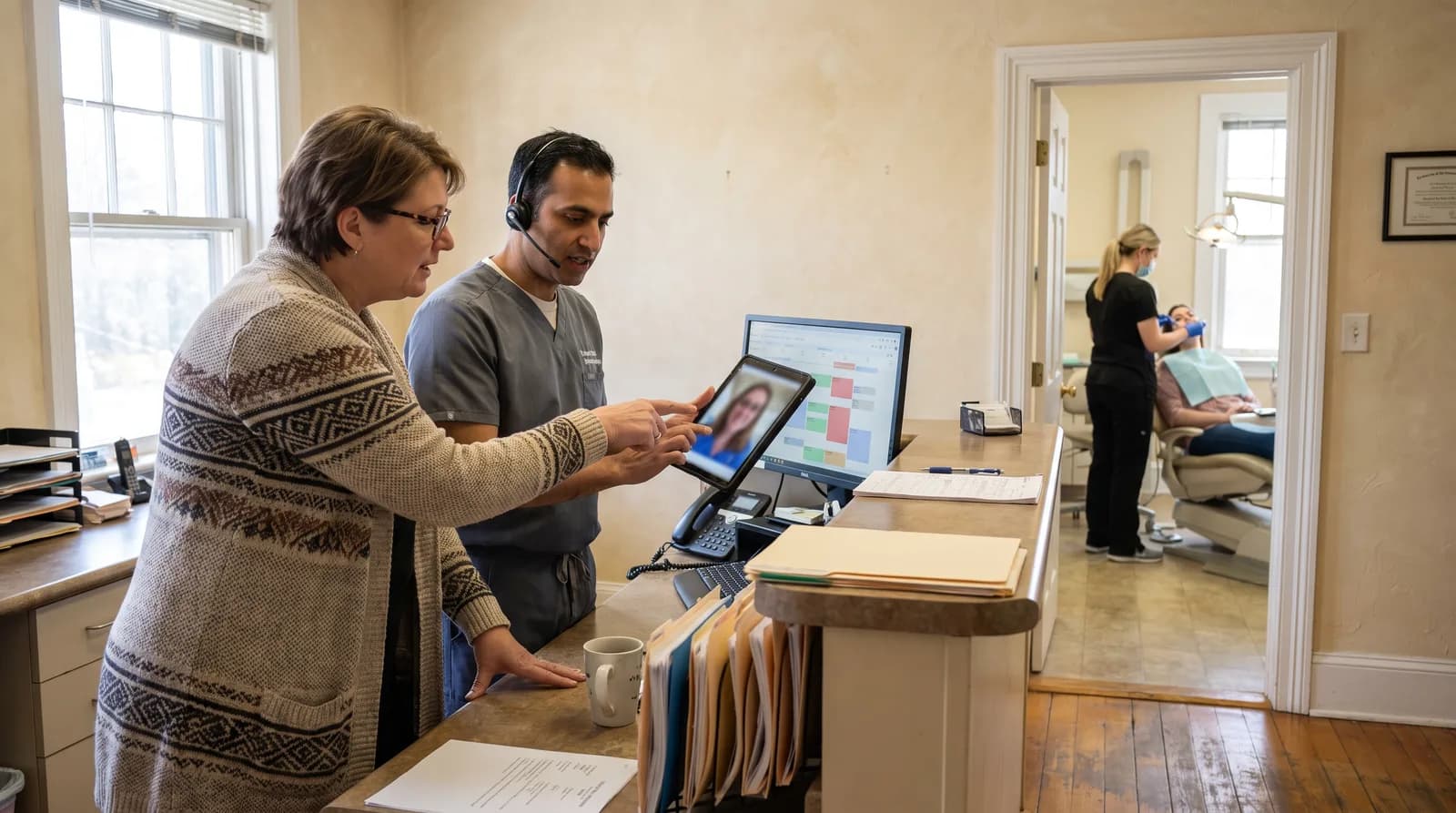
Dental practices miss calls because one person usually answers the phone while also checking patients in, verifying insurance, and processing payments. When two tasks land at the same second, the phone loses. Volume, staffing, and timing decide how often that happens.
Picture a three-provider practice taking 200 calls a week. The front desk isn't sitting idle waiting for the phone to ring. They're mid-conversation with a patient at the window, on hold with an insurance company, or walking someone back to an operatory. A call that lands in any of those moments rolls to voicemail. And most callers who hit voicemail never leave a message and never call back, which means the miss is permanent, not a delay.
So the problem isn't one dropped call. It's a structural mismatch between how many things hit the front desk at once and how many hands are there to catch them. Name that mismatch and the rest of the diagnosis gets easier.
It also explains why the problem feels invisible to owners. You're in the operatory producing dentistry, not watching the phone. The front desk looks busy and productive all day, because it is. The misses happen in the cracks between tasks, and nobody on the team experiences them as failures. That's exactly why they persist for years.
The most common collision points where a call gets dropped:
- A patient is checking out and paying while the phone rings.
- The coordinator is on hold with Delta Dental or Cigna verifying benefits.
- Someone is being walked back to the operatory or seated for treatment.
- The team is mid-handoff during a shift change or lunch rotation.
Is understaffing the real reason calls go unanswered?
Understaffing is the most common root cause, but it's rarely the whole story. A single front desk coordinator can physically handle one interaction at a time. When call volume overlaps with in-person tasks, calls drop no matter how skilled that person is.
Here's the thing about front desk math. One coordinator covering check-in, checkout, insurance, and the phone hits a ceiling fast. Add a lunch break, a quick errand, or one complicated insurance call, and the phone is effectively unstaffed for long stretches of the day. Reporting compiled by Dental Economics on practice call handling found the average caller abandons the line after about 90 seconds of hold time. Most dental hold experiences blow past that without anyone noticing.
Hiring helps, but it's expensive and slow to pay off. Before you post a job, look hard at whether the real problem is headcount or how the existing hours are spread across the day. Sometimes the same team, scheduled differently, catches far more calls.
There's also a hidden cost to relying on one person. When that coordinator is out sick or on vacation, your call-answer rate can collapse for a full week. A practice that books most of its new patients by phone is then running its growth engine on a single point of failure. That fragility, not just the raw headcount, is what makes understaffing so risky.
Related: Staffing the front desk is as much a hiring decision as an operational one. See how to hire the front desk like a sales role →
How do peak hours and after-hours gaps cause missed calls?
Call volume isn't spread evenly across the day. It clusters around opening, lunch, and late afternoon, and a large share arrives when the office is closed. Those concentrated bursts overwhelm a front desk built for average load instead of peak load.
Mornings are the worst offender. Patients call before work, on the commute, or the moment they wake up with a toothache. Your team is opening the office, seating the first patients, and fielding that rush all at once. Then there's the after-hours problem. Industry call data shows after-hours calls represent 27% of total patient call volume, meaning more than a quarter of the people trying to reach you do it when nobody is there. Pediatric and emergency-leaning practices skew even higher, since dental pain rarely keeps office hours, a pattern echoed in CDC oral health data on untreated dental conditions.
The fix isn't staffing every hour at peak level, which no practice can afford. It's matching coverage to the actual call curve and deciding, in advance, how after-hours calls get captured instead of lost to a competitor. A weekend voicemail that nobody checks until Monday is functionally the same as no phone at all. By then the patient has already booked elsewhere.
| Time window | Why calls get missed | What helps |
|---|---|---|
| Morning open | Opening tasks collide with the early call rush | Stagger arrival times so one person owns the phone |
| Lunch hour | Coverage drops while inbound volume holds steady | Rotate lunches instead of closing the desk |
| After hours | 27% of volume lands with no one to answer | Capture calls with an answering service or AI |
What role does outdated phone technology play?
Old phone systems quietly cause misses that staffing alone can't fix. A single line with no queue, no overflow routing, and no after-hours path means a second caller hears a busy tone or drops straight to voicemail. The hardware sets a hard ceiling on how many calls you can catch.
Many practices still run a basic setup where calls ring at one handset and stop there. No simultaneous ring, no routing to a mobile phone, no record of who called and didn't connect. So a missed call leaves no trace, which means it never shows up in a report and never gets a follow-up. You can't recover what you can't see. That blind spot is a big reason 73% of dental practices plan to adopt AI tools by 2027, with call handling near the top of the list, and why search interest in answering technology keeps climbing in Search Engine Land coverage of AI-driven tools.
Before assuming you need more people, audit the system itself. Can it ring multiple devices? Does it log unanswered calls? Is there any after-hours path at all? If the answer is no, the technology is your bottleneck, not the team.
Calls don't have to hit a dead end after hours.
DentiVoice answers when your team can't, capturing new patients around peak hours and overnight so calls turn into booked appointments instead of voicemails.
See how the AI receptionist works →Related: Multi-location groups face the same root causes at larger scale, where one missed call repeats across every office. See how DSOs cut missed calls group-wide →
Why do front desk workflows break down under pressure?
Even a well-staffed desk with modern phones misses calls when the workflow has no rule for what wins. When a patient at the counter and a ringing phone compete, staff default to the person they can see. Without a documented priority, the phone loses every single time.
This is a process gap, not a people gap. Your coordinator isn't choosing to ignore the phone. They're making a reasonable in-the-moment decision to help the patient in front of them. But multiply that choice across a busy day and unanswered calls pile up invisibly. Pair it with the reality that a patient who can't reach you usually just dials the next practice on their list, and a quiet workflow gap turns into measurable lost revenue. Patient reviews compiled by BrightLocal consistently show responsiveness shapes whether someone chooses or abandons a local provider. Broader service-response research summarized by HubSpot shows the same pattern across industries: slow or missed responses drive customers to a competitor.
The fix is a clear protocol: who answers, what gets paused, and how an interrupted in-person patient is handled gracefully. Write it down and drill it. A documented phone-priority rule outperforms another hire in plenty of offices.
Related: The choice between adding staff and automating the phone comes down to cost and consistency. Compare hiring versus automating the front desk →
How can you tell which root cause is hurting your practice?
Diagnose before you spend. Pull your call logs, map unanswered calls against the time of day, and check whether misses cluster at peak hours, after hours, or evenly across the schedule. The pattern tells you whether the cause is staffing, timing, technology, or workflow.
Start with data you already have. Most phone systems and practice management software can show call volume by hour. If misses spike between 8 and 10 AM, it's a peak-load and coverage problem. If they're heavy after closing, it's an after-hours gap. If they're spread evenly all day, look at staffing levels or your workflow rules. A connected platform that ties calls to booked appointments makes this far easier, because you can finally see not just missed calls but missed revenue attached to them. Tracking that link is also how you measure whether a fix actually worked, the same way you would benchmark other front-desk metrics like your no-show rate.
Once you know the dominant cause, the fix gets obvious. Match the solution to the pattern instead of guessing, and re-pull the data 30 days later to confirm the gap closed.
A simple three-step diagnostic any office manager can run this week:
- Export one week of call logs from your phone system or PMS such as Dentrix, Eaglesoft, or Open Dental.
- Tag each unanswered call by hour and by whether the office was open or closed.
- Find the largest cluster, fix that one cause first, then recheck the numbers after 30 days.
Want to see where your calls and revenue leak?
A quick walkthrough shows how DentalBase connects call handling to booked appointments, so missed calls stop being invisible on your reports.
Book a free demo →The bottom line on why dental practices miss calls
The reason dental practices miss calls is almost never one broken thing. It's the overlap of thin staffing, concentrated peak and after-hours volume, dated phone technology, and workflows with no rule for what wins when the desk gets slammed. Each cause compounds the others.
Your next step is cheap and concrete. Pull one week of call data and find where the misses cluster. That single pattern points straight at the root cause draining the most new patients from your schedule, and it tells you whether the answer is a hire, a schedule change, a new phone setup, or an automated layer that answers when your team simply can't.
Whatever you change, measure it the same way every time: missed calls per week, and how many of those convert to booked appointments once captured. Fix the biggest leak first, confirm the number moved, then work down the list. That's how a chronic problem becomes a solved one.
Stop guessing why your practice misses calls.
See how DentalBase and DentiVoice capture the calls your front desk can't get to and turn them into booked appointments.
Book a Free Demo →Want more guides on front desk performance and practice growth?
Browse Resources →Sources & References
Frequently Asked Questions
Most practices miss calls because one front desk person handles the phone alongside check-in, checkout, and insurance. When tasks overlap, the phone rolls to voicemail. Volume spikes, thin staffing, and timing decide how often it happens.
The average dental practice misses about 15 to 20 calls per week, and roughly 38% of new patient calls go unanswered during business hours. Many of those callers never try again and book elsewhere instead.
Not always. Hiring helps when volume truly exceeds capacity, but uneven scheduling, no after-hours path, and weak phone workflows cause many misses. Diagnose the pattern in your call logs before adding headcount, since the same team scheduled differently may catch more.
Misses cluster at morning open, lunch, and after hours. After-hours calls alone make up about 27% of total volume. Mapping unanswered calls by time of day reveals whether your problem is peak load, after-hours coverage, or all-day understaffing.
An AI receptionist answers calls your team can't reach, including after hours and during peak spikes, and can book appointments directly. It works best paired with a workflow fix, so live staff and automation cover different gaps rather than overlapping.
Pull one week of call logs and map unanswered calls against the time of day. Clustering at peak hours points to coverage, after-hours misses point to a closed-office gap, and even spread points to staffing or workflow problems.
Was this article helpful?
Written by
DentalBase Team
Expert dental industry content from the DentalBase team. We provide insights on practice management, marketing, compliance, and growth strategies for dental professionals.