How AI Reception Helps Reduce Missed Calls and Voicemails
See how AI reception and DentiVoice reduce missed calls and voicemails, cover after-hours and overflow, and book patients straight into your PMS.
Share:
Table of contents
Dental offices reduce missed calls fastest by putting an AI receptionist on every line, around the clock, no matter how many phones ring at once. That is what DentiVoice does on the DentalBase platform. About 38% of new patient calls go unanswered during business hours, according to ADA Practice Transitions. After hours, every call reaches voicemail. Each one is $400-600 of new patient production that moves to whichever practice picks up first.
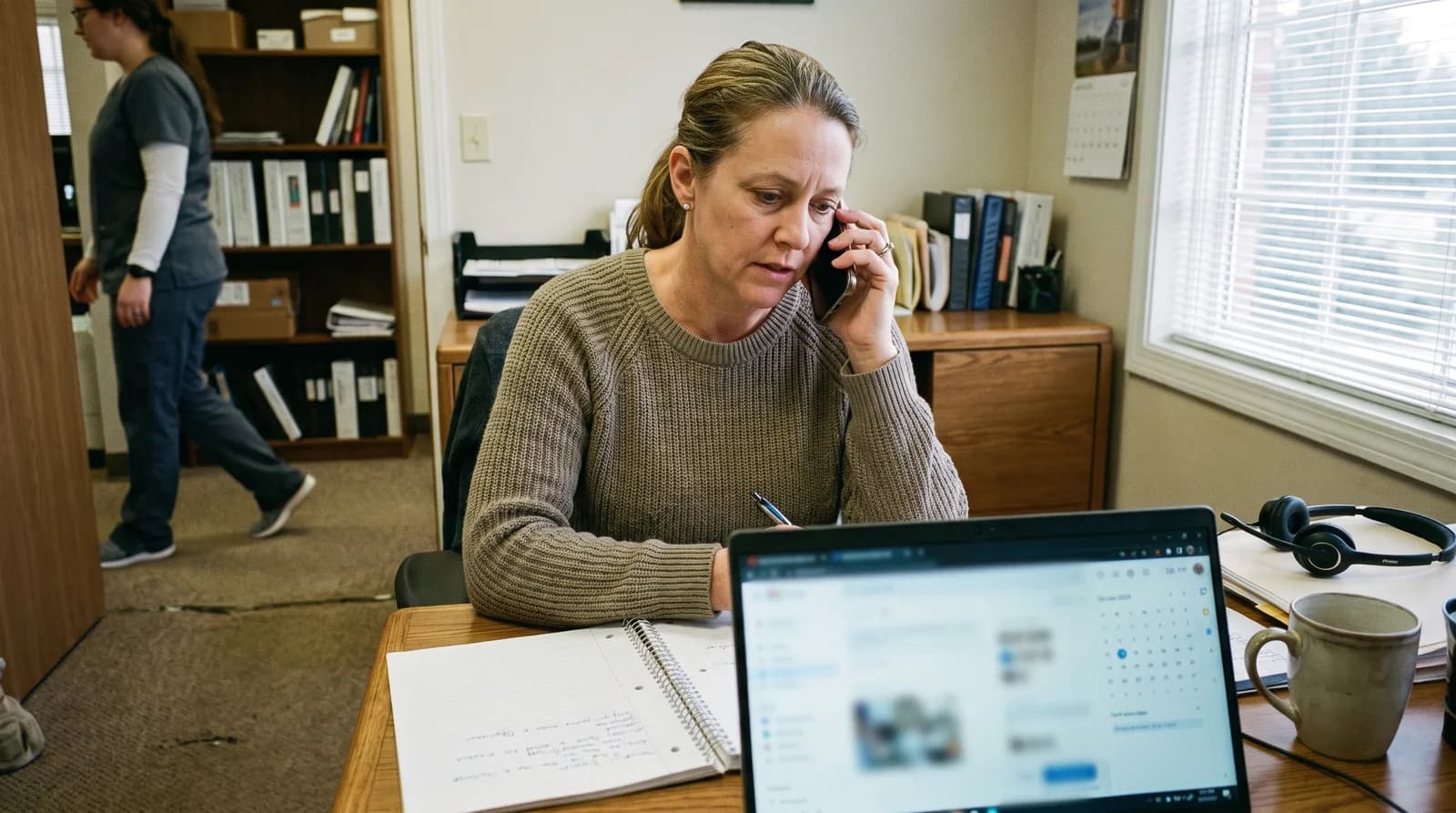
The cause is structural, not attitudinal. One person cannot check in a patient, post a payment, and answer three ringing lines at the same time. Human capacity has a ceiling, and after 5pm that ceiling is zero. Patients rarely wait: 98% of consumers read local reviews before choosing a business, BrightLocal reports, so your practice is already one name on a shortlist when the phone rings. Automation is the only fix that covers every hour without adding payroll.
Why Do Dental Practices Miss So Many Calls?
Missed dental calls come from five predictable gaps: peak-hour overflow, after hours, lunch, staff meetings, and unplanned absences. Together they account for nearly all lost call volume. Only two of them, overflow and after hours, are large enough that adding a person at the front desk cannot close them.

| Cause | When it happens | % of missed calls | What AI changes |
|---|---|---|---|
| Peak-hour overflow | Monday AM, post-lunch, 4-5pm | 30-40% | Simultaneous calls all get answered |
| After hours | Evenings, weekends, holidays | 25-35% | Full capability at 9pm, not a message box |
| Lunch break | 12-1pm daily | 15-20% | Coverage without a rota |
| Staff meetings and training | Weekly or monthly | 5-10% | Coverage continues during huddles |
| Sick days and vacations | Unpredictable | 5-10% | No gap when someone is out |
A second front desk hire runs $3,000-4,500 per month once Bureau of Labor Statistics wage data for receptionists is loaded with payroll taxes and benefits. That hire fixes business-hours overflow only. It does nothing for the 25-35% of misses that land after close, and it creates its own lunch and absence gaps. AI reception at $300-1,000 per month covers all five causes at once, which is why most practices that reduce missed calls start there rather than with headcount. Practice-level demand benchmarks are tracked by the ADA Health Policy Institute if you want to sanity-check your own call volume. For the hour-by-hour breakdown, see the seven times a dental office misses calls and why a fully staffed front desk still misses them.
Does AI Answer Dental Calls After Hours?
Yes. AI reception answers dental calls after hours with the same capability it has at 10am on a Tuesday: it checks live availability, books the 9pm caller into a real slot, and routes a genuine emergency to your on-call provider instead of a voicemail box.
Evenings, weekends, holidays, and the gap between the last patient and the first one tomorrow are all covered with no rota, no on-call rotation, and no answering service in between.
After-hours calls are about 27% of total patient call volume, per Dental Economics. That is the difference between an AI receptionist and a traditional answering service, which takes a message and hands you a callback list the next morning. By then the caller has already booked elsewhere. Around 80% of callers who reach voicemail never leave a message at all, and most will not call back, according to Forbes.
- Overflow: call two, three, and four are answered on the first ring instead of rolling to voicemail.
- After hours: the caller books a real appointment slot at 9pm, not a promise of a callback.
- Emergencies: urgency is assessed against your protocol and true emergencies reach your on-call provider.
- Morning handoff: your team opens to a list of booked visits rather than a list of people to chase.
Before you price an answering service contract, read what actually changes on the after-hours call.
Put every line on answer this week
DentiVoice answers day and night with no call cap, books straight into your practice management system, and handles insurance, reschedules, and emergencies.
See the AI ReceptionistCan AI Handle Dental Overflow Calls?
Yes. AI reception has no simultaneous-call limit, so the second, third, and tenth line all get answered at once. That covers Monday mornings, the post-lunch rush, and the 4-5pm close, which together account for 30-40% of all missed dental calls.
Overflow is the gap a second hire is meant to close and usually cannot. A front desk mid-check-in can hold one line, and the third caller hears a ring-out whether the office is staffed by one person or three. Overflow calls also skew toward new patients, who are the least likely to try a second time.
You can size the problem before you fix it. Pull your phone report and look for three things: calls that rang more than four times, calls abandoned inside 20 seconds, and any hour where inbound volume runs past the number of people free to answer. A week of that data tells you how much overflow you are actually carrying.
How Does AI Reception Convert Calls Staff Currently Miss?
Answering is only the first step. AI reception converts because it finishes the task that turns an inquiry into a booked visit: checking live availability, offering a slot, writing the appointment into the practice management system, texting a confirmation, and clearing the insurance question that usually stalls the decision.
Scheduling inside the same call
The AI reads live availability from your practice management system, offers specific times, confirms the booking, and sends a confirmation text before the call ends. No message taking and no callback queue. Practices using AI scheduling report 25-35% booking rates on calls that previously went unanswered, so every 100 voicemail-bound calls turn into roughly 25-35 confirmed visits.
Insurance answered before the patient hangs up
Insurance questions drive 15-25% of dental calls. Unanswered, they send the caller straight into comparison shopping, where three practices get called and the clearest answer wins. The AI checks your accepted plans, explains coverage for common procedures, and outlines payment options during the first call, which removes the single most common reason a caller keeps dialing.
Emergency triage without waking the team
After-hours emergencies are 5-10% of missed volume, and a patient in pain at 2am will not wait for business hours. The AI works through your configured protocol: assess urgency, give appropriate first-aid guidance, connect true emergencies to the on-call provider, and schedule urgent next-day visits for everything else. That first contact is usually what earns the long-term patient. A new patient's first call covers what that exchange should sound like.
Can Dental Missed Call Recovery Be Automated?
Yes. Dental missed call automation works when one system owns the whole chain: answer the line, read live availability, book the slot, text a confirmation, and log the call. Break that chain anywhere and the call turns back into a callback task, which is where most recovery attempts fail.
Most tools sold as missed call automation only automate the notification. A voicemail transcription lands in an inbox, a text-back tool sends an apology, and the appointment still depends on someone dialing back within the hour. That is alerting, not recovery, and it is the difference between knowing you missed a call and keeping the patient.
- Answer. Every simultaneous line picked up on the first ring, including outside business hours.
- Qualify. New or existing patient, reason for the call, insurance plan, urgency level.
- Book. Live availability read from the practice management system and the slot written back during the call.
- Confirm. An SMS sent before the caller hangs up, which is also the cheapest no-show control available to you.
- Escalate. Anything outside the agent's scope routed to the office with the transcript and callback number attached.
Clinical judgment and anything needing a chart review stay with your team. That makes the escalation rule the setting most worth getting right, not the greeting. A practice that automates steps one through four and routes the rest cleanly will reduce missed calls without changing headcount.
How Does DentiVoice Reduce Missed Calls and Voicemails?
DentiVoice is the AI receptionist inside DentalBase. It answers every line on the first ring, books directly into Dentrix, Open Dental, Eaglesoft, Curve Dental, or Denticon, handles cancellations and reschedules, and routes emergencies. Voicemail stops being the fallback, because there is no queue for calls to overflow into.

- Every line, day or night. No call cap and no closing time, so overflow and after-hours volume both land on a live answer. See how DentiVoice answers every dental call.
- Booking written to the schedule, not a notepad. The slot is held in your practice management system during the call, which is where message-based systems break down. Booking accuracy is covered here.
- Cancellations and reschedules absorbed. The seat gets refilled instead of sitting open, and your team is not spending the morning returning calls about it.
- Recall and overdue patients called back out. The same agent runs outbound follow-up, which is how overdue patients turn into booked visits.
- A call log you can audit. Every call is transcribed and categorized, so missed-call recovery becomes a number you can check rather than a feeling. What your call data reveals walks through the reporting.
Non-clinical requests that need a human still reach one. DentiVoice sends the office an SMS or email alert with the transcript and callback number, so nothing sits unread in a voicemail box.
Voicemail is where most of the loss sits, and it is the number that moves first. Overflow and after-hours calls stop routing to a message box, so the only voicemails left are the ones a patient deliberately chooses to leave. Your team opens the day with booked appointments instead of a callback list, and removing that callback queue is what lets a front desk reduce missed calls during business hours too.
What Revenue Do Recovered Calls Actually Return?
Recovered call revenue scales with call volume and new patient value. A practice missing 10-15 calls a day leaves 200-300 patient conversations unanswered every month. Booking back a quarter to a third of them at $400-600 in average production is where the return comes from.
| Practice size | Daily missed calls | AI booking rate | Monthly revenue recovered |
|---|---|---|---|
| Small (1 provider) | 5-8 | 25% | $10,000-24,000 |
| Medium (2-3 providers) | 10-15 | 28% | $22,400-50,400 |
| Large (4+ providers or DSO) | 20-30 | 30% | $48,000-108,000 |
These figures assume $400-600 average production per recovered appointment across 20 working days. Against a platform cost of $300-1,000 per month, that is at least a 10x return at the small end and higher at scale. Spending to reduce missed calls beats most marketing spend for one reason: it recovers demand that already exists rather than buying more of it. That is revenue leakage, not a lead-generation problem.
The leak is not limited to new patients. Existing patients calling to reschedule or confirm who hit voicemail delay care, no-show, or drift away, which is how a recall gap forms. Answered calls also feed the review flow that Moz's local search ranking factors identify as a driver of Map Pack visibility, so the effect compounds into more calls next quarter.
What Happens to Marketing ROI When Every Call Gets Answered?
Every missed call also wastes the marketing spend that produced it. Once AI answers, SEO, Google Ads, and Google Business Profile traffic all convert at a higher rate with no budget increase, because the bottleneck was never traffic. It was the 20-35% of resulting calls that nobody picked up.
A practice spending $1,000-3,000 a month on SEO is paying for rankings that take months to earn, and Google's own documentation is clear that the payoff is gradual. If a quarter of the calls that ranking produces arrive after hours and die in voicemail, a quarter of the spend is written off. The same applies to paid search: Google Ads runs overnight by default, and every after-hours click that reaches a message box is a $5-50 loss. Paid and organic programs both assume the phone is answered.
It compounds. More booked calls means more completed visits, more review requests, and stronger local visibility. Call answer rate is upstream of nearly every other marketing number you track, which is why it belongs in the metrics worth tracking.
What Should You Look For in Dental Missed Call Software?
Dental missed call software is only useful if it closes the loop. Look for live write-back to your practice management system, unlimited simultaneous calls, after-hours coverage with emergency routing, insurance-aware answers, SMS confirmation, and an auditable call log. Message taking and voicemail transcription do not recover the appointment.
Two different categories get sold under the same phrase. Call tracking tells you which calls you missed and where they came from. AI reception stops you missing them. Which one is the right solution for a dental office depends on whether your problem is visibility or capacity, and plenty of practices discover they had a capacity problem all along.
| Category | What it does | What it does not do | Fits when |
|---|---|---|---|
| Voicemail and transcription | Records the call and drops a text version in an inbox | Book anything | You have capacity to call back within the hour |
| Call tracking software | Attributes calls to marketing sources and reports missed volume | Answer the phone | You need to know which channel produces calls |
| Text-back automation | Sends an SMS after a call rings out | Check availability or hold a slot | Callers reliably reply to texts |
| Answering service | Puts a human on the line and takes a message | Write to your schedule during the call | You mainly need after-hours message capture |
| AI reception | Answers every line, books into the practice management system, confirms by text | Handle clinical judgment or chart review | Calls are lost to overflow and after hours |
A second front desk hire belongs on the same list. It buys real capacity during business hours at 3-15x the monthly cost of the categories above, and it leaves the after-hours gap open.
If you are comparing vendors, the AI receptionist tools comparison lays out the differences. Front desk cross-training is the honest alternative to price it against.
What Is Central Call Management for a Dental Group?
Central call management puts one AI agent across every location instead of each office defending its own line. Calls route by the number dialed, the agent applies that site's hours, providers, and accepted plans, and the appointment lands on the correct schedule.
Overflow from a busy Monday at one office no longer depends on another office having a spare hand. A group that routes centrally also stops paying for the same coverage gap five times over.
For a group, the reporting matters as much as the answering. One view of answer rate and booked appointments by location shows which office has a phone problem rather than a demand problem, and that is where a group can reduce missed calls fastest. It stays invisible while each front desk reports its own numbers.
How Do You Roll Out AI Reception and Measure It?
Rollout takes days, not months, with no hardware and no change to how your team works. The AI connects to your practice management system, learns your services, insurance list, and emergency protocol, then starts taking calls. Measure five numbers monthly so the change shows up in the schedule and not just the call log.

- Connect the practice management system so the AI can read availability and write appointments.
- Load your specifics: services, accepted plans, providers, hours, and the emergency protocol.
- Set escalation rules for what must reach a human and how the office gets alerted.
- Run a week in parallel with the front desk and review transcripts daily.
- Hand over the overflow and after-hours lines once the transcripts read cleanly.
- Call answer rate, target 99%+. The single number that proves you reduce missed calls; compare it with your pre-AI baseline, usually 60-70% in hours and 0% outside them.
- AI resolution rate, target 80-90%. Below 75% means the agent needs more configuration, not replacing.
- Appointments booked by AI. Multiply by average production for recovered revenue.
- Cost per AI-booked appointment, target $3-10. Compare against Google Ads at $150-300 per patient.
- Transcript spot checks. Read ten calls a week; tone and accuracy problems surface there first.
Compliance is not optional either. You need a HIPAA business associate agreement, encrypted handling of patient information, TCPA consent for outbound calls, and call recording disclosure matching your state's rules. Confirm all four in writing before the agent takes a live call.
See what a week of answered calls looks like
DentiVoice takes the calls your front desk cannot reach, books them into your schedule, and shows you exactly what came in overnight.
Book a Free DemoExplore more guides and tools for dental practice growth.
Browse ResourcesSources & References
Frequently Asked Questions
Answer them live instead of returning them. AI reception picks up overflow and after-hours calls on the first ring and books the appointment during that call, which removes the callback queue entirely. Practices typically move from a 60-70% answer rate to near 100% within a week.
Yes, with full capability rather than message taking. The AI checks live availability, books evening and weekend callers into real slots, and routes emergencies to your on-call provider. After-hours calls are roughly 27% of total patient call volume, per Dental Economics.
Yes. AI reception has no simultaneous-call limit, so the second, third, and tenth caller are all answered at once. That covers Monday mornings, the post-lunch rush, and end-of-day peaks, which account for 30-40% of all missed dental calls.
DentiVoice, the AI receptionist inside DentalBase, answers every line, books into Dentrix, Open Dental, Eaglesoft, Curve Dental, and Denticon, handles reschedules, and logs each call. Look for live PMS write-back and emergency routing when comparing any vendor.
Yes. Missed dental call automation works when one system answers, qualifies, books into the practice management system, and confirms by text in a single call. Tools that only transcribe voicemail or send a text-back automate the alert, not the booking, so the appointment still depends on a callback.
Central call management for dental AI means one agent covers every location. Calls route by the number dialed, the agent applies that site's hours, providers, and accepted plans, and the booking lands on the right schedule. Group reporting shows answer rate and booked appointments per location.
They are reliable when configured with an explicit protocol. The agent assesses urgency, gives appropriate first-aid guidance, connects true emergencies to the on-call provider, and books urgent next-day visits for everything else. Review transcripts weekly to confirm the triage is behaving.
A practice missing 10-15 calls a day leaves 200-300 conversations unanswered each month. Booking back 28% of them at $400-600 average production is worth $22,400-50,400 monthly. A smaller practice missing 5-8 calls a day recovers $10,000-24,000 at a 25% rate.
A second hire at $3,000-4,500 monthly adds capacity during business hours only. It does not cover the 25-35% of misses that happen after close, and it introduces its own lunch, meeting, and sick day gaps that AI reception does not have.
Around 80-90%. Scheduling, insurance verification, general questions, and appointment changes are resolved end to end. The remaining 10-20%, mainly complex clinical questions and unusual billing cases, are escalated to the team with a transcript and callback number.
Was this article helpful?
Written by
DentalBase Team
Expert dental industry content from the DentalBase team. We provide insights on practice management, marketing, compliance, and growth strategies for dental professionals.