Dental Local SEO: How to Dominate the Google Map Pack (2026)
How to rank in the Map Pack for dental searches. GBP optimization, review strategy, citation building, and technical fixes.
Share:
Table of contents
"Dentist near me" generates 1.2 million Google searches every month in the US, per Google Trends data. Your practice either shows up for those searches or it doesn't. And the practices that show up in the Map Pack, the three-listing box at the top of local results, capture the vast majority of clicks and calls. Dental local SEO is the set of tactics that determines whether your practice appears in that box or gets buried on page two.
Here's what makes local SEO different from regular SEO. When someone searches "dental implants near me" or "emergency dentist [city]," Google doesn't show the best dental website in the country. It shows the most relevant, closest, and most trusted practice near the searcher's location. That means your website content matters, but so does your Google Business Profile, your review count, your citation consistency, and your proximity to the patient. According to BrightLocal, 98% of people read local reviews before choosing a business, and 46% of all Google searches seek local information. If your practice isn't optimized for local intent, you're invisible to nearly half of Google's traffic.
This guide covers the specific ranking factors that control the Map Pack, how to optimize your Google Business Profile, the citation and review strategies that build local authority, and the technical fixes that most dental practices miss.
What Is Dental Local SEO and Why Does It Matter More Than Traditional SEO?
Dental local SEO is the practice of optimizing your online presence to rank in location-based search results, specifically the Google Map Pack and local organic listings. It matters more than traditional SEO for dentists because nearly all dental patients search locally, and the Map Pack captures more clicks than organic results for "near me" queries.
Traditional SEO focuses on ranking web pages for informational keywords. Dental local SEO focuses on ranking your business entity, your Google Business Profile, your reviews, your citations, and your location relevance for searches with local intent. They're different disciplines with different ranking factors.
The stakes are high. 86% of users who searched for a dentist contacted one, according to a Google Health Study cited by HubSpot. That's an extraordinarily high intent rate compared to most industries. The patients are searching. The question is whether they find you or your competitor across the street. For a broader view of how local SEO fits into your overall dental marketing strategy, start with our pillar guide.
Map Pack vs. Organic: Where Patients Actually Click
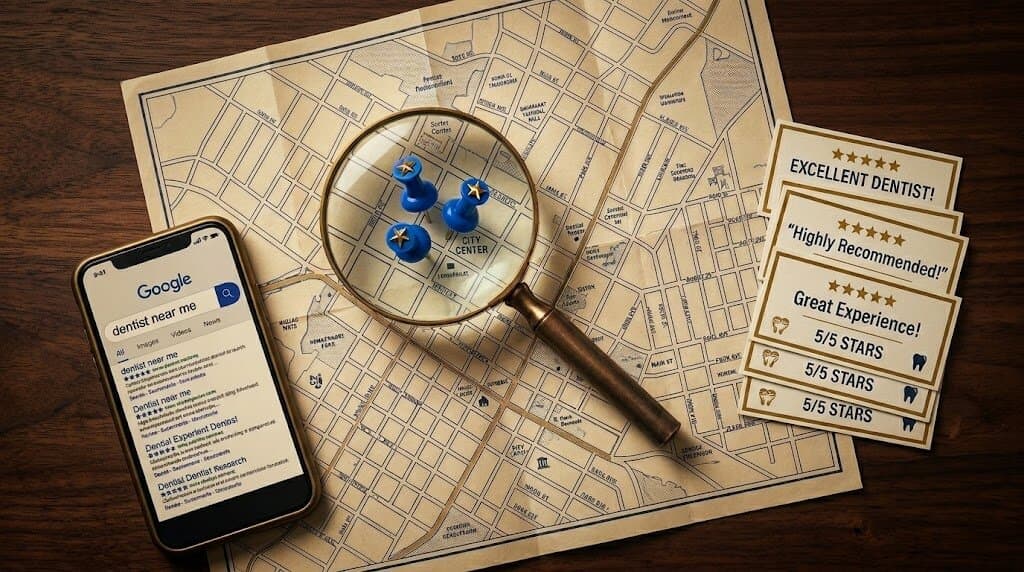
When a patient searches "dentist near me," the results page shows three sections: paid ads at the top, the Map Pack in the middle (three local listings with map, reviews, and phone numbers), and organic results below. For local dental searches, the Map Pack receives a disproportionate share of clicks because it shows the information patients need: reviews, distance, hours, and a one-tap call button. Practices that rank in the Map Pack but not in organic results still get patients. Practices that rank in organic but not the Map Pack often don't.
Want Your Practice in the Map Pack?
Our dental SEO service handles local rankings, Google Business Profile management, and citation building so you show up when patients search nearby.
Learn About Dental SEO →What Are the Ranking Factors That Control the Google Map Pack?
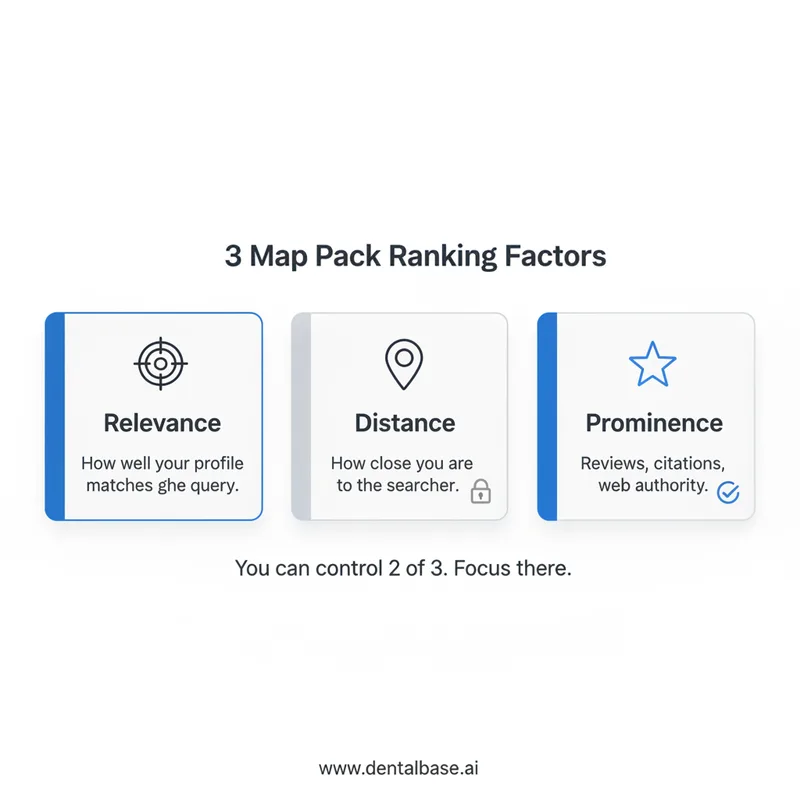
The three primary ranking factors for the Google Map Pack are relevance (how well your profile matches the search query), distance (how close your practice is to the searcher), and prominence (how well-known and trusted your practice is online based on reviews, citations, and web presence).
Google has confirmed these three factors publicly. You can't control distance, which is why a practice in downtown Chicago will never rank in the Map Pack for someone searching from a suburb 30 miles away. But you can control relevance and prominence, and that's where dental local SEO work happens.
Relevance: Matching Your Profile to Search Intent
Relevance comes from the information in your Google Business Profile. Your primary category (Dentist), secondary categories (Cosmetic Dentist, Pediatric Dentist, Emergency Dental Service), your service descriptions, and the keywords in your business description all signal to Google what searches your practice should appear for. A practice with "Dentist" as its only category will rank for fewer searches than one that also lists "Dental Implants Provider" and "Orthodontist" where applicable.
Prominence: Reviews, Citations, and Web Authority
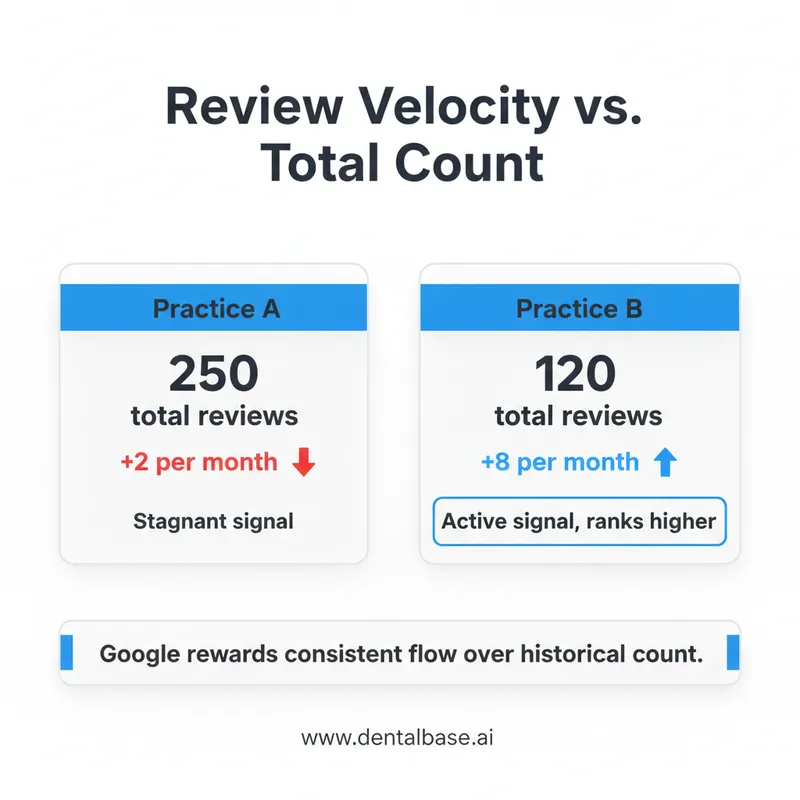
Prominence is where most dental local SEO effort goes. 77% of patients use online reviews when finding a dentist, per Software Advice data cited by BrightLocal. Google uses review count, review velocity (how many you get per month), average rating, and review recency as prominence signals. A practice with 200 reviews averaging 4.8 stars will outrank a practice with 30 reviews averaging 5.0 stars in most cases because volume signals ongoing patient trust.
Citations, mentions of your practice name, address, and phone number on other websites, also feed prominence. Dental directories like Healthgrades, Zocdoc, and Vitals, plus general directories like Yelp and the Better Business Bureau, all contribute. The key rule: your name, address, and phone number must be identical everywhere. A practice listed as "Smith Family Dentistry" on Google and "Smith Family Dental" on Yelp creates a consistency issue that weakens your local signal.
How Do You Optimize Your Google Business Profile for Local Rankings?
Optimizing your Google Business Profile (GBP) means completing every available field, adding fresh visual content regularly, posting weekly updates, and actively managing your review responses. GBP is the single most important asset for dental local SEO because it directly controls what patients see in the Map Pack.
Dental practices using Google Business Profile posts see 35% more website clicks, according to BrightLocal research. That's a significant traffic increase from a free channel. Yet most practices set up their GBP once and never touch it again.
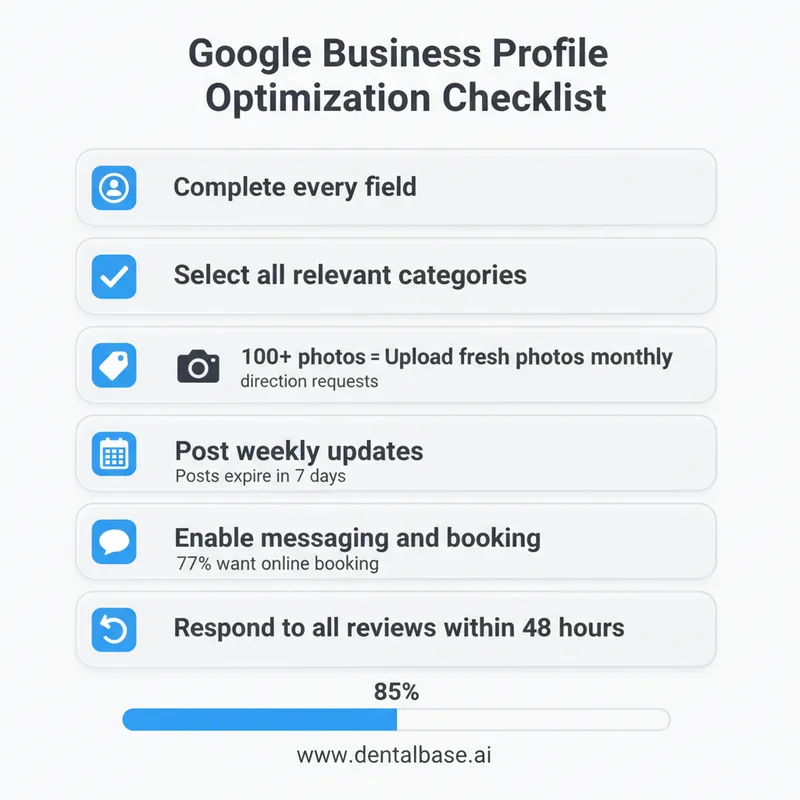
GBP Optimization Checklist
- Complete every field: Business name (exact legal name, no keyword stuffing), address, phone, website, hours (including special hours for holidays), services list with descriptions, insurance accepted, and appointment links. Google rewards complete profiles with better visibility.
- Select all relevant categories: Primary category should be "Dentist." Add secondary categories for every service you offer: Cosmetic Dentist, Pediatric Dentist, Emergency Dental Service, Dental Implants Provider, Orthodontist. Each category opens you up to additional search queries.
- Upload fresh photos monthly: Interior shots, team photos, equipment, and exterior photos. Google tracks photo upload frequency and freshness. Practices with 100+ photos get significantly more direction requests than those with fewer than 10.
- Post weekly GBP updates: Service highlights, seasonal promotions, new team members, or educational content. Posts expire after 7 days, so consistency matters. Each post is another relevance signal to Google.
- Enable messaging and booking: 77% of patients want online booking, per Zocdoc data cited by Dental Economics. Enabling the booking button in GBP removes friction for patients who want to schedule without calling.
Related: Want the full breakdown of SEO tactics beyond GBP? → Dental Marketing SEO: How to Rank Your Practice on Google
How Do Reviews and Reputation Drive Dental Local SEO?
Reviews are the most influential prominence signal for dental local SEO. Google uses review volume, velocity, rating, recency, and owner responses as ranking factors, and patients use them as the primary trust filter when choosing a dentist from the Map Pack.
The numbers are stark. 88% of people are likely to use a business if the owner responds to all reviews, according to BrightLocal. And 98% read local reviews before making a decision. For dental practices, reviews aren't just a ranking factor. They're the conversion factor. Two practices can sit side by side in the Map Pack, but the one with 180 reviews at 4.8 stars will get 3-4x more clicks than the one with 40 reviews at 4.6 stars.
Building a Review System That Compounds
- Ask after every positive appointment: The best time to request a review is immediately after treatment when the patient is happy. Send an automated SMS or email within 2 hours with a direct link to your Google review page. Don't ask patients to "find you on Google." Give them the one-tap link.
- Respond to every review within 48 hours: Positive reviews get a personalized thank-you. Negative reviews get a professional, empathetic response that takes the conversation offline. Google watches response rates and speed as engagement signals.
- Target 5-10 new reviews per month: Velocity matters more than total count for ranking. A practice that gets 8 reviews per month will outrank one with more total reviews but only 1-2 per month. Consistent flow signals an active, trusted business.
For a deeper dive into building a complete review strategy alongside your other dental marketing techniques, we cover the channel-by-channel approach separately. Social media also feeds local SEO by driving profile visits and engagement. Our guide on social media marketing for dentists covers how to use it effectively.
Your Phone Is Part of Your Local SEO
When patients find you in the Map Pack and call, 38% of those calls go unanswered. DentiVoice answers every call, books appointments, and captures the patients your local SEO worked to attract.
See How DentiVoice Works →What Technical Local SEO Fixes Do Most Dental Practices Miss?
Most dental practices miss three technical local SEO fixes: building location-specific service pages on their website, ensuring NAP (name, address, phone) consistency across all directories, and adding local business schema markup to their site. These are invisible to patients but visible to Google's ranking algorithm.
Location-Specific Service Pages
If you serve patients across multiple neighborhoods or cities, build a dedicated page for each. "Dental implants in [city]" as its own page ranks faster than a generic implant page because it matches the exact local search query. Each page should include the city name in the title, H1, and body text, your office address, a Google Maps embed, and at least 500 words of unique content about that service in that area. Don't just swap out city names on a template page. Google recognizes thin duplicate content and won't rank it.
NAP Consistency Across Directories
Your practice name, address, and phone number must be identical on Google Business Profile, your website, Yelp, Healthgrades, Zocdoc, Facebook, the Better Business Bureau, and every other directory where your practice appears. Even small variations ("Suite 200" vs "Ste 200" or "Street" vs "St.") weaken your local signal. Use a citation audit tool or manually check your top 20 listings quarterly. Fix inconsistencies immediately.
Local Business Schema Markup
Schema markup is structured code you add to your website that tells Google exactly what your business is: a dental practice, at this address, with these hours, offering these services, with this rating. Most dental websites don't have it, which means Google has to guess at this information from your page content. Adding LocalBusiness schema gives you a direct data line to Google's algorithm. It takes a developer 30 minutes to implement and has an outsized impact on local ranking signals.
Mobile performance matters too. Mobile accounts for 62% of all dental-related searches, per Google. A site that loads in 5 seconds on mobile loses patients before they ever see your content. Consumers expect websites to load in 3 seconds or less. Test your site speed at Google's PageSpeed Insights and fix anything that scores below 70.
Dental local SEO isn't a one-time project. It's an ongoing system. The practices that consistently rank in the Map Pack are the ones that post to GBP weekly, generate 5-10 reviews per month, keep their citations clean, and build location-specific content that matches how patients actually search. If you're spending money on Google Ads but not investing in local SEO, you're paying for visibility that organic rankings could deliver for free over time. Start with your Google Business Profile: complete every field, upload fresh photos, and set up an automated review request system. Those three actions alone move the needle faster than any technical fix. For a structured approach to combining local SEO with your other marketing channels, our guide on building a dental office marketing plan walks through the process. And if you're evaluating whether to handle local SEO in-house or hire help, see our breakdown of the best dental marketing companies.
Ready to Dominate Local Search?
DentalBase handles local SEO, Google Business Profile management, review generation, and PPC from one platform. See how it works for your practice.
Book a Free Demo →Explore more guides and tools for dental practice growth.
Browse Resources →Sources & References
Frequently Asked Questions
Most practices see initial Map Pack improvements within 2-4 months of consistent Google Business Profile optimization and active review generation. Significant ranking changes typically take 4-6 months. Practices in less competitive markets see faster results, while dense metro areas may take 6-12 months to break into the top three.
Google Business Profile completeness and review signals are the two most controllable ranking factors. Distance matters but you can't change your office location. Practices with fully optimized GBP profiles, 100-plus reviews, and consistent NAP across directories outrank competitors with better websites but neglected local profiles.
There's no fixed number, but practices with over 100 reviews and consistent monthly velocity of 5-10 new reviews typically outrank those with fewer. Focus on monthly velocity over total count. A practice getting 8 reviews per month will overtake a competitor with more total reviews but only 1-2 per month.
Yes. Dental practices that use GBP posts see 35% more website clicks according to BrightLocal research. Posts expire after 7 days, so weekly posting is needed to maintain the ranking signal. Service highlights, seasonal promotions, and educational content perform best for dental practices.
NAP stands for Name, Address, and Phone number. These three data points must be identical across your Google Business Profile, website, Yelp, Healthgrades, Facebook, and every other directory. Even small variations like 'Suite 200' versus 'Ste 200' weaken your local ranking signal in Google's algorithm.
You can handle GBP optimization, review generation, and basic citation management yourself with about 2-3 hours per week. Technical SEO work like schema markup, site speed optimization, and building location-specific service pages typically requires professional help or a dedicated dental marketing partner.
Was this article helpful?
Written by
DentalBase Team
Expert dental industry content from the DentalBase team. We provide insights on practice management, marketing, compliance, and growth strategies for dental professionals.