
Consultant Dental Marketing: Do You Need One? (2026 Guide)
When to hire a dental marketing consultant vs. an agency or platform. Costs, red flags, green flags, and when to skip the consultant entirely.
Share:
Table of contents
Hiring a consultant dental marketing professional sounds like the smart move when your practice is stuck. Production is flat, new patient numbers haven't budged in two quarters, and you're not sure whether the problem is your SEO, your ads, your website, or all three. A consultant promises clarity. But not every practice needs one, and the wrong hire can burn through $5,000-$15,000 with nothing to show for it.
The decision isn't really "should I hire a consultant?" It's "what kind of marketing help does my practice actually need right now?" A solo consultant, a full-service agency, and a marketing platform solve different problems at different price points. According to Dental Economics, the average cost to acquire a new dental patient through digital channels runs $150-$300. If you're spending above that and can't figure out why, outside help makes sense. If you're spending nothing and need a plan from scratch, the answer might be different.
This guide breaks down when a dental marketing consultant is worth the investment, when you're better off with an agency or platform, what to expect in terms of cost and deliverables, and how to avoid the most common mistakes practices make when hiring outside marketing help.
What Does a Dental Marketing Consultant Actually Do?
A dental marketing consultant audits your current marketing, identifies gaps and inefficiencies, and builds a strategic plan tailored to your practice's goals, budget, and competitive market. They advise. They don't typically execute.
That distinction matters more than most practice owners realize. A consultant might tell you that your Google Ads campaigns are targeting the wrong keywords, that your website loads too slowly for mobile users, or that you're spending $2,000 per month on social media management that generates zero trackable appointments. Good diagnosis. But then someone still has to fix it.
What a Consultant Typically Delivers
- Marketing audit: Review of your current channels, ad spend, SEO performance, website conversion rate, and patient acquisition cost. A thorough audit takes 2-4 weeks and should include competitive analysis of other practices in your zip code.
- Strategic plan: A 6-12 month roadmap with specific channel recommendations, budget allocation, and KPIs. The plan should answer "where should we spend, how much, and what should we expect to see by month 3, 6, and 12?"
- Vendor evaluation: If you need an agency, SEO company, or ad manager, a consultant can help you evaluate proposals and avoid overpaying. They know what realistic deliverables look like because they've seen dozens of vendor contracts.
- Ongoing advisory: Some consultants offer monthly check-ins to review performance data and adjust the strategy. This is where the real value compounds, because marketing conditions change faster than most practice owners can track.
What a consultant does not typically do: run your Google Ads, write your blog posts, manage your social media, or redesign your website. If you need execution, you need an agency or an in-house hire. For a full breakdown of how to evaluate agencies, see our guide on how to choose a dental marketing company.
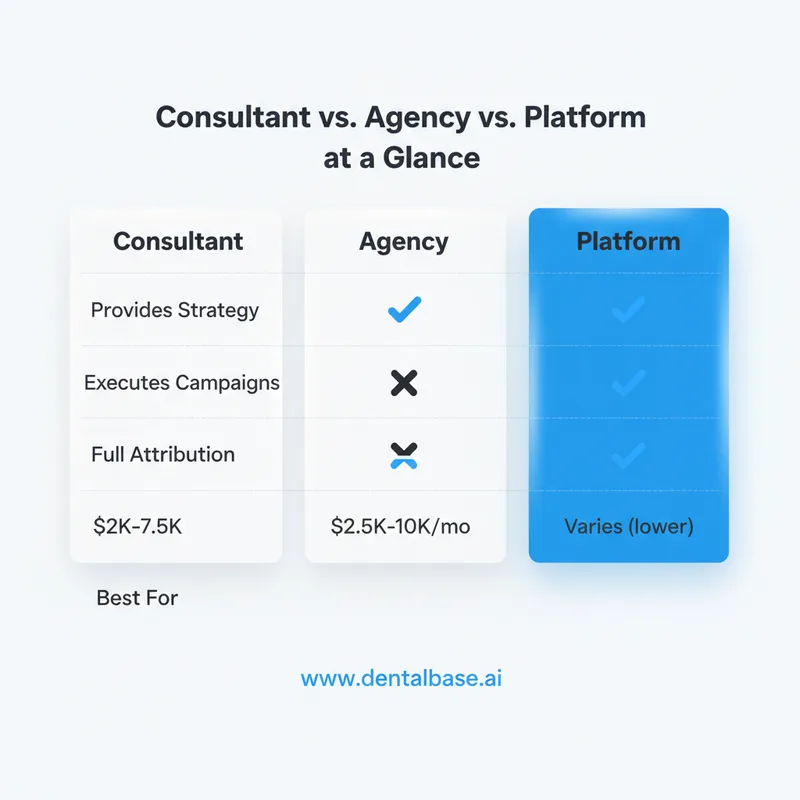
Consultant vs. Agency vs. Platform
Which type of marketing help fits your practice?
Marketing Consultant
Best for: Practices that have some marketing in place but don't know what's working or where to invest next.
Cost: $2,000-$7,500 for an audit + plan, or $500-$2,000/mo for ongoing advisory
You get: Strategy and diagnosis. You still need someone to execute.
Full-Service Agency
Best for: Practices that need both strategy and execution across multiple channels (SEO, PPC, social, website).
Cost: $2,500-$10,000+/mo depending on scope
You get: Strategy + execution + reporting. Less control, higher cost.
Marketing Platform (e.g. DentalBase)
Best for: Practices that want professional execution with transparent data and lower cost than a traditional agency.
Cost: Varies by services selected, typically less than agency retainers
You get: SEO, PPC, social, AI receptionist, and attribution in one place.
When Is Hiring a Consultant Dental Marketing Expert Worth It?
A dental marketing consultant is worth hiring when you're spending money on marketing but can't connect that spending to actual patient growth. If you know your numbers are off but don't know where the leak is, a consultant's audit is the fastest way to find it.
There are five situations where a consultant consistently delivers value:
- You're spending $3,000+ per month on marketing and can't tell what's working. If your agency sends you reports full of impressions and click-through rates but you don't know your cost per new patient, a consultant can cut through the noise and tell you whether your spend is productive or wasted.
- You're opening a new location or expanding services. A new office in a different zip code faces different competitors, different search volume, and different patient demographics. A consultant who knows dental markets can build a launch plan that avoids the expensive trial-and-error phase.
- You've been burned by a previous agency. Bad agency experiences are common in dental marketing. Research from BrightLocal and our own analysis for the best dental marketing companies guide show the most frequent complaints are vague reporting, no attribution to booked appointments, and long contracts with no performance guarantees. A consultant dental marketing specialist can help you evaluate what went wrong and what to look for next time.
- You're transitioning from an associate to a practice owner. Dental school teaches you dentistry, not marketing. A consultant who specializes in dental practices can compress years of marketing education into a 90-day strategic plan.
- Your patient mix needs to shift. Moving from insurance-heavy to fee-for-service, or from general dentistry to implants and cosmetic, requires different marketing. A consultant can rebuild your positioning, messaging, and channel strategy around the patient types you actually want to attract.
Not Sure Where Your Marketing Dollars Are Going?
DentalBase connects your ads, calls, and patient data so you can see which channels are producing real appointments, not just clicks.
Explore the Platform →How Much Does a Dental Marketing Consultant Cost?
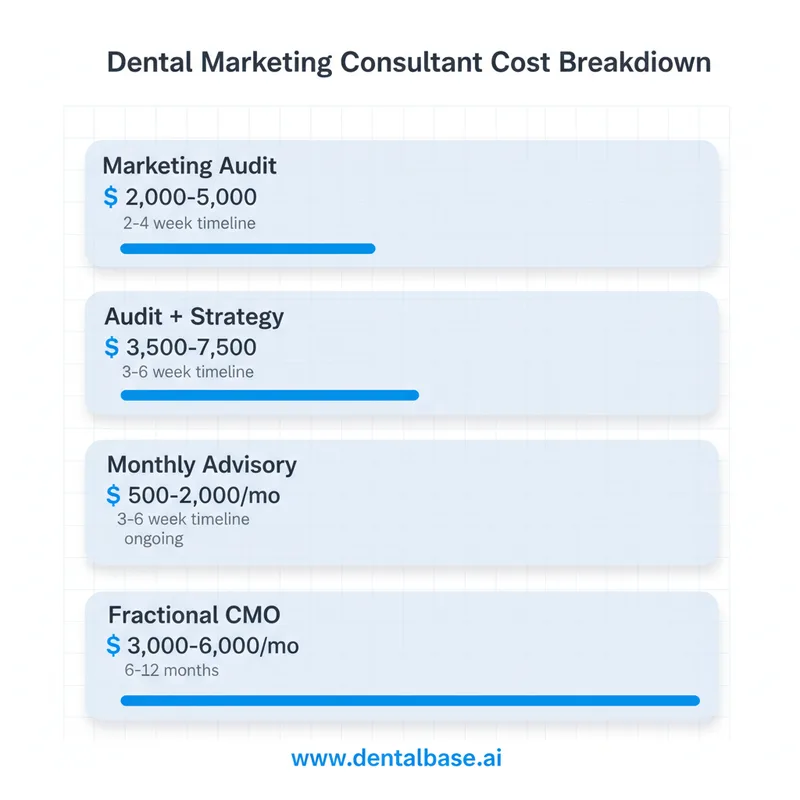
Dental marketing consultants typically charge $2,000-$7,500 for a one-time audit and strategic plan, or $500-$2,000 per month for ongoing advisory retainers. Costs vary based on the consultant's experience, your market size, and the scope of work.
Here's what the pricing landscape looks like in practice:
| Service Type | Typical Cost | What You Get | Timeline |
|---|---|---|---|
| Marketing Audit | $2,000-$5,000 | Full review of channels, spend, ROI, and competitive position | 2-4 weeks |
| Audit + Strategic Plan | $3,500-$7,500 | Audit plus 6-12 month roadmap with budget allocation and KPIs | 3-6 weeks |
| Monthly Advisory | $500-$2,000/mo | Ongoing performance reviews, strategy adjustments, vendor oversight | Ongoing |
| Fractional CMO | $3,000-$6,000/mo | Part-time marketing leadership, team management, strategy + execution oversight | 6-12 month engagement |
A common mistake is comparing consultant fees to agency fees without accounting for the difference in scope. A consultant charging $5,000 for an audit is selling diagnosis. An agency charging $5,000 per month is selling execution. According to WordStream's benchmarks, dental practices spend $6-$8 per click on Google Ads alone, so a consultant dental marketing engagement that optimizes your ad targeting can save multiples of its cost. They're not substitutes. Some practices need both. Some need neither.
Here's a useful benchmark: if a consultant's $5,000 audit identifies $2,000 per month in wasted ad spend, the engagement pays for itself in 2.5 months. If they find nothing actionable, you've learned that your marketing is already performing at its ceiling, and the growth problem is elsewhere, maybe case acceptance, scheduling efficiency, or dental marketing techniques that need a different approach.
What Red Flags Should You Watch for When Hiring?
The dental marketing consultant space has low barriers to entry, which means the quality range is wide. According to Moz, even basic SEO audits require technical expertise that many generalist consultants lack. Knowing the warning signs before you sign a contract protects your budget and your time.
Red Flags vs. Green Flags
What to look for (and avoid) when evaluating a dental marketing consultant
Red Flag
Guarantees specific patient numbers or revenue outcomes. Marketing has too many variables for anyone to guarantee results. Honest consultants set expectations, not promises.
Green Flag
Shows you a portfolio of past dental clients with measurable before-and-after data. Asks detailed questions about your current numbers before proposing anything.
Red Flag
Recommends a 12-month retainer before seeing your data. A consultant should be able to define scope after an initial discovery call, not lock you into a long commitment before understanding your situation.
Green Flag
Proposes a paid discovery phase (2-4 weeks) before committing to a longer engagement. Willing to define deliverables and exit terms clearly in writing.
Red Flag
No dental industry experience. General marketing consultants don't understand dental patient behavior, insurance dynamics, or the competitive structure of local dental markets.
Green Flag
Has worked with 10+ dental practices and understands metrics like production per new patient, case acceptance rates, and patient lifetime value ($12,000-$15,000 average for general dentistry).
One more signal to watch: how does the consultant talk about your existing team? A good consultant works with your office manager and front desk. A bad one talks over them. Your staff knows things about patient flow, phone volume, and scheduling bottlenecks that no outside advisor can learn from a spreadsheet.
Want Transparent Marketing Without the Consultant Price Tag?
DentalBase gives you SEO, PPC, social media management, and AI-powered patient communication with full attribution, so you always know what's driving appointments.
Book a Free Demo →When Should You Skip the Consultant and Go Straight to Execution?
You don't need a consultant dental marketing engagement if your marketing problem is simple and you already know what to do. If the issue is "we're not running Google Ads" or "we don't have an SEO strategy," you don't need someone to tell you that. You need someone to build it.
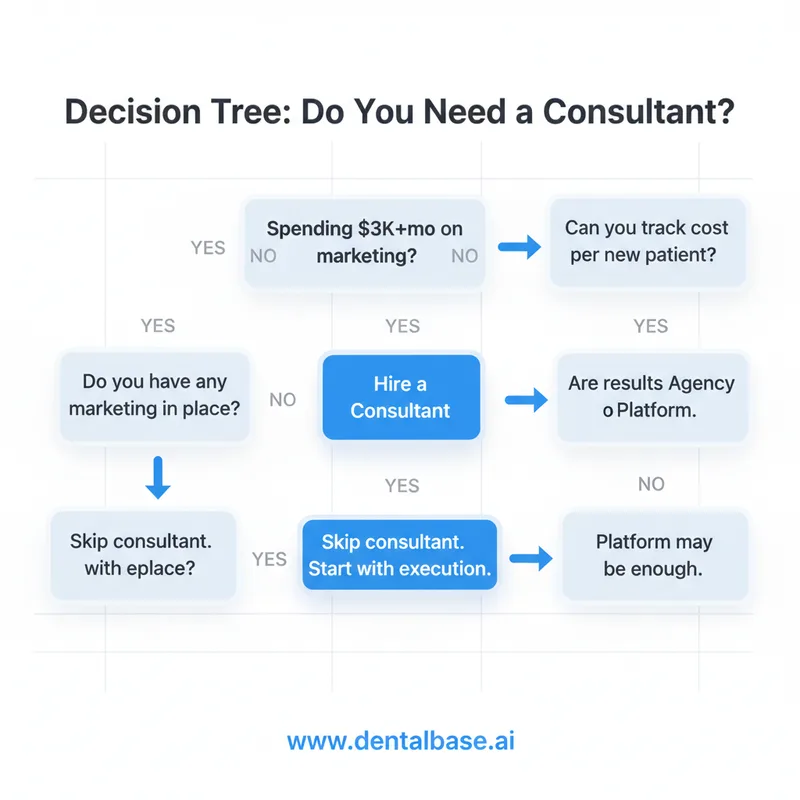
Skip the consultant and go directly to an agency or platform in these situations:
- You have no marketing in place at all. A practice with zero digital presence doesn't need an audit. It needs a dental office marketing plan and someone to execute it. Starting with a consultant adds a $3,000-$7,500 step that delays results by a month or more.
- Your budget is under $2,500 per month total. A consultant's retainer plus an agency's retainer plus ad spend doesn't fit in a small budget. At this level, put everything into execution: dental SEO, Google Ads, and automated patient communication.
- Your problems are operational, not strategic. If your phone rings 200 times a week and 38% of calls go unanswered (the national average, per ADA data), the fix is a better phone system or an AI receptionist, not a marketing consultant. A single missed new patient call costs $1,200+ in lifetime value.
- You just need better tools. Some practices don't have a strategy problem. They have a visibility problem. They can't see which marketing channels are producing booked appointments because their systems are disconnected. A platform that connects ads, calls, and patient data solves that without a consultant.
The honest truth: many practices that think they need a consultant actually need better execution of dental office marketing ideas they already know about. The strategy isn't complicated. Showing up in local search, running targeted ads, following up with patients, and asking for reviews. The execution is the hard part.
Related: Want to understand the full picture of how dental marketing channels work together? → Complete Guide to Dental Marketing
How Does a Marketing Platform Compare to a Consultant for Dental Practices?
A marketing platform gives you execution, data, and ongoing optimization without the overhead of a consultant retainer or a full-service agency contract. For practices that need both strategy and action, it's often the most efficient path.
The gap between what consultants deliver and what practices actually need has created a market for platforms that bundle marketing services with performance tracking. HubSpot research shows that businesses using integrated marketing platforms see higher ROI than those managing disconnected vendors. Instead of paying a consultant $5,000 to tell you your SEO is underperforming and then paying an agency $3,000 per month to fix it, a platform handles both under one roof.
What DentalBase Offers as an Alternative
DentalBase was built specifically for dental practices that want professional marketing without the fragmented vendor experience. Here's what the platform covers:
- Dental SEO: Local search optimization, Google Business Profile management, and content strategy that targets the keywords your ideal patients are searching. Practices working on dental marketing SEO see organic traffic compound month over month.
- Google Ads Management: Campaign setup, landing page creation, call tracking, and monthly optimization. The average dental landing page converts at about 10% when built correctly.
- Social Media Management: Content creation, scheduling, and engagement management across the platforms that matter for your practice. Video posts get 48% more engagement, so the focus is on content formats that build patient confidence.
- DentiVoice AI Receptionist: Automated call handling, appointment reminders, and patient reactivation. Captures the 38% of calls that go unanswered and the 27% of call volume that comes after hours.
- Marketing attribution: See which channels drive real appointments, not just traffic. Every ad dollar, every call, every form submission tracked back to the source.
The difference between a platform and a consultant is accountability. A consultant gives you a plan and walks away. A platform gives you the plan, runs it, and shows you the results every month.
Dental marketing doesn't have to mean choosing between expensive advice and blind execution. The practices that grow fastest are the ones that find the right level of help for their stage, whether that's a focused consultant engagement, a dental marketing agency, or a platform that does both. What matters is that you can see what's working, stop what isn't, and make decisions based on patient acquisition numbers, not gut feeling.
If you're spending $3,000 or more per month and can't connect that spend to booked appointments, start with an audit, either from a consultant or from a platform that includes diagnostic reporting. If you're spending less and just need to get started, skip the strategy phase and invest directly in dental marketing techniques that produce results at your budget level.
See What DentalBase Can Do for Your Practice
SEO, PPC, social media, and AI-powered patient communication, all in one platform with full marketing attribution. Book a free walkthrough.
Book a Free Demo →Explore more guides and tools for dental practice growth.
Browse Resources →Sources & References
Frequently Asked Questions
Dental marketing consultants typically charge $2,000-$5,000 for a marketing audit, $3,500-$7,500 for an audit plus strategic plan, or $500-$2,000 per month for ongoing advisory. Fractional CMO arrangements run $3,000-$6,000 per month for part-time marketing leadership over a practice's entire marketing function.
A consultant provides strategy, diagnosis, and recommendations but doesn't run your campaigns. An agency handles execution across channels like SEO, PPC, and social media. Some practices need both, while others benefit more from an integrated platform that bundles strategy, execution, and attribution tracking together.
Hire a consultant when you're spending $3,000 or more per month on marketing without clear results, opening a second location, recovering from a bad agency engagement, transitioning from associate to practice owner, or shifting your patient mix toward higher-value elective procedures.
Look for dental industry experience with at least 10 practice clients, willingness to start with a paid discovery phase before a long commitment, measurable before-and-after data from past engagements, and clearly defined deliverables with exit terms in writing. Avoid anyone who guarantees specific patient numbers.
In many cases, yes. An integrated platform like DentalBase provides dental SEO, Google Ads management, social media, and AI-powered patient communication with built-in attribution tracking. This combines the strategic insight a consultant delivers with the hands-on execution an agency provides, often at lower total cost.
Key warning signs include not knowing your cost per new patient, more than 30% of inbound calls going unanswered, fewer than 50 Google reviews, your practice not appearing in the local map pack for key searches, or new patient acquisition numbers staying flat for two or more quarters.
Was this article helpful?
Written by
DentalBase Team
Expert dental industry content from the DentalBase team. We provide insights on practice management, marketing, compliance, and growth strategies for dental professionals.