
Dental Patient Retention Marketing: Strategies That Work (2026)
Learn dental patient retention marketing strategies that keep chairs full. Covers email, SMS, social media, reactivation, and recall tactics for 2026.
Share:
Table of contents
Your practice spent $40,000 on Google Ads last year and brought in 200 new patients. Good return, right? Maybe not. If 20-30% of your existing patients went inactive during that same period, you didn't grow your practice. You replaced the patients you lost. That's the treadmill most dental offices are running on without realizing it, and dental patient retention marketing is the strategy that gets you off it.
The math is straightforward. According to Dental Economics, the average patient lifetime value for a general dentist falls between $12,000 and $15,000. Lose 10 patients a month and you're watching $120,000-$150,000 in future revenue walk out the door every single month. This article breaks down the specific channels, systems, and tactics that keep your patients coming back, and why patient retention deserves as much budget and attention as acquisition.
Why Does Dental Patient Retention Marketing Matter More Than Acquisition?
Dental patient retention marketing matters more than acquisition because keeping an existing patient costs 5-7x less than finding a new one, and retained patients accept more treatment, refer more friends, and generate predictable recurring revenue.
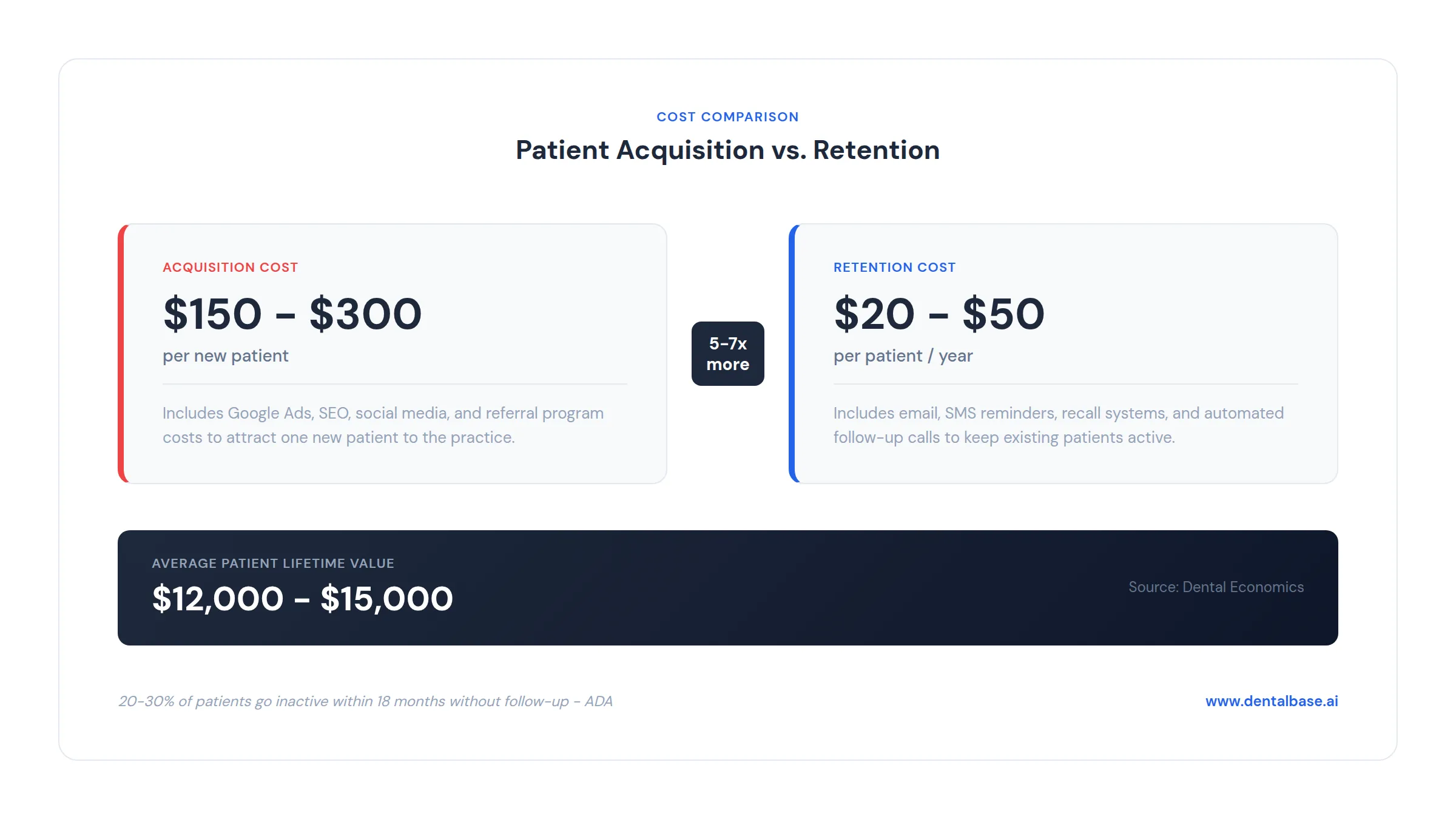
Here's a scenario most practice owners will recognize. A three-provider office spends $3,500 per month on paid ads, $1,500 on SEO, and another $800 on social media management. That's $5,800 per month going toward new patient acquisition. Meanwhile, the practice has no automated recall system, sends no post-treatment follow-ups, and doesn't track which patients haven't been in for 12 months. The ADA reports that 20-30% of patients become inactive within 18 months without follow-up. For a practice with 2,000 active patients, that's 400-600 people drifting away every year and a half.
The acquisition budget fills some of those seats. But it doesn't build a larger patient base. It just maintains the current one at a much higher cost per patient. Practices with structured follow-up programs retain 15% more patients annually, according to PatientPop. Retention isn't a soft metric. It's the difference between a practice that grows and one that just stays busy.
Related: Want to know exactly where your retention rate stands? → How to Measure Your Dental Patient Retention Rate (2026)
What Are the Core Channels for Patient Retention Marketing?
The core channels for dental patient retention marketing are email, SMS, automated phone follow-ups, social media, and direct mail. Each channel serves a different purpose in the patient lifecycle, and the most effective practices use three or more in combination.
Not every channel works the same way. SMS is fast and gets read within minutes, which makes it ideal for appointment reminders and same-day confirmations. Email works better for educational content, post-treatment instructions, and monthly newsletters that keep your practice top-of-mind. Automated phone calls, especially AI-powered follow-up systems, are the strongest channel for reactivating lapsed patients because they create a two-way conversation. Social media builds familiarity over time but rarely drives direct bookings on its own.
Here's how the channels compare:
| Channel | Monthly Cost | Best Use Case | Response Speed |
|---|---|---|---|
| SMS | $50-$150 | Appointment reminders, confirmations | Minutes |
| $30-$100 | Education, newsletters, post-treatment | Hours to days | |
| AI Phone Follow-Up | $200-$500 | Reactivation, recall, rescheduling | Real-time |
| Social Media | $300-$800 | Brand awareness, trust-building | Passive/ongoing |
| Direct Mail | $500-$1,500 | Reactivation postcards, seasonal promos | Days to weeks |
The takeaway isn't to pick one. It's to layer them. A patient who receives an SMS reminder, sees your Instagram post about preventive care, and gets a recall email at the 6-month mark is far more likely to book than one who gets a single postcard.
Related: Need scripts and sequences for patients who've gone quiet? → Dental Patient Reactivation Campaigns: What to Say
How Should You Build a Dental Recall Marketing System?
A dental recall marketing system should follow a structured cadence of automated messages at 30, 60, and 90 days before a patient's next recommended visit, with escalating urgency and channel switching at each stage.
Most practices have some version of a recall system. Usually it's a single postcard or a phone call from the front desk when the schedule looks thin. That's not a system. A real recall marketing program is automated, multi-channel, and triggered by the patient's last visit date, not by your front desk's availability.
A Practical Recall Cadence
Start with an email at the 5-month mark for patients on a 6-month hygiene cycle. The tone should be educational, not salesy. Something like: "It's been a few months since your last cleaning. Here's why staying on schedule matters for long-term oral health." If the patient doesn't respond within two weeks, send an SMS. Keep it short: "Hi [Name], you're due for your cleaning at [Practice]. Tap here to book: [link]." Still no response at the 7-month mark? That's when an automated follow-up call makes the biggest difference.
The Journal of Dental Hygiene found that SMS appointment reminders reduce no-show rates by 38%. But that number only applies when the messages are timely and personalized. Generic "you're overdue" blasts get ignored. Mention the patient's name, their last procedure, and give them a one-tap way to schedule. Automated recall systems increase patient return rates by 25-40%, according to Dental Economics.
Automate Your Recall and Follow-Up Calls
DentiVoice places AI-powered outbound calls for recall reminders, missed appointment follow-ups, and patient reactivation, so your front desk can focus on patients in the office.
Learn About DentiVoice →Can Email Marketing Improve Dental Patient Retention?
Yes. Email marketing is one of the most cost-effective dental patient retention marketing channels, returning $44 for every $1 spent according to the DMA, with welcome emails averaging an 82% open rate.
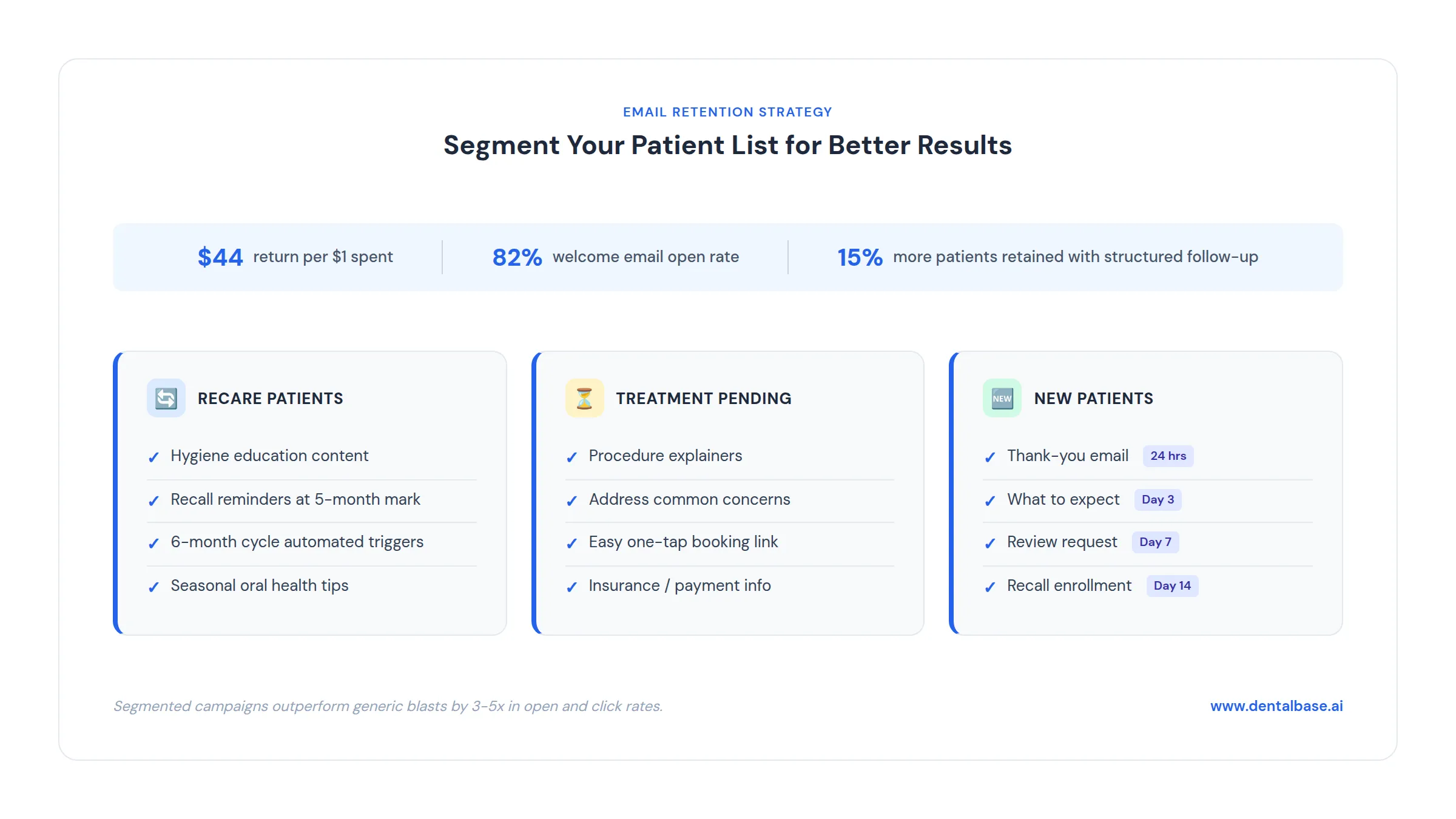
But there's a gap between "we send emails" and "we have an email retention strategy." Most dental practices send the same quarterly newsletter to every patient on their list. A 60-year-old patient with a crown history and a 25-year-old who came in for a cleaning don't need the same message. Segmentation is where email retention actually works. Closing it starts with our nine dental email templates by patient stage.
Segments That Drive Results
Break your patient list into groups that match their clinical and behavioral profile. Recare patients (cleanings only, no pending treatment) should receive hygiene education and recall reminders. Treatment-pending patients who received a diagnosis but haven't scheduled should get follow-ups explaining the procedure, addressing common concerns, and making it easy to book. New patients who completed their first visit should enter a welcome sequence: a thank-you email within 24 hours, a "what to expect" email at day 3, and a review request at day 7.
Post-treatment follow-ups are underused and high-impact. A patient who just had a root canal and receives an email the next morning with aftercare instructions feels cared for. That's a patient who returns for the crown. That's a patient who tells a friend. According to BrightLocal, 88% of people are likely to use a business if the owner responds to all reviews. The same principle applies to proactive communication: patients who feel seen stay longer. A structured patient survey program helps you identify which parts of the experience resonate and which ones need work, giving your segmentation real data to build on.
One more thing. Don't ignore your subject lines. "Time for your dental checkup!" has been sent by every practice with an email tool since 2012. Try something specific: "Your cleaning is 3 weeks out, [Name]. Here's your quick-book link." Specific beats generic every time.
How Does Social Media Support Patient Retention in Dental Practices?
Social media supports dental patient retention by keeping your practice visible between appointments, building trust through educational content, and reinforcing the patient-practice relationship without asking for anything in return.
Let's be clear about what social media doesn't do for retention. It doesn't replace your recall system. It doesn't send appointment reminders. And it rarely drives direct bookings from existing patients. What it does is keep your practice in the patient's mental space during the 5-6 months between visits. That matters. When a patient sees your post about why flossing prevents gum disease, they're reminded that your practice exists, that you care about education, and that they should probably schedule that cleaning they've been putting off.
According to PwC, 41% of people say social media content impacts their healthcare treatment decisions. For retention, the content strategy is different from acquisition. You're not trying to convince strangers you're a good dentist. You're trying to stay relevant to people who already know you are.
Content That Retains Patients
Educational posts work well: "3 signs your old filling needs replacing" or "What your bleeding gums are actually telling you." Behind-the-scenes content builds familiarity. A short video of your team prepping for the day, a staff birthday celebration, or a quick tour of new equipment makes patients feel connected to your office. Patient spotlights (with consent) create social proof and make the featured patient feel valued, which is a retention play in itself.
Avoid the trap of only posting promotions. A feed full of "20% off whitening this month!" teaches patients to wait for deals instead of booking at regular intervals. Keep your promotional posts to one out of every five, and make the rest educational, personal, or community-focused. For a deeper look at building a social media strategy for your practice, we've covered the full approach separately.
Need Help With Your Social Media and Retention Marketing?
DentalBase manages social media, email campaigns, and AI-powered follow-ups for dental practices. See how it all works together.
Explore Our Services →What Mistakes Kill Dental Patient Retention Campaigns?
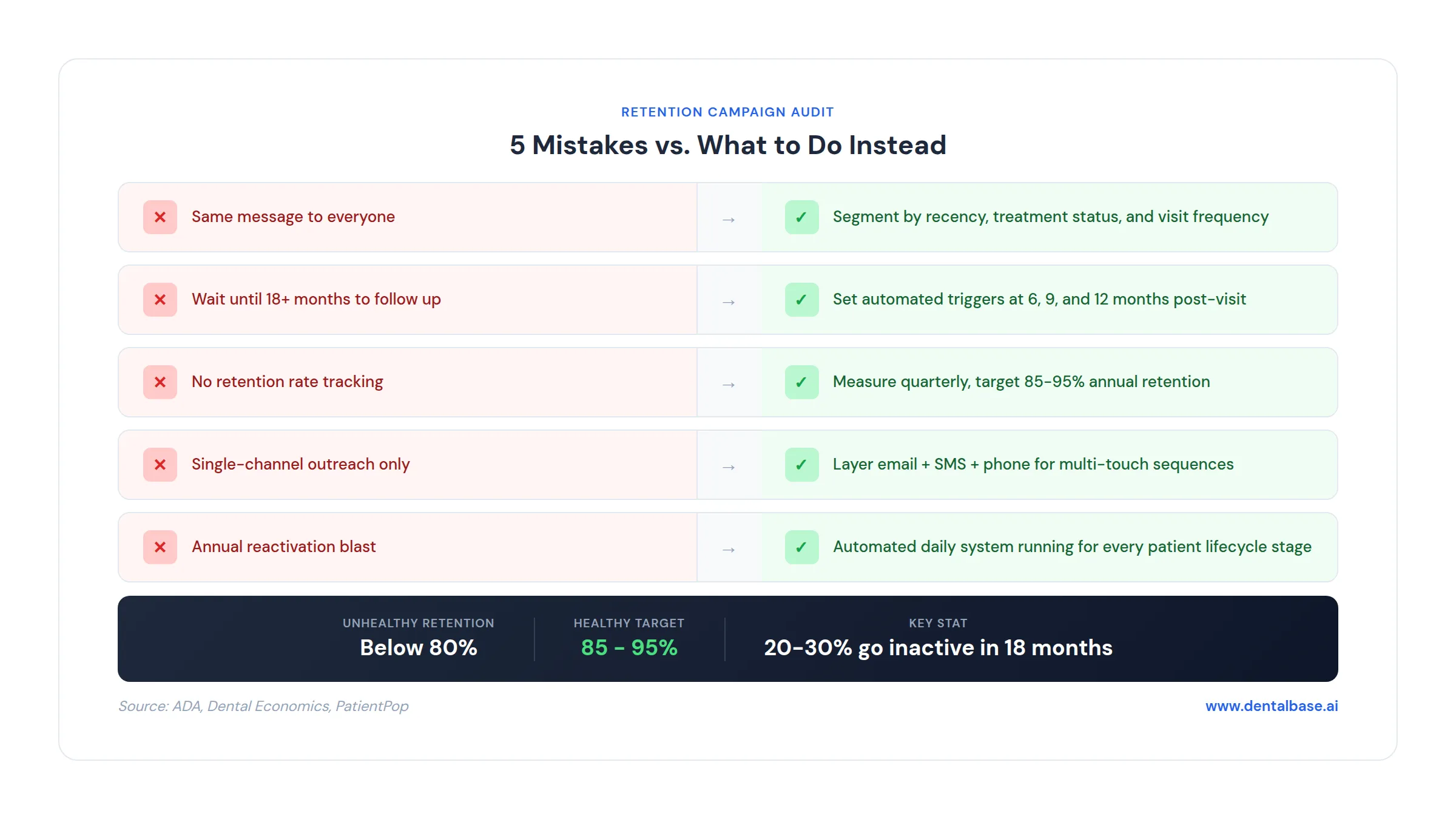
The biggest mistakes that kill dental patient retention campaigns are generic messaging, no segmentation, ignoring lapsed patients until they're gone, and failing to measure retention rate as a KPI.
Here's the thing. Most practices don't have a retention problem because they're doing the wrong things. They have a retention problem because they're not doing anything at all. The front desk is too busy to make recall calls. Nobody owns the email list. The "reactivation campaign" is a stack of postcards that went out once in 2024.
Five Mistakes and How to Fix Them
- Sending the same message to everyone. A patient who visited last month and a patient who hasn't been in for 14 months need completely different messages. Segment by recency, treatment status, and visit frequency. One-size-fits-all emails get one-size-fits-all results: mediocre.
- Waiting too long to follow up. The window for reactivating a lapsed patient shrinks fast after 12 months. By 18 months, the ADA data shows they're likely gone for good. Set triggers at 6, 9, and 12 months post-last-visit.
- Not tracking retention rate. If you don't measure it, you can't improve it. Calculate your retention rate quarterly. A healthy practice sits between 85-95% annual retention.
- Relying on one channel. An SMS-only strategy misses patients who don't text back. An email-only strategy misses patients who don't open emails. Layer your channels: email first, SMS second, phone call third. A multi-touch approach consistently outperforms single-channel outreach.
- Treating retention as a one-time project. Running a "reactivation blast" once a year isn't retention marketing. It's damage control. Real dental patient retention marketing runs automatically in the background, every day, for every patient at every stage of their lifecycle.
Practices that avoid these five mistakes and build systems instead of running campaigns see measurably different results. It's not about working harder. It's about having the infrastructure in place so retention happens whether your front desk remembers or not.
Reduce No-Shows and Keep Patients on Schedule
Practices with online scheduling see 24% fewer no-shows. See how DentalBase connects your scheduling, reminders, and follow-ups into one workflow.
Book a Free Demo →Dental patient retention marketing isn't a campaign you run once. It's an operating system for your patient relationships. The practice that automates recall, segments its email list, stays visible on social media, and follows up by phone when patients go quiet is the practice that grows its patient base every year instead of just replacing the patients it lost. And the gap between those two outcomes compounds over time.
Start with one action this week. Pull a list of every patient who hasn't visited in 12 months or more. Count them. That number is your retention gap, and it's the clearest indicator of how much revenue you're leaving on the table. Then build the system to close it. If you don't have the infrastructure in place to run automated recall, follow-up sequences, and multi-channel outreach, that's the first problem to solve.
Ready to Build a Retention System That Runs Itself?
DentalBase combines AI follow-ups, recall automation, and full-service marketing into one platform. See how it works for your practice.
Book a Free Demo →Explore More Guides and Tools for Dental Practice Growth
Browse Resources →Sources & References
Frequently Asked Questions
Retaining an existing dental patient costs roughly $20-$50 per year through email, SMS, and recall systems. Acquiring a new patient through advertising typically costs $150-$300. That 5-7x gap makes retention marketing one of the most efficient investments a practice can make.
A healthy dental patient retention rate falls between 85% and 95% annually. Practices below 80% are likely losing revenue faster than marketing can replace it. Track your retention rate quarterly by comparing active patients to your total patient base over the previous 18 months.
Most practices see strong results with one to two emails per month, not counting automated recall and appointment reminders. Over-emailing leads to unsubscribes. Focus on value: educational content, seasonal reminders, and post-treatment follow-ups perform better than promotional blasts.
Yes. SMS appointment reminders reduce no-show rates by 38%, according to the Journal of Dental Hygiene. Two-message sequences work well: one reminder 48 hours before the appointment and a second the morning of. Include a one-tap confirm or reschedule link.
A multi-touch sequence works best: start with a personalized email, follow up with an SMS after five days, and place an automated phone call at the two-week mark. Practices using AI-powered outbound calls for reactivation report 25-40% higher return rates than single-channel outreach.
Yes, but for awareness, not direct scheduling. Social media keeps your practice visible between visits. Educational posts, behind-the-scenes content, and patient spotlights build familiarity. 41% of people say social media content influences their healthcare decisions, according to PwC.
Acquisition marketing targets strangers through SEO, ads, and referral programs. Retention marketing targets people who already trust you through recall reminders, follow-up messages, and ongoing engagement. Retention campaigns are cheaper, convert at higher rates, and protect your existing revenue base.
Was this article helpful?
Written by
DentalBase Team
Expert dental industry content from the DentalBase team. We provide insights on practice management, marketing, compliance, and growth strategies for dental professionals.