Dental Recall Messages: Scripts, Texts, and Letters (2026)
Dental recall messages that get patients to book: phone scripts, text and email templates, a recall letter, and answers to common objections.
Share:
Table of contents
Dental recall messages are the texts, calls, and letters that bring due and overdue patients back to your schedule. The best ones match the patient's stage: a friendly text before the due date, a short call after it passes, and a letter when nothing else has worked. This guide gives you the wording for each, plus the timing behind it.
It's written for the person who sends them. For the full system around the messages, see our guide to a dental patient recall system. If you'd rather hand the outreach off, DentalBase's services include an AI receptionist that makes recall calls.
What Are Dental Recall Messages, and Which One Goes Out When?
Dental recall messages are the reminders you send patients who are due or overdue for hygiene and follow-up care. Each stage gets a different channel and tone: texts before the due date, calls once it passes, and a letter as the last attempt. The timeline below shows the full sequence.
| Timing | Channel | Message focus |
|---|---|---|
| 4-6 weeks before due | Text + email | Friendly reminder with a booking link |
| 2 weeks before due | Text | Two or three real time slots to pick from |
| Due date, no booking | Phone call | Short call that offers two times |
| 2 weeks overdue | Call + text | Mention the time since the last visit |
| 6 weeks overdue | Letter or call | Final attempt before reactivation |
Personalization at every step matters. "Hi Sarah, your 6-month cleaning with Dr. Martinez is due. We have Tuesday at 10 or Thursday at 2" beats "You're due for a cleaning. Call to schedule." Use the name, the provider, and real openings. Every recall save also protects the true production value of that hour, and orthodontic offices run their own version for retainer checks after debond.
Match the message to the patient, not just the date. A patient with a hygiene visit due next month needs a nudge. One who skipped two reminders needs a person. And one who hasn't been in for a year needs a different conversation entirely.
What Should a Dental Recall Text Say?
A good dental recall text is short, names the patient and provider, offers a real time slot, and includes a booking link. It should read like a note from the hygienist, not a form letter, and it should never include clinical details or protected health information.
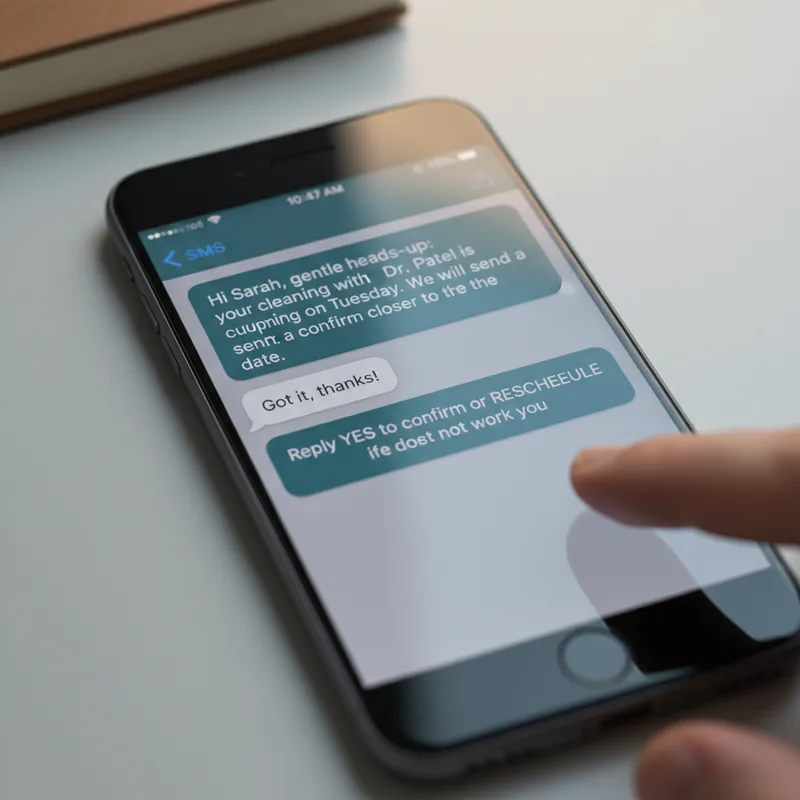
Here are three samples you can copy and adapt:
- Before the due date: "Hi Sarah, it's Dr. Martinez's office. Your 6-month cleaning is coming up. We have Tuesday at 10 or Thursday at 2. Book here: [link]. Reply STOP to opt out."
- On the due date: "Hi Sarah, your cleaning is due this week. We still have Thursday at 2. Want us to hold it? Book here: [link]. Reply STOP to opt out."
- Overdue: "Hi Sarah, it's been seven months since your last visit and we'd love to see you. We have Tuesday at 10 or Wednesday at 3. Book here: [link]. Reply STOP to opt out."
A few rules keep these working:
- Offer one or two real time slots, not a vague invitation.
- Make one ask and include one link.
- Leave out procedure names, so nothing sensitive shows on a lock screen.
- End every text with an opt-out line.
What About Recall Emails?
Emails can carry more detail than texts, but the same rules apply: one ask, one link, real openings. Keep the subject line specific, such as "Sarah, your cleaning with Dr. Martinez is due" or "We saved Thursday at 2 for you." Open with the patient's name, offer two time slots, and put the booking button near the top. Aim for a note, not a newsletter.
Texts aren't the whole story, though. A 2011 JADA-reported trial in a pediatric dental clinic found fewer no-shows with voice reminders (8.2%) than texts (17.7%). Pair the two, and see recall calls versus SMS for how. For longer messages, start from these dental email templates.
How Do You Call Patients for Recall?
Keep a recall call under a minute: say who you are, name the gap since the last visit, and offer two specific times. Skip the long script and the list of services. A returning patient needs a reason to come back now and an easy way to book.
- Open with your name, the practice, and the patient's name.
- Name the gap: "We haven't seen you in seven months."
- Offer two times: "I have Tuesday morning or Wednesday afternoon. Which works better?"
- If they hesitate, ask one question: "Is it timing, cost, or something else?"
- Confirm the slot, then repeat the day and time back.
If you reach voicemail, keep it under 20 seconds: your name, the practice, one time you're holding, and a direct number or booking link. Leave out clinical details. These calls also differ from your new patient phone script, because a returning patient doesn't need your address or a services list.
Vary the time of day on each try: if the first call is at 2 p.m., try early evening next. Hand the call to a clinician or the office manager if the patient mentions pain, a complaint, or a billing dispute. At that point it's no longer a recall call.
Let AI handle your recall calls.
DentiVoice makes outbound recall calls that sound like a real conversation. It checks availability, books into your PMS, and follows up with patients your front desk doesn't have time to reach.
See How DentiVoice Works →What Should a Dental Recall Letter Say?
A dental recall letter should fit on one page: a personal opening, the date of the last visit, one clear ask, and a way to book by phone or online. Send it as the final attempt after texts and calls fail, or to patients who rarely answer their phones.
Sample recall letter
Dear Sarah, it has been seven months since your last visit with Dr. Martinez, and we'd like to get you back on schedule. A cleaning takes about an hour, and we have openings next week. Call us at [phone] or book online at [link]. We hope to see you soon. [Name], [Practice]
Sign it by hand so it feels personal, and log the mailing date. Follow with a call about a week later, since a letter alone rarely closes the loop. Like any recall outreach, it should sound warm and free of blame.
Letters work best for three groups: patients with no mobile number on file, patients who haven't answered four contacts, and anyone you know prefers mail. Put the phone number in a size people can read at a glance.
What Do You Say to Overdue Patients?
Say less and offer more: acknowledge the gap without blame, give two real times, and make booking effortless. Start before the due date when you can. A reminder to book feels helpful, while a call about a lapse feels like a guilt trip.
Overdue doesn't mean lost. ADA policy treats a patient as inactive only after 24 months without service, and the ADA's 2024 Communications Trend Report found that 36% of consumers had not visited a dentist in two years, with cost the top reason. A Dental Economics attrition guide counts patients as active on a rolling 18-month window. A patient two to six weeks overdue is a routine call, not a cold one.
Expect them to look you up first. BrightLocal's 2026 survey found that 97% of consumers read reviews for local businesses. For patients gone six to twelve months or more, switch scripts: how to open a reactivation call by lapse window shows how the opener changes.
For a call at six weeks overdue, soften the opener and lead with availability: "Hi Sarah, it's Maria from Dr. Martinez's office. I know life gets busy. I'm holding a couple of cleaning slots next week and thought of you. Would Tuesday at 10 or Thursday at 2 help?"
How Do You Answer Common Objections?
Answer objections by acknowledging the concern and offering a specific next step, not by repeating the reminder. Cost, anxiety, time, and "I'll call you" cover most pushback. The table gives a short reply for each that keeps the conversation moving toward a booked time.
| Patient says | What to say |
|---|---|
| "It's too expensive." | "Fair enough. Let me check your coverage first, and we can talk through options before you commit." |
| "I'm nervous about going." | "A lot of patients feel that way. Would a quiet morning slot help? We'll go at your pace." |
| "I'm too busy." | "I can hold an early morning or a lunch slot. Would 7:30 on Thursday work?" |
| "I'll call you." | "Happy to. So you don't have to remember, I can pencil in Tuesday at 10, and you can cancel anytime." |
Patients who book and then disappear need a different message, and the no-show follow-up script covers what to say in the first 24 hours.
Related: Recall no-shows undo good messaging. See how to reduce hygiene recall no-shows in your practice →
How Do You Know Your Dental Recall Messages Are Working?
Track bookings per message type, not just messages sent. Working dental recall messages shrink your overdue list each month and get patients scheduled within two weeks of first contact. If those numbers stall, change the wording or the timing before you add volume.

| Metric | Target | Red flag |
|---|---|---|
| Bookings per message type | Rising for text, call, and letter | One channel books almost nothing |
| Overdue patient count | Shrinking month over month | Growing 5% or more a month |
| Days from first outreach to booking | Under 14 | Over 30 |
Pull these from your PMS recall report each month and set your own baseline before chasing a target. The recall system guide linked above covers the weekly routine, and how to measure and improve patient retention shows what the numbers mean for the whole practice.
Change one thing at a time. If you swap the wording and the send time in the same week, you won't know which one moved the numbers. Run each version for at least a month before you judge it.
Where Does AI Fit in Recall Messaging?
AI fits the volume work: first-touch texts, outbound recall calls, and after-hours replies. Staff should handle patients who raise cost, fear, or a complaint. That split keeps your dental recall messages consistent without adding hours to a front desk that's already stretched thin.
Capacity is the real constraint. Dental Economics works through a 35% miss rate on 300 to 500 calls a month: 105 to 175 unanswered calls, with a patient's lifetime value at $8,000 to $10,000 or more. Piling outbound recall calls on that desk moves the problem. See when AI recall calls beat a human caller, or compare recall software options.
Recall Message Checklist
Check each item you have in place.
Your score: count your checks out of 8. Six or more means your messages are structured. Under four means patients are slipping through.
Stop losing patients between visits.
DentalBase automates recall outreach, tracks overdue patients, and books appointments through AI-powered calls and texts.
Book a Free Demo →More guides on patient retention and practice operations.
Browse Resources →Sources & References
Frequently Asked Questions
Dental recall messages should name the patient and provider, say a visit is due, offer one or two real time slots, and include a booking link. Keep them short, leave out clinical details, and end every text with an opt-out line. Specific beats generic every time.
A good recall script runs under a minute: say who's calling, name the gap since the last visit, offer two specific times, and confirm the one the patient picks. If they hesitate, ask what's in the way, then solve that one problem before you close.
Send a text and email four to six weeks before the due date, a second text two weeks before, a call on the due date, and a call plus text at two weeks overdue. Make a final attempt at six weeks, then move the patient to reactivation.
Use all three, in order. Texts and emails work before the due date because they're quick to answer. A call works better once a patient is overdue, since you can hear the hesitation. One pediatric dental trial found voice reminders beat texts for attendance.
Include the date of the last visit, a personal opening, one clear ask, and both a phone number and a booking link. Keep it to a single page, sign it by hand, and mail it as the final attempt before the patient moves to reactivation.
Offer to hold a specific time so they don't have to remember: "I'll pencil in Tuesday at 10, and you can cancel anytime." Then log a follow-up for the next week. That reply is usually a polite delay, not a refusal, so keep the door open.
Yes. AI can send first-touch texts, make outbound recall calls, book into your practice management system, and answer replies after hours. Keep staff on patients who raise cost, anxiety, or complaints, and confirm the vendor signs a business associate agreement before it touches patient data.
Recall targets patients who are due or recently overdue for hygiene and follow-up care. Reactivation targets patients who have lapsed for six months or more and need a different script. Both use messages, but reactivation needs a softer opener and more personal outreach.
Was this article helpful?
Written by
DentalBase Team
Expert dental industry content from the DentalBase team. We provide insights on practice management, marketing, compliance, and growth strategies for dental professionals.