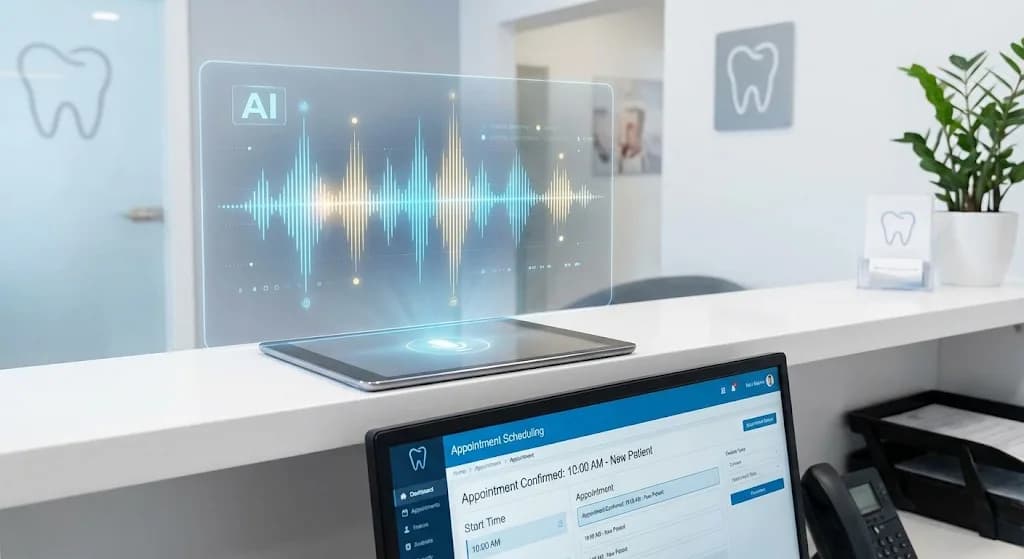
AI Receptionist Accent Understanding for Dental Practices
Discover how AI receptionist accent understanding dental technology manages diverse speech patterns, dialects, and difficult callers at your practice.
Share:
Table of contents
AI receptionist accent understanding dental technology is something most practice owners don't think about until a patient hangs up in frustration. Your front desk already struggles with call volume. According to ADA Practice Transitions, 38% of new patient calls go unanswered during business hours. Now add a language barrier or heavy regional accent to the mix, and the problem gets worse fast.
This guide breaks down how modern AI voice recognition handles accents, dialects, and callers who are upset, confused, or hard to understand. You'll learn what actually works, where the technology still falls short, and how to evaluate whether an AI phone system can serve your patient population.
How Does AI Voice Recognition Process Dental Patient Accents?
AI voice recognition systems process accents by comparing incoming speech against millions of audio samples that include regional, ethnic, and non-native English speech patterns. The technology doesn't hear words the way humans do. It converts sound waves into probability maps and matches them against trained models that account for vowel shifts, consonant dropping, and cadence variation.
That's a big deal for dental practices in diverse metro areas. A five-provider practice in Houston might field calls from native Spanish speakers, Vietnamese speakers, and callers with Southern American English accents, all before lunch. Older speech-to-text systems trained primarily on broadcast English would fail on at least a third of these calls. Newer models from major cloud providers train on datasets spanning dozens of English dialects and over 100 languages.
The dental context adds another layer. Callers say things like "I need my Invisalign retainer adjusted" or "my temporary crown came off." These aren't common phrases in general speech models. DentiVoice AI Receptionist and similar dental-specific systems supplement general speech models with vocabulary trained on dental workflows, procedure names, and insurance terminology. Without that dental layer, even good accent recognition stumbles on clinical terms.
Why General-Purpose Speech Models Fall Short
General voice assistants handle "set a timer" well. They handle "I need to reschedule my scaling and root planing appointment" poorly. The difference is training data. Dental AI systems that sit on top of general speech engines add a specialized vocabulary layer. That layer matters as much as accent handling for real-world call quality. Worth noting: 80% of callers who reach voicemail don't leave a message and won't call back, according to Forbes. Every misunderstood word increases the chance of a hang-up.
What Speech Challenges Do Dental AI Phone Systems Face?
Dental AI phone systems face three core speech challenges: accent variation within a single language, code-switching between languages mid-sentence, and environmental noise that distorts audio input. Each one requires a different technical approach, and no single system handles all three equally well.
Accent variation is the most studied problem. English alone has dozens of recognized dialects. A caller from Boston drops the "r" in "doctor." A caller from rural Appalachia uses vowel patterns that shift word boundaries. AI models handle this through acoustic modeling that identifies phonemes, the smallest units of sound, rather than trying to match whole words.
Code-switching is trickier. A bilingual caller might say, "I need to cancel my cita for Thursday." The system has to recognize that "cita" is Spanish for "appointment" and respond accordingly. This requires multilingual model support, not just accent flexibility within one language. AI phone answering systems built for dental offices are starting to handle common code-switching patterns, especially in Spanish-English contexts.
Then there's noise. Callers phone in from cars, playgrounds, and busy offices. Background noise reduces transcription accuracy by 15-30%, depending on the system. Good AI receptionists use noise-canceling preprocessing before the speech model even starts working.
Never Miss Another Patient Call
DentiVoice AI Receptionist answers every call 24/7, handling accents, scheduling, and patient questions automatically.
Learn About DentiVoice →Can Multilingual AI Receptionists Handle Language Barriers?
Multilingual AI receptionist dental systems can handle language barriers for the most common languages in your patient base, though performance varies by language and system. Spanish, Mandarin, Vietnamese, Korean, and Arabic are typically supported by leading dental AI platforms, with Spanish having the strongest accuracy rates in US dental contexts.
Here's the thing. "Multilingual support" means different things from different vendors. Some systems detect the caller's language and switch their speech model automatically. Others require the caller to press a number to select a language, which older or anxious patients often skip. Automatic detection is better but not perfect. It typically needs 3-5 seconds of speech to identify the language, during which the caller might hear silence or an English greeting that confuses them.
For your practice, the practical question is: what percentage of your calls come in a non-English language? If it's 5% or less, basic multilingual support is probably fine. If you're in a market like Miami, Los Angeles, or Houston where 20-40% of your patients prefer Spanish, you need a system with strong Spanish-language dental vocabulary, not just translation. After-hours calls represent 27% of total patient call volume, according to Dental Economics. That's when your bilingual staff member isn't available.
Real-World Language Switching Performance
A three-operatory practice serving a heavily Korean-speaking community in northern Virginia tested two different AI receptionist systems over 30 days. One correctly handled 71% of Korean-language scheduling requests, the other managed only 43%. The gap came down to dental-specific language training. The better-performing system had been trained on dental appointment vocabulary in Korean, not just general Korean speech. If your patient base speaks a language other than English or Spanish, ask vendors specifically about dental vocabulary depth in that language.
Related: Get a full breakdown of features to compare before choosing a system → Virtual Dental Receptionist: Buyer's Guide for 2026
How Do AI Systems Handle Difficult and Upset Callers?
AI systems handle difficult callers through sentiment detection, patience protocols, and escalation triggers that route high-emotion calls to a human team member when the situation exceeds the AI's ability to resolve it. The best systems don't just hear words. They analyze tone, pace, and volume to determine caller frustration levels in real time.
An upset patient doesn't speak the same way a calm one does. They talk faster. They interrupt. They raise their volume. Some AI systems respond to these signals by slowing their own speech, using shorter confirmations, and offering to transfer the call sooner. Others plow through their script regardless, which makes an angry caller angrier.
The dental context here matters more than you'd think. A patient calling about post-extraction pain at 9 PM isn't just frustrated. They might be in a clinical situation that requires triage. AI systems that handle dental emergency triage need to distinguish between "I'm annoyed my bill is wrong" and "I'm bleeding and can't reach my dentist." Those are very different calls requiring very different responses.
According to research from Marchex, the average hold time before a patient hangs up is just 90 seconds. Difficult callers have even less patience. If your AI system can't read the room, so to speak, you'll lose the very patients who need the most attention.
When AI Should Escalate to a Human
- Medical urgency signals: Mentions of bleeding, swelling, severe pain, or trauma should trigger immediate routing to an on-call provider or answering service. No exceptions.
- Repeated misunderstanding: If the AI fails to understand a caller after two attempts, a warm transfer to voicemail or a callback queue is better than a third failed try.
- Explicit request: "Let me talk to a person" should always work. Some systems bury this option. Don't let yours be one of them.
- Legal or complaint scenarios: A caller mentioning lawyers, lawsuits, or formal complaints should never be handled by AI.
See How DentiVoice Handles Real Patient Calls
Book a live demo and hear how the AI manages accents, triage, and difficult conversations for dental practices.
Book a Free Demo →How Should You Evaluate AI Receptionist Accent Understanding for Your Dental Practice?
Evaluate AI receptionist accent understanding dental capabilities by testing the system with real calls from your actual patient population before signing a contract. Vendor demos use scripted, clear-speaking callers. Your patients won't sound like that. Request a pilot period and measure comprehension accuracy yourself.
Start by identifying your top three caller profiles. If you're in a suburb of Atlanta, that might be Southern English speakers, West African English speakers, and elderly patients with softer voices. If you're in San Jose, it's likely Mandarin-accented English, Hindi-accented English, and Spanish speakers. Your AI system needs to perform well across your specific mix, not just a national average.
During evaluation, track these metrics over at least two weeks:
| Metric | Target | How to Measure |
|---|---|---|
| First-attempt comprehension rate | 85%+ | Review call transcripts for correct intent capture |
| Escalation rate for speech issues | Under 10% | Count transfers triggered by failed understanding |
| Caller hang-up rate | Under 15% | Compare pre-AI and post-AI abandonment |
| Appointment booking completion | 70%+ of scheduling calls | Confirmed bookings vs. scheduling-intent calls |
A dental call tracking system makes this evaluation possible. Without call-level data, you're guessing. According to Dental Economics, the average dental practice misses 15-20 calls per week. Your evaluation should confirm the AI is catching those calls, not creating new missed opportunities through poor speech handling.
Our full guide on choosing an AI dental receptionist covers vendor comparison in more detail.
Explore the Full DentalBase Platform
From AI call handling to marketing attribution, see how DentalBase connects every part of your patient acquisition funnel.
View All Services →What Call Quality Benchmarks Should Dental Practices Expect From AI?
Dental practices should expect AI receptionist systems to correctly understand and respond to at least 85% of calls without human intervention, including calls from accented speakers. Below that threshold, you're creating friction instead of solving it. Systems trained on dental-specific vocabulary consistently outperform general-purpose ones by 15-20 percentage points.
But accuracy alone doesn't tell the full story. Speed matters too. If the AI takes four seconds to process each sentence, the conversation feels unnatural, and callers disengage. The target response latency is under 1.5 seconds. Anything above two seconds, and callers start talking over the AI, which creates a feedback loop of misunderstanding.
According to BrightLocal, 98% of people read local reviews before choosing a business. If your AI receptionist frustrates callers, those experiences end up in your Google reviews. One bad review mentioning "couldn't understand me on the phone" does real damage. It signals to prospective patients that your practice might not accommodate them.
Benchmarks by Call Type
- New patient scheduling: 80%+ completion rate. These calls involve name spelling, insurance details, and appointment preferences, all areas where accent handling is tested hardest.
- Existing patient rescheduling: 90%+ completion rate. The system already has patient data, so it needs less verbal input to complete the task.
- Insurance and billing questions: 60-70% AI resolution. These are complex enough that many will still need human follow-up, and that's acceptable.
- Emergency triage: 95%+ correct routing. This isn't about full comprehension. The AI needs to detect urgency keywords and route immediately.
73% of dental practices plan to adopt AI tools by 2027, according to Dental Economics. The practices that adopt early with proper evaluation will have systems tuned to their patient base by the time competitors are just getting started. That head start compounds. Research on patient acceptance of AI receptionists shows that familiarity breeds trust, and earlier adoption means more time for patients to adjust.
A single missed new patient call costs your practice $1,200 or more in lifetime value, according to Dental Economics. Multiply that by the 15-20 missed calls per week that the average practice experiences, and the math is simple. Even an imperfect AI receptionist accent understanding dental technology pays for itself if it catches half of those missed calls.
Conclusion
The single most important takeaway is this: don't evaluate AI receptionist accent understanding dental systems in a vacuum. Test them with your patients, in your market, with your specific language mix. A system that scores 95% accuracy in a vendor demo might score 70% with your actual callers. The only way to know is a real-world pilot with tracked metrics.
Your next step is straightforward. Identify the three most common caller profiles at your practice, request a trial from any AI receptionist vendor you're considering, and measure first-attempt comprehension over two weeks. That data will tell you everything a sales pitch can't. Compare the leading AI dental receptionists for patient communication and explore more guides to make an informed decision.
Ready to Hear How AI Handles Your Patient Calls?
Book a free demo of DentiVoice and test accent handling, scheduling, and triage with your own call scenarios.
Book a Free Demo →Want More Guides on Dental Practice Growth?
Browse Resources →Sources & References
Frequently Asked Questions
Well-trained dental AI systems achieve 85% or higher first-attempt comprehension across accented callers. Systems with dental-specific vocabulary training outperform general-purpose speech engines by 15-20 percentage points on clinical terms, insurance language, and procedure names commonly used in patient calls.
Yes. Spanish is the strongest non-English language for most US dental AI platforms. The best systems detect Spanish automatically within 3-5 seconds and switch models without requiring the caller to press a button. Ask vendors about dental vocabulary depth in Spanish, not just general translation.
Quality AI systems attempt clarification once or twice, then transfer the call to a human team member or callback queue. The worst outcome is repeated failed attempts that frustrate the caller. Good systems recognize when they've failed and escalate quickly rather than looping.
Not equally. English and Spanish perform best in US dental contexts. Mandarin, Vietnamese, Korean, and Arabic are supported by leading platforms but with lower accuracy. Performance depends on dental vocabulary training in each language, which varies significantly between vendors.
Advanced AI receptionists use sentiment detection to analyze tone, pace, and volume in real time. When frustration is detected, the system slows its speech, shortens responses, and offers human transfer sooner. Medical urgency signals like pain or bleeding trigger immediate routing to on-call staff.
Absolutely. Vendor demos use scripted callers who speak clearly. Your actual patients won't sound like that. Request a two-week pilot, track first-attempt comprehension and booking completion rates, and test with your specific patient demographics before committing to a contract.
A single missed new patient call costs $1,200 or more in lifetime value, according to Dental Economics. The average practice misses 15-20 calls per week, and 80% of callers who reach voicemail never call back. AI receptionist systems reduce this revenue loss significantly.
Was this article helpful?
Written by
Dentalbase Team
The Dentalbase Team is a collective of dental marketing experts, AI developers, and practice management consultants dedicated to helping dental practices thrive in the digital age.