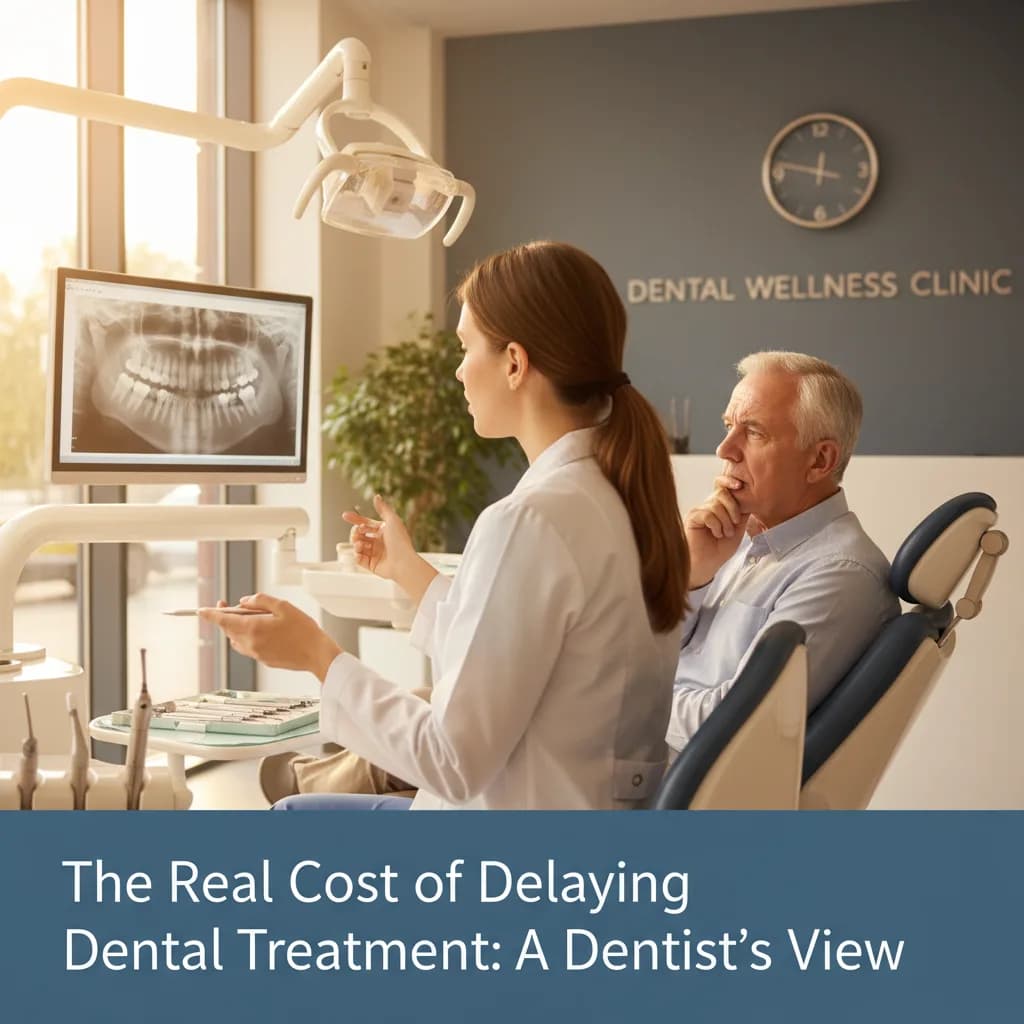
The Real Cost of Delaying Dental Treatment: A Dentist's View
The real cost of delaying dental treatment, from a dentist. What I see in patients who wait, and the pattern that plays out in practice.
Share:
Table of contents
The cost of delaying dental treatment is something I often see before the patient even opens their mouth. It shows up in the way they sit in the chair. The half-apologetic smile. The line that starts with, "I know I should have come in sooner."
After years of practicing dentistry, I've noticed the most common reason patients end up in a difficult spot is not bad luck or bad genetics. It's time. The time between the first sign of a problem and the day they finally sit down to deal with it.
What I want to share in this article is the pattern I keep seeing. What waiting actually does to the mouth, the body, and the wallet. And the specific changes I've made in my own practice to help patients stop putting it off. If you're a practice owner reading this, some of it might be useful for how you talk to your own patients.
What does the cost of delaying dental treatment look like from the chair?
The cost of delaying dental treatment shows up in three layers. A clinical layer, where small problems become big ones. A financial layer, where the bill multiplies. And a trust layer, where patients start avoiding dentistry altogether because every visit feels expensive and scary. I see all three in the same mouth more often than I'd like.
Here's what happens most often. A patient comes in for a cleaning, I flag an early cavity on a molar, and we schedule them to come back in three weeks. They cancel. Life gets in the way. I don't see them again for 18 months. When they come back, that cavity isn't a cavity anymore. It's a crack, or a full abscess, or a tooth that's no longer savable.
The clinical reality is straightforward. According to the ADA Health Policy Institute, untreated dental disease progresses predictably. Decay moves through enamel in months, hits dentin in a year or two, and reaches the pulp soon after. Nothing about that timeline is dramatic. It's just chemistry and time.
What's harder to see is what I call the trust layer. Patients who let one problem turn into three start to believe dentistry is something that happens to them instead of something they control. They stop coming in for cleanings. They become the 20-30% of patients who become inactive within 18 months without structured follow-up, according to ADA data. That's not just a retention metric. That's a person who has quietly decided to give up.
If you want to dig into the retention side of this specifically, I wrote more about it in my previous piece on why first-visit patients ghost.
Why do patients delay dental treatment, even when they know better?
Most patients who delay dental treatment aren't careless. They're afraid, busy, short on cash, or still carrying a bad memory from a visit years ago. I almost never meet someone who delays because they don't care about their teeth. The real reasons are emotional or practical, and figuring out which one you're dealing with changes how you respond.

Fear is the biggest one. A NIDCR summary of patient behavior data shows that dental anxiety is one of the top reasons adults skip recommended care. It's not always about the drill. Sometimes it's the anticipation, the smell of the office, or the memory of a specific procedure that didn't go well.
Cost uncertainty is second. Patients don't delay because they can't afford care. They delay because they don't know what it's going to cost, and the unknown feels worse than the problem. I've had patients sit on a fractured tooth for six months, convinced it was going to cost $5,000 to fix, when it was actually a $350 filling.
Then there's what I call "life getting in the way." PatientPop research shows 48% of patients spend over two weeks researching before they schedule. That's a long window for something to come up. A work deadline. A kid's recital. A bill that has to get paid first. The appointment gets postponed once, then again, then indefinitely.
So when a patient finally sits down in the chair 18 months late, I don't ask them why they waited. I already know. I ask them what they need to feel ready to move forward today.
Patients who delayed once usually delay again
A consistent follow-up system catches patients before the second or third delay becomes a year off the books. This is what our own platform was built to solve.
See how it works →How does a small cavity turn into an $8,000 problem?
A small cavity caught early is usually a $150 to $300 filling. Left untreated for 18 to 24 months, that same tooth often needs a root canal ($1,200), a crown ($1,500), and in some cases an extraction and implant ($4,000 to $6,000). The math of waiting compounds fast. That's the real math in a single sentence.
Here's how the progression actually plays out in my chair.
Stage 1: The early cavity (months 0 to 6)
Decay sits in the outer enamel. A small composite filling, twenty minutes, done. The patient walks out with a working tooth and a bill that's under $300. This is the best outcome, and it's the one I see least often because patients at this stage usually feel fine and don't come in.
Stage 2: Decay hits the dentin (months 6 to 18)
The patient notices sensitivity to cold, or a weird feeling when they chew. Still fixable with a larger filling or a crown-prep, but the cost climbs to somewhere between $400 and $1,500 depending on coverage and location.
Stage 3: The pulp is involved (months 18 to 30)
Now we're in root canal territory. The patient is usually in pain by now, sometimes significant pain, and the tooth needs endodontic treatment plus a crown. All-in cost: $2,000 to $3,200.
Stage 4: The tooth is not savable (month 30 and beyond)
Extraction, bone graft, and implant. That's $4,500 to $6,500 on the conservative side. For a single tooth. And the patient has lost the original tooth entirely.
I've seen patients move through all four stages on the same tooth in under three years. The total bill? Close to $8,000 for a problem that started as a $250 filling. That's not an unusual case. That's a normal Tuesday.
| Stage of delay | Typical treatment | Approximate cost |
|---|---|---|
| Early cavity (0 to 6 mo) | Composite filling | $150 to $300 |
| Dentin decay (6 to 18 mo) | Large filling or inlay | $400 to $1,500 |
| Pulp involvement (18 to 30 mo) | Root canal plus crown | $2,000 to $3,200 |
| Non-restorable (30+ mo) | Extraction and implant | $4,500 to $6,500 |
The numbers matter, but the real loss is bigger than the bill. Dental Economics reports that the average patient lifetime value for a general dentist is $12,000 to $15,000. When a patient loses a tooth because of delay, they often lose confidence in dentistry too. They stop coming back at all. That's how a $250 filling avoided becomes a $15,000 lifetime value walked out the door. For more on this math, our piece on case acceptance benchmarks walks through the numbers in depth.
Can delaying treatment affect more than just your teeth?
Yes, and this is the part I wish more patients understood before they decided to wait. Untreated periodontal disease has documented links to cardiovascular disease, diabetes control, pregnancy outcomes, and respiratory infections. The mouth is not a closed system. When patients delay treating gum disease, they're letting a chronic inflammatory condition run quietly in the background of their entire body.
The CDC estimates that about 42% of adults over 30 have some form of periodontal disease, and roughly 8% have severe periodontitis. Most of these cases go untreated. The connection to systemic health isn't theoretical. It shows up in lab work.
A few things I see clinically.
- Diabetic patients. Patients with uncontrolled gum disease consistently have a harder time managing their A1C. When we treat the periodontal side, their diabetes control often improves. That's not me claiming to cure diabetes. It's inflammation reduction, full stop.
- Cardiovascular risk. The bacterial load from chronic periodontal infection can enter the bloodstream. Research published through the NIDCR has tied this to increased inflammatory markers linked to heart disease.
- Pregnancy. Gum disease has been associated with higher rates of preterm birth and low birth weight. This is why we recommend a cleaning in the second trimester for pregnant patients who haven't been in recently.
None of this is a reason to scare a patient. But it's a reason to be direct when they ask whether they really need to come in. The cost isn't only the tooth. Sometimes it's the rest of the body quietly paying the interest.
What I changed in my practice to help patients stop delaying
The three changes that moved the needle most in my practice were: presenting treatment plans in phases instead of all at once, offering same-day starts for anything urgent, and following up with delayed-treatment patients at 30 and 60 days with a real human outreach. None of these are revolutionary. All of them work.

1. Phased treatment plans
When I used to present a full treatment plan, patients heard one number: the total. A $6,000 plan felt like a $6,000 decision, and they'd say they needed to think about it. Now I walk them through it in phases. "The urgent piece is this one tooth, $800. The next phase is two fillings in three months, $600. The final phase is cleanup, $400 over the next year." Same total. Completely different patient response.
2. Same-day starts for urgent work
If a patient comes in with pain or an active infection and my schedule has any flex at all, we start treatment the same day. Even if it's just the first stage. The longer a patient sits with an unscheduled urgent problem, the more likely they are to disappear. Reactivation campaigns help, but they're not a substitute for catching the patient while they're already in the chair.
3. Structured follow-up on delayed treatment
This was the biggest change for us. We used to hope patients would come back on their own. Now, if a patient leaves without completing recommended treatment, they get a text at 30 days and a phone call at 60. Not a scheduling call. A check-in. "Hi, this is Sarah from Dr. Rahim's office. I know we talked about the crown on #30 last month. Just wanted to see how you're feeling and whether now is a better time."
According to the Journal of Dental Hygiene, SMS reminders alone reduce no-show rates by 38%, and the same timing logic applies to post-treatment follow-up. The structured outreach moved our completion rate on recommended treatment from 54% to 71% inside of a year. I wrote about the mechanics of this in more detail in our guide to building a dental recall system and the companion piece on AI-assisted patient reactivation.
As a co-founder of a practice management company, the irony isn't lost on me that the lowest-tech change was the one that worked hardest. A human voice on a phone, at the right time, with no pressure. That's still the most effective tool we have.
Follow-up is the most underrated part of dentistry
DentiVoice handles the 30 and 60 day outreach automatically so your team can focus on the patients already in the chair.
See the receptionist →How do you talk to patients about delayed treatment without sounding pushy?
Frame it as information, not persuasion. Walk the patient through the clinical reality, show the image, give them the numbers, and then step back. My job is to make sure they understand what waiting looks like. Their job is to decide. When patients feel educated instead of sold to, they say yes more often.
The specific phrasing I use is some version of this. "Here's what I'm seeing. Here's what it likely becomes if we wait 12 months. Here's what it costs to fix today versus later. I can do it today, or we can schedule it for whenever works. Either way, I want you to understand what you're choosing."
That last part matters. Patients who feel like they chose to delay make different decisions than patients who feel like the dentist pushed them into treatment they weren't ready for. The ones who choose to wait are also the ones who come back when the problem gets worse, because they trust I told them the truth the first time.
A few things I've learned not to do.
- Don't quote the worst-case scenario. If you tell every patient their cavity is going to turn into an implant, you lose credibility on the ones where it will. Be honest about the range of outcomes.
- Don't schedule aggressively in the same conversation. Give the patient 24 hours. The ones who were going to book will book. The ones who weren't, won't, and pressuring them in the moment damages the relationship.
- Don't use fear as the primary lever. Fear works once. Trust works every visit after that.
For the script side of this, our article on phone scripts that convert new patient calls has more detail, and the case acceptance guide goes deeper on the conversation structure.
The patients who end up with the best long-term outcomes are rarely the ones who say yes fastest. They're the ones who felt like they understood what they were saying yes to.
The quiet pattern I see every week
If there's one thing I want practice owners to take away from this, it's that the cost of delaying dental treatment is almost never just the dollar figure on the treatment plan. It's the compounding cost of a patient who stops trusting dentistry, stops coming in, and eventually needs three times the work for twice the price.
The fix is not aggressive selling. The fix is a system that catches the patient before the second delay becomes a year off the books. Human follow-up, phased plans, and direct conversations about what waiting actually looks like. That's it. The same boring basics that have always worked.
If you're building that system for your own practice, start with one thing this week. Pull the list of patients who have unscheduled recommended treatment from the last 90 days. Have someone on your team call them. No scheduling pressure, just a check-in. That one call, made consistently, is the single most effective tool I've ever added to my practice.
See how DentiVoice handles patient follow-up
The 30 and 60 day outreach that catches patients before they disappear, done automatically. Built by dentists for dentists.
Book a Free Demo →More guides for practice owners
Browse Resources →Sources & References
Frequently Asked Questions
A cavity caught early is typically a $150 to $300 filling. Delayed 18 to 24 months, the same tooth often needs a root canal and crown ($2,000 to $3,200). Delayed further, extraction and implant can push the cost of delaying dental treatment to $6,000 or more on a single tooth.
Most patients delay because of fear, cost uncertainty, or life interruptions rather than apathy. Fear of pain, not knowing the final bill, and competing priorities like work or childcare are the three reasons I see most often in practice. Understanding which one applies changes the conversation.
Yes. Untreated periodontal disease has documented links to cardiovascular disease, diabetes management, adverse pregnancy outcomes, and respiratory infections. The CDC estimates 42 percent of adults over 30 have some form of periodontal disease, and most go untreated, which keeps chronic inflammation active systemically.
On average, decay progresses through enamel in 6 to 12 months, reaches the dentin within 12 to 18 months, and involves the pulp by 18 to 30 months. The exact timeline varies by tooth and patient, but the pattern is predictable enough to plan around.
Frame it as information instead of persuasion. Walk the patient through the clinical reality, show them the image, outline the cost range today versus later, and let them choose. Patients who feel educated rather than sold to accept treatment at higher rates and trust the dentist more over time.
According to Dental Economics, the average patient lifetime value for a general dentist is $12,000 to $15,000. When a delayed-treatment patient disengages entirely, that full lifetime value walks out the door, which is typically 40 to 60 times the cost of the original treatment they avoided.
In my practice, structured 30 and 60 day follow-up raised completion rates on recommended treatment from 54 to 71 percent within a year. A low-pressure check-in, not a scheduling push, is what works. SMS reminders alone reduce no-show rates by 38 percent according to the Journal of Dental Hygiene.
Was this article helpful?

Written by
Dr. Muhammad Abdel-rahim DMD
Muhammad Abdel-rahim, DMD, is a dentist and implantologist at Peterborough Family Dental & Implant Center with a passion for blending clinical excellence, leadership, and innovation. He believes dentistry extends beyond restoring smiles to building trust, confidence, and sustainable systems that help patients and teams thrive. With experience leading and scaling dental practices, Dr. Abdel-rahim brings a strategic mindset to patient care and practice growth. He is particularly interested in communication, critical thinking, and the thoughtful application of artificial intelligence to improve clinical outcomes, workflows, and the overall patient experience.