Dental Practice Phone Capacity: Can You Handle the Volume?
Dental practice phone capacity caps growth. Learn the call math, why a second line won't help, and how to decouple volume from headcount.
Share:
Table of contents
Your practice doesn't have a marketing problem. It has a phone problem. I know that's not what you want to hear after signing a Google Ads contract, but the math doesn't change because the timing is inconvenient. Dental practice phone capacity is the first thing that breaks when marketing actually works, and most owners have never calculated how many calls their front desk can actually handle before something slips. That number is smaller than you think. And when a campaign hits, you find out fast.
By the end, you will know how many calls your front desk can realistically handle per hour, what a marketing spike does to that number in week one, why a second phone line doesn't move the ceiling, and how to calculate your missed call rate before it shows up as lost revenue. You will also have a clear answer to the hire-versus-automate question, grounded in what your calls actually contain rather than gut feel.
What does dental practice phone capacity actually mean?
Dental practice phone capacity is the number of inbound calls your front desk can handle per hour against the calls arriving per hour. It is not about having two phone lines. It is not about having a good team.
Most owners think about phone capacity as a technology question. Do we have enough lines? Do we have voicemail? But the bottleneck is almost never lines. It is people and time. One front desk person, handling check-ins, insurance questions, scheduling changes, and inbound calls at the same time, can realistically answer and process somewhere between 10 and 15 calls per hour under normal conditions. That sounds like a lot. It isn't, once a campaign starts. When the technology does fail, it is usually a VoIP line dropping calls under load, and the bandwidth and router issues behind dropped dental VoIP calls need a different fix than staffing.
The Bureau of Labor Statistics classifies reception work as administrative support: routine, repetitive, and rules-based. That classification matters because it tells you what is automatable. The parts of your phone volume that don't require judgment are the parts eating your capacity. And they are the majority.
Related: For a closer look at where these specific coverage gaps come from. See why your front desk still misses calls, and the fix →
What does a successful marketing campaign actually do to your phones in week one?
A successful Google Ads or social campaign doesn't spread calls evenly across six weeks. It spikes them. The first week of a good campaign can send 30 to 50% more inbound calls than your baseline, concentrated in business hours, on the days your ads are running hardest.
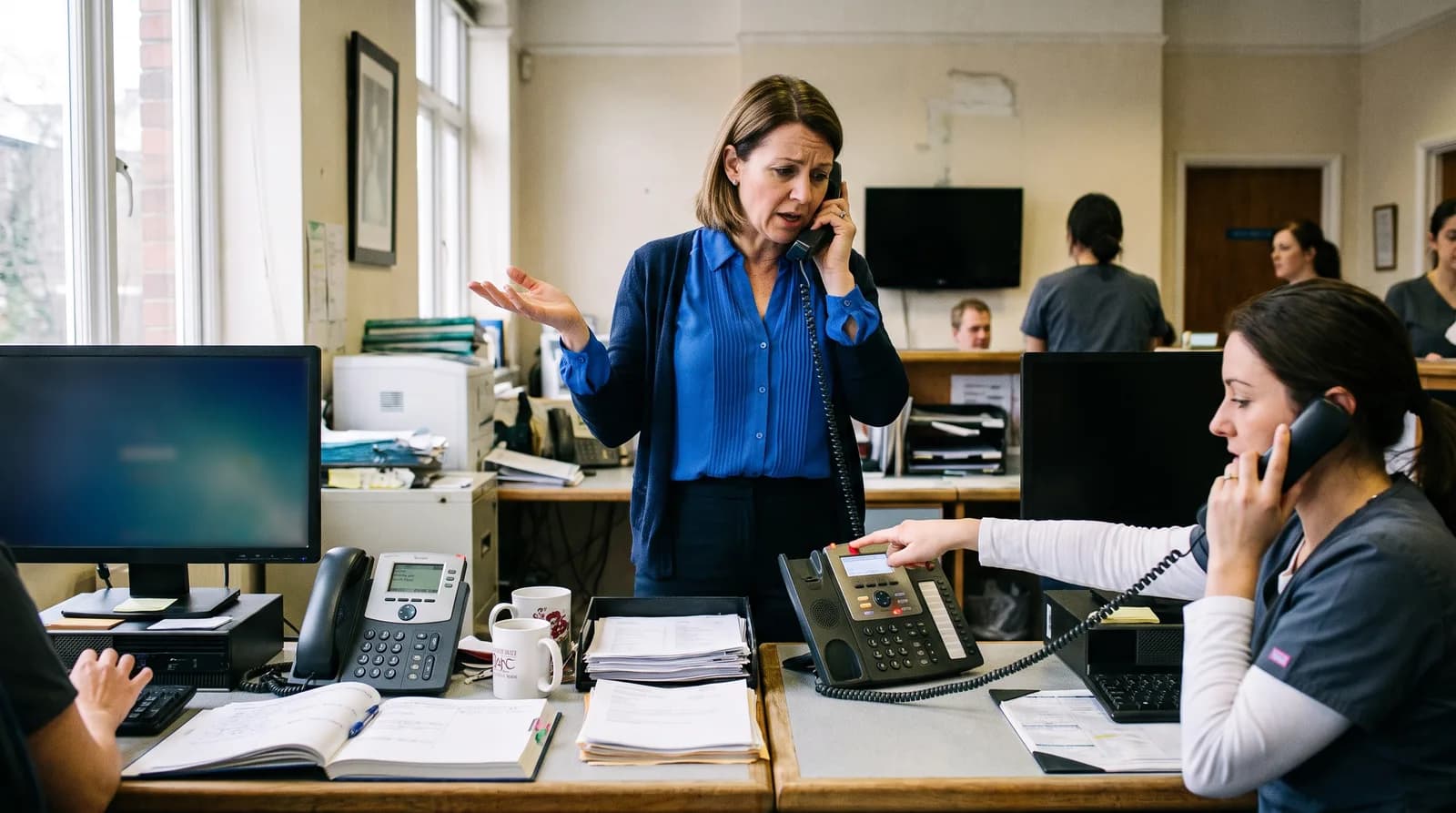
I ran this pattern at my own practice in Peterborough. We turned up a Google campaign, call volume jumped almost immediately, and within four days my front desk coordinator was putting people on hold just to finish a check-in. Two patients hung up in the first week. I know that because we were tracking it. Most practices aren't tracking it, which means they fund the campaign, see new patient numbers disappoint, and blame the marketing. The campaign worked. The phone didn't.
Research cited by Dental Economics puts the average missed call cost at over $1,200 in lifetime patient value. Multiply that by the calls that went unanswered during your spike week, and you can calculate exactly what your front desk's phone capacity ceiling cost you in that campaign.
Video campaigns do the same thing to dental practice phone capacity, and they do it after hours. A reel that lands at nine on a Sunday night sends calls into a closed office. Worth planning for. If you are about to start filming, the dental video types that drive patient calls is worth reading alongside this, because the volume arrives whether or not the phones are ready for it.
Want the full capacity diagnostic?
Phone capacity is one of five systems that cap practice growth. The full framework covers scheduling, front desk bandwidth, treatment coordination, and hygiene. See how DentalBase addresses the whole stack.
Read the Full Diagnostic →How many calls can one front desk person actually handle in eight hours?
Let me give you a real number, not a benchmark range. One front desk person, working a full eight-hour day with a 30-minute lunch and two short breaks, has roughly 420 usable minutes. Not all of those minutes are available for the phone.
The available minutes calculation
The math looks like this. An average dental phone call (booking a new patient, confirming an appointment, handling an insurance question) runs 4 to 7 minutes when measured honestly. Call it 5 minutes average. That means your front desk can handle, at most, 84 calls in a day if the phone is all they do. But the phone is never all they do. If phone work takes 60% of their time, the real number is closer to 50 calls per day. Around 6 per hour.
| Scenario | Available phone minutes/day | Calls handled/day (5 min avg) |
|---|---|---|
| Phone is 80% of the role | 336 min | ~67 calls |
| Phone is 60% of the role | 252 min | ~50 calls |
| Phone is 40% of the role | 168 min | ~34 calls |
What the numbers show in practice
Now run your own practice against that. How many calls does your practice receive on a busy Tuesday? What percentage of that time is your front desk also doing something other than the phone? The gap between those two numbers is your phone capacity ceiling, and every call above it either waits, goes to voicemail, or hangs up.
Why adding a second line doesn't solve the problem
A second phone line gives callers another way to reach a phone that nobody is answering. That is not a solution. It is a more expensive version of the same problem. The constraint isn't the hardware. It is the person.
I have seen practices with four lines, all ringing at the same time, and one coordinator trying to manage them. The patients on lines two, three, and four are not being helped. They are being held. And according to research consistently shows callers hang up in under 90 seconds when put on hold. The CDC's oral health data makes clear how strongly routine dental access depends on patients successfully reaching a practice. A phone that goes unanswered is a barrier to care, not just a missed booking. New patients, who have the least loyalty and the most options, hang up faster than established ones.
The second-line reflex is the same as the second-hire reflex we covered in the front desk bottleneck post. It addresses the symptom of more calls arriving without addressing the constraint, which is the number of calls one person can process per hour. You can double the lines and still not move that number.
What does the missed call rate benchmark actually say?
The ADA Health Policy Institute tracks practice operations data, and industry reporting consistently places the missed call rate at dental practices between 25 and 38 percent of new patient calls during business hours. Some sources put it higher. The range holds across practice sizes and regions because the root cause is structural, not individual.
A practice seeing 40 new patient calls per week and missing 30% of them is losing 12 potential new patients weekly. At a conservative $800 average first-visit production and a lifetime value of $12,000 to $15,000, the arithmetic on a sustained missed call rate is genuinely uncomfortable. Most owners have never run that number. I'd encourage you to run it.
The BrightLocal consumer review research shows that most people searching for a new dentist contact two or three practices before booking. Your missed call does not just cost you the appointment. It sends a patient to the practice down the street who did pick up. And if that practice is tracking reviews, they are building a lead on you in the only metric patients actually read before choosing.
Related: If a slow phone response is showing up as patient experience complaints, the root cause is often the same capacity math. The Dental Patient Experience That Drives Retention →
How do you measure your current phone capacity before you hit the ceiling?
You measure it by tracking three numbers for two weeks. Call volume by hour, answer rate, and time-to-answer. Most phone systems can pull this data. If yours cannot, a call log sheet at the front desk for 10 business days gives you enough to work with.
The three numbers to track
Track these three numbers for two weeks:
- Call volume by hour: total inbound calls in each hour block.
- Answer rate by hour: calls picked up versus missed or sent to voicemail.
- Time-to-answer: average seconds before pickup during peak windows.
Where your ceiling shows up
The peak pattern is almost always the same three windows:
- Monday mornings. Patients who thought about calling over the weekend all call at once.
- Post-lunch. Phones ring while the desk is transitioning back from break.
- Friday afternoons. Same-day requests and people calling before the weekend.
Related: Those Friday same-day requests often turn into same-day cancellations too, for the same reasons. See why dental patients cancel same day and how to recover the slot →
Once you see the pattern, you know exactly when your capacity runs out and when to prioritise extra coverage. What your call data reveals once DentiVoice is running covers how this kind of pattern shows up automatically once every call becomes structured data.
Phone capacity self-audit
Check each item your practice can confirm right now.
3 or more checks: you have the data to act. Fewer than 3: start here before you run your next campaign.
Run this diagnostic before you run a marketing campaign, not after. The worst time to discover your ceiling is the week a campaign hits. If you want a read on what that bottleneck looks like when it extends into wait time and patient wait time perceptions, that post is worth reading alongside this one.
Is the fix AI, or is the fix more staff?
The fix is decoupling call volume from headcount. That is the principle. How you get there is a separate question, and the answer depends on what your calls actually contain.
When automation is the right answer
If your phone volume is mostly routine (appointment bookings, confirmations, general questions), then a large share of it can be handled by AI without the caller noticing a meaningful difference. The 12 most common AI receptionist objections is the honest place to read about where AI phone handling works well and where it doesn't. I built DentiVoice specifically around this problem, so I have a clear view of both sides.
| Signal | Automate first | Hire instead |
|---|---|---|
| Type of dropped calls | Bookings, confirmations, general questions | Insurance disputes, treatment questions, complaints |
| Nature of the overflow | Rules-based and repeatable | Requires judgment, empathy, or context |
| When volume spikes again | AI scales with it, no ceiling moves | A new hire hits the same ceiling faster |
| Cost to fix | Monthly subscription, immediate deployment | Salary, benefits, 4-6 weeks to train |
| What your team gains | Time freed for judgment work | Headcount for complex tasks |
When you genuinely need to hire
If your phone volume skews toward complex insurance conversations, treatment questions, and billing disputes, those calls still need a human. But here is what I have found: in most practices, 60 to 70% of inbound calls are routine. Book an appointment. Confirm a time. Ask about parking. Those are the calls that should never be eating your front desk's capacity. Free those up, and your team can give real attention to the calls that need it.
Hiring a second person to answer routine calls is a real option, but it comes with a salary, benefits, training time, and the risk that the new hire becomes another person who is also overwhelmed when the next volume spike hits. Automating routine call handling scales with volume by design. The ceiling moves. That is the whole point.
Specialty practices hit this ceiling on a different curve. Orthodontic consult calls run long by nature, and the mix of parents comparing treatment options fills capacity faster than a general practice's average call. If that's your situation, our guide to orthodontic answering service options and costs walks through what a call-handling system needs to cover for that specific volume pattern.
DentiVoice handles the routine calls so your team handles the ones that matter
Appointments, confirmations, after-hours inquiries. Handled without hold queues, without missed calls, without adding headcount. See how practices use it.
See the AI Receptionist →Where does phone capacity fit in the bigger practice picture?
Phones are the first failure point because they are the first point of contact. A patient who can't get through doesn't make it to scheduling, treatment coordination, or hygiene recall. They just don't exist in your practice. Every other growth system downstream depends on the phone working.
Related: The same capacity problem shows up on outbound calls too, once a practice tries to reach its own overdue patients at scale. See how DentiVoice turns overdue patients into booked visits →
That's what makes phone capacity uniquely high-leverage. Fix it, and every marketing dollar you spend actually lands. Don't fix it, and you pay to generate demand your practice physically cannot absorb. For a broader read on where capacity fails next once the phone is handled, the practical guide to AI in dental practice covers the full operational stack.
The practice owners I have watched grow steadily are not the ones with the biggest ad budgets. They are the ones who figured out their capacity ceiling before they pushed volume into it. Phones first. Then everything else.
Find out where your phone capacity ceiling actually sits
Book a short walkthrough and we'll show you how DentiVoice moves the ceiling without adding headcount.
Book a Free Demo →More resources for practice owners
Guides, templates, and tools for running a better practice →Sources & References
Frequently Asked Questions
It is the number of inbound calls your front desk can fully handle per hour. One coordinator doing mixed duties typically manages 6 to 10 calls per hour before hold times and missed calls start rising.
A front desk person spending 60% of their time on phones can handle roughly 50 calls per day at a 5-minute average call length. The realistic ceiling drops when check-ins, admin, and billing compete for the same time.
A second line gives callers another way to reach a phone nobody is answering. The constraint is the number of calls one person can process per hour, not the number of lines. Adding lines without adding capacity just creates more hold queues.
Industry data consistently places missed new patient call rates between 25 and 38% during business hours. The rate spikes during Monday mornings, post-lunch, and periods when front desk attention is split.
If the majority of your calls are routine bookings and confirmations, AI call handling decouples volume from headcount and scales with growth. Hiring is the right answer only when the overflow calls genuinely need human judgment.
Was this article helpful?

Written by
Dr. Muhammad Abdel-rahim DMD
Muhammad Abdel-rahim, DMD, is a dentist and implantologist at Peterborough Family Dental & Implant Center with a passion for blending clinical excellence, leadership, and innovation. He believes dentistry extends beyond restoring smiles to building trust, confidence, and sustainable systems that help patients and teams thrive. With experience leading and scaling dental practices, Dr. Abdel-rahim brings a strategic mindset to patient care and practice growth. He is particularly interested in communication, critical thinking, and the thoughtful application of artificial intelligence to improve clinical outcomes, workflows, and the overall patient experience.