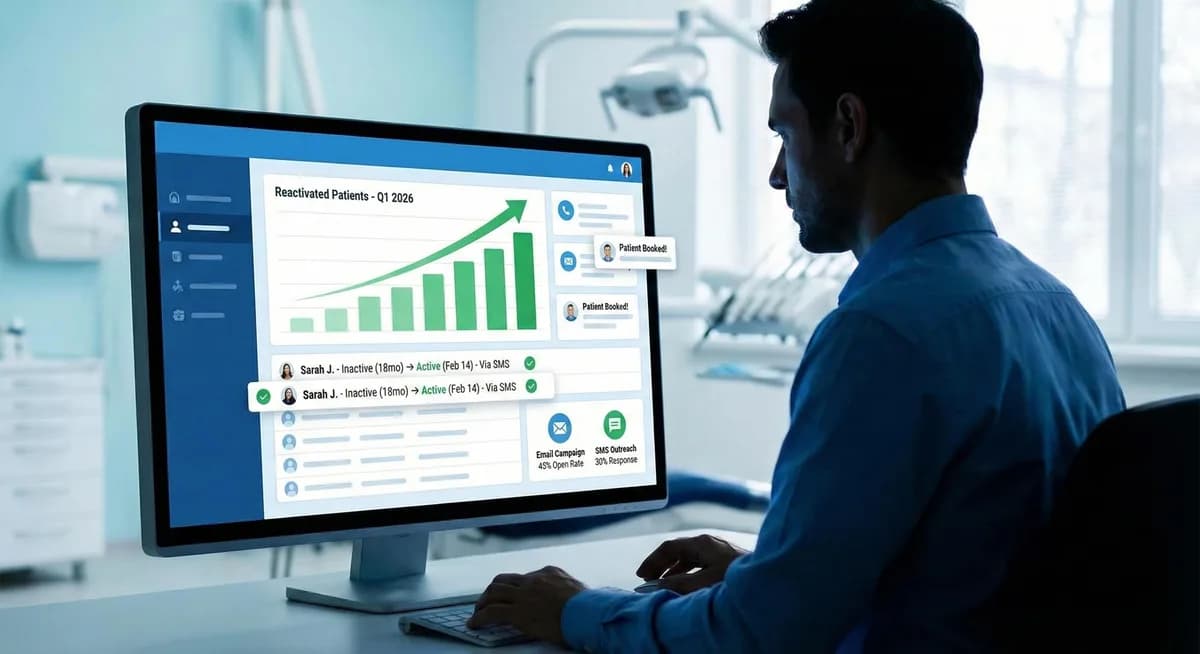
How to Reactivate 20-30% of Inactive Dental Patients
Reactivate inactive dental patients at 20-30% rates with segmentation, multi-channel outreach, AI phone campaigns, compliance rules, and monthly ROI tracking.
Share:
Table of contents
The fastest path to practice growth isn't acquiring new patients. It's learning how to reactivate inactive dental patients who already know your practice, trust your team, and have established records in your PMS. The average dental practice has 200-500 inactive patients (no visit in 6-24 months) at any given time. At $500-2,000 in potential production per reactivated patient depending on treatment backlog, that inactive list represents $100,000-500,000 in recoverable revenue sitting untouched in your database. Every month without a reactivation system is another month of compounding loss as those patients drift further from returning and eventually establish care elsewhere permanently.
According to the American Dental Association, reactivating existing patients costs 5-7x less than acquiring new ones. Yet most practices make no systematic effort to reactivate inactive dental patients because the manual process (pulling lists, making calls, tracking responses) competes with every same-day operational task. This guide provides the complete system: how to identify and segment inactive patients, which outreach channels convert at what rates, the specific messaging that achieves 20-30% reactivation, compliance guardrails, and the concrete measurement framework that proves ROI to practice owners month over month.
Why Do Dental Patients Go Inactive and Which Ones Will Come Back?
Understanding why patients leave determines which ones you can recover and which messaging will bring them back. Not all inactive patients left for the same reason, and not all are equally recoverable. The table below breaks down the five primary reasons patients go inactive, the percentage of your inactive list each reason represents, and the outreach strategy most likely to bring each group back.
| Reason for Inactivity | % of Inactive | Recovery Potential | Best Approach |
|---|---|---|---|
| Forgot / got busy | 40-50% | Very high | Simple reminder with booking link |
| Insurance change | 15-20% | Medium-high | Verify current coverage, offer payment options |
| Cost concerns | 10-15% | Medium | Highlight preventive value, financing options |
| Moved away | 10-15% | Low | Minimal effort, single touchpoint |
| Negative experience | 5-10% | Low | Personal outreach from provider, acknowledge issue |
The critical insight: 40-50% of your inactive patients simply forgot or got busy. They didn't leave because of your practice. They left because nobody reminded them to come back with enough persistence through the right channel. That segment alone represents the 20-30% reactivation target because they need nothing more than a well-timed, convenient reminder to act on an intention they already have. The patients who forgot aren't unhappy with your practice. They're overwhelmed by life. Your outreach cuts through that noise and gives them the nudge to do something they already wanted to do. Pair the right outreach with these recoverable patients and the math works easily. For the detailed AI-powered reactivation mechanics, see our AI dental patient reactivation guide.
Reactivate inactive patients without adding staff hours
DentalBase identifies inactive patients from your PMS, segments them automatically, and runs personalized multi-channel campaigns that book appointments directly.
Book a Free Demo →How Should You Segment Inactive Patients for Maximum Conversion?
Sending the same message to every inactive patient is the most common reactivation mistake. Strategic segmentation by both inactivity duration and treatment history produces 2-3x higher conversion rates because each segment needs different urgency, messaging, and channel selection.
Segmentation by duration
- Warm (6-9 months): These patients intended to return. Light-touch SMS reminder with a booking link converts 20-30%. "Hi [Name], it's been a few months since your last visit at [Practice]. Ready to schedule? Tap here: [Link]."
- Cooling (9-15 months): These patients need a specific reason. Reference insurance benefits, outstanding treatment, or new services. Conversion: 12-20%. "Your dental benefits include 2 cleanings per year. You have 1 remaining before your plan resets in December. Book now: [Link]."
- Cold (15-24 months): These patients have mentally moved on. AI phone outreach works best because voice creates a personal reconnection. Conversion: 5-12%. The AI calls during business hours, references their history, handles objections like insurance changes and scheduling concerns, and books directly into the PMS.
- Dormant (24+ months): Low probability. Single SMS or email with minimal investment. Conversion: 2-5%.
Segmentation by treatment history
Patients with unscheduled treatment plans are the highest-value reactivation targets. A patient diagnosed for implants, crowns, or Invisalign who never scheduled represents thousands in accepted but unbooked production. Treatment-specific messaging ("Hi [Name], your implant consultation from last year hasn't been scheduled. We'd love to help you complete that treatment.") converts 2-3x higher than generic reminders. Pull your unscheduled treatment report from the PMS and prioritize these patients in every campaign. Most practices are shocked to discover $50,000-200,000 in accepted but unscheduled treatment sitting in their system. These patients said yes to the treatment. They just never followed through on scheduling, and nobody followed up persistently enough to close the loop. For outreach to leads who never became patients at all, see our AI lead outreach guide.
What Multi-Channel Outreach Achieves the 20-30% Target?
To reactivate inactive dental patients at scale, you need multiple channels working in coordinated sequence. Single-channel approaches (email only, postcard only) plateau at 8-12% reactivation. Multi-channel sequences achieve 20-30% by reaching patients through their preferred communication method.
The four-touchpoint reactivation sequence
The sequence should be automated through your PMS so it runs for every qualifying patient without staff involvement. Day 1: Personalized SMS with booking link. Day 4: Email with specific reason to return (treatment plan, insurance deadline, new service). Day 8: AI phone call from the practice number, referencing their history and offering scheduling. Day 15: Final SMS with soft close. Stop the sequence when the patient books, declines, or opts out at any touchpoint. Click-based suppression prevents over-contact that damages the patient relationship and causes opt-outs. Patients who opt out of your communication system are permanently lost to future campaigns, so protecting the relationship is as important as driving conversions in the current cycle. Our warm, cooling, and cold email templates supply the wording for every email touch in that sequence.
Channel performance by segment
SMS achieves the highest response rates for warm patients (30-45%) because the barrier to rebooking is low and a one-tap link removes all friction. AI phone calls achieve the highest conversion rates for cold patients (18-28% of answered calls) because voice creates the personal connection needed to re-engage someone who hasn't thought about your practice in over a year. Email serves as a valuable secondary channel across all segments (particularly for patients over 50 who check email more consistently than text), catching patients who prefer longer-form communication and adding 5-10% incremental conversions. Systems like the DentalBase AI receptionist handle both outbound reactivation and inbound reception, ensuring patients who call back after receiving outreach actually reach someone who can book them. 38% of dental calls go unanswered, so covering the inbound side is critical.
Related: Build automated campaigns that run reactivation continuously. → Automated Dental Reactivation Campaigns: Complete Guide
What Compliance Rules Govern Patient Reactivation Outreach?
Reactivation campaigns at scale require compliance across three regulatory frameworks. Violations carry penalties that can exceed the revenue recovered.
- HIPAA: Patient data used for outreach (names, contact info, treatment history) is protected health information. The outreach platform must have a signed Business Associate Agreement. Messages referencing treatments require encrypted channels. Fines reach $50,000 per violation.
- TCPA: The Telephone Consumer Protection Act requires prior consent for automated texts and calls. Collect consent through intake forms. Include opt-out in every message. Honor opt-outs within 24 hours. Penalties: $500-1,500 per unsolicited message.
- FTC: The FTC requires truthful messaging. Don't misrepresent offers, urgency, or insurance coverage in reactivation outreach. If you mention insurance benefits, verify the patient's current coverage status before sending. State-level laws (including California's CCPA) may add data handling and disclosure requirements for multi-location and multi-state practices.
Never send reactivation messages to patients who formally transferred records. Exclude patients who opted out of communications. Apply the same compliance standards to your review collection and reputation management systems.
How Do You Measure Reactivation ROI and Optimize Monthly?
Track five metrics monthly to prove the system works and identify where to optimize for higher conversion rates.
- Reactivation rate by segment (targets: warm 20-30%, cooling 12-20%, cold 5-12%): The primary effectiveness measure. If any segment falls below target, test new messaging, timing, or channel sequence for that segment.
- Revenue recovered per month (target: $10,000-30,000): Total production from reactivated patients. A practice reactivating 40 patients at $500 average generates $20,000 in recovered monthly production. Patients with unscheduled treatment plans push the per-patient average significantly higher.
- Cost per reactivation (target: $5-15): Compare to $150-300 new patient acquisition cost. Reactivation should deliver 10-30x better cost efficiency.
- Show rate for reactivated appointments (target: 85-90%): Reactivated patients who no-show waste the outreach investment. Add confirmation texts and day-before reminders to maintain high show rates. Reactivated patients are at slightly higher no-show risk than active patients because the practice visit habit is broken, so stronger confirmation sequences are warranted for this group specifically.
- 12-month retention of reactivated patients (target: 60-70%): Measures whether reactivation sticks. Below target means the underlying experience or recall system needs attention.
Review the dashboard on the first Monday of each month. Identify the weakest metric. Test one change over 30 days. After 3-4 cycles, your system will be calibrated to your patient population. The data from your own campaigns is more valuable than any benchmark because it reflects the actual communication preferences, insurance mix, and scheduling behavior of patients in your specific market. What works for a suburban family practice may differ from an urban cosmetic practice, and monthly optimization reveals those differences. According to Moz, practices with strong review velocity rank higher in local search. Each reactivated patient who visits and leaves a Google review strengthens both retention and discoverability. Track outreach link conversions through Google Analytics 4. Pair reactivation performance data with your marketing plan and social media strategies for compounding growth.
Recover 20-30% of your inactive patients on autopilot
DentalBase identifies, segments, and contacts inactive patients automatically with personalized multi-channel outreach and direct PMS scheduling.
Book a Free Demo →To reactivate inactive dental patients at 20-30%, you need three things working together: segmentation that matches messaging to each patient's reason for lapsing, multi-channel sequences that reach patients through SMS, email, and AI phone calls with click-based suppression, and measurement that proves ROI and guides monthly optimization. Start with the warm segment (6-9 months inactive via SMS). That single campaign typically recovers $5,000-15,000 in first-visit revenue within 30 days. Add cooling and cold segment campaigns over the next 60 days. Within one quarter, your inactive patient list transforms from a static database entry into a continuous revenue recovery engine that generates production every single month without staff effort. For practices connecting reactivation to ad campaigns, social media management, and recall gap closure, DentalBase integrates every patient touchpoint from reactivation to recall to reception to reputation into one comprehensive AI-powered dental growth platform.
Turn your inactive patient list into recovered revenue
DentalBase automates patient reactivation from segmentation to booked appointment with compliance and performance tracking built in.
Book a Free Demo →Explore more guides and tools for dental practice growth.
Browse Resources →Sources & References
Frequently Asked Questions
20-30% of contacted patients with a properly segmented, multi-channel automated system. Warm patients (6-9 months inactive) convert at 20-30%, cooling (9-15 months) at 12-20%, and cold (15-24 months) at 5-12%.
Five main reasons: forgot or got busy (40-50%), insurance change (15-20%), cost concerns (10-15%), moved away (10-15%), and negative experience (5-10%). The largest segment (forgot/busy) is the most recoverable with simple reminders.
SMS achieves highest response rates for warm patients (30-45%). AI phone calls achieve highest conversion for cold patients (18-28% of answered calls). Multi-channel sequences combining both plus email achieve 20-30% overall reactivation.
A practice reactivating 40 patients monthly at $500 average production recovers $20,000. Patients with unscheduled treatment plans average $800-2,000 per visit. Total recovery of $10,000-30,000 monthly is typical.
Treatment-specific messages convert 2-3x higher than generic reminders. 'Your crown from last year hasn't been scheduled' outperforms 'We miss you.' For warm patients, simple booking link reminders work because the barrier is low.
Use a platform with a signed Business Associate Agreement. Encrypt all PHI in transit and at rest. Messages referencing treatments need encrypted channels. Collect TCPA consent through intake forms. Honor opt-outs within 24 hours.
Warm segment SMS campaigns produce appointments within 1-2 weeks. Adding cooling and cold segments takes 60 days. Full system optimization across all segments takes 3-4 monthly cycles of single-variable testing.
Five metrics monthly: reactivation rate by segment, revenue recovered ($10,000-30,000 target), cost per reactivation ($5-15), show rate for reactivated appointments (85-90%), and 12-month retention rate (60-70%).
Was this article helpful?
Written by
Dentalbase Team
The Dentalbase Team is a collective of dental marketing experts, AI developers, and practice management consultants dedicated to helping dental practices thrive in the digital age.