
Dental Reputation Management: How to Get More 5-Star Reviews (2026)
How to build a dental reputation management system: review generation, HIPAA-safe responses, monitoring, crisis handling, and cost breakdown.
Share:
Table of contents
A single one-star review sits at the top of your Google Business Profile. It was posted six months ago by a patient who was angry about a billing issue, not the quality of care. You never responded. That review has been seen by every patient who searched for your practice since then, and according to BrightLocal, 98% of people read local reviews before choosing a business. That's dental reputation management in a nutshell: what patients see about you online determines whether they call or scroll past.
The stakes go beyond perception. 77% of patients use online reviews when finding a dentist, per Software Advice data cited by BrightLocal. And 88% are likely to use a business if the owner responds to all reviews. Google also factors review signals, including volume, velocity, rating, and owner responses, directly into local search rankings, as documented by Moz's local ranking research. Your reputation isn't just a trust issue. It's a visibility issue. A practice with 40 reviews and no responses will rank below a competitor with 150 reviews and a reply to every one, even if the competitor has a worse website.
This guide covers the full dental reputation management system: how reviews affect rankings, how to generate them consistently, how to respond to negative feedback without violating HIPAA, how to monitor what patients say about you online, and what to do when a reputation crisis hits.
Why Does Dental Reputation Management Affect Both Trust and Rankings?
Dental reputation management affects both trust and rankings because Google uses review signals as a direct local ranking factor, and patients use reviews as their primary filter for choosing a dentist. A strong reputation simultaneously improves your Map Pack position and your conversion rate from profile views to phone calls.
The connection is tighter than most practice owners realize. A practice that ranks third in the Map Pack with a 4.9 rating and 200 reviews will get more clicks than the practice ranking first with a 4.2 rating and 30 reviews. Patients look at the Map Pack as a shortlist, then they filter by reputation. Position gets you seen. Reviews get you chosen.
According to Dental Economics, the average patient lifetime value for a general dentist is $12,000-$15,000. If a single unanswered negative review costs you even two patients per month, that's $24,000-$30,000 in lifetime revenue lost annually. Reputation management isn't a "nice to have." It's revenue protection. For a broader view of how reputation fits into your overall dental marketing strategy, start with our pillar guide.
Your Reputation Drives Your Rankings
DentalBase SEO includes Google Business Profile management, review monitoring, and local ranking optimization in one platform.
Learn About Dental SEO →How Do You Build a Review Generation System That Compounds?
You build a review generation system by automating the ask after every positive appointment, making the process one-tap simple for patients, and targeting a consistent monthly velocity of 5-10 new Google reviews rather than chasing a one-time total.
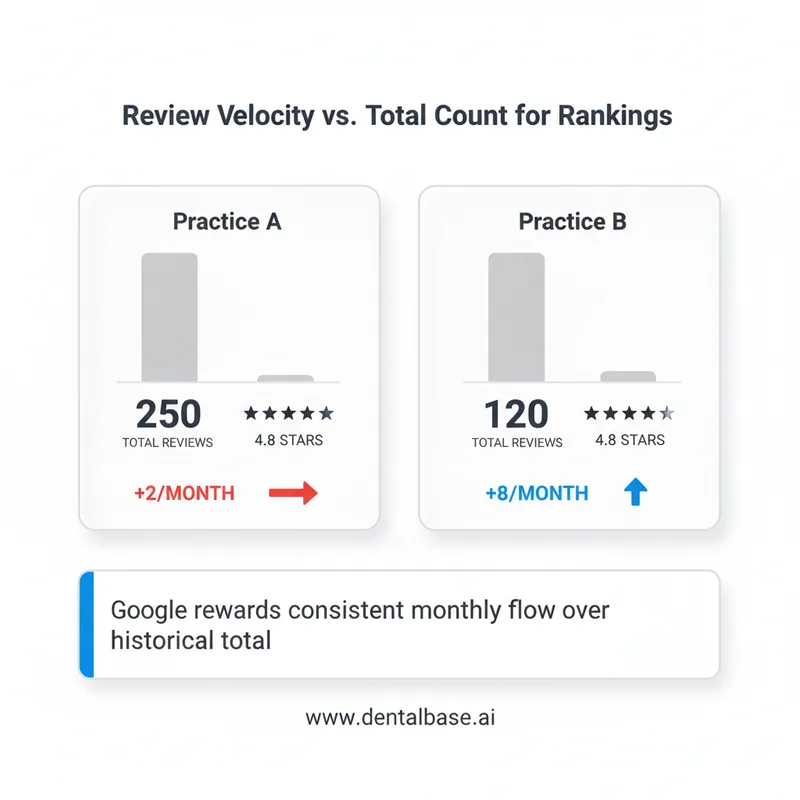
Most practices approach reviews wrong. They run a "review push" once a quarter, get 15 reviews in a week, then go silent for three months. Google rewards consistent velocity more than total count. A practice getting 8 reviews per month will outrank one with more total reviews but only 1-2 per month, because steady flow signals an active, trusted business.
The System That Works
- Automate the request within 2 hours of checkout. Send an SMS or email with a direct link to your Google review page. Don't ask patients to "find you on Google." Give them the one-tap link. The closer to the appointment, the higher the response rate. Same-day requests convert 3-5x better than next-week requests.
- Make it personal. "Hi [Name], thanks for visiting Dr. [Last Name] today. If you have a moment, your feedback helps other patients find us: [link]." Generic "Please leave us a review" messages get ignored. Personal ones get responses.
- Ask your best patients first. Start with patients who expressed satisfaction during their visit. Your front desk knows who left happy. Those patients are your highest-probability reviewers. Don't ask everyone indiscriminately. Quality and positivity matter.
- Track it monthly. Review count on the first of each month. Goal: 5-10 new reviews. If you're below target, increase the automation frequency or have your front desk make verbal asks during checkout for the next two weeks.
For more on how reviews feed into your local search rankings, see our guide on dental local SEO.
How Should You Respond to Reviews Without Violating HIPAA?
Respond to every review within 48 hours, keep responses professional and generic enough to avoid confirming anyone's patient status, and never reference treatments, diagnoses, or appointment details, because acknowledging that someone is a patient is itself a HIPAA violation.
This is where most practices either freeze (responding to nothing) or make costly mistakes (responding with too much detail). Neither is acceptable. A practice that ignores reviews looks indifferent. A practice that responds "We're sorry your root canal was uncomfortable, we've noted this for your next visit" just broadcast protected health information to the internet. The ADA's practice management guidelines emphasize that even confirming someone is a patient can constitute a HIPAA violation in a public forum.
Response Templates That Are Safe
HIPAA-Safe Review Response Templates
Use these as starting points. Personalize the tone, never the clinical details.
Positive Review Response
"Thank you for sharing your experience. We're glad to hear things went well, and we appreciate you taking the time to leave feedback. We look forward to seeing you again."
Negative Review Response
"We take all feedback seriously and want to make this right. Please contact our office directly at [phone] so we can discuss your concerns privately. We value every patient's experience."
Mixed Review Response
"Thank you for your honest feedback. We're always working to improve, and we'd love to hear more about how we can do better. Please reach out to us directly at [phone]."
The golden rule: take every negative conversation offline. Acknowledge the concern publicly, show empathy, provide a phone number, and resolve it privately. Never argue in a public review thread. Every prospective patient reading that exchange is judging how you handle conflict, and a defensive or dismissive reply does more damage than the original negative review.
What Should Your Reputation Monitoring System Look Like?
Your dental reputation management monitoring system should track new reviews across Google, Facebook, Yelp, and Healthgrades in real time, alert your team within hours of a new review, and generate a monthly report showing review volume, average rating trend, and response rate.
Most practices check their reviews when they remember, which is usually after a patient mentions they saw something concerning online. By then, a negative review may have been sitting unanswered for weeks, visible to every prospective patient who searched for your practice during that time.
Monitoring Checklist
- Google Business Profile: This is where 85-90% of your reviews live. Set up Google notifications so you're alerted to every new review. Check it daily or use a monitoring tool that aggregates alerts.
- Facebook: Patients sometimes leave recommendations (Facebook's version of reviews) here. Check weekly.
- Yelp and Healthgrades: Lower volume but still indexed by search engines. Check monthly at minimum.
- Google yourself: Search "[your practice name] reviews" monthly to see what patients see. Sometimes third-party sites aggregate reviews you didn't know existed.
The monitoring doesn't need to be expensive. Google alerts are free. A 10-minute daily check of your GBP review tab catches most issues. If you manage multiple locations, a tool that consolidates all reviews into one dashboard saves significant time. Many of the best dental marketing companies include review monitoring as part of their service package.
Never Miss a Review Again
DentalBase monitors your reviews, manages your Google Business Profile, and alerts your team to new feedback so you can respond within hours, not weeks.
Explore the Platform →How Do You Handle a Dental Reputation Crisis?
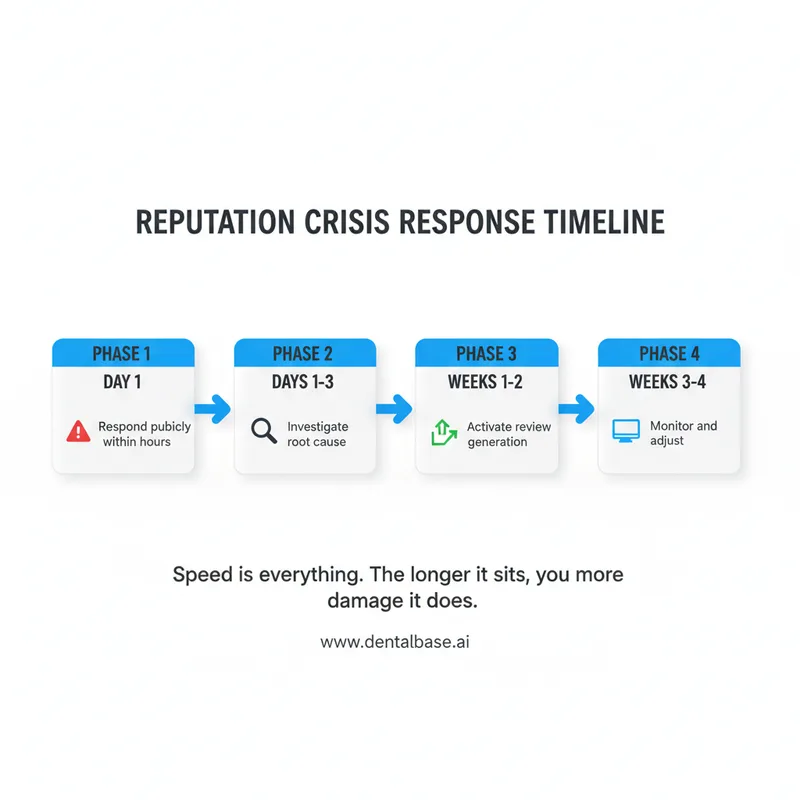
Handle a reputation crisis by responding immediately with empathy, taking the conversation offline, addressing the root cause internally, and then burying the negative signal with a surge of positive reviews from satisfied patients. Speed is everything. The longer a crisis sits unaddressed, the more damage it does.
A "crisis" in dental reputation management isn't one bad review. It's a pattern: three negative reviews in a week, a patient complaint going viral on social media, a news mention, or a sustained drop in your average rating from 4.7 to 4.2 over a month. These situations require a structured response, not panic.
Crisis Response Playbook
- Day 1: Respond to every negative review publicly within hours. Use the HIPAA-safe templates above. Acknowledge, empathize, take it offline. Do not delete reviews. Do not argue. Prospective patients watching this unfold are judging your character.
- Day 1-3: Investigate internally. Was this a legitimate patient experience issue? A billing problem? A staff behavior concern? Find the root cause before the next step. If it's a systemic issue, fix it. If it's a one-time event, document it.
- Week 1-2: Activate your review generation system. Reach out to your happiest recent patients and ask for reviews. Not fake reviews. Not incentivized reviews. Genuine feedback from patients who had positive experiences. A surge of 10-15 positive reviews in two weeks pushes the negative ones below the fold and restores your average rating.
- Week 3-4: Monitor and adjust. Check your GBP daily during a crisis period. Respond to every new review within hours. Track whether your average rating is recovering. If it's not, increase review outreach volume.
One scenario practice owners fear: a fake or malicious review from a competitor or a person who was never a patient. Google allows you to flag reviews that violate their policies (fake reviews, reviews for the wrong business, spam). Flag it through your GBP dashboard, but don't expect fast removal. In the meantime, the best defense is volume: 200 genuine reviews at 4.8 stars make one fake 1-star review statistically irrelevant.
Related: Your phone system is part of your reputation too. Missed calls create frustrated patients who leave bad reviews. → See How DentiVoice Catches Every Call
What Does a Complete Dental Reputation Management System Cost?
A complete dental reputation management system costs $0-$500 per month depending on whether you handle it in-house or use software and agency support. The core components are free (Google alerts, manual monitoring), while automation and multi-platform tools add cost but save significant staff time.
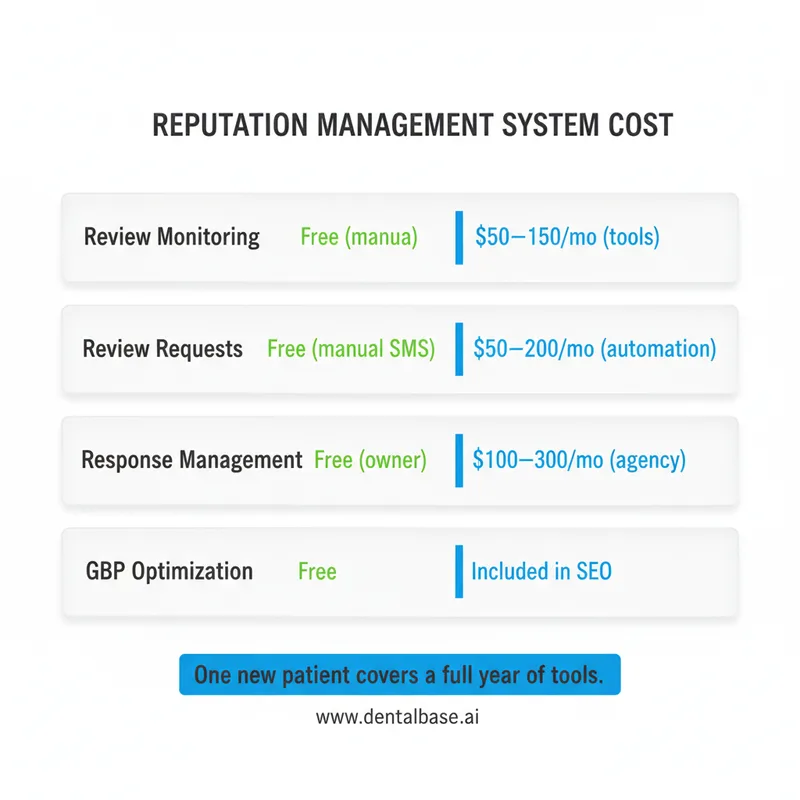
| Component | DIY Cost | With Tools/Agency | Time Required |
|---|---|---|---|
| Review monitoring | Free (manual) | $50-$150/mo | 10 min/day vs. automated |
| Review request automation | Free (manual SMS) | $50-$200/mo | 5 min/patient vs. automatic |
| Review response management | Free (owner writes) | $100-$300/mo | 5-10 min per review |
| GBP optimization | Free (owner manages) | Included in SEO service | 1-2 hours/week |
The ROI calculation is straightforward. If automated review requests cost $100 per month and generate 8 additional positive reviews per month, and those reviews help you rank higher in the Map Pack (where the dental marketing SEO benefits compound), the return is many multiples of the cost. A single new patient from improved visibility covers a full year of review management software. For benchmarks on how reputation management fits into your total marketing budget, see our guide on dental marketing ROI.
Dental reputation management is the only marketing channel where doing nothing actively hurts you. Every other channel, PPC, SEO, content, social media, simply stops producing when you stop investing. But an unmanaged reputation degrades over time as negative reviews accumulate, positive patients stay silent, and competitors build review volume ahead of you. The system doesn't need to be expensive. It needs to be consistent: ask for reviews after every positive visit, respond to every review within 48 hours, monitor your profiles weekly, and have a crisis plan ready before you need one. Start with the review generation system. That single action produces the most visible results fastest, both in patient trust and in local search rankings. If you need more dental marketing techniques to build alongside your reputation, we cover the full channel lineup separately. And for a structured plan to organize reputation alongside your other channels, see our guide on building a dental office marketing plan.
Build a Reputation That Fills Your Schedule
DentalBase handles review monitoring, GBP management, SEO, and patient communication in one platform. See how it protects and grows your online reputation.
Book a Free Demo →Explore more guides and tools for dental practice growth.
Browse Resources →Sources & References
Frequently Asked Questions
There's no minimum, but practices with 100-plus reviews and consistent monthly velocity of 5-10 new reviews typically outrank competitors. Focus on getting reviews steadily each month rather than hitting a one-time total. Velocity signals an active, trusted business to Google's ranking algorithm.
Yes, but you must keep responses generic. Never reference treatments, diagnoses, visit dates, or anything that confirms the person is a patient. Acknowledge the concern, express empathy, and provide your office phone number to continue the conversation privately. A template-based approach protects you.
Respond within 48 hours to every review, positive or negative. Google tracks response rates and speed as engagement signals that affect local rankings. Practices that respond to all reviews consistently outrank those that respond sporadically or not at all.
Google uses review volume, velocity, average rating, recency, and owner response rate as direct local ranking factors. A practice with 200 reviews at 4.8 stars will typically outrank one with 30 reviews at 5.0 stars because volume signals broader patient trust and engagement.
Flag it through your Google Business Profile dashboard as a policy violation. Don't expect fast removal. In the meantime, respond professionally without accusing anyone of lying. The best defense against fake reviews is volume: 200 genuine reviews make one fake 1-star statistically irrelevant.
Core components like Google alerts and manual monitoring are free. Review request automation costs $50-$200 per month. Full-service management including response writing runs $200-$500 per month. A single new patient from improved visibility covers a full year of reputation management tools.
Was this article helpful?
Written by
DentalBase Team
Expert dental industry content from the DentalBase team. We provide insights on practice management, marketing, compliance, and growth strategies for dental professionals.