Dental Content Marketing: Attract Patients With Valuable Content (2026)
Which dental content types produce the best ROI, how to build a publishing system, and how dental content marketing reduces your patient acquisition cost.
Share:
Table of contents
A practice that publishes one blog post per month answering a question patients actually search for will outrank a competitor spending twice as much on ads within 12 months. That's not a guess. It's the compounding math of dental content marketing: every piece of content you publish is an asset that generates traffic, builds trust, and drives appointments long after the writing is done.
AI writing tools can accelerate your publishing cadence, but only if you use them correctly. Most practices end up with generic filler that hurts more than it helps. Our guide on AI blog writing for dentists covers how to get useful output without sacrificing quality or voice.
The data backs this up. 71% of people looking for a dentist run a search before scheduling, per Pew Research. And 68% of all online experiences start with a search engine, according to BrightEdge data. When a patient searches "how much do dental implants cost" or "is Invisalign worth it," the practice that answers best usually gets the appointment. Paid ads capture patients who are ready to book. Content marketing captures patients who are still researching, and that group is larger, cheaper to convert over time, and more likely to trust you when they're ready to commit.
This guide covers what dental content marketing actually involves, which content types produce the best results, how to build a publishing system your team can sustain, and where most practices waste their content budget.
What Is Dental Content Marketing and How Is It Different From Advertising?
Dental content marketing is the practice of creating educational, search-optimized content that attracts patients by answering their questions, rather than interrupting them with ads. The key difference: advertising stops producing the moment you stop paying. Content keeps working for months or years after you publish it.
A Google Ad targeting "dental implants near me" generates a click the day it runs. Turn off the budget and the clicks stop immediately. A blog post ranking for "how long do dental implants last" generates traffic every day, for free, as long as it holds its ranking. Over 12-18 months, a library of 20-30 well-targeted blog posts can produce more organic traffic than $3,000 per month in ad spend.
That doesn't mean content replaces ads. It means they serve different parts of the patient journey. Ads capture high-intent patients who are ready to book today. Content captures patients who are 2-8 weeks away from booking, still comparing options, researching costs, and deciding whether they trust your practice. For a broader view of how content fits alongside PPC, SEO, and other channels, see our complete guide to dental marketing.
Want Content That Ranks and Converts?
DentalBase SEO includes content strategy, keyword targeting, and blog publishing that's built to attract patients from organic search.
Learn About Dental SEO →Which Types of Dental Content Produce the Best ROI?
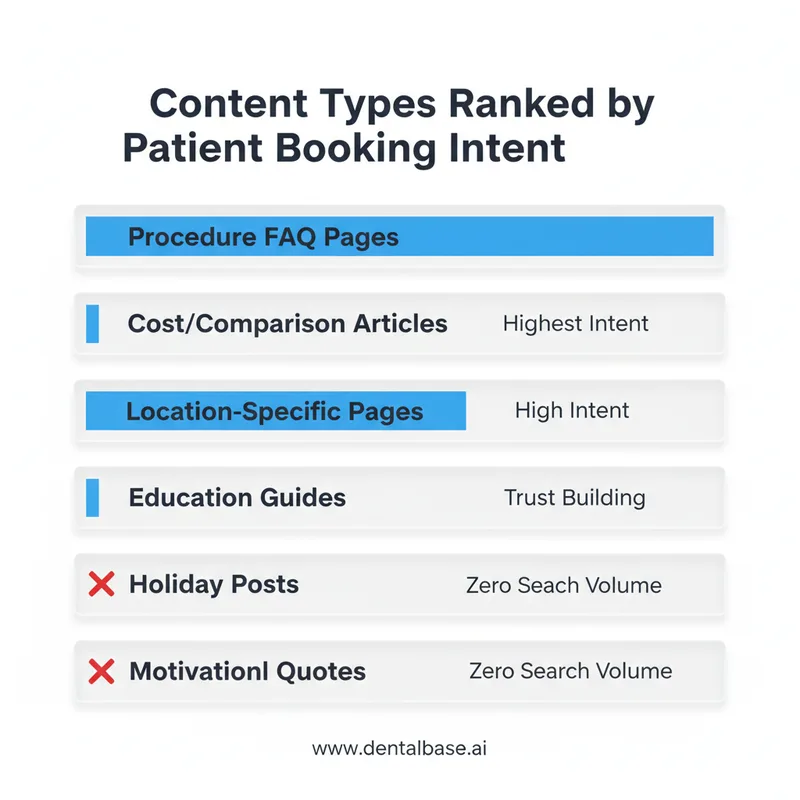
The content types that produce the best ROI for dental practices are procedure FAQ pages, cost comparison articles, location-specific service pages, and patient education guides. These formats rank well because they match how patients actually search and they target queries with real booking intent behind them.
Not all content is equal. A 300-word post about "the importance of brushing" won't rank, won't differentiate your practice, and won't convert anyone. The content that moves the needle is specific, data-backed, and answers a question the patient can't easily get answered elsewhere.
High-ROI Content Types
- Procedure FAQ pages (highest intent): "What to expect during a root canal," "Is Invisalign painful," "How long do dental implants last." These target patients researching a specific procedure they're likely to book. Each page should be 1,500-2,500 words with clinical context, recovery timelines, and a clear CTA to schedule a consultation. One strong FAQ page can generate 50-200 organic visits per month for years.
- Cost and comparison articles: "Dental implants vs. bridges: cost, pros, and cons" or "How much does Invisalign cost in [city]." Patients making $3,000-$8,000 treatment decisions want data, not marketing fluff. These pages rank for high-value commercial keywords and attract patients who are close to committing.
- Location-specific service pages: "Invisalign provider in [neighborhood]" or "Emergency dentist in [city]." These rank faster than generic service pages because they match exact local search queries. Build one for every service-area combination your practice targets.
- Patient education guides: "Complete guide to dental implant recovery" or "What happens if you skip your cleaning for two years." These build trust and position your practice as the authority. They also earn backlinks from other sites, which boosts your overall domain authority.
Skip these content types: "Happy National Dental Hygiene Month!" posts, motivational quotes with stock photos, and generic "5 tips for a healthy smile" articles. They don't rank, don't differentiate, and don't convert. Every piece of dental content marketing should target a keyword that real patients search for. For the full SEO approach to making content rank, see our guide on dental marketing SEO.
How Do You Build a Content System Your Practice Can Sustain?
You build a sustainable dental content marketing system by publishing 2-4 pieces per month on a fixed schedule, batching the work into one planning session, and focusing on evergreen topics that compound in value rather than timely posts that expire.
The biggest content marketing failure mode isn't bad content. It's inconsistency. A practice that publishes four excellent blog posts in January and then nothing until June gets worse results than one that publishes one decent post every two weeks for the full year. Search engines reward consistency. So do patients who start following your blog.
A Practical Monthly Workflow
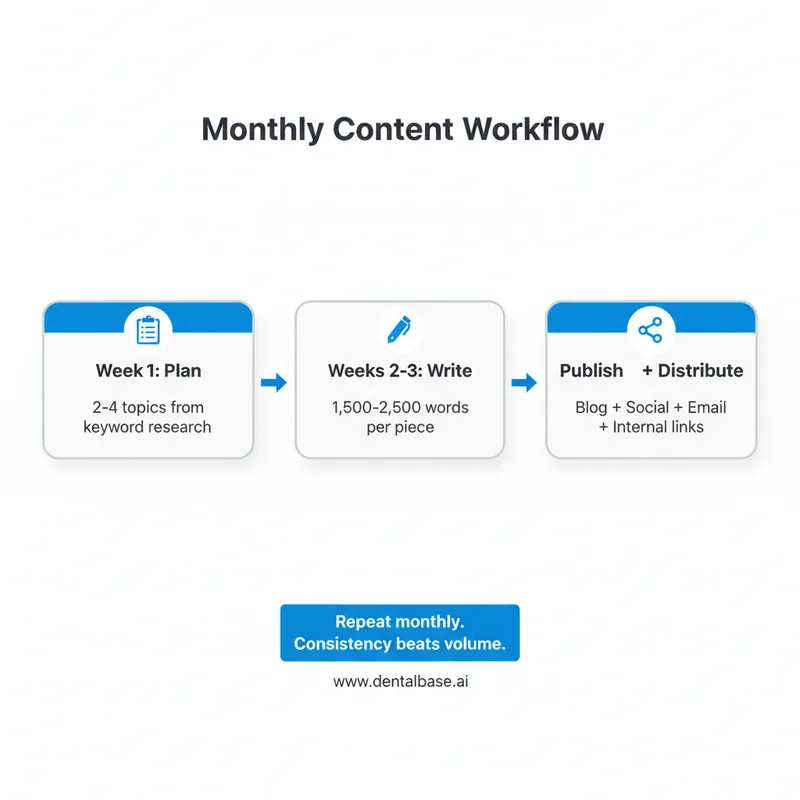
- Week 1: Plan. Pick 2-4 topics from your keyword research. Prioritize by search volume and patient intent. A 30-minute session with your team can generate a month of topics. Ask your front desk what questions patients ask most often. Those questions are your content calendar.
- Week 2-3: Write. Each piece should be 1,500-2,500 words, optimized for one primary keyword, and structured with H2 question headings that match how patients search. Include at least one internal link to a service page and one to another blog post. If you don't have a writer on staff, outsource to someone who understands dental terminology. Generic freelance writers produce generic content.
- Week 4: Publish and distribute. Post the article, share it on social media, include it in your monthly email newsletter, and link to it from related existing pages. A single blog post that gets shared across three channels reaches 5-10x more people than one that sits on your blog unannounced.
For a step-by-step approach to organizing this alongside your other marketing channels, our guide on building a dental office marketing plan walks through the full process.
Related: Content marketing also feeds your social media strategy. → Social Media Marketing for Dentists: The 2026 Playbook
How Does Content Marketing Work With SEO and AI Search?
Content marketing and SEO are inseparable for dental practices. Content gives search engines something to rank. SEO ensures that content is structured, targeted, and technically sound enough to appear in search results and AI-generated answers.
The landscape is shifting. AI Overviews now appear in 60%+ of all searches, according to Search Engine Land. Content with verifiable citations has a 34.9% AI selection rate versus 3.2% without, per Authoritas research. That means your dental content marketing needs to do more than rank in traditional results. It needs to be the source AI engines pull answers from.
Writing for Both Google and AI Engines
The good news: the same principles that rank well in Google also get cited by AI. Lead each section with a direct answer to the question in the heading (30-60 words). Include specific data points with named sources. Structure content with clear H2 and H3 headings. And make sure every claim is backed by something verifiable, not just opinion. AI engines extract 40-60 word answer blocks at 2.7x the rate of longer passages, per seoClarity research. Short, factual, front-loaded answers win in both traditional and AI search.
44.2% of AI citations come from the first 30% of an article's content. That means your intro and first two sections carry disproportionate weight. Put your strongest data, clearest answers, and primary keyword in the front half of every article. Don't save your best material for the conclusion.
For practices investing in dental local SEO, content marketing amplifies the effort. A blog post targeting "best dentist for implants in [city]" feeds both your organic rankings and your local authority. The two channels compound each other.
Content That Ranks in Google and Gets Cited by AI
DentalBase SEO builds content strategies optimized for both traditional search and AI answer engines, with keyword targeting, answer block structure, and citation formatting built in.
Learn About Dental SEO →Where Do Most Dental Practices Waste Their Content Budget?
Most dental practices waste their content budget on generic topics with no search volume, inconsistent publishing schedules, and content that never gets distributed beyond the blog page. These three mistakes turn content marketing from an investment into an expense.
The Three Biggest Content Wastes
- Writing for no one: A blog post about "Why we love dentistry" has zero search volume. Nobody is Googling that. Every piece of content should target a keyword that real patients search for. Use tools like Google's "People Also Ask" box, your front desk's FAQ list, and competitor blog analysis to find topics with actual demand. If you can't find search volume for a topic, don't write about it.
- Publishing and forgetting: A blog post that goes live and never gets shared is a tree falling in an empty forest. Share every post on social media (at least twice: once on publish day, once the following week). Include it in your next email newsletter. Link to it from your service pages. The distribution is as important as the writing.
- Hiring the wrong writers: A $50 blog post from a generic content mill reads like it was written by someone who has never been inside a dental office. Because it was. Patients and Google can both tell the difference. Invest in writers who understand dental terminology, can cite clinical sources, and write at a level that positions your practice as an authority, not a content factory.
Here's a useful benchmark for measuring whether your dental content marketing is working. Track organic traffic to your blog monthly. If it's growing 10-20% month over month after the first 90 days, your content strategy is working. If it's flat after six months of consistent publishing, something is wrong with your topic selection, your SEO, or both. For guidance on measuring returns across all your marketing channels, see our guide on dental marketing ROI.
How Does Content Marketing Reduce Your Long-Term Patient Acquisition Cost?
Content marketing reduces patient acquisition cost by building a library of pages that generate organic traffic without ongoing per-click costs. Once a blog post ranks, it produces visits and leads at near-zero marginal cost, unlike paid ads where every click requires a new payment.
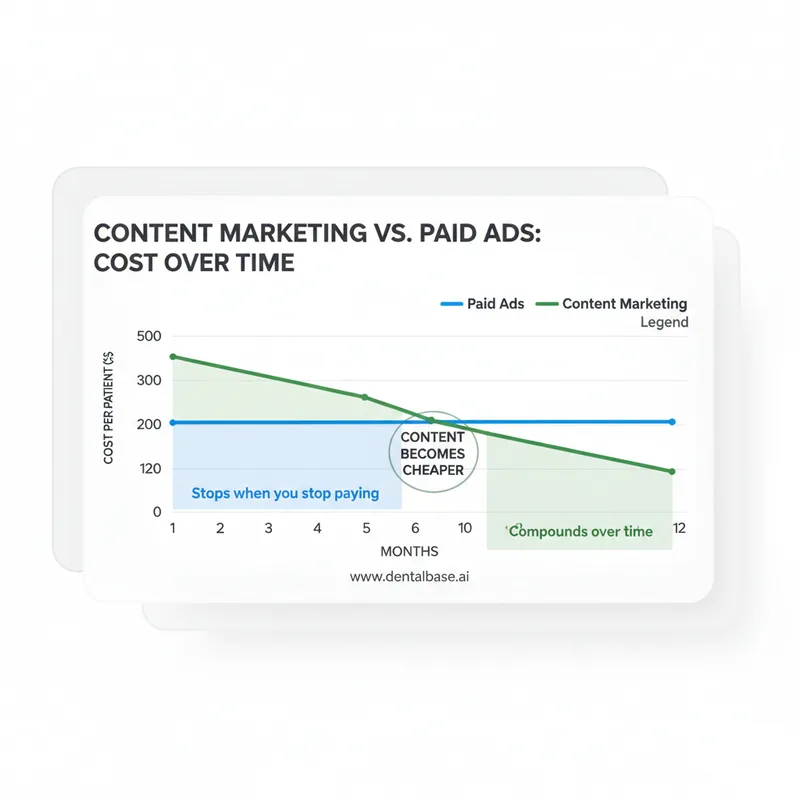
The average cost to acquire a new dental patient through paid channels runs $150-$300, per WordStream benchmarks. Through organic content, that cost drops to $20-$50 per patient once the content is ranking, because you've already paid for the writing and the ongoing cost is just hosting and occasional updates. According to HubSpot, businesses that publish consistent blog content generate significantly more organic traffic than those that don't. A practice with 30 ranking blog posts generating 3,000 organic visits per month at a 3.5% conversion rate (the dental industry average) is producing 105 leads monthly from content alone.
The compounding effect is what makes dental content marketing different from every other channel. A Google Ad produces one click per payment. A blog post produces thousands of clicks over its lifetime. After 12 months of consistent publishing, your content library becomes your largest and cheapest patient acquisition channel. That's the endgame: reducing your dependence on paid media by building owned assets that work 24/7.
Content marketing isn't the fastest way to fill your schedule. Dental PPC advertising does that. And it's not a replacement for patient retention marketing, which protects the patients you already have. But it's the only dental marketing channel where every dollar spent creates a permanent asset. The practice that publishes consistently for 12-18 months builds a competitive advantage that a bigger ad budget can't buy. Start with the content types that have the highest ROI: procedure FAQs, cost comparisons, and location-specific pages. Build a monthly rhythm your team can sustain. And measure organic traffic growth every 90 days to make sure the strategy is working. For more dental marketing techniques beyond content, we cover the full channel lineup separately. And if you're evaluating agencies to handle content for you, see our guide on the best dental marketing companies.
Ready to Build a Content Engine That Produces Patients?
DentalBase handles SEO, content strategy, and blog publishing alongside PPC and patient communication. See how it all works together.
Book a Free Demo →Explore more guides and tools for dental practice growth.
Browse Resources →Sources & References
Frequently Asked Questions
Expect 3-4 months before individual blog posts start ranking in Google. Meaningful organic traffic growth typically appears at 6-9 months of consistent publishing. By 12-18 months, a library of 20-30 posts can become your largest traffic source and lowest-cost patient acquisition channel.
Two to four pieces per month is the sweet spot for most practices. Publishing less than twice monthly makes it difficult to build momentum in search rankings. More than four per month is unsustainable for most teams without dedicated writers and rarely necessary for local dental markets.
Procedure-specific topics like 'how much do dental implants cost,' 'is Invisalign worth it,' and 'what to expect during a root canal' consistently get the most traffic because they match high-intent patient searches with real booking potential behind them.
No. Content marketing and PPC serve different patient journey stages. Google Ads capture patients ready to book today. Content captures patients still researching. Most growing practices run both, with content reducing long-term dependence on paid spend as organic traffic compounds.
Quality dental blog content costs $200-$500 per article from a specialized writer, or $2,000-$4,000 per month for an agency managing strategy and publishing. Against patient lifetime values of $12,000-$15,000, a single ranking blog post that generates one new patient per month pays for itself many times over.
Track organic traffic to your blog monthly, monitor keyword rankings for target terms, and measure how many new patient inquiries come from blog visitors using UTM parameters or intake forms. Aim for 10-20% month-over-month organic traffic growth after the first 90 days of consistent publishing.
Was this article helpful?
Written by
DentalBase Team
Expert dental industry content from the DentalBase team. We provide insights on practice management, marketing, compliance, and growth strategies for dental professionals.