
Dental SEO: How to Rank Your Practice on Google
Dental SEO is how practices show up when patients search 'dentist near me.' This guide covers every ranking signal—local, on-page, and technical—so practice owners can build organic growth that compounds over time.
Share:
Table of contents
Dental SEO is the discipline of making your practice visible to patients who are already searching for care. According to BrightEdge research, 68% of all online experiences start with a search engine—which means the majority of your prospective new patients type something into Google before they ever see your website, read a review, or call your front desk. If your practice does not rank, those patients go to the competitor who does.
The numbers behind the opportunity are worth pausing on. "Dentist near me" generates 1.2 million Google searches every month in the US. Organic search converts dental visitors at 3.5%—nearly double the roughly 2% rate of paid search, per WordStream. And unlike ads, rankings compound: a page that earns position one this year keeps earning visits next year without additional spend. That is the core case for investing in a dental SEO strategy.
This guide covers every major ranking signal—local, on-page, technical, and authority—along with a practical sequence for building or improving your practice's organic presence. It is written for practice owners and dentists who want to understand what they are buying, or building, before committing resources.
See How DentalBase Approaches Dental SEO
We work with practice owners who want organic growth without the guesswork. Book a free walkthrough to see the process.
Book a Free DemoWhat Is Dental SEO and Why Does It Differ from General SEO?
Dental SEO is the practice of optimizing a dental website and its surrounding digital footprint so it ranks prominently on Google when patients in a defined geographic area search for dental care. It differs from general SEO in two key ways: the dominant search intent is local ("dentist near me," "emergency dentist [city]"), and the conversion event is an appointment, not a purchase or a download. That combination—hyperlocal intent plus high-value, offline conversion—shapes every tactical decision.
General SEO focuses on ranking for informational or transactional terms at national scale. Dental SEO prioritizes the Google Map Pack (the three-listing block that appears above organic results for local queries), Google Business Profile signals, and city- or neighborhood-specific landing pages. A national retailer optimizes for breadth; a dental practice optimizes for depth within a five-to-ten-mile radius.
The other distinction is competition. Dental keywords are not as competitive as finance or insurance, but local markets vary enormously. A solo practice in a rural county faces different rivals than one in a dense urban ZIP code with fifteen DSO-backed competitors. Effective SEO for dentists requires a local competitive audit before any strategy is set.
How Does Google Decide Which Dental Practices Rank?
Google evaluates dental practices across three primary signals for local search: relevance (does your profile and website match what the patient searched?), distance (how close is your practice to the searcher?), and prominence (how well-known and trusted is your practice online?). Prominence is where most of the actionable work lives, because distance is fixed and relevance is table stakes once your pages are properly structured.
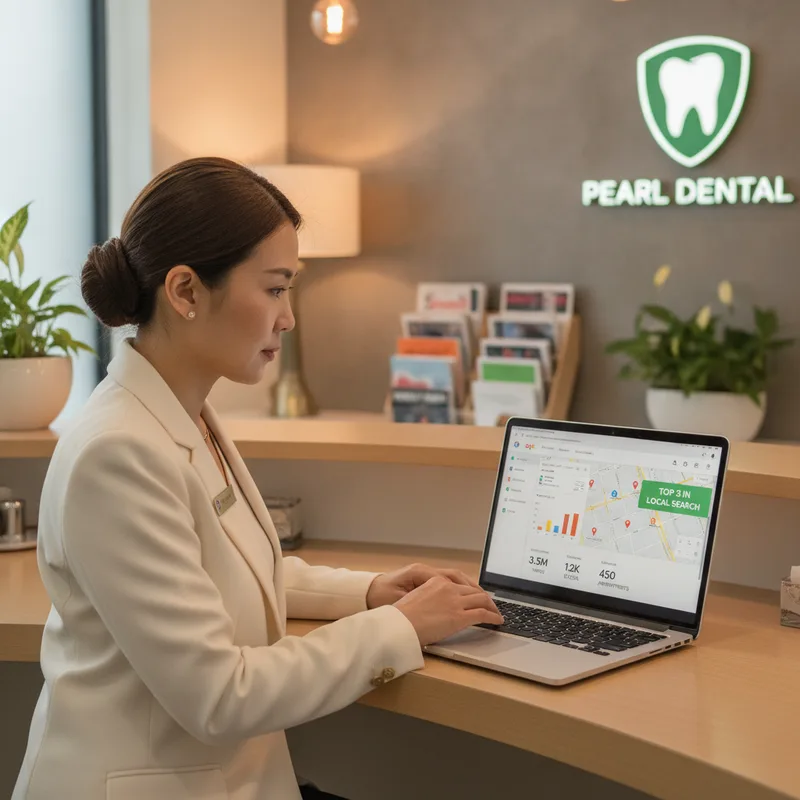
Within the Map Pack specifically, Google Business Profile completeness carries the most weight. Practices with complete category selections, updated hours, active Q&A sections, and recent photo uploads consistently outrank partially-filled profiles at similar distances. According to BrightLocal's Local Consumer Review Survey, 98% of people read local reviews before choosing a business—and review signals (quantity, recency, average rating, and owner response rate) are a confirmed local ranking input.
For organic blue-link results below the Map Pack, on-page content quality, keyword relevance, page speed, and backlink authority are the primary drivers. A practice that ranks in both the Map Pack and the top three organic results for a given query dominates the search results page in a way that compounds click-through rates significantly.
What Should a Dental SEO Strategy Include?
A well-structured dental SEO strategy has five interlocking components, each of which reinforces the others. Skipping any one of them creates a ceiling on how far your rankings can go.
1. Google Business Profile optimization. Claim and verify your GBP listing. Select your primary category as "Dentist" and add all relevant secondary categories (e.g., Cosmetic Dentist, Pediatric Dentist, Orthodontist). Fill every field: services, description with your primary keywords, business hours, holiday hours, and at least ten recent photos. Enable messaging. Post at least twice per month using the Posts feature.
2. On-page SEO. Each service you offer deserves its own page—not a bullet point on a catch-all "services" page. A page titled "Dental Implants in [City]" signals to Google that you are specifically relevant for that search. Title tags should include the primary keyword and location. Meta descriptions should communicate the appointment benefit. Internal linking between service pages and supporting blog content distributes authority across the site.
3. Local citation building. Citations are listings of your practice name, address, and phone number on directories like Yelp, Healthgrades, Zocdoc, and the ADA's provider finder. Consistency matters: even small variations (Street vs. St., Suite 200 vs. Ste. 200) across directories confuse Google's entity matching and suppress local rankings. Audit existing citations before building new ones.
4. Review generation. Build a repeatable system for requesting reviews from satisfied patients immediately after their appointment—SMS, email, or a QR code at checkout. Practices where owners respond to all reviews see 88% higher likelihood of patient contact, according to BrightLocal. Responding to negative reviews is not just reputation management; it is a ranking signal.
5. Content marketing. Blog content that answers real patient questions (cost, procedure anxiety, insurance coverage, recovery timelines) earns rankings for informational queries and establishes the authority that flows back to your service pages. Blogging for dentists is covered separately, but the connection to SEO is direct: authoritative content builds the domain authority that lifts every page on your site.
| SEO Component | What It Affects | Typical Time to Impact |
|---|---|---|
| Google Business Profile | Map Pack position | 2–6 weeks |
| Citation cleanup | Local trust signals | 4–8 weeks |
| On-page optimization | Organic keyword rankings | 6–12 weeks |
| Content marketing | Domain authority, long-tail traffic | 3–9 months |
| Link building | Competitive keyword rankings | 4–12 months |
How Do You Rank a Dental Website for Local Searches?
Ranking a dental website for local searches requires working the Map Pack and organic results simultaneously, because they respond to partially different signals. Here is how to approach each.
For the Map Pack: Start with GBP verification and category selection. Add services individually using GBP's service editor—each service you list improves your relevance for that specific query. Generate reviews consistently (ten or more recent reviews outperform fifty older ones). Build local citations on the top twenty directories and ensure NAP consistency across all of them. Upload fresh photos at least twice per month. Use GBP Posts to publish offers, events, or educational content weekly.
For organic results: Audit your current site structure. Every major service should have a standalone URL (e.g., /services/dental-implants-[city]/). Title tags should follow the formula: [Primary Keyword] in [City, State] | [Practice Name]. Each page needs a unique meta description. Internal links should flow from your homepage to service pages and from service pages to supporting blog content. Your homepage should include your city and primary services in the H1 and first paragraph.
According to Moz's local ranking factor research, on-page signals (proximity aside) are the second-most-influential factor for Map Pack rankings—meaning a well-structured website lifts both your organic and local rankings simultaneously.
What Role Does Technical SEO Play for Dental Practices?
Technical SEO is not glamorous, but it functions as a floor: poor technical health suppresses every other effort. A page with excellent content and strong backlinks can still fail to rank if it loads in five seconds on mobile or throws crawl errors. For dental practices, three technical factors matter most.
Page speed and Core Web Vitals. According to Google, consumers expect websites to load in three seconds or less—and mobile accounts for 62% of all dental-related searches. Google's Core Web Vitals (Largest Contentful Paint, Cumulative Layout Shift, Interaction to Next Paint) are confirmed ranking signals. A site that fails Core Web Vitals on mobile is penalized relative to a faster competitor, regardless of content quality.
HTTPS. Google has treated HTTPS as a ranking signal since 2014. An HTTP site in 2026 also triggers browser security warnings that deter patients before they even read a word. This is a solved problem, but legacy practice websites occasionally still run without SSL certificates.
Crawlability and indexing. Google must be able to find and index your pages. Common issues include noindex tags left on service pages after a redesign, duplicate content from www/non-www URL variants, and broken links on pages that should pass authority to high-value service pages. A basic technical audit using Google's Search Console and SEO Starter Guide catches most of these issues at no cost.
If you're evaluating your current site's performance, the DentalBase services overview includes a look at how technical site health feeds into local SEO results.
Does Link Building Matter for Dental SEO?
Yes, and it matters more as your market becomes more competitive. Link authority—the measure of how many trustworthy external websites link to yours—is one of Google's most durable ranking signals. For dental practices, the bar is lower than in national-scale industries, which means a targeted approach to acquiring even five to fifteen high-quality backlinks can meaningfully shift rankings.
The most practical sources of dental backlinks include: the American Dental Association's member resources, state and local dental association listings, dental school alumni directories, local news coverage of community events, and patient-facing review platforms that link back to your website. Sponsoring a local charity run, speaking at a community health fair, or partnering with a nearby medical practice on a referral program can all generate press or directory links that carry real authority.
What does not work: link farms, paid link schemes, or mass directory submissions to low-authority sites. Google has been penalizing these since the Penguin algorithm update, and a manual penalty from a link scheme is far more damaging—and harder to reverse—than simply building links slowly through legitimate means.
For practices focused on new patient acquisition more broadly, the new dental patient acquisition guide covers how SEO fits alongside referrals, paid media, and retention programs.
How Do Patient Reviews Affect Dental SEO Rankings?
Patient reviews influence dental SEO through two distinct pathways: direct ranking signals and conversion behavior. On the ranking side, Google measures review quantity, average star rating, recency, and whether the practice owner responds. A practice with forty reviews at 4.8 stars that adds five new reviews per month outperforms one with 200 older reviews and no recent activity, even controlling for other factors.

On the conversion side, BrightLocal's Local Consumer Review Survey found that 77% of patients use online reviews when finding a dentist, and 88% are likely to use a business if the owner responds to all reviews. That means reviews that go unanswered—even positive ones—represent a missed conversion signal to prospective patients reading the listing.
The practical implication: build a review request system that fires within 24 hours of a completed appointment. A two-step process (initial SMS or email with a direct Google review link, followed by one reminder three days later if no review is posted) consistently outperforms a single request sent weeks after the visit. Responding to every review—positive and negative—within 48 hours signals an active, patient-attentive practice to both Google and prospective patients.
Patient review patterns are also covered in the context of what they signal about overall practice health in our review strategy article.
What Is a Dental SEO Audit and What Does It Cover?
A dental SEO audit is a systematic assessment of everything that affects your practice's search visibility. It identifies gaps between where you rank now and where the competitive landscape says you could rank with targeted improvements. A thorough audit covers the following areas.
GBP audit: Is the listing verified? Are all categories, services, and photos complete? Are there duplicate listings that need to be merged? Is the phone number consistent with what's on your website?
On-page audit: Does every service have its own page? Are title tags and meta descriptions within character limits and keyword-optimized? Are there duplicate title tags across multiple pages? Is the H1 on each page unique and descriptive?
Technical audit: What does Google Search Console show for crawl errors and Core Web Vitals? Is the site HTTPS? Does the site pass mobile-friendliness testing? Are there orphan pages (pages with no internal links pointing to them)?
Citation audit: Is NAP data consistent across the top 20 directories? Are there any incorrect phone numbers or addresses from a previous location?
Backlink audit: What sites currently link to you? Are any links coming from spammy or irrelevant domains that should be disavowed?
Competitive gap analysis: Which keywords are your top three local competitors ranking for that you are not? Which of their pages earn the most estimated traffic?
The audit produces a prioritized action list, not just a report. The highest-leverage fixes—usually GBP completeness, NAP consistency, and thin service pages—should be addressed first, because they produce ranking improvements that validate the broader investment.
How Does Dental SEO Compare to Paid Search (Google Ads)?
Paid search and dental SEO serve different parts of the patient acquisition funnel and operate on different economic models. Understanding both helps practice owners allocate budgets more deliberately.
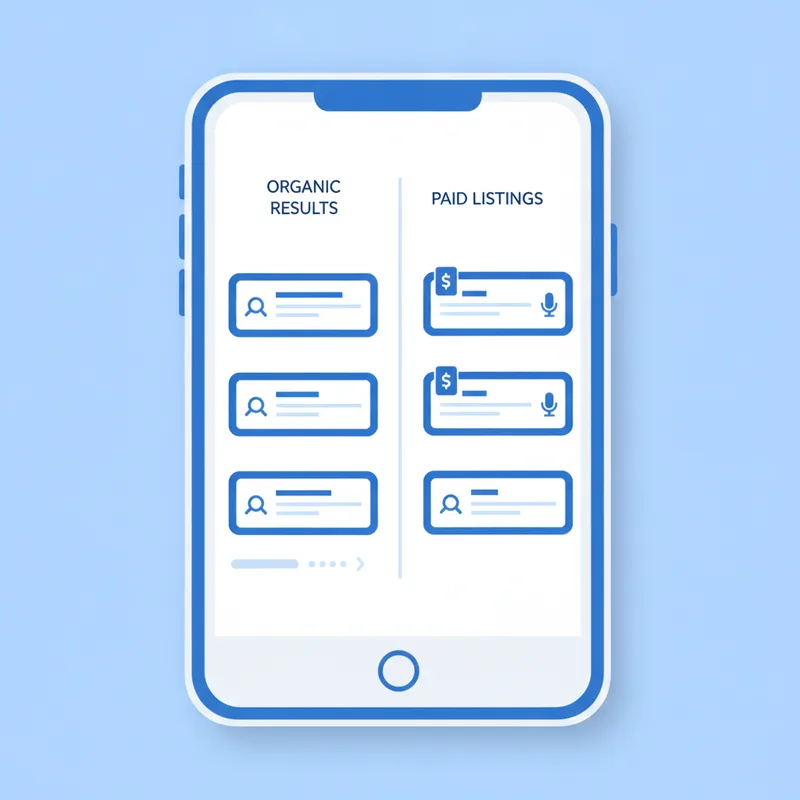
Google Ads delivers immediate visibility for high-intent queries—"emergency dentist near me" on a Tuesday morning, for example. The cost-per-click for dental keywords runs $6–$8 according to Google Ads benchmarks, and the conversion rate hovers at roughly 2%, per WordStream. Stop paying, and visibility stops immediately. That is a fundamentally different model from organic search, where rankings built over six to twelve months continue producing traffic without additional spend.
Organic search converts at 3.5%—a structural advantage over paid, driven partly by the trust patients extend to non-ad results and partly by the informational journey many patients take before scheduling. Search Engine Land's 2025 research on AI Overviews found that AI-generated answer boxes now appear on 60%+ of searches, which reduces organic CTR for some queries but increases the citation value of appearing in the answer itself—a position only organic content can earn.
For practices with a twelve-month-plus horizon, SEO is typically the stronger investment for sustainable new patient growth. Paid search is appropriate for launching a new location quickly, promoting a specific high-margin service, or covering a gap while SEO rankings build. Many practices run both, using paid to capture immediate demand while SEO builds the organic base.
The DentalBase PPC service covers how paid and organic work together for practices that want both channels managed in a coordinated way.
Organic vs. Paid: The Numbers Side by Side
Organic search conversion rate: 3.5% (WordStream)
PPC conversion rate for dentists: ~2% (WordStream)
Average cost per dental PPC click: $6–$8 (Google Ads Benchmarks)
How Should a Dental Practice Measure SEO Progress?
Measuring dental SEO requires tracking the right metrics at the right intervals—not obsessing over daily rank fluctuations, which are normal and expected. Here are the metrics that actually reflect progress.
Google Business Profile insights: Monthly views of your GBP listing, direction requests, website clicks, and phone calls originating from GBP. These are the clearest signals that local visibility is translating to patient intent.
Organic search traffic in Google Analytics: Total organic sessions, new user percentage, and the specific pages receiving organic traffic. Growing organic traffic to service pages (not just the homepage) indicates your content strategy is working.
Keyword position tracking: Track fifteen to twenty core keywords monthly—your primary service terms plus location modifiers. Movement on these terms is your report card for on-page and authority efforts.
Conversion events: How many organic visitors complete a contact form, book an appointment online, or call the practice from the website? Google Analytics goals or a call tracking number tied to organic traffic make this measurable. According to a PatientPop study, 48% of patients conduct over two weeks of research before scheduling—so tracking assisted conversions (not just last-click) gives a more accurate picture of SEO's contribution.
Review velocity: How many new Google reviews per month? The trend matters as much as the total count. A practice consistently earning five new reviews per month signals ongoing engagement to Google's local algorithm.
The patient source tracking guide covers how to attribute new patients accurately across all channels—including distinguishing organic search from direct or referral traffic.
What Dental SEO Services Actually Include
Dental SEO services vary widely in scope and quality. Understanding what a professional engagement should cover helps practices evaluate providers and hold them accountable. A well-structured dental SEO engagement typically includes the following deliverables.
Month 1–2 (foundation): Technical audit and remediation, GBP optimization, NAP citation audit and cleanup, keyword research, and on-page optimization for priority service pages.
Ongoing (monthly): New content creation (two to four pages or posts per month), backlink outreach, GBP posting, review response management, rank tracking, and monthly performance reporting with next-period priorities.
Quarterly: Content gap analysis, competitor ranking analysis, and a review of technical health to catch any new crawl issues introduced by site updates.
Red flags in a dental SEO proposal include guaranteed ranking positions (no ethical agency can guarantee Google's algorithm), month-one ranking results for competitive terms (rankings take time to move), and link-building packages that do not specify the domains or methods used. A credible provider will show you case studies from comparable practices, explain what they are doing each month, and connect their work to appointment metrics—not just ranking metrics.
The DentalBase dental SEO service page outlines how the engagement is structured and what practice owners can expect at each phase.
Ready to Build Organic Patient Growth?
See how DentalBase builds dental SEO programs for practices that want consistent, measurable results from organic search.
Sources & References
- Moz Local Search Ranking Factors
- BrightLocal: Local Consumer Review Survey 2024
- Search Engine Land: AI Overviews in 60%+ of Searches (2025)
- Dental Economics: Digital Marketing for Dental Practices
- BrightLocal: Local Citation Building for Small Businesses
- ADA Practice Management Resources
- HubSpot: SEO and Marketing Statistics
Frequently Asked Questions
Most practices see measurable ranking movement on local and neighborhood terms within three to six months. Competitive city-center keywords typically take six to twelve months. The timeline depends on domain age, competition level, and whether foundational issues like an unverified Google Business Profile or thin service pages are addressed quickly.
Dental SEO services typically range from $500 to $3,000 per month depending on market competition, the number of locations, and the scope of work. A single-location practice in a mid-size market often sees meaningful results in the $800–$1,200/month range. The question worth asking is cost-per-acquired-patient compared with paid search or direct mail.
Local SEO focuses on the Google Map Pack—the three-business listing that appears above organic results for 'dentist near me' queries. General dental SEO targets the organic blue-link results for broader terms like 'dental implants' or 'how much does a crown cost.' Both matter; local SEO drives immediate appointment intent while organic SEO builds authority over time.
Yes. Google uses review quantity, recency, and average rating as local ranking signals. According to BrightLocal, 98% of people read local reviews before choosing a business, and practices where owners respond to all reviews see 88% higher likelihood of patient contact. A consistent review generation strategy directly supports both conversions and rankings.
Both serve different roles. Google Ads delivers immediate visibility but stops when spend stops; organic search converts at 3.5% versus roughly 2% for paid, and rankings compound over time. Most practices with a twelve-month horizon benefit from SEO as the foundation, with paid ads used to cover gaps or launch new services quickly.
Google Business Profile completeness and proximity are the most-cited local ranking factors. Beyond GBP, consistent NAP (name, address, phone number) data across directories and a steady stream of recent patient reviews carry the most weight. On-page relevance signals—service pages and location pages—are the next-highest-leverage area.
Was this article helpful?
Written by
DentalBase Team
Expert dental industry content from the DentalBase team. We provide insights on practice management, marketing, compliance, and growth strategies for dental professionals.