AI Dental Radiograph Software: Pearl, Overjet, Videa
Compare AI dental radiograph software from Pearl, Overjet and VideaHealth: what each FDA clearance covers, why accuracy claims are not comparable.
Share:
Table of contents
Choosing ai dental radiograph software has become harder as the marketing has got louder. All three of the widely deployed platforms hold FDA clearances. All three publish figures showing dentists find more disease with their help. None of those figures can be compared against each other.
That is not a criticism of any vendor. It is how the clearance pathway works. Each company ran its own trial, with its own readers, its own image set and its own endpoint, then submitted it separately. Reading the numbers side by side is a category error.
This guide sets out what Pearl, Overjet and VideaHealth are each documented as cleared to do, why the accuracy claims resist comparison, how the software reaches your imaging and practice management systems, and what changes at the chair when a patient sees a coloured overlay. Our practice growth services cover the case presentation side rather than the imaging side.
What Is AI Dental Radiograph Software, and What Does It Do?
It is software that analyses dental x-rays and marks suspected findings for the dentist to review. Ai dental radiograph software does not diagnose. It flags regions of interest, usually as a coloured outline or box, and the clinician decides what the finding means.
The regulatory category is computer-aided detection, shortened to CADe. These are prescription devices, cleared as an aid to a qualified clinician rather than a replacement for one. That distinction is not marketing softness. It is the legal basis on which every one of these products is sold.
It is the same clinical ceiling that limits virtual dental visits: both categories assist a clinician's judgment, and neither one replaces the hands-on exam once a finding needs to be confirmed in the chair.
What the software typically marks
- Caries. The anchor use case, generally on bitewing and periapical images.
- Bone levels. Measured or estimated for periodontal assessment.
- Calculus and periapical radiolucencies. Available on some platforms, not all.
- Restoration findings. Margins, existing crowns, bridges and implants, depending on the clearance.
Adoption is moving quickly. Around 73% of dental practices plan to adopt AI tools by 2027, according to Dental Economics, and caries remains the condition being targeted first for good reason. Tooth decay is among the most prevalent chronic diseases, as the National Institute of Dental and Craniofacial Research data shows.
That 73% adoption figure spans more than clinical imaging tools. Many of the same practices are also exploring how dental teams are putting ChatGPT to work outside the operatory, for marketing and administrative tasks that have nothing to do with reading a radiograph.
What Does FDA Clearance Actually Mean Here?
It means the FDA agreed the device is substantially equivalent to one already legally marketed. A 510(k) clearance is not an approval, not a certification of accuracy, and not a finding that one product outperforms another. It is a pathway based on comparison to a predicate device.
This gets misread constantly, including by people selling the software. "FDA cleared" tells you a review happened. It tells you nothing about how the product performs against a competitor, because the FDA never ran that comparison.
Three questions "FDA cleared" does not answer
Which finding is it cleared to detect? Which image type, bitewing, periapical, panoramic or CBCT? And which patient ages? A single vendor may hold several clearances covering different combinations, and the one you care about may not be included.
Clearance is not reimbursement
Worth separating early. A cleared device can still be unbillable, because clearance says nothing about whether a payer will reimburse anything associated with its use. Treat those as two unrelated questions when you build the business case.
What Is Pearl Second Opinion Cleared For?
Pearl's Second Opinion holds the broadest set of imaging modalities among the three. It received 510(k) clearance in March 2022 for detecting a range of dental conditions on radiographs, and Pearl has added clearances since covering bone level measurement, paediatric caries, CBCT and panoramic images.
Pearl (Second Opinion)
Founded 2019 · Los Angeles
First clearance: March 2022, multiple pathologies on 2D radiographs
Modalities cleared: Bitewing, periapical, CBCT, panoramic
Panoramic clearance: December 2025, for caries, periapical radiolucencies and impacted third molars
Paediatric: Caries detection from age 4, primary or mixed dentition
Output style: Colour-coded detection overlays across several finding categories
The panoramic clearance in December 2025 is the notable recent addition, because panoramic images are difficult to read consistently. Anatomical overlap and distortion make them harder than bitewings. Pearl states that clearance was supported by a standalone performance study plus a fully crossed multi-reader, multi-case trial.
For a practice already taking panoramic images routinely, that coverage matters more than a headline accuracy figure. Ask which of your image types are actually included.
What Is Overjet Cleared For?
Overjet's clearances centre on measurement rather than detection alone. Its first clearance, in 2021 for Dental Assist, covered radiographic bone level measurement in periodontal disease, and it reports 7 clearances across 2021 to 2025 including caries detection, calculus, charting and CBCT.
Overjet
Founded 2018 · Boston
First clearance: 2021, radiographic bone level measurement in periodontal disease
Caries clearance: May 2022, Caries Assist, detection and outlining on bitewings
Quantified output: Bone level as a percentage of root length, at mesial and distal sites
Reported clearances: 7 between 2021 and 2025, including a CBCT clearance in December 2025
Also sells to: Payers and dental groups, alongside practice-side products
The quantified output is the real differentiator to understand, and it is a difference in kind rather than quality. A numerical bone level percentage gives your hygienist something specific to reference during a perio conversation. A detection box does not.
The dual-market fact worth knowing
Overjet sells to insurers and large dental groups as well as to practices, with its platforms reported as covering more than 75 million Americans through payer and group deployments. That is neither good nor bad on its face. But you should know that the same analytical technology operates on both sides of a claim, and decide for yourself whether that matters to you.
Related: Network decisions and payer relationships deserve their own analysis. Read the guide to dropping a PPO plan →
What Is VideaHealth Cleared For?
VideaHealth's clearances span the widest range of individual algorithms. Videa Caries Assist was cleared in May 2022 for caries detection, and in January 2024 Videa Dental Assist was cleared covering more than 30 AI algorithms across most common dental conditions, including paediatric caries from age 3.
VideaHealth
Founded 2018 · Boston
First clearance: May 2022, Videa Caries Assist for caries detection
Expanded clearance: January 2024, Videa Dental Assist, more than 30 algorithms
Conditions covered: Caries, periapical radiolucencies, calculus and others
Paediatric: Caries detection from age 3
Training data: Reported at more than 100 million data points from DSOs, insurers and universities
The training-data claim deserves a moment. Dataset breadth is offered as evidence that a model generalises across patient populations, which is a reasonable argument and an unverifiable one from outside. You cannot audit it. Treat it as a stated design priority rather than a measured outcome.
Detection is the easy part. Getting the case accepted is not.
DentalBase does not sell imaging AI. We work on the case presentation, follow-up and reactivation that decide whether a flagged lesion becomes booked treatment.
See how case follow-up works →How Do the Three Compare on Documented Capability?
They overlap heavily on caries and diverge on everything else. All 3 are cleared for caries detection on standard intraoral radiographs, and the meaningful differences sit in imaging modalities, quantified output, paediatric age ranges and how many separate findings each clearance covers.
| Documented capability | Pearl | Overjet | VideaHealth |
|---|---|---|---|
| Caries detection | Yes | Yes | Yes |
| Bone level, quantified | Bone level measurement cleared | Percentage of root length | Not the stated focus |
| Panoramic images | Cleared December 2025 | Not stated | Not stated |
| CBCT | Cleared | Cleared December 2025 | Not stated |
| Paediatric caries | From age 4 | Ages vary by clearance | From age 3 |
| Published list pricing | None | None | None |
Read "not stated" as exactly that, not as absent. These companies file new clearances often, and this table reflects what is documented publicly rather than a product roadmap. Confirm current coverage with each vendor in writing before you decide anything.
What a capability grid cannot show you is fit. Any ai dental radiograph software looks convincing on a vendor's sample images, because those images were selected. What matters is how it behaves on yours, at your sensor resolution, with your exposure habits and your patient mix.
So use the grid to cut the field to 2 candidates, then test those 2 properly. Running all 3 in parallel takes longer and teaches your team less.
Why Can You Not Compare Their Accuracy Numbers?
Because each figure comes from a different study answering a different question. Overjet reports dentists detecting 32% more carious surfaces in an analysis of over 7,000 tooth surfaces. VideaHealth reports 43% fewer missed caries and 15% fewer erroneous detections in its trial. Different designs entirely.
Consider what varies between those studies. The readers differ in number and experience. The image sets differ in source, quality and disease prevalence. The reference standard differs. The endpoint differs, since "more surfaces detected" and "fewer lesions missed" are not the same measurement.
A higher percentage from a different trial is not a better product. It is a different question.
There is a deeper issue as well. A study showing more detections cannot, on its own, tell you whether those extra detections were correct. More findings is only an improvement if the findings are real, which is why VideaHealth reporting a reduction in erroneous detections alongside its sensitivity figure is a more informative pairing than a detection rate alone.
Call these patients in week one
- ✓ Ask for the study design, not the headline figure.
- ✓ Ask how many readers took part, and their experience.
- ✓ Ask what the reference standard was.
- ✓ Ask for peer-reviewed publications, not press releases.
Hold these until February
- ✗ Comparing percentages from separate vendor trials.
- ✗ Treating "FDA cleared" as an accuracy ranking.
- ✗ Accepting a demo on hand-picked images as evidence.
- ✗ Assuming performance holds on your own image quality.
Bring the study design to your next vendor call
We are not selling imaging AI, so we have no stake in which one you pick. If it helps to talk through the evaluation and what happens to diagnosed treatment afterwards, that is what a call is for.
Talk it through →How Does It Integrate With Your Imaging and Practice Software?
Through your imaging software in most cases, which is the constraint that decides feasibility. These platforms read radiographs from the imaging system and display overlays inside or alongside it, so the practical question is whether your specific sensor and imaging combination is supported today.
What to establish before a trial
- Your imaging software and version. Support is granular. A vendor supporting a platform may not support your release of it.
- Where the overlay appears. Inside your existing viewer, or in a separate window your team must switch to.
- Whether findings write back. Do flagged findings reach the chart, or stay in the AI layer only.
- Where images are processed. On-premise or in the cloud, and which vendor holds them afterwards.
- Speed at the chair. Seconds matter when a hygienist is mid-appointment.
The data question is a compliance question, not just an IT one. Radiographs are protected health information, so any cloud processing needs a business associate agreement and a clear answer on retention and secondary use of your images.
The same integration questions surface when you evaluate AI at the front desk rather than the operatory. Our comparison of Adit, Weave, and DentiVoice on practice management integrations applies this test to the phone and scheduling side of the stack.
Related: Vendor data handling deserves the same scrutiny you give messaging tools. Review what HIPAA requires of patient communication →
What Does AI Dental Radiograph Software Cost to Run?
None of the three publishes list pricing, so every figure in circulation is a third-party estimate. Expect per-provider or per-location monthly subscriptions, often with setup or integration fees, and expect the quote to change with practice size and contract length.
Because published numbers do not exist, the useful move is to normalise the quotes you receive rather than hunt for a benchmark. Ask each vendor for the same structure and compare like with like.
Normalise these five things across quotes
- Unit of pricing. Per provider, per location, per chair or per image analysed.
- What counts as a user. Hygienists and associates often price differently to owners.
- Setup and integration fees. Frequently separate, sometimes mandatory.
- Contract term and exit. Notice period, and what happens to your image data afterwards.
- Training included. Calibration across your team is the difference between adoption and shelfware.
Then judge it against production, not against the invoice. If the software surfaces treatment that was genuinely present and the patient accepts it, the arithmetic works quickly given average patient lifetime value of $12,000 to $15,000 for a general dentist, per Dental Economics. If nothing changes in your case presentation, it will not.
Does the Overlay Change Case Acceptance?
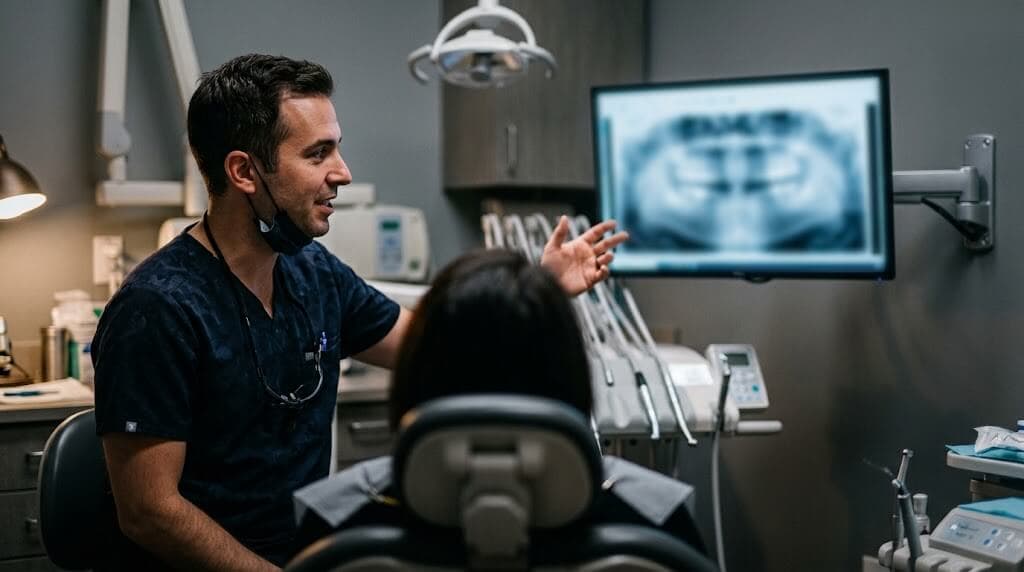
Often yes, and this is where practices see the effect first. A coloured outline on a lesion gives a patient something specific to look at, which converts an abstract recommendation into a visible finding they can see for themselves on the screen.
Be careful about the mechanism. The overlay is a communication aid, not a persuasion device, and using it to pressure a patient into treatment is both an ethical problem and a clinical one. The dentist's judgement still determines whether treatment is indicated at all.
Where the gains actually come from
Patient trust is doing the work here. Some 98% of consumers read local reviews before choosing a business, BrightLocal's survey found, and the same instinct applies in the chair. Patients want evidence, not assertion. Visual evidence closes that gap faster than a verbal explanation does.
The follow-through is where the gain usually leaks away. A patient who accepts treatment still has to schedule it and pay for it, and response speed moves conversion across every channel, as HubSpot's benchmark data shows. Have the money conversation ready before the overlay creates demand, whether that means an in-house membership plan or a third-party option.
Then protect the appointment you just made. SMS reminders cut no-show rates by 38%, according to the Journal of Dental Hygiene, and automated recall lifts patient return rates by 25-40%, Dental Economics reports. Newly diagnosed treatment that no-shows twice tends to quietly disappear from the schedule.
Timing matters as well. Treatment diagnosed late in the year meets exhausted annual maximums, which is why a Q4 benefits campaign pairs neatly with newly surfaced findings. Diagnose in October, and the plan still has room.
The overlay opens the conversation. Something has to finish it.
Flagged treatment still needs presenting, financing and following up. See how DentalBase handles the presentation and follow-up side of newly diagnosed treatment.
Book a walkthrough →Related: Scripts matter more once the patient can see the finding. Read 25 front desk scripts and prompts →
What Are the Real Risks of Adopting It?
Over-detection is the one clinicians raise most, and it is legitimate. A system tuned toward sensitivity will flag more, including findings that do not warrant intervention, and a team that treats every flag as a diagnosis will overtreat. The software's calibration and your team's discipline both matter.
Four failure modes to plan for
- Automation bias. Clinicians deferring to the overlay instead of reading the image themselves.
- Documentation drift. Charting an AI flag as a clinical finding without independent confirmation.
- Inconsistent thresholds. Two associates treating the same flag differently, which patients notice.
- Shelfware. Paid for, switched on, ignored by the team within 6 weeks.
Calibrate before you launch, not after
Run the software silently on a few weeks of images and compare its flags against what your clinicians recorded independently. Where you disagree is your training agenda, and where any ai dental radiograph software earns or loses your team's trust.
Patients who feel oversold do not argue. They simply do not return, and 20-30% of patients go inactive within 18 months without follow-up according to the ADA. Trust is the asset at risk here, which the ADA's practice management resources treat as a core operational concern rather than a soft one.
The economics reinforce the point. Reactivating an existing patient costs 5-7x less than acquiring a new one, Harvard Business Review has reported, and replacing one through digital channels runs $150 to $300 on WordStream's benchmarks. An overtreatment reputation is an expensive way to save time on radiograph review.
Where Should You Start?
Start by writing down the finding you actually want help with. A practice worried about interproximal caries has a different shortlist to one building a periodontal programme, and that single sentence eliminates most of the comparison work before you speak to anyone.
Then verify 3 things in writing: that the clearance covers your finding, your image type and your patient ages; that your exact imaging software and version is supported; and what happens to your radiographs in the vendor's cloud. Everything else is negotiable.
Ask each vendor for their study design this week, and give them a deadline you would apply to any other supplier. The one that sends it without being chased twice is telling you something useful about how support will feel in 12 months.
Flagged treatment still has to get scheduled
Imaging AI finds the disease. DentalBase works on the presentation, financing conversation and follow-up that turn a finding into completed treatment.
Book a free demo →Sources & References
Frequently Asked Questions
Cleared, not approved. These products go through the 510(k) pathway, which establishes substantial equivalence to a device already on the market. Approval refers to a different and more demanding pathway that these detection tools do not use.
No. These are computer-aided detection devices cleared as an aid to a qualified clinician, not a replacement. The software marks suspected findings, and the dentist remains responsible for diagnosis and for deciding whether treatment is indicated.
There is no published head-to-head trial, so the question cannot be answered from available evidence. Each company ran separate studies with different readers, image sets and endpoints. Comparing their reported percentages against each other is not valid.
It depends on your specific software and version, since support is granular rather than universal. Confirm your exact imaging platform, release version and sensor combination with the vendor in writing before agreeing to any trial period.
Clearance and reimbursement are unrelated. A cleared device carries no guarantee that any payer will reimburse differently, so build your business case on treatment actually diagnosed and accepted rather than on expected claim outcomes.
It can, if a team treats every flag as a diagnosis. Systems tuned toward sensitivity surface more findings, including some not warranting intervention. Calibrating your clinicians against the software before launch is the practical safeguard.
Some indications are. VideaHealth reports paediatric caries detection from age 3 and Pearl from age 4, with primary or mixed dentition. Age ranges differ by clearance, so confirm the specific paediatric indication rather than assuming coverage.
Was this article helpful?
Written by
DentalBase Team
Expert dental industry content from the DentalBase team. We provide insights on practice management, marketing, compliance, and growth strategies for dental professionals.