ChatGPT Prompts for Dental Front Desk Teams: 25 Examples
Copy-paste ChatGPT prompts for dental front desk teams: price shoppers, insurance questions, recall calls, no-shows, and review replies.
Share:
Table of contents
ChatGPT prompts for dental front desk teams are reusable instructions that turn a blank chat box into a repeatable draft generator for price-shopper calls, recall texts, no-show follow-ups, and review replies. They solve a narrow problem, and they solve it well. Your coordinator has forty seconds between a check-in and a ringing line. She does not have time to write a careful reply to a price shopper, a lapsed patient, or an upset caller from scratch.
What this guide covers
| → | The five-part structure every working prompt needs |
| → | 25 copy-ready prompts across six call types |
| → | The guardrail that stops invented fees and coverage numbers |
| → | A four-week rollout your team will actually follow |
| → | Where prompts stop helping and coverage has to take over |
The gap is real, and it is measurable.
38% of new patient calls go unanswered during business hours (ADA Practice Transitions) | 15-20 calls missed per week at the average practice (Dental Economics) | $1,200+ in lifetime value lost per missed new patient call (Dental Economics) |
Better drafting will not fix a staffing shortfall, but it removes friction from the work your team already does. Practices that pair prompts with the right dental marketing and front desk services tend to see the difference fastest.
Below are 25 prompts your team can copy today, grouped by the calls and messages that actually eat the day. Each one produces short, spoken-sounding language you can use on the phone or paste into a text.
Why do dental front desk teams need prompts at all?
They need prompts because a blank chat box produces generic output. A prompt turns ChatGPT into a repeatable draft generator, so a coordinator writes a recall message or a price-shopper reply in seconds instead of rebuilding the wording from scratch on every single call.
What a Monday actually looks like at the desk
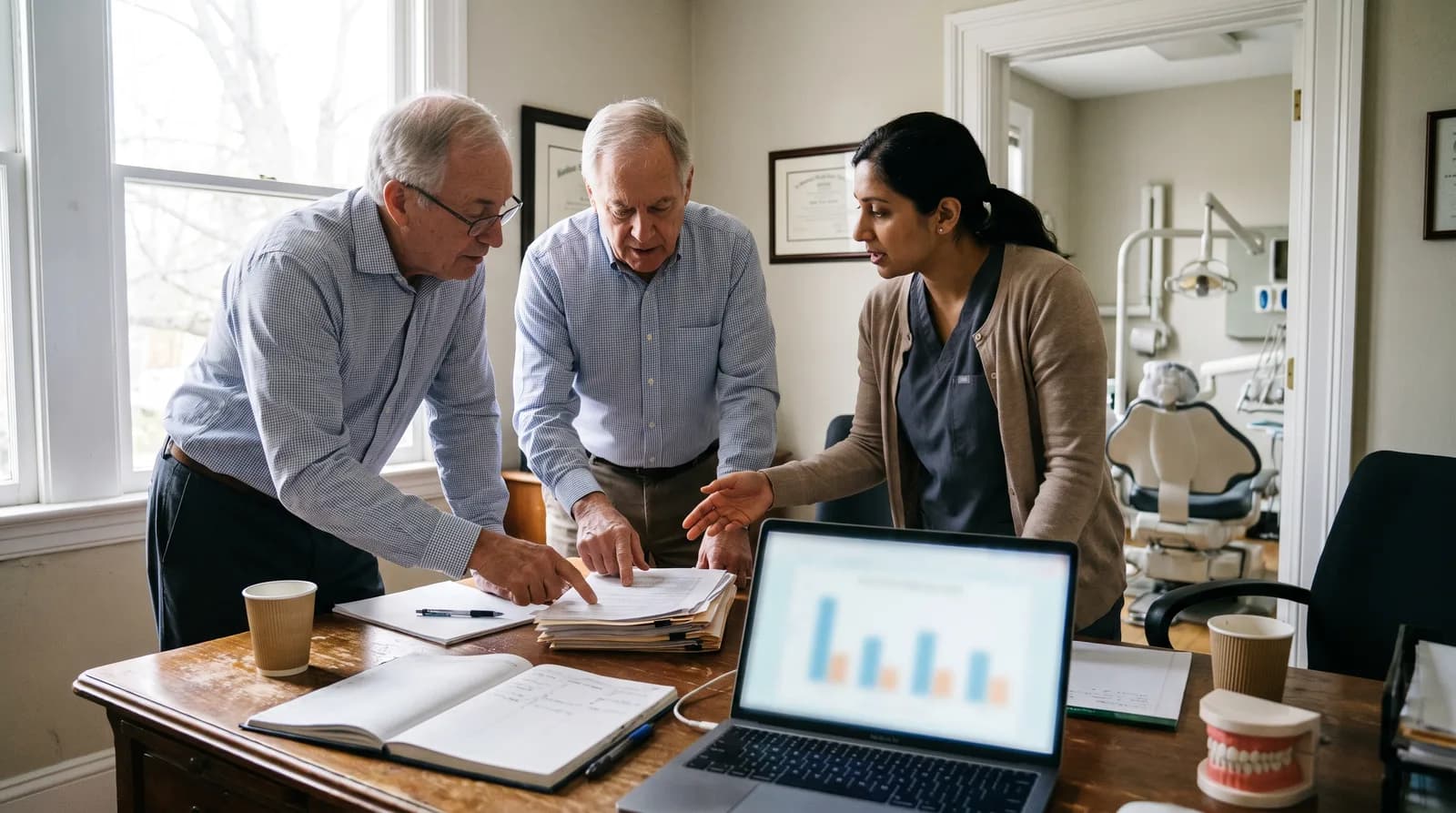
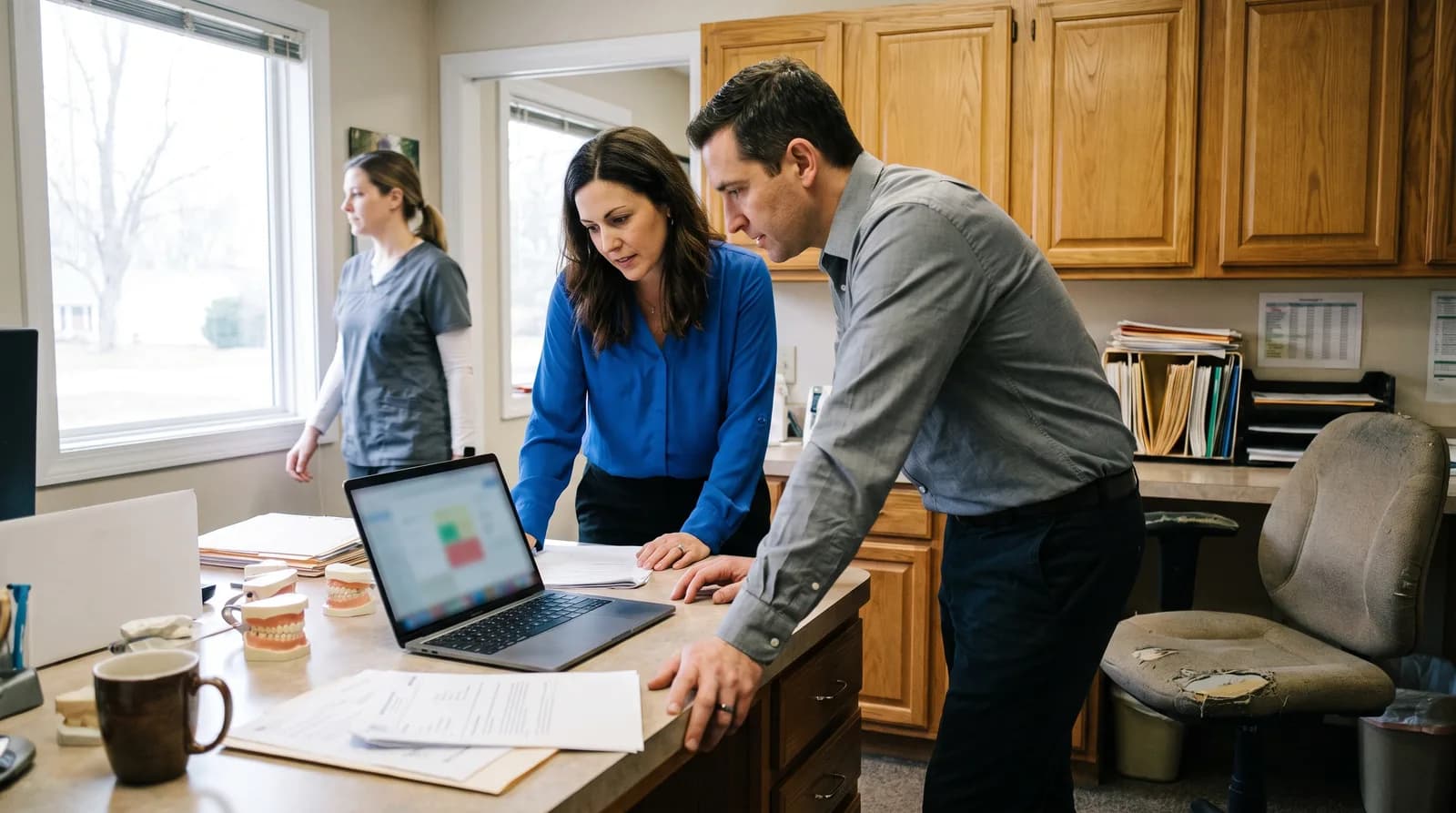
Think about what the desk absorbs. Check-ins, insurance verification, two walk-ins, a lab call, and the phone every few minutes. Something gets dropped. Usually it is the follow-up nobody owns.
Why turnover makes this worse
Dental assistant and front office roles carry steady turnover, and the Bureau of Labor Statistics projects continued growth in dental support occupations, which keeps the hiring market tight. A new hire who cannot write a confident reply to "how much is a crown" costs you patients for months.
Prompts help a new hire ramp up faster, but they work best alongside a real cross-training plan for the front desk that covers scheduling, insurance, and checkout, not just phone scripts.
Prompts shorten that ramp. They are training wheels that produce usable language on day three instead of month three, which pairs well with a structured front desk training plan for day one.
Related: Front desk capacity, not marketing spend, is what caps most practices. Read about front desk bandwidth →
What makes ChatGPT prompts for dental front desk teams work?
A working prompt has five parts: role, situation, constraint, format, and goal. Drop any one and the output drifts. Constraint matters most in dentistry, because that is what stops ChatGPT from inventing a fee, a coverage percentage, or a clinical claim nobody on your team authorized.
The five parts, side by side
| Part | What it does | Example wording |
|---|---|---|
| Role | Sets vocabulary and seniority | "You're a scheduling coordinator at a two-doctor general practice." |
| Situation | Gives the model the real facts | "A caller asks the price of a crown. We're out of network with her plan." |
| Constraint | Stops the guessing and the fluff | "Never quote a dollar figure. Don't mention insurance coverage amounts." |
| Format | Makes output usable at the desk | "Give me three versions, each under 40 words, spoken not written." |
| Goal | Points the reply somewhere | "End by offering a specific exam time this week." |
The guardrail that prevents invented numbers
Here's the thing about constraints. Left alone, the model will happily tell a caller that a crown "typically runs $1,000 to $1,500." That number came from nowhere. It is now a promise your practice has to honor or walk back.
So write the guardrail into the prompt itself. Every one of the 25 prompts below assumes it. Two lines is enough:
Reusable guardrail, paste at the end of any prompt
Never state a specific fee, insurance percentage, or clinical outcome. If a number is needed, write [FEE] and I'll fill it in. Keep every reply under 45 words and write it to be spoken out loud, not read.
It travels well. If your team is new to prompting in general, our wider guide to using ChatGPT in a dental office covers the basics before you specialize.
Which prompts handle price shopper calls?
Price shopper prompts work by shifting the call from a number to a next step. The goal is not to dodge the question. It is to answer honestly, explain why the fee varies by case, and offer a specific appointment time before the caller hangs up and dials another practice.
Three prompts to start with
1. The out-of-network crown call
You're a scheduling coordinator at a general practice. A caller asks what a crown costs. We're out of network with her plan. Write three replies under 40 words that acknowledge the question, explain the fee depends on the tooth and any build-up needed, and offer an exam Thursday at 2pm or Friday at 10am.
2. The uninsured new patient
Same role. Caller has no dental insurance and asks about a cleaning and exam. Mention we have a new patient exam option and payment plans without quoting figures. Two versions, one warmer, one more direct.
3. The comparison shopper
Caller says another office quoted less. Write a 35-word reply that doesn't criticize the other practice, names one thing we include that's worth asking about, and offers to hold a time.
Notice the third one. It gives the model something concrete to work with instead of asking it to be persuasive in the abstract.
Nobody drafts a good reply while three lines are ringing.
DentiVoice answers overflow and after-hours calls with dental-trained AI, then books straight into your PMS.
See how the AI receptionist works →How do you prompt for insurance questions without creating problems?
Carefully, and with one hard rule: the prompt must forbid the model from stating coverage. ChatGPT has no access to a patient's benefits, so any percentage it produces is invented. Use it to draft the explanation and the handoff, never the numbers themselves.
Safe versus unsafe framing
| Ask the model for this | Never ask for this |
|---|---|
| Wording that explains why coverage is verified, not quoted | A percentage the plan "usually" pays |
| A plain-language definition of deductible or annual maximum | A dollar figure for a specific procedure |
| A checklist of questions that identify the plan quickly | Confirmation that a named plan is accepted |
| A softer rewrite of a denial letter you paste in | A prediction of whether an appeal will succeed |
Five prompts for benefits conversations
- "Explain to a caller in under 40 words why we can't confirm exact coverage on the phone, and what we'll do instead. Friendly, not bureaucratic."
- "Write a text message telling a patient their benefits verification came back and we need five minutes to review options before their visit."
- "Draft a short script for explaining the difference between a plan's annual maximum and a deductible. Sixth-grade reading level, no jargon."
- "Rewrite this insurance denial explanation so it sounds like a person and not a form letter. [paste text]"
- "Give me five questions our team should ask a caller to identify their plan quickly."
That last one is quietly the most useful. It produces a verification checklist your team can tape to the monitor, and it pairs directly with how you handle dental insurance inside the practice.
Which prompts should a dental front desk use for recall outreach?
Recall prompts work by generating short, specific messages with exactly one ask. Vague nudges get ignored. Around 20-30% of patients become inactive within 18 months without follow-up, per ADA data, which makes the wording of a single reactivation text worth more than most owners assume.
Why the wording pays for itself
Reactivating an existing patient costs 5-7x less than acquiring a new one, according to Harvard Business Review research, and automated recall systems lift return rates 25-40%, per Dental Economics.
Six recall and reactivation prompts
| Prompt | Use it when |
|---|---|
| "Write a 30-word text to a patient last seen 14 months ago. Warm, no guilt, offer two specific times." | First touch |
| "Same patient, third attempt. Different angle. Mention their hygiene interval is overdue without sounding clinical." | Two texts ignored |
| "Draft a voicemail script under 20 seconds for a lapsed patient. Spoken rhythm, one ask." | No mobile on file |
| "Write an email to 40 patients with unscheduled treatment plans. Reference that a plan is on file without naming the procedure." | Batch outreach |
| "Turn this recall list note into a friendly text: [paste]." | Working a list |
| "Give me three subject lines under six words for a reactivation email." | Email campaign |
Marketing teams have been testing this shape of message for years, and general email marketing research from HubSpot holds up in dental: shorter beats longer, and one call to action beats three.
How should your team prompt for no-shows and rescheduling?
Prompt for tone first, logistics second. A no-show message that leads with policy makes the patient defensive, and defensive patients do not rebook. Ask ChatGPT for warmth plus a specific time, then let the team add the policy line only where it is genuinely needed.
Four prompts for gaps in the schedule
- "Write a same-day text to a patient who missed a 9am hygiene visit. No blame. Offer two openings this week."
- "Draft a script for calling a second-time no-show. Kind but clear that we'll need a card on file going forward."
- "Rewrite our cancellation policy in 50 words so it sounds reasonable rather than punitive."
- "Write a text for filling a same-day opening, sent to three patients on the short-call list."
Worth noting: the short-call prompt earns its keep fastest. A coordinator who can fire off a decent fill-the-gap text in ten seconds recovers chair time that would otherwise sit empty, and SMS reminders cut no-show rates by 38%, according to the Journal of Dental Hygiene.
Which prompts help with upset or difficult callers?
Prompts for difficult calls work as rehearsal, not as real-time scripting. Ask the model to role-play the caller so your team practices before it matters. Then ask separately for the language, because reading a script mid-conflict sounds exactly like reading a script.
First, rehearse the call
Rehearsal prompt
Role-play an upset patient who waited 35 minutes past her appointment time and is now going to be late for work. Stay in character. Push back if my response feels scripted. Start when I say go.
Then, draft the language
- "Give me three ways to acknowledge a long wait without admitting fault or over-apologizing."
- "Write a de-escalation opener under 20 words for a caller angry about a bill."
- "Draft what to say when a patient demands to speak to the doctor immediately and the doctor is chairside."
Practice beats polish. Fifteen minutes of role-play in a morning huddle changes how the next hard call goes. The American Dental Association publishes team communication resources worth pairing with this.
Difficult calls still need a human. Routine ones don't.
DentiVoice handles scheduling, rescheduling, and after-hours volume so your team is free for the calls that need judgment.
Book a Free Demo →Do ChatGPT prompts for dental front desk teams create HIPAA risk?
Only if you paste patient details into the chat window. Give the model the gist of a complaint, never the record. Describe the theme in one neutral line, ask for a short reply, and have one person approve every response before it posts publicly.
The four-step safe pattern for review replies
- Strip anything identifying. No name, no procedure, no date, no chart number.
- Summarize the theme in one line. "Patient unhappy about wait time and felt rushed."
- Ask for a reply under 50 words that acknowledges, does not confirm treatment, and moves the conversation offline.
- Have one named person approve every response before it posts.
What you cannot do is confirm someone was a patient. That alone is disclosure. The ADA Health Policy Institute tracks how heavily patients weigh practice reputation, and a careless reply does more damage than the original review.
The stakes are straightforward: BrightLocal's consumer review survey found 98% of people read local reviews before choosing a business, and 88% are more likely to use a business whose owner responds to reviews. If you are formalizing this, work from a HIPAA compliance checklist rather than instinct.
How do you roll prompts out so the team actually uses them?
Put them where the work already happens. A prompt library nobody can find is a prompt library nobody opens. Save the ten prompts your team reaches for most in a shared doc, pin it in the tool they already have open, and assign one owner.
A four-week rollout that tends to stick
| Week | Focus | Done looks like |
|---|---|---|
| Week 1 | Pick three prompts only: price shopper, recall text, no-show follow-up. | Three prompts pinned |
| Week 2 | In the morning huddle, each person shares one output they liked and one that missed. | Feedback captured |
| Week 3 | Edit the prompts based on what missed. This is the step everyone skips. | Version two written |
| Week 4 | Add the review-response and insurance prompts once the first three are habit. | Library at ten prompts |
Set expectations, too. Every draft gets read before it is sent. According to Dental Economics, 73% of practices plan to adopt AI tools by 2027, and the ones that do it well treat output as a first draft rather than a finished product. You can see more on that shift in Dental Economics practice coverage, and slot the habit into your daily front office workflow checklist.
Where do ChatGPT prompts for dental front desk work fall short?
They fall short the moment nobody is at the desk. A prompt drafts language; it does not answer a ringing phone at 7pm or during a lunch rush. After-hours calls represent 27% of total patient call volume, per Dental Economics, and no prompt library touches that.
What prompts fix, and what they don't
| Prompts do fix this | Prompts do not fix this |
|---|---|
| Replies that take too long to write | Hours nobody is covering |
| Inconsistent tone between team members | A model that does not know your fee schedule, providers, or open slots in Dentrix or Open Dental |
| A slow ramp for new hires | Booking, somebody still has to open the schedule and enter the appointment |
| Blank-page hesitation on awkward calls | Call volume that exceeds what your team can pick up |
That is the line between drafting help and phone coverage. If your problem is that replies take too long to write, prompts fix it. If the problem is that the phone rings more than anyone can answer, you need answering capacity, not better wording, which is the pattern behind how dental offices handle the phone in 2026.
Answering capacity is a platform decision, not a prompt one. If that is the gap, this side-by-side review of Adit's AI Front Desk against DentiVoice and Weave breaks down what each platform actually covers on the phones and what it leaves to your team.
The same logic applies to paperwork. Prompts can draft a reminder text about unfinished forms, but they cannot collect insurance cards or e-signatures for you. If new-patient paperwork is your bigger bottleneck, this rundown of the best intake software to reduce front desk workload covers platforms built specifically for that step.
What should you do this week?
Start with one call type, not twenty-five. Pick the conversation that wastes the most time at your desk, build a single prompt with all five parts, and have your team use it for five days. Then edit it based on what actually missed.
Your five-day checklist
- Name the call type that wastes the most time
- Write one prompt with all five parts
- Paste the guardrail at the end of it
- Pin it where the team already works
- Review outputs Friday and rewrite the prompt
Most practices find the price shopper call is the right place to begin, because it happens daily and the cost of a weak answer is immediate. Get that one right and the rest follow the same shape.
The larger point holds regardless of tooling. A good prompt library makes writing faster. It does not make anyone available. Once you have squeezed the drafting time down, the next constraint is almost always coverage, and that is a different conversation entirely.
See what your phones look like with AI answering
Prompts help your team draft faster. A demo shows how DentiVoice answers the calls nobody gets to.
Book a Free Demo →Explore more guides and tools for dental practice growth.
Browse Resources →Sources & References
- ADA Health Policy Institute: Dental Care Research and Data
- BrightLocal Local Consumer Review Survey
- US Bureau of Labor Statistics: Dental Assistants Occupational Outlook
- Dental Economics: Practice Management Coverage
- HubSpot: Email Marketing Statistics and Benchmarks
- Google Search Central: Creating Helpful, Reliable Content
Frequently Asked Questions
Start with three: a price-shopper reply, a recall text for patients last seen over a year ago, and a same-day no-show follow-up. These three cover most daily volume. Add insurance and review-response prompts only once the first three are habit.
Only if you never enter patient details. Describe the situation generically instead of pasting names, procedures, dates, or chart numbers. Standard consumer ChatGPT accounts have no business associate agreement, so treat every input as public.
No. ChatGPT has no access to any patient's benefits, so any percentage or dollar figure it produces is invented. Use it to draft the explanation and the handoff wording, then verify actual coverage through your practice management system.
Write the restriction into the prompt itself. Add a line telling it never to state a fee, insurance percentage, or clinical outcome, and to write a bracketed placeholder instead. Your team fills in real numbers from the fee schedule.
No. ChatGPT drafts text but cannot answer a phone, read your schedule, or book an appointment. It shortens writing time for the person already at the desk. Answering calls requires a voice system connected to your practice management software.
Most teams get usable output within a few days. Give a new hire three prompts, review the drafts for a week, and correct the wording together. Reviewing output is where the actual training happens, not in the prompt itself.
Yes, with minor edits. The five-part structure of role, situation, constraint, format, and goal transfers across models. Output tone varies slightly, so test the same prompt in each and keep whichever version your team prefers.
No, that's a different problem. These prompts help your team draft faster replies inside ChatGPT, they don't affect whether ChatGPT recommends your practice to a patient searching for a dentist. Getting recommended by ChatGPT depends on separate signals: consistent business listings, structured data on your site, and review volume. If that's what you're after, our SEO & AEO services page covers how that works.
Was this article helpful?
Written by
DentalBase Team
Expert dental industry content from the DentalBase team. We provide insights on practice management, marketing, compliance, and growth strategies for dental professionals.