AI in Dentistry: Patient Calls, Retention, and Limits
AI in dentistry covers diagnostics, patient calls, scheduling, and retention. See what practices use today and where AI still falls short.
Share:
Table of contents
Why Is AI in Dentistry Moving Beyond X-Rays?
AI in dentistry has moved far beyond diagnostic imaging. Artificial intelligence first gained traction in healthcare through radiology and image analysis, and most dentists encountered it there first. Today, practice owners are discovering a wider role for the technology, one that spans patient experience, practice management, and business growth.
The modern dental landscape asks for more than clinical skill. Patient expectations for fast communication, personalized service, and convenient scheduling have created new operational pressure. At the same time, practices face stiffer competition and need marketing that delivers measurable results.
That shift has positioned AI in dentistry as a practical answer to both clinical and business needs. Intelligent phone systems make sure a practice never misses a call, and predictive tools forecast patient behavior. Understanding these applications helps owners make informed decisions, because the right technology investments affect both the bottom line and patient satisfaction.
The short version
Dental AI now covers four areas: diagnostic imaging, treatment planning, patient communication, and administrative automation. It augments the dentist rather than replacing clinical judgment, and adoption is rising as practices look for efficiency and better patient retention.
What Is AI in Dentistry?
AI in dentistry is a set of artificial intelligence tools built to address the specific challenges of running a dental practice. Unlike generic business software, these systems understand oral healthcare terminology, treatment workflows, and patient communication patterns.
At its core, dental AI uses machine learning to process large amounts of data and make useful decisions. The systems learn from historical practice data, patient interactions, and industry patterns, so their recommendations and automated responses get more accurate over time.
Core AI Technologies Used
Dental practices rely on three main types of AI. Natural Language Processing (NLP) lets systems understand patient questions in everyday language across phone, text, or online chat. This powers an AI receptionist that can book appointments, answer common questions, and route complex calls to the right staff member.
Predictive analytics is the second component. It studies patient data to forecast no-shows, treatment acceptance, and optimal recall timing, which reshapes how practices approach retention and revenue.
Machine learning ties the two together by improving performance as it analyzes outcomes. An AI scheduler learns which appointment options patients prefer and adjusts its conversation flow, which tends to lift booking rates over time.
Three layers of dental AI
Natural Language Processing
Understands calls, texts, and chat so AI can book and answer in plain language.
Predictive Analytics
Forecasts no-shows, recall timing, and treatment acceptance from patient data.
Machine Learning
Improves accuracy over time by learning from real practice outcomes.
How Is AI Used in Dentistry Today?
Dental AI today reaches well past diagnostic tools into full practice management. Current applications cover clinical imaging, treatment planning, patient communication, and revenue operations, touching nearly every patient interaction.
Diagnostics and Imaging
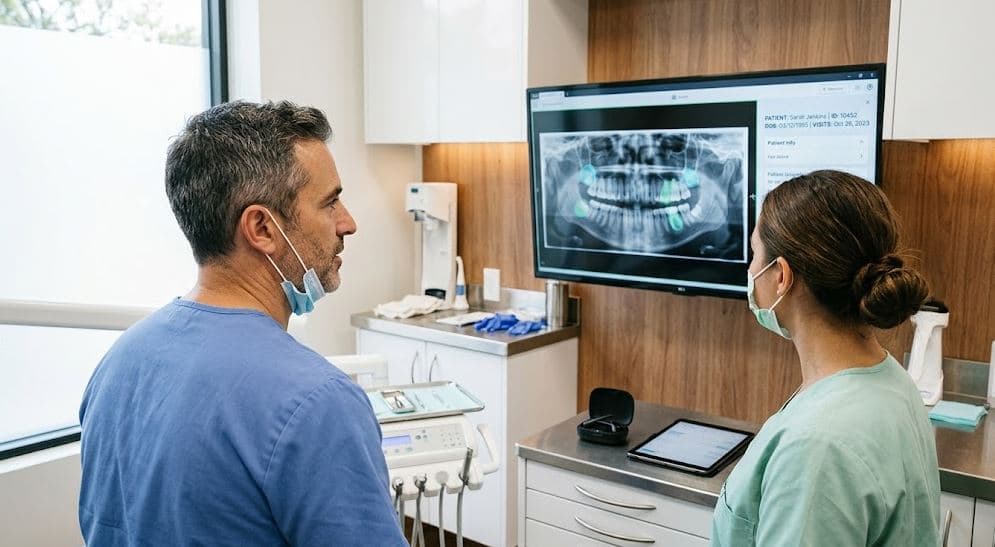
X-ray analysis remains a prominent use, but modern systems do more. AI imaging software can detect early caries, assess periodontal conditions, and flag anomalies that might be missed during a routine exam. These tools integrate with existing practice management software and mark concerning findings for dentist review. General oral health references from the CDC and the National Institute of Dental and Craniofacial Research remain the clinical baseline against which AI findings are checked.
Advanced imaging platforms also assist with treatment planning, suggesting implant placement based on bone density and identifying potential complications before a procedure. That support improves documentation for case presentations to patients.
Practice Management and Administration
Dental AI has reshaped administrative work through automation. AI-powered phone systems handle scheduling, insurance verification, and recall campaigns without staff intervention, and they run around the clock so a practice never misses a caller after hours. According to Dental Economics, the average dental practice misses 15 to 20 calls per week, and after-hours calls account for 27% of total patient call volume, much of which automation can recover.
Patient communication has changed through AI chatbots and automated messaging that send appointment reminders, post-treatment instructions, and answers to common questions. These tools keep engagement steady while reducing front desk load. For a fuller breakdown, see our guide on what an AI dental assistant does.
Revenue cycle management is another strong use. Intelligent systems review insurance claims in real time, catch likely denials before submission, and suggest corrections that improve reimbursement. AI also optimizes scheduling by studying provider productivity and patient flow.
What Are the Benefits and Limitations of AI in Dentistry?
AI in dentistry delivers measurable efficiency gains while carrying real constraints that practices should weigh. The strongest results show up in call handling, retention, and data-driven decisions, while cost and clinical nuance remain limiting factors.
Key Benefits
Practices using AI report better operational efficiency and patient satisfaction. AI receptionists remove busy signals and long hold times, which matters because the average hold time before a patient hangs up is about 90 seconds, per Marchex. Recovering those interactions protects new patient flow; learn more about why dental practices miss calls.
Retention is another clear win. The ADA reports that 20 to 30% of patients become inactive within 18 months without follow-up, while Dental Economics finds automated recall systems increase patient return rates by 25 to 40%. Because reactivating an existing patient costs far less than acquiring a new one, those gains compound, as our breakdown of dental patient lifetime value shows.
Data-driven decision making becomes possible through AI analytics that surface trends humans miss. These insights help practices adjust marketing spend, refine service offerings, and forecast cash flow more accurately. Federal labor data from the U.S. Bureau of Labor Statistics projects steady demand for dentists, reinforcing why efficiency gains compound over a career.
The strongest, most consistent gains tend to cluster in a few areas:
- Call recovery: AI receptionists capture after-hours and overflow calls that would otherwise reach voicemail.
- Retention: Automated recall and reminders bring lapsing patients back before they drift to another practice.
- Front desk relief: Routine scheduling, verification, and FAQs move off staff plates.
- Revenue accuracy: Real-time claim review reduces denials and protects reimbursement.
- Decision data: Analytics expose trends in demand, marketing spend, and cash flow.
Current Limitations
Despite the upside, AI systems face practical limits. Current dental AI tools handle routine tasks well but struggle with complex problem-solving that needs human judgment and empathy. Patients with unusual situations or emotional concerns still need a person.
Implementation cost is the other constraint, especially for smaller practices. Setup fees, training, and integration can strain a budget even when long-term savings justify the spend, and systems require ongoing maintenance and updates to stay effective.
How Does AI Work in a Real Dental Practice?
Looking at how these tools function day to day clarifies their value. In practice, AI shows up most often in three places: answering calls, protecting retention, and pre-screening radiographs before the dentist reviews them.
On the front desk, an AI phone system can screen new patients, book routine visits, and collect insurance details before handing complex cases to staff. This directly targets the missed-call problem, since 80% of callers who reach voicemail do not leave a message and will not call back, according to Forbes. Deciding between staffing and automation is its own question, covered in dental front desk vs AI.
On retention, AI-driven systems analyze appointment patterns, treatment acceptance, and communication preferences to trigger personalized outreach before a patient lapses. SMS appointment reminders alone reduce no-show rates by 38%, per the Journal of Dental Hygiene, which is why no-show benchmarks and costs matter to the bottom line.
How Automated Scheduling Affects Patient Retention
Automated scheduling improves retention by closing the gaps where patients drift. The ADA reports 20 to 30% of patients go inactive within 18 months without follow-up. Dental Economics finds automated recall lifts return rates by 25 to 40%, and the Journal of Dental Hygiene reports SMS reminders cut no-shows by 38%. The measurable metrics are recall completion, reactivation rate, and no-show percentage.
AI-Assisted X-Ray Review
In imaging, AI software pre-screens digital radiographs before the dentist examines them, flagging potential issues such as interproximal caries, periapical pathology, and bone loss patterns. The value is highest during busy periods when examination fatigue can set in. Because the analysis is objective and visual, it can support treatment recommendations that patients understand more easily, while the final read stays with the clinician.
What Is the Current Adoption of AI in U.S. Dentistry?
Adoption of AI in dentistry is rising but still uneven across practice types. Forward-looking intent is strong: Dental Economics reports that 73% of dental practices plan to adopt AI tools by 2027, even as today's usage concentrates in larger groups with the budget and staff to integrate it.
Adoption tracks closely with practice size and the specific problem being solved. Solo practices tend to start with phone automation to recover missed calls, while larger groups invest earlier in imaging analysis and full practice management. The table below maps the common starting point by practice type.
| Practice Type | Most Common Starting Point | Primary Goal |
|---|---|---|
| Solo Practice (1 dentist) | AI phone systems | Recover missed calls and after-hours volume |
| Small Group (2-4 dentists) | Imaging analysis | Consistent diagnostic support |
| Large Group (5-9 dentists) | Practice management automation | Operational efficiency at scale |
| DSO / Corporate (10+ dentists) | Full AI suite | Standardized workflows across locations |
Geographic patterns also vary, with higher adoption in metropolitan areas where competition drives faster innovation and rural practices moving more slowly due to infrastructure and cost. The COVID-19 pandemic accelerated interest as practices sought contactless patient management, automated screening, and remote consultation. Patient research habits reinforce the trend, since the BrightLocal Local Consumer Review Survey shows how heavily people rely on online information before choosing a provider.
Will AI Replace Dentists?
No, AI will not replace dentists. The evidence points to a collaborative model in which AI handles data processing and routine administration while clinicians retain diagnosis, treatment decisions, and patient relationships.
AI is strong at pattern recognition and repetitive tasks, but it cannot replicate clinical judgment, manual dexterity, or the relationship skills that define quality care. Complex treatment planning depends on medical history, lifestyle, and personal preference, which sits beyond algorithmic analysis.
The American Dental Association frames AI as decision support, not a decision-maker. AI can flag issues and suggest options, but final diagnoses and treatment decisions remain with licensed professionals. In short, current applications enhance provider capability rather than replace it, while keeping the human connection central to care.
Regulation, Ethics, and Data Privacy
Integrating dental AI means working within healthcare regulation and ethics. HIPAA compliance is the primary concern: patient data used by AI must be protected with secure transmission, encrypted storage, and controlled access, and vendors should provide Business Associate Agreements.
FDA and HIPAA Considerations
The FDA has begun regulating AI diagnostic tools, particularly imaging analysis software that gives clinical recommendations, so practices should confirm appropriate FDA clearance for intended use. Administrative tools like scheduling and communication systems typically fall outside that oversight. On ethics, the ADA recommends informing patients when AI contributes to diagnosis or treatment planning, and clear contracts should establish data ownership and access if a vendor relationship changes.
What AI Means for the Future of Dentistry
The growth of dental AI signals a shift toward data-driven, patient-centered care that values both clinical quality and operational efficiency. The technology now reaches from diagnostic support into communication systems that never miss a call and analytics that sharpen marketing decisions.
The evidence indicates that AI enhances rather than replaces human expertise. Practices adopting it report better patient satisfaction, stronger efficiency, and improved financial performance while keeping the personal relationships that quality care depends on. The practical question is not whether to adopt AI, but which applications deliver the most value for a specific patient population and set of goals.
Further Reading: Related Topics
To go deeper on the practice growth and operations themes connected to AI in dentistry, the guides below cover automation, patient acquisition, marketing, and front desk strategy.
See where AI fits in your practice
From missed calls to patient retention, DentalBase helps practices put AI to work without losing the human touch.
Book a Free DemoSources & References
Frequently Asked Questions
AI in dentistry is used for diagnostic imaging analysis, treatment planning, patient scheduling, and administrative automation. Common applications include AI X-ray review for early caries, predictive analytics for retention, automated reminders, and AI receptionists that book appointments and answer calls.
No. AI augments dentists rather than replacing them. It handles data processing and routine administration, while clinicians retain diagnosis, treatment decisions, and patient relationships. The ADA frames AI as decision support, not a decision-maker.
The main benefits are recovered missed calls, stronger patient retention, and data-driven decisions. Automated recall systems can raise return rates by 25 to 40%, and SMS reminders cut no-show rates by 38%, according to industry data.
It can be, when implemented correctly. Patient data used by AI must use secure transmission, encrypted storage, and controlled access, and vendors should provide Business Associate Agreements. Diagnostic AI may also require appropriate FDA clearance.
Adoption is uneven but growing. It concentrates in larger group practices with budget and staff to integrate it, while solo practices typically start with phone automation. Dental Economics reports 73% of practices plan to adopt AI tools by 2027.
Was this article helpful?
Written by
Dentalbase Team
The Dentalbase Team is a collective of dental marketing experts, AI developers, and practice management consultants dedicated to helping dental practices thrive in the digital age.