AI Search for Dentists: Get Cited by AI Overviews in 2026
AI search for dentists changes how new patients find your practice. Discover AEO tactics that get your dental practice cited by AI Overviews and ChatGPT.
Share:
Table of contents
AI search for dentists changed the equation in 2024, and most practice owners noticed it in new-patient numbers before they identified the cause. Organic traffic was still registering in Google Analytics, but the phone rang less. The form submissions thinned. The math stopped adding up, and the explanation wasn't a penalty or a competitor outranking you. It was a structural shift in how search results are presented. This fits into a broader shift toward automated front desks, which our DentalBase AI receptionist guide covers in full.
Google AI Overviews, ChatGPT, Perplexity, and similar tools now answer patient questions directly, before a single organic result appears. The click never happens. Your dental marketing and SEO services that worked fine for years are running into a wall that traditional optimization cannot clear on its own.
This article explains how AI search for dentists works in 2026, what answer engine optimization for dental practices means in practice, and the specific steps to get cited instead of skipped.
Much of the structural work behind answer engine optimization happens on the blog itself, in how each post is written and organized. This step-by-step guide to starting a dental blog covers the platform, compliance, and publishing decisions that make AEO-ready content possible in the first place.
Getting cited by AI Overviews is only part of the online-presence equation, patients still cross-check your site, reviews, and Google listing before they book. This guide to how patients choose a dental office online lays out how those pieces fit together.
What Does "AI Search for Dentists" Actually Mean in 2026?
AI search for dentists means your practice can now be cited, or completely bypassed, by tools that answer patient questions directly, without sending traffic to any website. Google AI Overviews, ChatGPT, Perplexity, and similar engines read the web, synthesize answers, and present them to patients who never click through to any specific page.
What a patient actually sees now
A patient asking "how much does a dental implant cost in [city]" used to see a list of ranked pages. Now they see a paragraph-length answer assembled from multiple sources, with a handful of citations beneath it. Your practice either appears in those citations or it doesn't. The traditional ranking model, where position one gets the most clicks, no longer describes the full picture. Position in the AI answer is a separate goal from position in the blue links.
What the click-through data shows
According to Advanced Web Ranking, organic CTR drops by 61% on queries where an AI Overview appears. For high-intent searches like "emergency dentist near me" or "family dentist accepting new patients," that CTR collapse can directly reduce the number of new patients who find you through search. Practices that have not yet adapted their dental SEO for AI search are seeing the impact in their new-patient numbers now.
How Does Answer Engine Optimization for Dentists Differ from Traditional SEO?
Answer engine optimization for dentists extends traditional SEO rather than replacing it, shared foundations like technical health, backlinks, and local signals still matter. What AEO adds is a specific formatting requirement: content must be structured so that AI engines can extract a direct answer from each section, as a standalone 40-60 word response to the heading question.
Traditional SEO optimizes for human readers and Google's ranking algorithm. AEO optimizes for machine extraction. The difference shows up in how you write each section of a page.
Both sides of that work usually sit inside one retainer, so it is worth checking what dental SEO services actually cover beyond rankings before assuming your current provider handles answer engines at all.
| Element | Traditional SEO | AEO for Dental |
|---|---|---|
| Headings | Keyword-rich labels ("Dental Implant Cost") | Question format ("How much does a dental implant cost?") |
| Opening paragraph | Context and keyword density | Direct 40-60 word answer to the heading question |
| Citations | Optional, for authority | Required, verifiable sources drive a 34.9% citation rate |
| Schema markup | Helpful for rich snippets | Essential for FAQ, LocalBusiness, and MedicalBusiness extraction |
| Named entities | Good practice | 15-20 per 1,000 words for knowledge graph signals |
Research from seoClarity found that AI engines extract 40-60 word answer blocks at 2.7 times the rate of longer passages. That specific length requirement maps to how AI engines parse paragraph content. A 400-word wall of text does not get cited. A 50-word direct answer does.
The other major difference is source attribution. Content with verifiable citations is selected by AI engines at a 34.9% rate versus 3.2% for content without, according to Authoritas research. Every statistic in your content should trace back to a named source: the ADA, BrightLocal, Dental Economics, or a peer-reviewed journal.
Why Are AI Overviews Dental Practices' Most Pressing Visibility Problem?
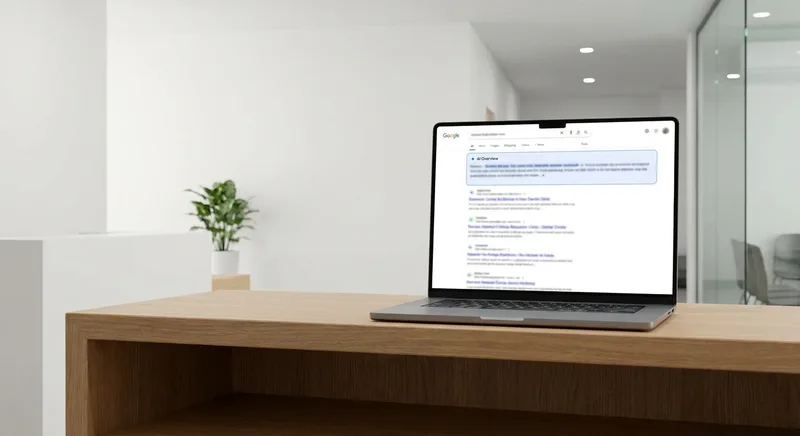
AI Overviews are the most immediate threat to dental search visibility because they appear on high-intent queries, exactly the searches new patients run before calling a practice. According to Advanced Web Ranking, organic CTR drops 61% on affected queries, and family dentist, emergency dental, and new-patient searches are precisely where AI Overviews appear most often. High-value procedure searches like implants are especially exposed here, our dental implant SEO guide covers the citation-ready content structure AI Overviews pull from for these exact terms.
What the lost clicks cost a practice
The math is unforgiving. If your practice ranked in position two for "dentist [city]" and that query now shows an AI Overview, your effective click share drops to a fraction of what it was. The patients are still searching. They're just not clicking through to your site because the AI answered them first.
Why the citation panel is still an opening
That said, the AI Overview is also an opportunity. It must cite sources. Those sources can be you. Practices that structure their content correctly, answer-first paragraphs, schema markup, local entity signals, appear in the citation panel beneath the AI answer. That citation is a clickable link, and patients who engage with the AI Overview and then click a citation are high-intent prospects.
- 68% of all online experiences start with a search engine, according to BrightEdge, meaning search (including AI search) remains the primary discovery channel for dental patients.
- Organic search converts at 3.5% for dental practices, per WordStream, well above most paid channels when you account for full funnel cost.
- 44.2% of AI citations come from the first 30% of an article's content, according to seoClarity, front-loading your strongest data is not optional.
The practices most at risk are those that built their patient acquisition entirely on organic rankings without adapting to AI format requirements. The practices in the strongest position are those that see AI Overviews as a new placement to win, not just traffic to mourn.
How Do You Get Cited by ChatGPT and AI Assistants as a Dental Practice?
Getting cited by ChatGPT, Perplexity, and AI assistants requires satisfying the core signals those tools use to evaluate trustworthiness: structured content with direct answer blocks, named entity density, verifiable attribution to credible sources, and a clear local presence in directories AI tools reference when resolving geographic queries.
- Rewrite your service pages as answers, not brochures. Each service page should open with a 40-60 word direct answer to the most common patient question about that service. "What is a dental crown?" should be answered in the first paragraph, not buried in section three.
- Add FAQ schema to every high-traffic page. AI engines parse FAQ schema at a significantly higher rate than unstructured content. Use structured data markup (FAQPage schema) so AI tools can extract your Q&A pairs directly.
- Name your sources explicitly. "According to the ADA" or "a 2025 BrightLocal study found" signals verifiability. Unattributed statistics, even accurate ones, are less likely to be extracted and cited.
- Build entity completeness. Your practice name, address, phone number, practitioners' names, credentials, and services should appear consistently across your website, Google Business Profile, and third-party directories. AI tools cross-reference these signals.
- Publish content that directly answers question-intent queries. "How much does Invisalign cost?" and "What is the recovery time after a tooth extraction?" are the kinds of questions AI engines are asked daily. Practices that publish clear, cited answers build a citation footprint over time.
Research on content structure and AI citation confirms that structured content with verifiable sourcing consistently outperforms unstructured content in AI extraction rates. Dental Economics' reporting on AI adoption in dentistry provides context on how the profession is adapting, and why practices that structure their content now hold a measurable first-mover advantage in AI citation pools.
What Role Does Local SEO Play in AI Search for Dental Practices?
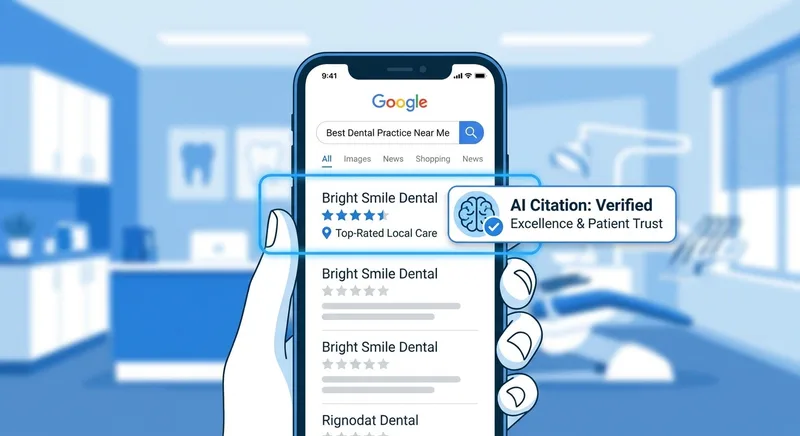
Local SEO is the foundation of AI search for dental practices because patient intent is almost always geographic, and AI tools draw on the same local signals as traditional map packs. Working through the GBP fields that drive dental map pack rankings therefore does double duty for AI answers. Google Business Profile completeness, consistent NAP data, local citations, and proximity are the inputs AI tools use to resolve "dentist near me" queries into cited recommendations.
Local intent has not changed, only the delivery
The "dentist near me" query generates 1.2 million US searches every month, according to Google Trends. That search intent hasn't changed, the delivery mechanism has. AI tools now synthesize a local recommendation from the same signals that powered local pack rankings, which means your local SEO investments directly feed your AI search visibility.
The local signals AI tools read
- A complete, active Google Business Profile. According to BrightLocal, dental practices using Google Business Profile posts see 35% more website clicks.
- Review volume and recency. 98% of people read local reviews before choosing a business, per BrightLocal. AI tools surface this reputation data when constructing local recommendations.
- Local schema markup on your website, including your city, neighborhood, and service area, so AI tools can resolve geographic queries accurately.
- Consistent NAP (name, address, phone) across directories, Yelp, Healthgrades, Zocdoc, the ADA's directory, because AI tools cross-reference these sources.
Reading those signals correctly still depends on which page carries which keyword in the first place. Our guide to keywords for a dental website covers how to map keywords across the homepage, service pages, and location pages so both AI tools and traditional search have a clear page to cite.
46% of all Google searches seek local information, according to Google. That proportion holds in dental search, where most patients are looking for a practice within a specific distance from home or work. For a broader look at how local search behavior affects patient acquisition, the BrightLocal Local Consumer Review Survey provides detailed data on how patients use search and reviews before choosing a dental provider.
Related: Smart speakers and phone assistants apply the same local signals in an even narrower format. Read the guide to voice search SEO for dental practices →
Which On-Page Changes Improve AEO for Dental Practices the Most?
The highest-impact on-page AEO changes are answer blocks, schema markup, named entity density, and question-format headings, all of which improve both traditional SEO signals and AI citation probability simultaneously. Start with your five most-trafficked service pages, as those carry the highest patient intent and the highest return on restructuring time.

- Rewrite the first paragraph after each heading as a 40-60 word direct answer to the heading question.
- Add at least one named data point with source attribution in each section ("according to the ADA," "a 2025 study by BrightLocal found").
- Convert any keyword-label heading ("Dental Implants") into a question heading ("What are dental implants and who are they for?").
- Add FAQPage schema with 4-6 Q&A pairs targeting the questions patients actually ask before booking.
- Increase named entity density, your practice name, city, practitioners' credentials, procedure names, and referenced organizations should appear naturally throughout the page, aiming for 15-20 named entities per 1,000 words.
These changes work because AI engines are essentially doing what a very literal reader does: they look for a heading that matches the query, then read the first paragraph to find the answer. If the first paragraph is a direct, cited answer, the engine has what it needs to extract and attribute.
For a broader view of how these on-page changes fit into a full dental growth strategy, the DentalBase dental SEO guide covers the technical and content layers that support both traditional and AI search visibility together.
Should Dental Practices Worry About AI Eating Their Search Traffic?
Yes, but the concern should convert into specific action rather than alarm. AI tools are redistributing search traffic, not eliminating it. Practices that appear as AI citations capture high-intent patients who were already planning to act, while practices invisible to AI tools lose that traffic to competitors, a solvable content and technical problem.
Where the traffic actually goes
The 73% of dental practices planning to adopt AI tools by 2027 (Dental Economics) signals that the profession is aware the landscape is shifting. The practices that will benefit most are those that treat AI search optimization as a systematic content and technical task, not a future concern.
The AI search shift is already underway.
Practices that adapt their content and local signals now will be the ones AI tools cite when patients search for a dentist in your area. DentalBase helps dental practices structure their digital presence for both traditional and AI search visibility.
See Our Dental SEO ServicesHow to test your own exposure
A practical way to assess your current exposure: search your own practice name plus your top services in Google with AI Overviews active. If you don't appear in the AI-generated answer, your content isn't structured for extraction. That's a fixable problem, and the fix starts with the on-page changes described in this article.
How Do AI Overviews Affect Dental Patient Acquisition Numbers?
AI Overviews affect dental patient acquisition by changing where patients make their first contact decision and which practices get that contact. Practices cited in AI Overviews capture high-intent patients who were already planning to act; practices not cited lose that touchpoint entirely to cited competitors, even if they rank in position three in the traditional blue-link results.
Practices that are not cited in AI Overviews lose that initial touchpoint. The patient gets their question answered, sees the cited practices, and contacts one of them. Your practice, even if it ranks in position three organically, may not appear in the AI answer at all, depending on whether your content is formatted for extraction.
Organic search still converts
That said, organic search remains the highest-converting digital channel for dental practices. WordStream benchmarks show a 3.5% conversion rate for organic dental search, above most paid channels on a cost-adjusted basis. AEO doesn't replace the value of organic search; it protects and extends it by ensuring your practice appears in the AI layer that now sits above the organic results.
Which metric to track from here
For practices tracking patient acquisition, the metric to watch is not just organic traffic but AI-referred traffic. Google Search Console is beginning to surface data on AI Overview impressions and clicks. Setting up that tracking now gives you a baseline to measure against as you implement AEO changes.
The DentalBase guide on new dental patient acquisition covers how to track multi-channel attribution, including the emerging AI search channel, so you can see exactly where each new patient originated. Visibility is only half of it, and what happens to that demand once the phone rings decides whether it converts.
What Schema Markup Does a Dental Practice Website Need for AI Search?
A dental practice website needs four schema types for AI search citation: LocalBusiness or MedicalBusiness, FAQPage, BreadcrumbList, and Article or WebPage. Each type helps AI engines resolve a different category of patient query, identity, location, offered procedures, and specific question-answers, giving AI tools a structured data layer to draw from without parsing unstructured prose.
The most impactful for AEO is FAQPage schema, because it directly feeds the Q&A extraction that AI tools use to build their answers. A page with four to six FAQ entries marked up in structured data gives AI engines a clean, machine-readable source of questions and answers tied to your practice's domain.
- Use JSON-LD format (Google's preferred format) in the
<head>of each page. - Keep your NAP data in the schema exactly consistent with your Google Business Profile.
- Add FAQ schema to service pages, not just blog posts, service pages are where patient intent is highest.
- Validate every schema implementation with Google's Rich Results Test before publishing.
For the canonical guidance on how AI-assisted features evaluate page quality and structure, the Google Search documentation on helpful content creation is the definitive reference for dental practice owners building their AEO foundation.
Which Dental Practices Are Most at Risk from the AI Search Shift?
Practices most at risk share a common profile: strong traditional rankings built on backlinks and domain age, thin or unstructured on-page content, and no FAQ schema or local entity markup. These practices rank well in blue-link results but have no presence in the AI citation layer above them, visible in an increasingly secondary position on the results page.
Practices leaning on paid search
A second at-risk group is practices that rely primarily on paid search and have underinvested in organic content. AI Overviews appear on organic queries, not paid placements, so a practice whose organic presence is thin has no AI citation surface area regardless of their Google Ads spend.
Worth noting:
According to Authoritas, 47% of AI Overview citations rank below position 5 in traditional organic results. Your traditional ranking does not determine your AI citation probability, your content structure does. A practice in position seven with excellent AEO can outperform the position-one result for AI citations.
What lower-risk practices do differently
The practices least exposed to the AI search shift are those treating their websites as answer libraries: every common patient question has a dedicated, well-structured, cited response. For practice owners assessing where they stand, reviewing the DentalBase overview of AI for dentists provides a grounded starting point for understanding which AI tools matter most to a dental practice's visibility.
What Is the Right Content Strategy for AI Search for Dentists in 2026?
The right content strategy for AI search for dentists in 2026 combines three layers: answer-optimized service pages targeting procedural questions, locally-structured blog content targeting cost and comparison queries, and an active Google Business Profile feeding AI local answer packs. Each layer targets a different category of AI query and reinforces the others through consistent entity signals.
Rewriting service pages for extraction
Service pages should be rewritten with AEO structure: question-format headings, 40-60 word answer blocks, FAQ schema, and source attribution. Blog content should target the long-tail questions patients ask before booking, "is a dental crown painful," "how many Invisalign aligners will I need," "what should I ask a new dentist", with the same answer-first structure applied consistently.
| Task | Impact on AI Citation | Time to Implement |
|---|---|---|
| Rewrite answer blocks on top 5 service pages | Very high | 1-2 weeks |
| Add FAQPage schema to service pages | High | 1-3 days |
| Complete and activate Google Business Profile | High (local queries) | 1 day |
| Add source attributions to existing content | High | Ongoing |
| Publish question-intent blog posts (4-6/month) | Medium-high | Ongoing |
| Convert heading labels to question format | Medium | 1 day per page |
For practices ready to move on AI search optimization, Search Engine Land's AI Overviews research tracks which content signals are currently performing in AI citation pools, useful context for prioritizing where to focus first.
The DentalBase guide on online marketing for dentists covers how to integrate content strategy with paid channels, social media, and review generation for a complete patient acquisition approach.
Getting Started: What to Prioritize First
Start with your Google Business Profile and your top three service pages, these two areas account for the majority of local AI citation opportunities and require no new content creation, only restructuring. A complete GBP with active posts, full attribute data, and recent reviews is the fastest path to AI local answers, achievable in one business day.
What comes after the quick wins
After those foundations are in place, shift to a consistent blog publishing cadence targeting question-intent queries. Each article should follow the same answer-first structure: a direct answer block under every heading, source attribution on every data point, and FAQ schema on every page. Over six to twelve months, that content library builds the topical authority that AI tools favor when constructing cited answers. Drafting those answer blocks goes faster with a prompt that fixes the answer length before the model starts writing.
Why AEO is ongoing, not a one-time fix
The practices that treat AEO as a one-time fix rather than an ongoing content discipline will see short-term gains followed by declining citation rates as competitors catch up. The practices that build AEO into their regular content operations will compound their advantage over time.
For dental practices that want to see how where patients come from maps against their current AI search visibility, DentalBase provides attribution data that shows which channels, including AI search, are delivering new-patient contacts. For benchmarking your digital marketing performance, HubSpot's marketing statistics resource provides current conversion and engagement benchmarks across digital channels including organic search.
The content structure behind AI citations, short answer blocks, question-format headings, and verifiable stats, applies to more than search visibility alone. See how the same approach drives content marketing for dentists that actually ranks in 2026 for the topic selection and publishing cadence behind it.
Content that answers well can still fail to be cited when the page it lives on is buried or thin. Our guide to the dental website architecture mistakes that keep implant pages from getting cited covers the structural side of the same problem.
Ready to adapt your practice to AI search?
DentalBase works with dental practices to build content and technical structures that perform in both traditional and AI search. See what that looks like for a practice like yours.
Book a Free DemoBrowse ResourcesRelated: Staying current on AI and search trends is easier with the right inputs. our guide to the dental CE courses and thought leaders covering this space is a solid starting point.
Sources & References
Frequently Asked Questions
Answer engine optimization for dentists is the practice of structuring website content so that AI tools, Google AI Overviews, ChatGPT, Perplexity, select and cite your practice when patients ask dental questions. The core tactics are direct answer blocks, schema markup, and verifiable source attribution.
No. AEO for dental practices builds on traditional SEO, not beside it. Strong rankings still feed AI citation pools. The change is that you must also format content for machine extraction: short answer blocks, named entities, FAQ schema, and question-format headings.
Most practices see early AI citation signals within 60-90 days of implementing structured answer blocks and schema. Google AI Overviews can surface new content faster because they draw from the live index, while ChatGPT models update on training cycles that vary by release.
Your Google Business Profile is a primary data source for AI local packs. Practices with active GBP posts see 35% more website clicks according to BrightLocal, and complete profiles with consistent NAP data are more likely to appear in AI-generated local answers.
No, solo and small-group practices benefit equally. AI tools favor the clearest, most credible answer regardless of practice size. A single-location dentist with well-structured content and strong local signals can outcompete larger chains for AI citations in their specific market.
Procedural explainers ('how does Invisalign work'), cost guides ('what does a crown cost'), and local comparisons ('dentist near me accepting new patients') draw the most AI citations. Content positioned in the first 30% of an article and backed by named sources performs at higher citation rates.
Was this article helpful?
Written by
DentalBase Team
Expert dental industry content from the DentalBase team. We provide insights on practice management, marketing, compliance, and growth strategies for dental professionals.