Dental Call Answer Time: How Fast Should You Pick Up?
Dental call answer time shapes bookings. See how rings, hold time, and callback speed change patient decisions, based on 9,248 calls.
Share:
Table of contents
Your dental call answer time affects whether a ringing phone becomes a booked appointment or a hang-up. Most front desks check voicemails after the office closes. Few track how long the phone rang before anyone answered.
DentalBase analyzed 9,248 patient calls handled through its DentiVoice AI receptionist platform to see how pickup speed, hold time, and callback delays change bookings. This guide pairs those findings with published industry figures.
You'll find practical answers on what a good pickup time looks like, how many rings is too many, how to measure your own number, and how fast to return a missed call. Phone speed is one piece of the patient acquisition system that DentalBase's dental marketing services cover, and it's where ad spend turns into appointments, or doesn't.
What Is a Good Dental Call Answer Time?
A good answer time is within 10 seconds, which means picking up by the second ring. DentalBase's analysis of 9,248 patient calls found that calls answered in that window booked at 62%, compared with 41% when the caller waited more than 30 seconds.
No industry body publishes an official standard, so 10 seconds is a working benchmark, not a rule. It comes from the pattern in the data: the longer the phone rang, the less often the call ended in an appointment. That's a 21-point gap from waiting alone.
Many callers never reach the timing question at all. According to ADA Practice Transitions, 38% of new patient calls go unanswered during business hours. For those callers, the wait never ends.
In practice, a good answer time comes down to three habits:
- Pickup by the second ring during business hours.
- Overflow routing when a second call arrives before the first one ends.
- A live answer or a fast-answering system after hours, not a bare voicemail greeting.
Pick a target, then measure against it. A practice that can't state its current average pickup time can't tell whether it sits above or below the 10-second mark.
How Many Rings Should a Dental Office Wait Before Answering?
Aim for the second ring and treat the third as the limit. A standard U.S. ring cycle lasts about six seconds, so the second ring ends near 8 seconds and the third near 14, which keeps pickups inside the window where callers start to leave.
In DentalBase's data, 31% of unanswered calls disconnected within 15 seconds. Those callers heard about three rings, concluded nobody was coming, and moved on. It's a fast decision.
The ring count also says something about staffing. If the third ring regularly passes with no pickup, someone is tied up and nothing is covering the line. The number of rings before a call rolls to voicemail or an overflow line is usually adjustable in your phone system, so here's a quick test:
- Call your main line from a cell phone and count the rings before voicemail or overflow starts.
- Repeat the test at 9:00 AM and during the lunch hour, when your front desk is busiest.
- Compare each result with the 15-second mark, which is about three rings.
If voicemail starts after five or six rings, a caller may hang up before reaching it. Shortening that setting won't fix a busy front desk, but it does move callers to a recoverable path sooner.
Related: The full call analysis breaks down answer speed, booking rates, and missed calls by hour of the day. We Analyzed 9,248 Dental Patient Calls: What Actually Works →
How Long Will a Patient Hold Before Hanging Up?
Most patients hang up within about 90 seconds. According to Marchex, 90 seconds is the average hold time before a caller gives up, and in DentalBase's call data, 68% of unanswered calls disconnected in under 60 seconds.
Ringing and holding stack on top of each other. A caller who rings for 20 seconds and then waits on hold has used up much of that 90 seconds before anyone speaks.
New callers are the group you can least afford to lose. DentalBase's data shows 64% of answered new patient calls ended in a booking, versus 48% for existing patients. And new callers are still choosing a practice, so another office is one search away.
They've also done their homework. According to BrightLocal, 98% of people read reviews before choosing a local business, so a patient who dials your number has usually picked you from a shortlist. If local listings are part of how patients find you, HubSpot's guide to local SEO covers the basics.
Holds hurt most in three situations:
- New patient inquiries, where the caller has no relationship with your office yet.
- Same-day or urgent requests, where the caller needs an answer within the hour.
- Insurance and cost questions, where the caller is comparing offices before booking.
Does Answer Speed Change Whether Patients Book?
Yes. DentalBase's call analysis found a 21-point booking gap between calls answered within 10 seconds (62%) and calls that waited past 30 seconds (41%). Speed isn't the only factor in a booking, but it moves the number.
The dollar impact adds up quickly. According to Dental Economics, a single missed new patient call costs a practice $1,200+ in lifetime value, and the average patient lifetime value for a general dentist runs $12,000-$15,000.
Run the math for a hypothetical week. Suppose five new patient calls go unanswered. At $1,200 each, that's $6,000 in lifetime value in one week, before counting how long each patient would have stayed.
Mobile also shortens the path to your phone. Mobile accounts for 62% of all dental-related searches, according to Google, and a mobile visitor can tap a number and call in seconds. Google's page experience documentation explains how mobile usability shapes those visits.
Here are the numbers side by side:
- Within 10 seconds: 62% of calls booked.
- Past 30 seconds: 41% of calls booked.
- Five missed new patient calls at $1,200 each: $6,000 in lifetime value per week.
Related: For a closer look at what each unanswered call costs a practice, see the related guide. 38% of Dental Calls Go Unanswered: The Hidden Revenue Loss →
When Does a Dental Office Struggle Most to Answer on Time?
Mondays, mid-morning, and the lunch hour are the hardest times to answer quickly. In DentalBase's data, Monday call volume ran 31% above the weekly average, 9:00-10:00 AM was the busiest hour at 17% of daily volume, and 12:00-1:00 PM had the lowest answer rate at 61%.
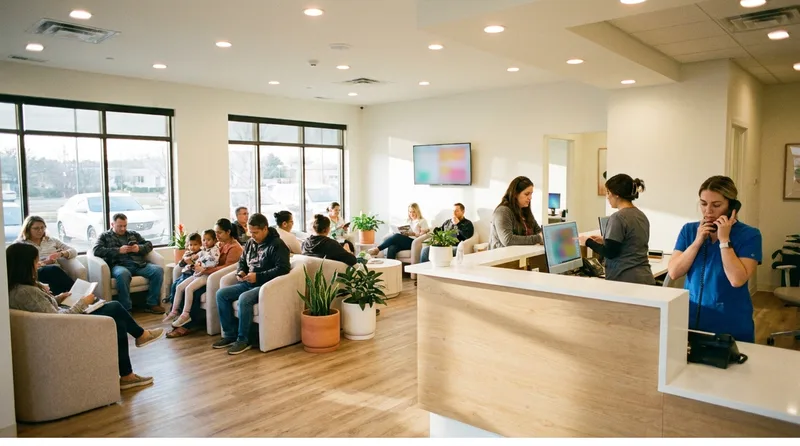
The pattern makes sense once you picture the front desk. Check-ins, insurance verifications, and hygiene turnovers all happen in person at the same moments the phone rings. A patient at the counter will wait. A caller won't.
Evenings and weekends are a separate gap. After-hours and weekend calls made up 27% of DentalBase's call volume, which matches the 27% Dental Economics reports for total patient call volume, and 39% of those callers were ready to schedule.
Dental problems don't keep office hours either. The conditions behind urgent calls, such as untreated decay and gum disease, are common, and NIDCR's oral health data and statistics page tracks how common. For an hour-by-hour view of call spikes, see this guide to dental practice peak call hours.
Where to add coverage first:
- Monday mornings: add a second person on the phones or move check-in tasks to another team member.
- Lunch hour: stagger breaks so one person always covers the line.
- Evenings and weekends: use an option that answers live, not a recorded greeting.
How Do You Measure Your Dental Call Answer Time?
Pull three numbers from your phone system: average speed of answer, abandoned call count, and the share of calls that reached voicemail. Many business phone systems and call-tracking tools report all three, and together they show how long callers wait and how many give up first.
Start with 30 days of data and work through five steps:
- Export call logs for the last 30 days from your phone system or call-tracking tool.
- Calculate average speed of answer for business hours only.
- Count abandoned calls, meaning callers who hung up before anyone answered.
- Count voicemails, then compare that number with your abandoned calls.
- Repeat the same numbers by hour and by weekday.
Step four matters most. In DentalBase's data, silent missed calls outnumbered voicemails 3 to 1, so a voicemail count alone understates what happened. According to Forbes, 80% of callers who reach voicemail don't leave a message and won't call back.
That's why end-of-day voicemail checks miss most of the problem. You can't fix a gap you can't count.
Related: Call tracking records each inbound call so you can see which ones were answered and how long callers waited. Dental Call Tracking for Dentists: Measure Every Call →
How Fast Should You Return a Missed Call?
Return missed calls within the hour if you can, because delay is where recoverable patients disappear. In DentalBase's data, voicemail callbacks averaged 4.2 hours, and 33% of those callers had already booked elsewhere by the time someone phoned back.
The data doesn't set a precise cutoff, but it shows the cost of hours instead of minutes. A one-hour limit would cut the 4.2-hour average by more than three-quarters.
The practice also has to make the second attempt. Only 19% of voicemail callers phoned back within seven days, so a message left is usually the last contact you'll get unless you reach out first.
A text message can hold a caller's attention while you work through the queue. Results vary, and how missed-call text back performs in dental offices is worth reading before you rely on it.
A simple callback routine looks like this:
- Assign one person to own missed-call callbacks each hour.
- Return new patient messages first, then same-day requests, then everything else.
- Send a text if the first callback goes unanswered.
- Log every attempt so the next person knows what's been tried.
How Can You Shorten Dental Call Answer Time Without Adding Staff?
Stagger lunch coverage, route overflow calls, and add an answering option for the peaks you can't staff. Each fix targets a different gap, so the right mix depends on whether your misses cluster at lunch, on Mondays, or after hours.

Here's how the common options compare:
| Option | Where it helps | Main limit |
|---|---|---|
| Staggered breaks | Lunch-hour answer rate | Needs a team member to cover; no help after hours |
| Overflow routing | Monday and mid-morning spikes | Still depends on someone being free to answer |
| Live answering service | Overflow and after-hours calls | Per-call fees; agents may lack access to your schedule |
| AI receptionist | Overflow and after-hours calls | Weaker on complex insurance and treatment calls |
For a deeper look at overflow tactics, see 8 ways to handle dental phone overflow when call volume exceeds what your team can answer.
Start with the lowest-cost fix that matches your gap. If lunch is the problem, scheduling solves it for free. If Mondays are the problem, you need either a second person or a different tool.
See how DentiVoice answers calls in seconds
Learn how DentiVoice picks up overflow and after-hours calls and books appointments for your practice.
See How It Works →Can an AI Receptionist Answer Faster Than Your Front Desk?
Yes. In DentalBase's call data, AI-answered calls connected in an average of 2 seconds, compared with 18 seconds for human-answered calls. Speed isn't the whole picture, though: AI booked 51% of calls versus 56% for humans, with the gap widest on complex calls.
The two groups handled different call mixes. AI took more after-hours, overflow, and routine scheduling calls. Human receptionists took more insurance questions, treatment discussions, and anxious patients.
- Routine scheduling: AI booked 59%, humans booked 57%.
- Complex calls: AI booked 29%, humans booked 47%.
- Average answer time: 2 seconds for AI, 18 seconds for humans.
That split points to routing, not replacement. Send routine scheduling and after-hours calls to the fastest answerer, and keep insurance and treatment conversations with a person. Both sets of numbers shift with call mix, so compare them against your own logs from the measurement step above.
Practices that used both reached the highest overall booking rate in the dataset, at 61%. Treat these figures as one dataset from DentiVoice practices, not an industry benchmark. For the cost side, read how a dental call center compares with an AI receptionist.
What Should You Fix First?
Start by measuring. Pull 30 days of call logs, find your average speed of answer and your abandoned call count, and compare both with the 10-second mark. Those two numbers tell you whether you're fixing lunch coverage, Monday overflow, after-hours calls, or all three.
Your dental call answer time sits between every marketing dollar and a booked chair, and you can measure it this week. Once you have the number, match the fix to the gap using the table above.
Pull the logs, pick a target, and re-check in 30 days. The swing from 30 seconds to 10 is the one tied to a 21-point booking gap.
Find out how many calls your practice is missing
Book a free demo and we'll show you when calls go unanswered and what those gaps cost.
Book a Free Demo →Explore more guides and tools for dental practice growth.
Browse Resources →Sources & References
Frequently Asked Questions
No industry-wide average is published, so measure your own. In DentalBase's data, human-answered calls took an average of 18 seconds to connect, compared with 2 seconds for AI. Under 10 seconds is the working target used in this guide.
It varies by practice and hour. DentalBase's study of 28 practices found 23% of business-hours calls went unanswered, while ADA Practice Transitions puts new patient calls at 38%. Treat both as reference points, then track your own rate by hour.
According to Dental Economics, the average dental practice misses 15-20 calls per week. Some offices miss far more during peak seasons. Your own number depends on staffing, call volume, and how many calls arrive at lunch, on Mondays, or after hours.
A good greeting gives the practice name, the speaker's name, and an offer to help. Keep it short, because every second of greeting adds to the caller's wait. Wording varies by practice, so test versions and compare booking outcomes.
Decide in advance which calls are urgent, such as swelling, trauma, or severe discomfort, and route them to the on-call dentist. Routine requests can be booked or queued for the next business day. Written triage rules keep every answerer consistent.
Not to start. Most business phone systems export call logs with timestamps, which is enough to calculate average speed of answer and abandoned calls over 30 days. Dedicated call-tracking tools add attribution, such as which ad or listing produced each call.
Was this article helpful?
Written by
DentalBase Team
Expert dental industry content from the DentalBase team. We provide insights on practice management, marketing, compliance, and growth strategies for dental professionals.