Dental Office Online Presence: How Patients Choose You
Patients judge your dental office online before they ever call. See how local search, reviews, your site, and your phone decide who books.
Share:
Table of contents
Your dental office gets judged long before anyone sits in a chair. A patient searches, skims three listings, reads a handful of reviews, opens your site on a phone, and calls. Four minutes, start to finish. Each of those steps maps to a different dental marketing service, and a practice can lose the patient at any one of them.
According to Pew Research, 71% of people looking for a dentist run a search before scheduling. Almost none of them tell you which step lost them. They just call someone else. That is the hard part about marketing a dental office: the failures are silent, and they never show up in your production numbers as a line item.
This guide walks each stage of that path, what patient behavior data says at every step, and which fixes pay off fastest. Some of it you can fix this week. Some of it takes a quarter.
How do patients actually find a dental office in 2026?
Most patients find a dental office through local search, then confirm the choice with reviews. According to BrightEdge, 68% of online experiences begin with a search engine, and Google reports that 46% of all searches look for local information. Referrals still happen. They almost always end in a search anyway.

The search result is your real front door
Google Trends data puts "dentist near me" at roughly 1.2 million US searches every month. A Google Health Study found 86% of users contacted a dentist after running a search. So the map pack, the reviews under it, and the first two organic results are doing more selling than anything hanging in your reception area.
Here is what a patient sees before they ever reach your site, roughly in order of attention:
- The map pack. Three local listings with star ratings, review counts, hours, and a call button. Most clicks stop here.
- Review snippets. The two or three lines Google pulls forward, which are often the newest reviews rather than the kindest ones.
- Your hours and distance. Closed on Fridays reads as unavailable, not as a schedule preference.
- Organic results. Your site, plus any directory page that outranks it.
None of that is website design work. It is listing hygiene, review volume, and consistent business information, which is why local SEO fundamentals tend to outperform a redesign when visibility is the actual problem.
What does your practice website need to turn visitors into patients?
Your website needs to load fast, work on a phone, and make booking obvious inside the first screen. Google reports that consumers expect pages to load in 3 seconds or less, and mobile accounts for 62% of all dental-related searches. Visual taste matters far less than those three things.
Speed and mobile beat aesthetics
A patient on a phone in a parking lot is not admiring your typography. They want a phone number, an address, and proof you take their insurance. Google's guidance on page experience signals is blunt about load time being a ranking and usability factor, and slow dental sites tend to be slow because of oversized hero images nobody needed.
Google also found that 44% of patients who discovered healthcare through mobile search went on to schedule an appointment. That is a real conversion path, and it breaks on small things. A phone number that is not tappable. A booking form asking for insurance group numbers up front. A menu that hides Contact three taps deep.
Dental Economics reports 57% of practices are looking to redesign their websites. Before you join them, check whether your dental office site is actually slow or just dated looking. Those are different problems with very different price tags. Our breakdowns of mobile-first design for dental sites and how to evaluate a dental website design company cover both paths.
Related: Ten elements separate a site that books patients from one that just sits there. See the must-have website elements →
Why do online reviews decide which dental office gets the call?
Reviews decide the call because they are the only opinion a stranger actually trusts about you. According to BrightLocal, 98% of people read local reviews before choosing a business, and Software Advice found 77% of patients use reviews when finding a dentist. Star rating is only half of it. Recency and your replies carry real weight.
Responding is the part most practices skip
BrightLocal's Local Consumer Review Survey found 88% of people are likely to use a business whose owner responds to all reviews. Not the positive ones. All of them. A calm, short reply to a two-star review does more for a hesitant reader than ten five-star reviews with no response underneath.
A practical review routine looks like this:
- Ask at the right moment. After a completed treatment the patient is happy about, not at checkout while they are reading a bill.
- Make it one tap. A text with a direct link converts. A card with a QR code does not.
- Reply within 48 hours. Thank the positive ones briefly and move the negative ones offline without arguing publicly.
- Watch recency. A 4.9 average built entirely in 2023 reads as a practice that stopped caring.
Showing up for the searches that matter
Local rankings, review volume, and the content that feeds both are a single workstream, not three separate vendors.
See how dental SEO works →How much does your Google Business Profile affect local visibility?
Your Google Business Profile usually outranks your own website for "dentist near me" searches, which makes it the most valuable page you do not own. BrightLocal found practices posting regularly to their profile see 35% more website clicks. It costs nothing. It is also the listing patients judge first.
The fields that actually move rankings
Categories, service areas, hours, and photos do more than the description box. Google reads consistency across your listing, your site, and third party directories, so a dental office phone number that changed two years ago and never got updated on an old listing quietly drags on visibility.
Post something every couple of weeks. It does not need to be clever. New hygienist, updated hours, a note about same-day emergency slots. Our full walkthrough of Google Business Profile optimization for dentists covers the ranking factors in order.
What happens after a patient clicks the call button?
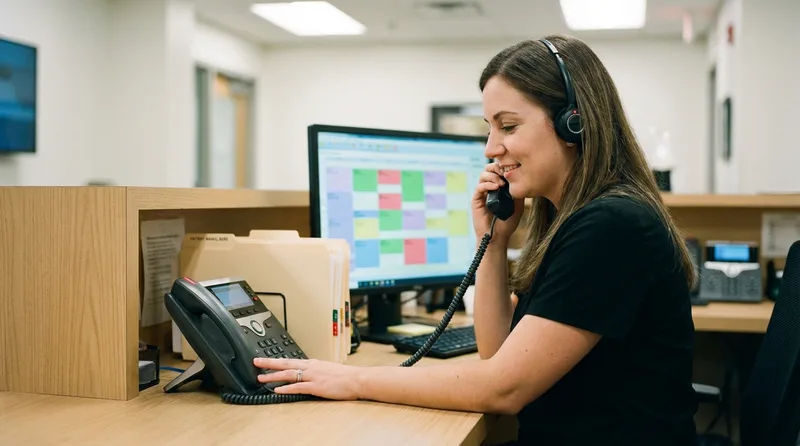
Your phone becomes the entire funnel. According to ADA Practice Transitions, 38% of new patient calls go unanswered during business hours, and Forbes found 80% of callers who reach voicemail never leave a message and never call back. Every unanswered ring hands a warm patient to the practice down the road.
The math on a single missed call
Dental Economics puts the average practice at 15 to 20 missed calls per week and values a single missed new patient call at $1,200 or more in lifetime value. Run that out. Even if only two of those twenty were new patients, you are losing real production every week while paying for ads that generated the ring.
Marchex data shows the average caller hangs up after 90 seconds on hold. After-hours calls account for 27% of total patient call volume, per Dental Economics, which means roughly a quarter of your demand arrives when nobody is at the desk. The ADA's practice management resources treat call handling as an operations problem, and that framing is right. It is not a marketing failure.
Two things fix most of it. Better scripts for the calls you do answer, and coverage for the ones you do not. We cover both in our guides to phone scripts that convert new patient calls and missed call solutions and what they cost.
Nobody should be losing patients to voicemail in 2026
DentiVoice answers every call, books into your practice management system, and handles the after-hours volume your team never sees.
See how the AI receptionist works →Should your dental office offer online booking?
Yes, if your schedule has gaps and your front desk is stretched thin. According to Zocdoc, 77% of patients want online booking, while Dental Economics reports only 26% of practices actually offer it. That gap is one of the easier competitive edges still sitting unclaimed in most markets.
What good online booking does
Dental Economics also found practices with online scheduling see 24% fewer no-shows, largely because patients who pick their own slot show up for it. The catch is implementation. A booking widget that emails a request to the front desk is not online booking. It is a contact form wearing a costume.
Real online scheduling should:
- Write directly into your schedule. If a team member has to retype it into Dentrix or Open Dental, you have added work rather than removed it.
- Respect appointment types. A new patient exam and a crown seat need different block lengths.
- Confirm instantly. The patient should have a time in hand before they close the tab.
- Send reminders automatically. SMS reminders cut no-show rates by 38% according to the Journal of Dental Hygiene.
Which marketing channels actually bring in new patients?
No single channel carries a practice on its own. WordStream benchmarks put organic search conversion for dental at 3.5%, paid search at just under 2%, and dental keyword costs at $6 to $8 per click. Your mix depends on how fast you need chairs filled and what you can spend each month.
Comparing the main channels
| Channel | Benchmark | Time to results | Fits when |
|---|---|---|---|
| Local SEO | 3.5% organic conversion | 3 to 6 months | You want durable, lower-cost volume |
| Google Ads | $6 to $8 per click, ~2% conversion | Days | You need chairs filled this month |
| Social media | 1.2% healthcare engagement rate | Months | You sell elective or cosmetic cases |
| Email and recall | $44 return per $1 spent | Weeks | You have a dormant patient list |
Notice the cheapest line on that table is aimed at people who already know your dental office. Reactivating an existing patient costs 5 to 7 times less than acquiring a new one, according to Harvard Business Review, and roughly 20% to 30% of patients go inactive within 18 months without follow-up. If you want the paid side running properly, start with our guide to setting up Google Ads for a dental practice.
Related: Channel choices land better inside a written plan with a budget and a calendar. Build your marketing plan step by step →
How long do patients research before they book?
Longer than most owners assume. PatientPop found 48% of patients spend more than two weeks researching before scheduling, and the ADA reports 72% name convenience as a top factor in choosing a provider. That two-week window is when your reviews, your hours, and your booking page do the persuading for you.

The path from symptom to appointment
Oral health needs are steady and widespread, as the NIDCR data on dental conditions shows. Demand is rarely the problem. The sequence people move through before they commit usually runs like this:
- Trigger. Sensitivity, a broken filling, a new insurance card, or a move across town.
- Search. A near-me query on a phone, often at night.
- Shortlist. Two or three listings compared on rating, distance, and hours.
- Verification. Reviews read, site skimmed, insurance checked, photos judged.
- Contact. A call or a booking form, usually to the practice that made the previous four steps easiest.
Worth noting: the ADA also found 67% of patients would travel further to receive care they prefer. Distance is a filter, not a verdict. If your reviews and your booking experience are stronger than the practice two blocks closer, you can still win that patient.
How do you tell which parts of your dental office marketing are working?
Track cost per new patient against lifetime value, and trace every new patient back to their first touch. Dental Economics puts average patient lifetime value at $12,000 to $15,000, while digital acquisition runs $150 to $300 per patient. Most practices track what they spend and never track where patients came from.
The four numbers worth watching
- New patients per channel. Not leads. Patients who showed up and got treated.
- Cost per new patient by channel. Ad spend plus agency fees divided by patients produced.
- Call answer rate. If this sits below 90%, fix it before touching ad budgets.
- Booking rate on answered calls. The front desk metric nobody tracks and everybody should.
Attribution gets messy because patients lie, politely. They say a friend referred them when they also searched your name and read fourteen reviews. Ask on the call, tag the source in your system, and accept that the picture is directional rather than precise. If you are weighing whether to build this in-house, our comparison of handling marketing yourself versus hiring an agency lays out the real trade-offs, and our breakdown of when an AI receptionist pays for itself does the same for call coverage.
What should you fix first with only 90 days?
Fix the phone, then the reviews, then the website. The phone leak is immediate and measurable, reviews compound over a few weeks, and a site rebuild takes months to show anything. Dental Economics reports the average practice misses 15 to 20 calls weekly. That is the fastest money on the table.
A 90-day order of operations
- Days 1 to 14: measure the phone. Pull call logs. Count unanswered, after-hours, and voicemail calls for two full weeks before changing anything.
- Days 15 to 30: close the coverage gap. Add staffing, an answering service, or an AI receptionist for the hours you are losing calls.
- Days 31 to 60: rebuild review flow. Set a request routine, reply to every existing review, and clean up your Google Business Profile fields.
- Days 61 to 90: fix the site conversion path. Tappable phone number, visible booking, insurance list, fast load. A redesign can wait.
Notice what is not on that list. New logo. New brand colors. A blog series. Those matter eventually, and they matter far less than a patient reaching a human at 6:15pm on a Thursday.
The single insight worth keeping from all of this: your dental office is not losing patients at the stage you think. It is usually losing them at the phone, which is the one stage nobody audits because it does not produce a report by default. Pull two weeks of call data before you spend another dollar on ads.
Start there. Then work backwards toward search, reviews, and the site, in that order, and you will fix the expensive problems before the cosmetic ones.
See what your practice is actually missing
A short walkthrough of your search visibility, review profile, and call coverage, with the gaps named and prioritized.
Book a Free Demo →More guides and tools for dental practice growth.
Browse Resources →Sources & References
Frequently Asked Questions
Most patients choose a dental office by running a local search, comparing two or three listings on rating and distance, then reading reviews before calling. According to Pew Research, 71% search before scheduling. Convenience and review quality usually decide the final pick.
Spend is easier to judge per patient than as a percentage. Digital acquisition runs $150 to $300 per new patient, against a lifetime value of $12,000 to $15,000 per Dental Economics. Track cost per new patient by channel before setting a budget.
Usually not. Load speed, a tappable phone number, and visible booking fix more than a rebuild. Google reports consumers expect pages to load in 3 seconds or less, and 62% of dental searches happen on mobile. Test those first.
Volume matters less than recency and replies. A steady flow of recent reviews beats a large old count. BrightLocal found 88% of people are likely to use a business whose owner responds to all reviews, so replying is the higher-leverage habit.
Front desk staff handle check-ins, insurance, and checkout while the phone rings. ADA Practice Transitions found 38% of new patient calls go unanswered during business hours. After-hours calls add another 27% of volume with nobody at the desk.
Yes for most practices. Zocdoc found 77% of patients want it while only 26% of practices offer it, per Dental Economics. Practices using online scheduling also see 24% fewer no-shows because patients pick their own slot.
Plan on three to six months for local search to produce steady volume. Google Business Profile work shows results faster than site content. Paid search fills chairs within days, which is why most practices run both alongside each other.
Was this article helpful?
Written by
DentalBase Team
Expert dental industry content from the DentalBase team. We provide insights on practice management, marketing, compliance, and growth strategies for dental professionals.