Oral Surgery SEO: Rank for Implants and Wisdom Teeth
Oral surgery SEO strategy for implant and wisdom tooth searches. Procedure pages, referral keywords, and local ranking factors that matter.
Share:
Table of contents
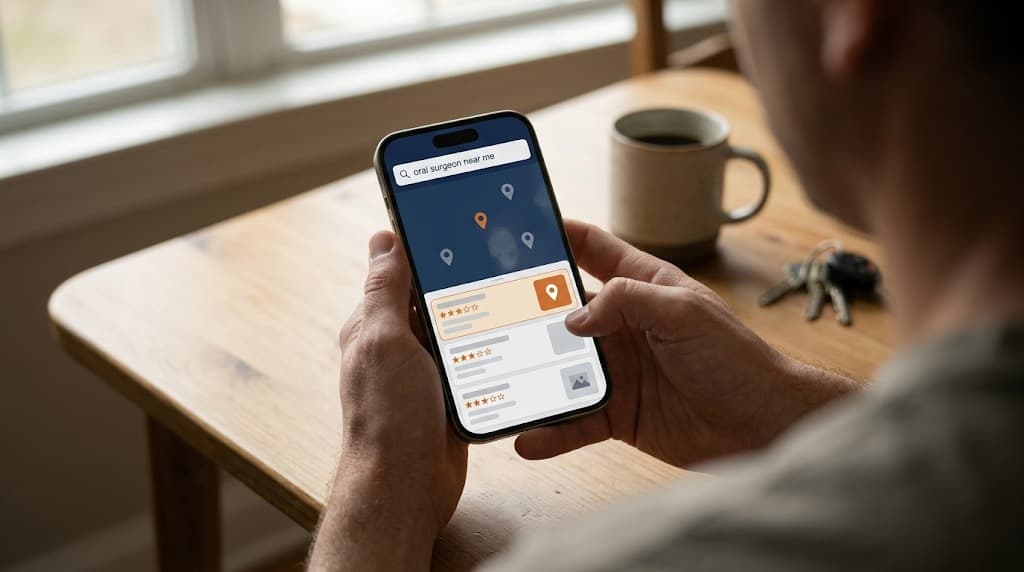
Oral surgery SEO is not the same game as ranking a general dental office. Your patients aren't searching for a checkup. They're searching for an implant, a wisdom teeth consult, or jaw surgery, usually right after a dentist told them they need one. They search by procedure, they search locally, and they decide fast.
That changes everything about how you should approach search. The keywords are procedure-specific, the radius is tight, and the case values are high enough that losing one ranking position costs real money. This guide covers the keywords to target, how to set up your Google Business Profile as a surgeon, why procedure-by-city pages win, and how AI search is reshaping the whole picture in 2026.
What Is Oral Surgery SEO and Why Is It Different?
Search done right for a surgical practice means ranking for procedure and location searches like dental implants or wisdom teeth removal near a patient. It differs from general dental search because the procedure mix is specialized, the case values are high, and patients come from a tight local radius.
Geography is the first difference. A patient who needs wisdom teeth out isn't looking three states away. They want a surgeon within a short drive. So the overwhelming majority of your new patients come from a roughly 15-mile radius. Local search, not national awareness, is your acquisition channel. That puts your Google Business Profile at the center of the strategy.
The second difference is intent. A general practice fields routine, recurring visits. You handle a smaller number of larger, often once-in-a-lifetime procedures, and the searcher is high-intent and ready to act. The ADA Health Policy Institute tracks how new-patient flow drives practice health, and for surgeons that flow is concentrated in a few high-value searches you cannot afford to miss.
SEO brings the call. Make sure you answer it.
Ranking is wasted if the call goes to voicemail. DentalBase pairs search visibility with 24/7 call capture so the patients you rank for actually book.
Explore Dental SEO →Which Keywords Should an Oral Surgery Practice Target?
Target procedure-plus-location terms across three intent levels: transactional searches like wisdom teeth removal near me, high-value research searches like full-arch implant cost, and brand-category searches like oral surgeon in your city. Each keyword type needs its own page built around that procedure and location.
The mistake most practices make is chasing one broad term. Surgical search intent is layered, and each layer wants a different page. The table below maps the keyword types to the intent behind them and the page that should capture each.
| Keyword Type | Example | Page That Should Rank |
|---|---|---|
| Transactional, ready to book | "wisdom teeth removal near me" | Procedure + city service page |
| High-value research | "full-arch implant cost [city]" | In-depth cost / FAQ guide |
| Brand-category, local | "oral surgeon [neighborhood]" | Location page + Google Business Profile |
| Concern / objection | "is wisdom teeth surgery safe" | Educational blog post |
Wisdom teeth is your highest-volume entry point, since nearly every young adult faces it. Implants and full-arch carry the biggest case values and the longest research cycles. For the most competitive implant terms specifically, our guide on dental implant SEO goes deeper than this overview can.
Oral Surgery SEO Procedure Pages
A strong oral surgery procedure page opens with a direct answer to the exact question a patient typed, states the procedure, timeline, and price range up front, then backs it up with recovery detail, sedation options, and a location-specific call to action. Thin, generic pages rarely rank for competitive procedure terms.
Most practices treat a procedure page like a brochure. It lists the service in a sentence or two and moves on. That approach loses to a page built the way a patient actually researches: they want to know what the procedure involves, how much it costs, how long recovery takes, and whether sedation is available, all before they pick up the phone.
- Answer block up top: a 40-to-60-word summary of the procedure, cost range, and recovery window, placed before any marketing copy
- Sedation and anesthesia options spelled out, since anxiety is a major decision driver for surgical patients
- Recovery timeline broken into concrete days, not vague ranges
- Insurance and financing detail, since cost hesitation is the top reason surgical searches stall
- A short FAQ block answering the three or four questions patients ask most about that specific procedure
- City and neighborhood mentions woven naturally into the copy, not stuffed into a footer
Each element earns its place because it matches a real point of hesitation. A page that answers the cost question, the safety question, and the recovery question in the body, rather than making a patient dig for it, converts better and gives AI search engines a clean answer to extract. Build this structure once per procedure, then repeat it for every city and procedure combination, using the same standard the dental implant marketing guide recommends for your highest-value pages.
Wisdom Tooth Search Demand by Season
Wisdom tooth search demand peaks twice a year: early summer, as students and young adults schedule extractions around school and sports breaks, and again in December and January, when insurance deductibles reset and patients rush to use benefits before or after the new plan year. Content and budget should follow that curve, not stay flat.
The summer spike is the bigger of the two. High school and college students make up a large share of wisdom teeth cases, and June through August lines up with the only stretch of the year when a multi-day recovery does not conflict with class or a game schedule. Search interest for wisdom teeth removal and recovery terms typically climbs through May as parents start researching ahead of the break.
The second spike is financial rather than seasonal in the traditional sense. Patients who have already met their annual deductible search hard in November and December to use the benefit before it resets. Right behind them, patients whose deductible just reset in January search again once the new plan year makes the procedure newly affordable. Both waves are cost-driven, which is why a procedure page's insurance and financing content matters as much in winter as recovery timing matters in summer.
| Window | Primary Driver | Content to Emphasize |
|---|---|---|
| May-August | School and sports breaks | Recovery timeline, downtime around activities |
| November-December | Deductible already met | Insurance and financing, urgency before year end |
| January-February | New plan year, reset benefits | Cost breakdown, what insurance now covers |
Time your content and paid search budget to these windows instead of spreading effort evenly across the year. Publish or refresh wisdom teeth content in March and April, ahead of the summer search climb, and again in October, ahead of the deductible-driven winter wave. The same research behavior shows up further upstream too, in the patterns covered by questions dental patients Google before booking a consult, which spike hardest right before each of these windows.
How Do You Optimize Your Google Business Profile as an Oral Surgeon?
Optimize your Google Business Profile by setting the primary category to Oral Surgeon, adding procedure-specific secondary categories, listing every service, uploading real photos, and building steady reviews. The profile is the single biggest factor in Map Pack and near-me visibility for surgical practices.
Google Business Profile Setup for Oral Surgeons
PRIMARY CATEGORY
Oral Surgeon
SECONDARY CATEGORIES
Maxillofacial surgeon · Dental implant provider · Cosmetic dentist (where accurate)
THEN STACK THE SIGNALS
All services listed · 20+ real photos · procedure-specific reviews · consistent NAP
A practice mis-categorized as a general dentist quietly loses the surgical searches it should win.
Category hygiene comes first, and it's often wrong. Set your primary category as Oral Surgeon. Then add secondary categories like maxillofacial surgeon and dental implant provider where accurate. The right categories tell Google which procedure searches you belong in. A practice mis-categorized as a general dentist quietly loses surgical queries it should win.
The GBP Elements That Move Surgical Rankings
- Primary category Oral Surgeon, plus accurate procedure-specific secondaries
- Every service listed: wisdom teeth, implants, bone grafting, sedation, jaw surgery
- 20-plus real photos of the office, team, and equipment
- Steady, procedure-specific reviews that name the treatment received
- Consistent name, address, and phone across every directory
For the deeper mechanics, our guide on optimizing your Google Business Profile walks through each field. The category and review work matters most for surgeons, because that is what wins the Map Pack.
Turn local rankings into booked surgical cases
DentalBase builds the local SEO foundation and captures the calls it generates, so search visibility becomes consultations.
Book a Free Demo →Why Do Procedure-by-City Pages Outrank Generic Service Pages?
Procedure-by-city pages outrank generic service pages because they match patient search intent precisely. A page built for dental implants in a specific city answers that exact query better than one broad services page trying to cover everything. Search engines reward that focus.
Procedure-by-City Page Architecture
Focused pages beat one generic services page
Each page targets one procedure and city, then interlinks so authority flows between them.
Picture the difference. A single page titled "Our Services" lists implants, wisdom teeth, and jaw surgery in three paragraphs. A patient searching "dental implants in [city]" gets a vague match. Now picture a dedicated page built around implants in that city, with cost ranges, recovery details, and FAQs. Google connects the query to that page with confidence. The patient finds exactly what they searched for.
Build separate, substantial pages for each major procedure and location: implants, wisdom teeth, sedation, and bone grafting. Interlink them so authority flows between related pages. Our location page SEO template and the broader site structure guide show how to organize this without thin, duplicate pages.
Related: SEO is one engine of growth. See how it fits the full strategy → Oral Surgery Marketing: A Practice Growth Guide
How Do Reviews and Authority Signals Affect Oral Surgery Rankings?
Reviews and authority signals are major ranking factors for oral surgery practices. Competitive markets often need 50 or more Google reviews to hold strong Map Pack positions, and reviews that name specific procedures help you rank for those treatments. Backlinks from referrers and associations build the authority that Google rewards.
Review volume is a threshold, not a bonus. In a crowded metro, a practice with 15 reviews rarely beats one with 80, all else equal. Patients agree: reputation data from BrightLocal shows how heavily people weigh reviews before choosing any local provider. For surgery, where anxiety is high, that weight is even greater.
Make the reviews work harder by encouraging patients to mention the procedure. A review that says "great experience with my dental implants" helps you rank for implants, not just for your name. On authority, pursue backlinks from referring dentists, local dental associations, and credible health directories. The National Institute of Dental and Craniofacial Research is the kind of authoritative source worth citing in patient-education content that earns links.
Why Referring Dentists Are an SEO Asset
Your referral network is also a link-building channel most surgeons overlook. A link from a referring dentist's website, or a co-authored patient guide, carries local relevance that Google values. It signals that real local providers trust you. That same relationship that sends you cases can quietly strengthen your rankings, which is a rare two-for-one in marketing. Build it into how you communicate with referrers.
How Does AI Search Change Oral Surgery SEO in 2026?
AI search changes oral surgery SEO by adding a new visibility layer on top of traditional rankings. AI Overviews now appear in most searches and pull answers from structured, citable content. Practices that publish clear answers on cost, recovery, and procedures are more likely to be cited and stay visible.
How Fast Are AI Overviews Growing?
The shift is real and fast. Search Engine Land reporting indicates AI Overviews appear in more than 60% of all searches. They change how patients find providers. When an AI answer summarizes "what does wisdom teeth removal cost," the practices whose content is structured to be quoted get surfaced. Those buried in dense pages do not.
How Do You Structure Content for AI Extraction?
The practical move is to write for extraction. Lead each procedure page with a direct, 40-to-60-word answer to the question a patient would ask. Add FAQ sections with clear cost, recovery, and risk answers. Mark them up so search engines can read them. This is the same answer-first structure that wins featured snippets, now doubly important as AI search grows. The CDC is a credible authority to reference when educating patients about oral health and surgical care.
Why Does Call Capture Matter More With AI Search?
There is one more reason AI search raises the stakes for surgeons specifically. When an AI answer or a search result sends a high-intent patient to your page, the next step is almost always a phone call. If that call goes unanswered, the ranking you worked months to earn produces nothing. Data reported by Dental Economics shows that most callers who reach voicemail never leave a message. For a surgical practice, that lost call is a lost implant case, which is exactly why search visibility and call capture have to work as one system.
To prioritize, focus your answer-engine effort where the intent and value are highest:
- Cost questions for implants and full-arch, the searches with the most hesitation
- Recovery and safety questions for wisdom teeth and sedation
- "Near me" procedure queries, which AI answers increasingly handle locally
Related: Compare the long game of SEO with the speed of paid search → PPC for Dentists: A Practical Guide to Paid Search
Conclusion
The heart of this work is matching how surgical patients actually search: by procedure, by location, and with high intent. Win the Map Pack with a properly categorized Google Business Profile, build dedicated procedure-by-city pages, earn procedure-specific reviews, and structure your content so AI answers cite you.
Start with the cheapest, highest-impact move: fix your Google Business Profile category and start gathering reviews that name your procedures. Then build out your strongest procedure page and measure its rankings over the next few months. Book a demo to see how DentalBase ties search visibility to the call capture that turns rankings into booked cases.
One last reminder. Rankings are a means, not the goal. The goal is a booked surgical case, and that only happens when a found patient reaches a real response on the phone. Treat search and call handling as one connected system, and your marketing spend stops leaking at the finish line.
Related: Specialty keywords like these follow the same ranking mechanics laid out in our complete dental SEO guide.
Rank for the procedures that fill your schedule
See how DentalBase combines oral surgery SEO with 24/7 call capture, so the patients searching for implants and wisdom teeth find you and book.
Book a Free Demo →Want more guides on dental SEO and practice growth?
Browse Resources →Sources & References
Frequently Asked Questions
Oral surgery SEO is the process of optimizing a surgical practice's website and Google presence so patients find it when searching for procedures like dental implants, wisdom teeth removal, or jaw surgery near them. It focuses on local, high-intent searches.
Oral surgery SEO targets a specific procedure mix with high case values and a tight local radius. Patients search transactional terms like wisdom teeth removal and high-consideration terms like full-arch implants, so the strategy must rank distinct procedure pages, not one generic site.
Target procedure-plus-location terms: wisdom teeth removal near me, dental implants in your city, oral surgeon plus neighborhood, and long-tail cost and recovery queries. Match each keyword to a dedicated page built around that procedure and location.
Set the primary category to Oral Surgeon, add secondary categories like maxillofacial surgeon and implant specialist, list every procedure, upload 20-plus real photos, and build steady, procedure-specific reviews. The profile drives Map Pack and near-me visibility.
Yes. Pages built for a specific procedure and city match patient search intent far better than a single generic service page. They let search engines confidently connect a query like oral surgeon in a suburb to one focused, relevant page.
AI Overviews now appear in most searches and pull from structured, citable content. Oral surgery practices that publish clear answers on cost, recovery, and procedures are more likely to be cited, which protects visibility as click-through from traditional results declines.
Local SEO usually shows meaningful movement within a few months and compounds over six to eighteen months. Google Business Profile and review gains can move faster, while content and authority for competitive implant terms build more gradually.
Was this article helpful?
Written by
DentalBase Team
Expert dental industry content from the DentalBase team. We provide insights on practice management, marketing, compliance, and growth strategies for dental professionals.