TikTok vs YouTube for Dental Marketing: Which Platform Wins?
TikTok vs YouTube dental marketing compared: audience, SEO value, content lifespan, conversion paths, production strategy, and the combined approach that wins.
Share:
Table of contents
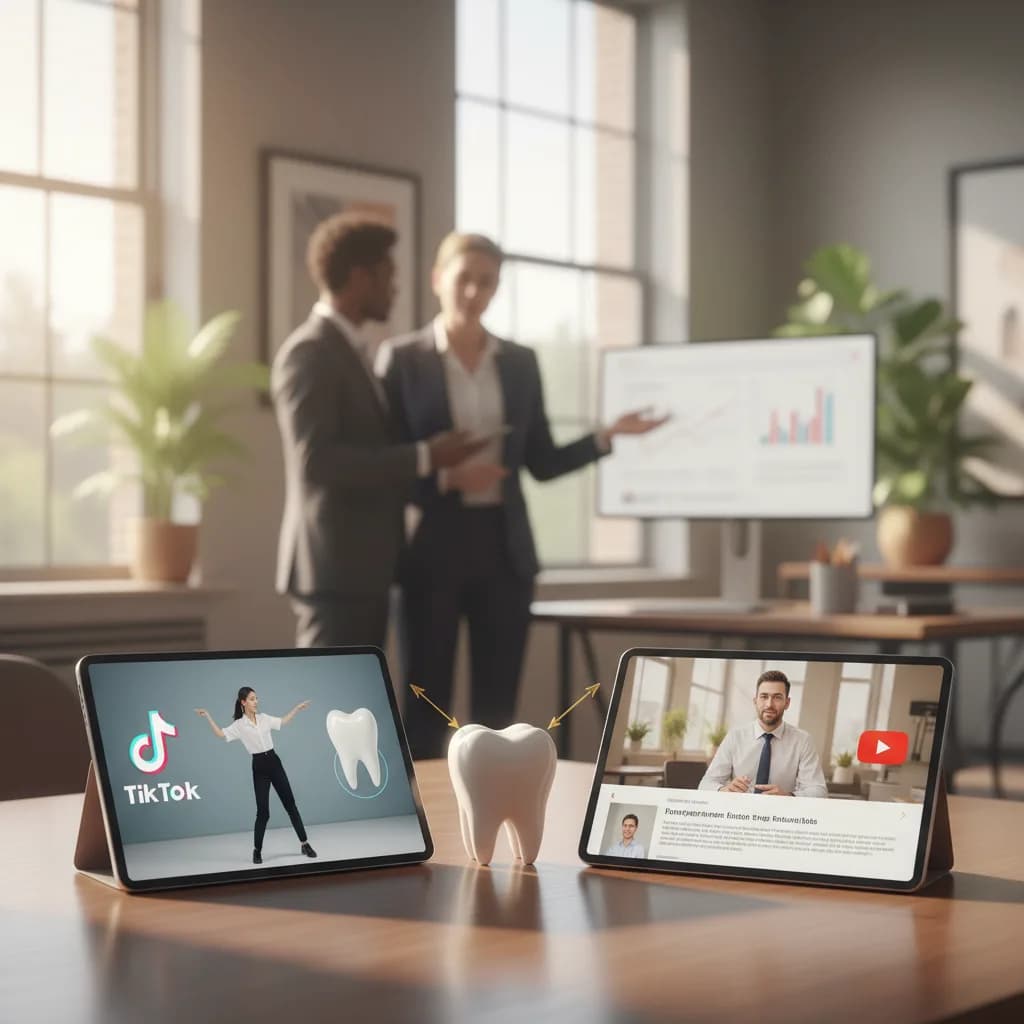
The tiktok vs youtube dental marketing debate comes down to one question: do you need awareness or conversion? TikTok builds awareness by putting your practice in front of thousands of local viewers through short, algorithm-driven content that peaks in 48 hours. YouTube builds trust and converts researchers into patients through searchable content that ranks in Google for years. The practices producing the most patients from video use both platforms for these different purposes. Choosing one and ignoring the other leaves either awareness or conversion on the table.
This guide provides the complete tiktok vs youtube dental marketing comparison: audience demographics, content format requirements, SEO and search value, patient conversion pathways, production strategy that covers both efficiently, and the metrics that prove which platform is actually producing patients. According to BrightLocal, 98% of consumers research businesses online before visiting. Video is where that research increasingly happens, especially for patients under 45. According to the ADA, dental practices with active video presence generate 30-50% more patient engagement than those without. For the TikTok deep-dive, see our should dentists use TikTok guide.
How Do TikTok and YouTube Compare Head-to-Head for Dental Marketing?
The head-to-head comparison reveals why the tiktok vs youtube dental marketing question isn't which platform but which purpose each serves.
| Factor | TikTok | YouTube |
|---|---|---|
| Primary audience | 18-34 (67% of users) | 25-54 (broadest demographic) |
| Optimal content length | 15-90 seconds | 3-8 minutes + Shorts (60s) |
| How patients find you | Algorithm (For You page) | Search + algorithm + Google |
| Google SEO value | None (doesn't rank in Google) | High (ranks in Google search) |
| Content lifespan | 24-72 hours peak | Months to years |
| Patient intent level | Low (browsing/entertainment) | High (actively searching) |
| Conversion path | Awareness → Google → call (weeks) | Search → watch → call (same day) |
| Booking rate from viewers | Indirect (3-5 touchpoints) | 50-70% of callers book |
| Best for | Cosmetic, younger patients, brand | Procedures, trust, long-term SEO |
YouTube's SEO advantage is the critical differentiator for dental marketing. A video titled "What to Expect During a Dental Implant Procedure" can rank on the first page of Google and produce patient calls for 3-5 years. A TikTok with identical content gets 5,000 views in 48 hours then disappears. YouTube is an investment that compounds. TikTok is a campaign that requires constant fresh content. See our video SEO guide and dental SEO strategy.
Convert video viewers into booked patients
DentalBase ensures patients who discover you on TikTok or YouTube and call are answered by AI reception, booked in real time, and tracked to the video source.
Book a Free Demo →What Content Works Best on Each Platform?
The content strategy diverges because the two platforms' audiences consume content with fundamentally different intent.
- TikTok content (15-60 seconds, entertainment-first): Myth busting with controversial hooks ("Your dentist has been lying about mouthwash"), satisfying procedure clips (calculus removal, Invisalign reveals), day-in-the-life of a dentist, staff culture moments, and trending audio with dental twists. TikTok rewards personality and authenticity. Polished production feels like an ad and gets skipped. Post 3-5 times weekly from smartphone content shot in under 10 minutes per video. See our Instagram content strategy for repurposing TikToks as Reels.
- YouTube long-form (3-8 minutes, education-first): Procedure explainers ("Dental Implant Process: Start to Finish"), provider introductions, patient testimonial stories, treatment comparisons ("Veneers vs Bonding"), and FAQ compilations. Title with exact patient search queries for Google ranking. YouTube rewards depth, education, and search-optimized metadata. Post 1 long-form weekly or bi-weekly.
- YouTube Shorts (under 60 seconds, bridging both): Shorts compete with TikTok using the same format but live on your YouTube channel alongside long-form content. A patient who finds your Short can browse your full procedure videos immediately. On TikTok there's no long-form library to explore. Repurpose TikTok content as Shorts to cover both with identical production.
- Content that fails on both: Hard-sell promotional content ("Book now, 20% off!"), graphic clinical footage without context, copyrighted music, and patient content without HIPAA consent. See our smartphone filming guide for production setup.
How Does Each Platform Actually Drive Patient Bookings?
The conversion pathway from viewer to patient is where tiktok vs youtube dental marketing differs most significantly.
- TikTok: indirect awareness pipeline (60-90 days to attribution). Patient sees TikTok → follows or remembers practice name → Googles practice days or weeks later → reads Google reviews → visits website → calls. TikTok rarely produces same-day bookings. The attribution gap makes ROI tracking difficult because patients say "I found you on Google" when TikTok planted the seed. Branded search volume increase (20-30% within 90 days) is the best TikTok ROI indicator.
- YouTube: direct search-to-booking pipeline (same session). Patient searches "dental implant cost [city]" → watches 5-minute explainer → clicks description link or calls number on screen → books. YouTube viewers who call book at 50-70% rates because they've invested 3-8 minutes researching your practice specifically. The search intent already existed; your video answered their question and made you the obvious choice. See our ROI tracking guide.
- Combined: 30-50% more patients than either alone. TikTok feeds the awareness top of funnel. YouTube converts the research bottom of funnel. When a patient who has seen your TikToks later searches for a dental procedure and finds your YouTube explainer, the multi-touch journey produces higher conversion than either platform alone. Practices running both platforms consistently report 30-50% more total new patients than those using either platform in isolation.
For practices where 38% of calls go unanswered, video investment on either platform wastes money when generated calls reach voicemail. AI reception ensures every video-driven call converts. See our call handling guide.
Related: See the complete video content types guide. → What Types of Videos Should Dentists Be Creating?
What Production Strategy Covers Both Platforms Efficiently?
The most efficient approach creates content for both platforms from the same filming sessions rather than producing separate content for each.
- Monthly batch filming (2 hours): One session produces all monthly content. Film 2-3 YouTube long-form videos (3-5 minutes each: procedure explainer, FAQ compilation, treatment comparison) and 8-12 short clips (15-60 seconds: quick tips, myth busters, behind-the-scenes moments). Short clips become TikToks, YouTube Shorts, Instagram Reels, and Facebook Reels simultaneously. Total monthly production: 2 hours filming + 3-4 hours editing = one work day for a complete multi-platform calendar.
- Repurpose every long-form into short-form: Every YouTube video contains 3-5 moments that work as standalone short clips. The key takeaway becomes a TikTok. The surprising fact becomes a YouTube Short. The patient reaction becomes an Instagram Reel. One 5-minute video produces 3-5 short-form assets across 4 platforms. See our dental videos trust guide.
- Platform-specific optimization after filming: Same clip, different packaging. TikTok: trending audio, bold text overlays, hook in first 2 seconds. YouTube long-form: keyword-optimized title and 300-word description with timestamps. YouTube Shorts: same as TikTok without TikTok watermark (YouTube suppresses watermarked content). Each platform's algorithm rewards specific signals that post-production optimization addresses.
- Posting cadence: 3 TikToks + 1 YouTube weekly. Consistency at this cadence outperforms sporadic high-quality production on either platform. Both algorithms reward regular posting. A 30-day gap resets algorithmic distribution. Practices committing to weekly content see meaningful audience growth within 90 days. According to Moz, YouTube engagement signals contribute to domain authority that strengthens SEO rankings for your website. Track through GA4.
How Do You Measure Which Platform Produces More Patients?
Five metrics compare platform performance and reveal where to invest more time.
- YouTube: search ranking position for target queries. Track where your videos rank for procedure-specific searches ("dental implant cost [city]," "Invisalign before and after"). Videos in the top 5 produce consistent monthly calls. Use per-page call tracking on your website to attribute calls to YouTube-sourced traffic. See our Google Ads ROI guide for attribution methodology.
- TikTok: branded search volume growth. After 90 days of consistent posting, check Google Search Console for increases in searches for your practice name. A 20-30% increase indicates TikTok awareness is converting to Google research. TikTok's value appears in Google's data, not TikTok's analytics.
- Both: "How did you find us?" intake tracking. Add "TikTok," "YouTube," and "Online video" to new patient forms. Track monthly. Most practices discover 15-25% of new patients interacted with video content before booking, even when they report "Google" as primary source. Cross-reference with call tracking data.
- YouTube: click-through from video to website (target 5-10%). Track description link clicks. Below 3% means the CTA needs strengthening. Above 10% means your content produces high-intent traffic your website needs to convert.
- Cost per patient by platform: TikTok: 2-3 hours weekly production time, $0 ad spend for organic. At 5-10 patients monthly: $50-100 equivalent cost per patient (valuing production time at $50/hour). YouTube: same production time investment. At 3-8 patients monthly from search: $75-200 per patient. Combined ROI calculation proves whether the total video investment produces more patients per dollar than Google Ads alone. Connect to your spend breakdown, marketing strategy, advertising, social media, reviews, and email marketing.
Turn video viewers into booked patients
DentalBase ensures every call from TikTok and YouTube viewers is answered by AI reception, tracked to the video source, and booked in real time.
Book a Free Demo →Explore more guides and tools for dental practice growth.
Browse Resources →Sources & References
Frequently Asked Questions
Both, for different purposes. TikTok builds awareness among patients 18-34 through viral short content. YouTube builds trust through searchable long-form content that ranks in Google for years. Combined: 30-50% more patients than either alone from one monthly filming session.
Content lifespan and patient intent. TikTok content peaks in 24-72 hours for browsing audiences. YouTube content ranks in Google for years for searching audiences. YouTube viewers who call book at 50-70% because they've researched specifically. TikTok viewers convert indirectly over 60-90 days.
YouTube significantly. YouTube videos rank in both YouTube and Google search results for procedure queries, producing patients for 3-5 years per video. TikTok content doesn't appear in Google search results and has zero SEO value. YouTube is an investment that compounds.
Short (15-60 seconds), entertaining, authentic: myth busting with controversial hooks, satisfying procedure clips, day-in-the-life, and trending audio with dental twists. Post 3-5 weekly from smartphone. Avoid polished or promotional content because TikTok audiences skip anything that feels like advertising.
Long-form (3-8 minutes), educational, search-optimized: procedure explainers, treatment comparisons, patient testimonials, and FAQ compilations. Title with exact patient search queries for Google ranking. Post weekly to build a searchable library that compounds patient calls over years.
One monthly filming session (2 hours): 2-3 YouTube long-form and 8-12 short clips. Each long-form produces 3-5 TikTok/Shorts clips. Total: one work day monthly covers TikTok, YouTube, Instagram Reels, and Facebook Reels from identical filming sessions.
YouTube: search ranking position and description click-through (5-10% target). TikTok: branded search volume increase (20-30% by day 90). Both: new patient intake attribution. 15-25% of patients interact with video before booking even when reporting 'Google' as their source.
YouTube: within 30-60 days as videos rank for procedure searches. TikTok: 60-90 days for branded search attribution to appear. Combined: consistent monthly attribution by day 90. Practices committing to weekly posting on both see meaningful growth within 3 months.
Was this article helpful?
Written by
Dentalbase Team
The Dentalbase Team is a collective of dental marketing experts, AI developers, and practice management consultants dedicated to helping dental practices thrive in the digital age.