Best Patient Recall Software Dental Systems (2026)
Compare dental patient recall software features: PMS integration, multi-channel outreach, AI scheduling, compliance tools, and ROI metrics that matter.
Share:
Table of contents
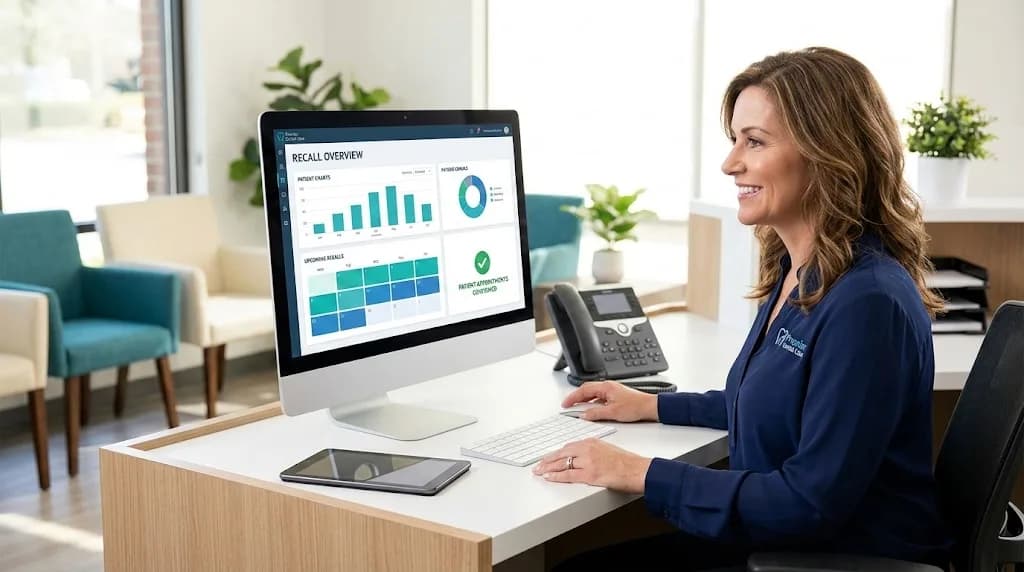
Choosing the right dental patient recall software determines whether your practice maintains 65-80% recall compliance or loses 15-20% of its patient base annually to attrition. The best recall systems in 2026 go far beyond basic appointment reminders. They connect to your PMS, identify patients approaching or past their recall date, send personalized multi-channel outreach, handle responses with AI, book appointments directly into your schedule, and optimize their own performance over time.
The dental recall software market has evolved significantly over the past five years. Five years ago, dental patient recall software meant email reminders on a fixed schedule. Today, the top platforms use AI to analyze patient behavior patterns, select the optimal communication channel for each individual, time messages for maximum response rates, and convert responders into confirmed appointments without staff involvement. According to the American Dental Association, practices using automated recall systems maintain 15-25% higher retention than those relying on manual processes. This guide evaluates the specific features that actually affect recall rates in measurable ways, the integration requirements that determine implementation success, and the concrete metrics that prove ROI to practice owners and DSO leadership.
What Features Should You Prioritize in Dental Patient Recall Software?
Not all recall features affect compliance rates equally. These six capabilities are listed in order of impact on actual patient rebooking rates, not marketing buzz.
| Feature | Impact on Compliance | Why It Matters |
|---|---|---|
| PMS integration (real-time) | Critical | Identifies due patients automatically, stops sequence when booked |
| Multi-channel delivery | High | SMS + email + phone reaches 35-45% vs 10-15% single channel |
| AI-powered scheduling | High | Converts responses to appointments without staff handoff |
| Intelligent timing | Medium-High | Adaptive send times based on patient response history |
| Personalization engine | Medium | Provider name, treatment type, insurance details in messages |
| Performance analytics | Medium | Tracks compliance by segment, channel, and provider |
PMS integration is non-negotiable. Software that requires manual list uploads or CSV imports creates the same consistency problem you're trying to solve. Real-time bidirectional integration means the system reads recall schedules and writes appointments back automatically. Without it, every other feature operates on stale data. Practices that evaluate recall platforms based on the number of communication templates or the design of the patient portal are optimizing for the wrong variables. Integration quality determines more of the outcome than any other single factor. For the complete guide on AI-powered recall systems, see our AI hygiene recall automation guide.
All six features in one platform
DentalBase includes real-time PMS integration, multi-channel outreach, AI scheduling, intelligent timing, deep personalization, and performance analytics in one recall system.
Book a Free Demo →How Do Multi-Channel Sequences Affect Recall Compliance Rates?
The channel strategy built into your dental patient recall software is the single biggest factor in recall compliance after PMS integration. Single-channel systems (email only or postcard only) achieve 40-55% compliance. Multi-channel systems layering SMS, email, and AI phone calls achieve 65-80%.
The optimal recall sequence
- Pre-due SMS (2-3 weeks before recall date): "Hi [Name], your next cleaning with [Provider] is coming up. Book your preferred time: [Link]." Response rate: 35-45%. SMS works best as the first touchpoint because it's immediate and low-friction.
- Due-date email (on recall date): Email with provider name, available times, and a prominent booking button. Response rate: 12-18%. Email catches patients who prefer writing or checking their schedule before committing.
- Overdue SMS (1 week past due): "Hi [Name], you're overdue for your cleaning at [Practice]. Tap to book: [Link]." Response rate: 20-30%. Urgency messaging reframes the recall from something the patient will get to eventually into something that needs attention now. This psychological shift is responsible for the higher conversion rate on overdue messaging compared to pre-due reminders.
- Overdue AI phone call (2-3 weeks past due): AI calls, references their recall schedule, handles objections, and books directly. Conversion rate: 15-25% of answered calls. Phone outreach recovers the patients that text and email couldn't reach, and it's the channel with the highest per-contact conversion rate for overdue patients who have been inactive for more than 30 days.
Click-based suppression must stop the sequence the moment a patient books at any step. Software that continues sending after booking damages the patient relationship and wastes resources. The best platforms also adapt channel order based on each patient's historical response data. If a patient consistently ignores SMS but answers phone calls, the system leads with phone for that individual. This adaptive intelligence is what fundamentally separates AI-powered recall from static rules-based automation that treats every patient identically. See how AI handles both inbound and outbound calls in our AI receptionist guide.
What PMS Integration and Compliance Requirements Are Non-Negotiable?
Dental patient recall software handles protected health information at scale, making integration security and regulatory compliance essential evaluation criteria.
PMS integration requirements
The platform must support bidirectional integration with your specific PMS (Dentrix, Eaglesoft, Open Dental, or cloud-based systems). Bidirectional means it reads patient data and recall schedules from the PMS and writes confirmed appointments back. One-directional systems that only read data still require staff to manually enter appointments, creating the handoff gap between patient intent and confirmed appointment that causes no-shows and lost production. Verify the integration is real-time (not batch-synced overnight) so the system immediately reflects cancellations, rebookings, and new appointments throughout the day. 38% of dental calls go unanswered during business hours, so the platform should also handle inbound scheduling when staff are unavailable.
Compliance requirements
- HIPAA: The platform must have a signed Business Associate Agreement. All PHI (patient names, contact info, treatment history, appointment data) must be encrypted in transit and at rest. Messages referencing specific treatments require encrypted delivery channels. Fines reach $50,000 per violation.
- TCPA: The Telephone Consumer Protection Act requires prior express consent for automated texts and calls. The platform should collect and log consent records, include opt-out instructions in every message, and honor opt-outs within 24 hours. Penalties: $500-1,500 per unsolicited message.
- FTC and state laws: The FTC requires truthful messaging. State-level privacy laws (California CCPA, etc.) may impose additional requirements. Verify the platform handles multi-state compliance automatically for DSO and multi-location practices.
Ask vendors for their BAA, SOC 2 certification or equivalent, and documented TCPA compliance features during evaluation. Request a live demo showing how the system handles opt-out requests, consent logging, and PHI encryption in transit. If they can't produce these immediately, move on. Apply the same compliance evaluation to your review collection and reactivation campaign platforms.
Related: Build a complete review system that captures feedback from every recalled patient. → Google Reviews for Dentists: Complete Guide
How Does AI Scheduling Close the Conversion Gap?
The conversion gap is the drop-off between patients who receive a recall message and patients who actually book an appointment. Traditional recall software sends reminders but still requires the patient to call your office during business hours to schedule. That handoff introduces three failure points: the patient forgets to call, the patient calls during a busy period and gets voicemail, or the patient reaches the front desk but is put on hold and hangs up.
AI scheduling eliminates all three failure points. When a patient receives a recall SMS and taps the booking link, the AI shows real-time available slots pulled directly from the PMS. The patient selects a time, receives instant confirmation, and the appointment writes back to your schedule automatically. No phone call required. No staff involvement needed. For patients who respond by text ("Can I come in Thursday?"), the conversational AI interprets the request, checks availability, proposes specific times, and confirms the booking through the same text thread.
AI phone outreach takes this further for overdue patients. When the AI calls a patient who hasn't responded to texts or emails, it can check schedule availability in real time during the conversation and book the appointment before the call ends. This eliminates the "I'll call you back to schedule" outcome that converts at under 20%. Direct booking during the AI call converts at 40-60% of patients who answer and express interest. For practices where 38% of inbound calls go unanswered, the same AI handles both outbound recall and inbound reception so no patient interaction falls through the cracks.
How Should You Evaluate ROI Before and After Implementation?
Dental patient recall software should pay for itself within 60-90 days. Here's how to calculate expected ROI before purchasing and measure actual ROI after launch.
Pre-purchase ROI projection
Calculate your current recall compliance rate (patients who complete their recall appointment within 30 days of their due date divided by total patients due). Multiply the compliance gap (target 70% minus current rate) by your active hygiene patient count by average hygiene visit production ($200-400). A practice with 1,500 patients moving from 50% to 70% compliance recovers 300 visits at $300 average, generating $90,000 in annual recovered production. Against platform costs of $300-800/month ($3,600-9,600 annually), the ROI is 9-25x.
Post-launch metrics to track
| Metric | Target | Review Frequency |
|---|---|---|
| Recall compliance rate | 65-80% | Monthly |
| Channel response rates | SMS 35-45%, email 12-18% | Weekly |
| Monthly hygiene production | Upward trend | Monthly |
| Annual patient attrition | Under 10% | Quarterly |
| Platform ROI | 10-25x | Quarterly |
Review the dashboard on the first Monday of each month. Identify the weakest metric and test one optimization (message copy, timing, channel mix) over 30 days. According to Moz, review velocity is a top local ranking signal. Every recalled patient who visits and leaves a Google review strengthens your local search position alongside retention. Track booking link conversions through Google Analytics 4 UTM parameters. Pair recall data with your marketing plan, social media strategies, and content calendar for compounding patient growth across channels.
The recall software built specifically for dental practices
DentalBase combines AI recall, reception, reactivation, review collection, and marketing in one platform with real-time PMS integration and full HIPAA compliance.
Book a Free Demo →The best recall platforms in 2026 do more than send reminders. It connects to your PMS in real time, sends personalized multi-channel sequences timed to each patient's behavior, converts responses into confirmed appointments through AI scheduling, maintains HIPAA and TCPA compliance automatically, and provides the analytics to prove ROI and guide optimization. Evaluate platforms on these six capabilities in order of impact: PMS integration, multi-channel delivery, AI scheduling, intelligent timing, personalization, and analytics. Start implementation with the pre-due SMS sequence and layer in email and AI phone call channels over 60 days. Within one quarter of implementing the complete system, your recall compliance will climb from the industry average of 40-55% toward 65-80%, recovering tens of thousands in annual hygiene production. The software should pay for itself many times over within the first quarter. For practices connecting recall to ad campaigns, patient reactivation, and social media management, DentalBase integrates every patient touchpoint from recall to reception to reputation into one comprehensive AI-powered dental growth platform.
Keep your hygiene schedule full with AI-powered recall
DentalBase automates recall, reception, and patient growth in one platform with real-time PMS integration.
Book a Free Demo →Explore more guides and tools for dental practice growth.
Browse Resources →Sources & References
Frequently Asked Questions
Software that connects to your practice management system, identifies patients approaching or past their recall date, sends automated personalized outreach via SMS, email, and phone, and books appointments directly into your schedule without staff involvement.
Six features in order of impact: real-time PMS integration (critical), multi-channel delivery (high), AI-powered scheduling (high), intelligent timing (medium-high), personalization engine (medium), and performance analytics (medium). PMS integration is non-negotiable.
Platforms typically range from $300-800 per month depending on features and practice size. Against recovered production of $60,000-120,000 annually from improved compliance, the ROI is 9-25x. Most platforms pay for themselves within 60-90 days of implementation.
65-80% with AI-powered multi-channel recall software versus the 40-55% industry average with basic automation. That 15-25 percentage point improvement recovers 300+ additional hygiene visits annually for a practice with 1,500 active patients.
It must be. Require a signed Business Associate Agreement, SOC 2 certification, encrypted PHI handling, and TCPA-compliant consent management. Messages referencing specific treatments need encrypted delivery. If a vendor can't produce compliance documentation immediately, move on.
The best platforms support bidirectional integration with major PMS systems including Dentrix, Eaglesoft, Open Dental, and cloud-based alternatives. Verify the integration is real-time (not overnight batch sync) and writes appointments back automatically.
AI adds adaptive timing based on patient behavior patterns, intelligent channel selection matching each patient's response history, automated appointment booking without staff handoff, and self-optimizing sequences that improve conversion rates with each campaign cycle.
Most practices see measurable compliance improvements within 30 days of launching the SMS sequence. Adding email and AI phone channels over 60 days builds the complete system. Full ROI is typically achieved within 60-90 days of implementation.
Was this article helpful?
Written by
DentalBase Team
The DentalBase Team is a collective of dental marketing experts, AI developers, and practice management consultants dedicated to helping dental practices thrive in the digital age.