
PPC for Dentists: A Practical Guide to Paid Search
PPC for dentists explained: what dental paid search costs, how to know if it's worth it, and how to build campaigns that turn clicks into booked patients.
Share:
Table of contents
If you have ever searched "dentist near me" and seen a row of ads above the map, you have watched PPC for dentists in action. Those slots are paid. A practice bids, a patient clicks, and the practice pays for that click whether the person books or not.
Here is the tension. Paid search drives about 35 percent of traffic for dentists, according to WordStream, yet the average dental campaign converts just under 2 percent. Spend without a plan and you fund clicks, not chairs. This guide walks through what PPC for dentists actually costs, how to tell if it earns its keep, and how to build campaigns that turn searches into booked appointments.
What is PPC for dentists?
PPC for dentists is pay-per-click advertising that places your practice at the top of search results, and you pay a fee each time someone clicks. The ads sit above organic listings on Google and Bing. You set a budget, bid on keywords like "Invisalign" or "emergency dentist," and only pay when a searcher clicks through. With oral health a near-universal need, tracked by the CDC Division of Oral Health, that search demand never really dries up.
The mechanics matter. Google ranks ads using a blend of your bid and a quality score that rewards relevant copy and fast landing pages. A higher quality score can win a better position at a lower cost per click. That is why two practices bidding the same amount can pay very different prices for the same keyword. Google explains the broader split between paid and organic results in its own Search Central documentation.
Dental ads show up in more places than the classic blue links. The main formats include:
- Search ads on the results page when someone types a query like "dentist open Saturday."
- Local Services Ads, the Google-screened listings with a green badge that charge per lead instead of per click.
- Display and retargeting, the banner ads that follow a visitor around the web after they leave your site.
Think of it as renting visibility. The moment your budget runs out, the ads stop. That speed is the appeal: a new practice can appear above established competitors on day one, something organic SEO takes months to achieve. The tradeoff is permanence. SEO keeps working unpaid; paid search does not.
Want paid search managed for your practice?
DentalBase builds and manages Google Ads campaigns aimed at booked appointments, not vanity clicks.
See PPC Ad Management →How much does dental PPC cost?
Dental PPC costs $6 to $8 per click for most keywords, per Google Ads benchmarks, with monthly budgets usually running $1,500 to $5,000 plus management fees. Competitive procedures and dense urban markets push the top of that range higher. A rural general practice often pays far less.

Run the math and the picture sharpens. A $2,000 monthly budget at $7 per click buys roughly 285 clicks. At a 2 percent conversion rate, that is about 6 new patients a month from paid search alone. Whether that works depends entirely on what a patient is worth to you.
| Keyword type | Typical cost per click | Why |
|---|---|---|
| General "dentist near me" | $6 to $8 | High volume, broad intent |
| Cosmetic and implants | $10 to $20+ | High case value, fierce bidding |
| Emergency dental | $8 to $15 | Urgent intent, ready to book |
One detail trips up most budgets: over half of paid clicks come from mobile, per Google. A caller on a phone wants to tap and dial. If your number is buried, you paid for a click that bounces. There is also the management layer to account for. Whether you run campaigns in house or through an agency, expect a fee of 10 to 20 percent of spend or a flat monthly retainer. That cost is real, but a campaign left unmanaged usually wastes more than the fee would have. Set realistic numbers before launch with our dental marketing budget guide.
Is PPC worth it for a dental practice?
PPC for dentists is worth it when two things are true: you can answer every call it produces, and you track the cost of each booked patient. Without those, paid search becomes a leaky bucket. The clicks arrive, the spend climbs, and nobody can say what came back.
Start with patient value. A routine cleaning patient might be worth a few hundred dollars over a year. An implant or Invisalign case can be worth thousands. That spread changes everything. Paying $150 to acquire a $300 patient rarely makes sense, but paying $150 for a $5,000 case is a bargain. The ADA Health Policy Institute publishes data on dental spending patterns that help you model lifetime value, and the U.S. Bureau of Labor Statistics outlook confirms steady demand for dental care.
Then there is the leak nobody budgets for. Research from ADA Practice Transitions found 38 percent of new patient calls go unanswered during business hours, and Weave Communications reports that most unanswered callers simply phone another practice. Every one of those was a click you paid for. That is why call coverage belongs inside your PPC plan, not beside it. An AI receptionist or a tightened phone workflow protects the spend that produced the call.
So who should fund paid search, and who should wait? A few honest signals:
- Good fit: a new practice with empty chairs, a high-value service line like implants, or a launch in a competitive ZIP code where organic rankings are years away.
- Proceed with care: a busy practice already booked weeks out, where new demand strains the schedule more than it helps.
- Fix first: any practice that misses calls or sends ads to a slow homepage. Patch those leaks before you spend, or you fund the competition's phone line.
Paying for clicks but missing the calls?
See how DentalBase answers every inbound call so your ad spend turns into booked patients.
Book a Free Demo →How do you build a dental PPC campaign that converts?
A dental PPC campaign converts when tight keywords, a fast landing page, and reliable call tracking work together. Most wasted spend comes from skipping one of the three. Get the structure right first, then optimize from real data over the following weeks.
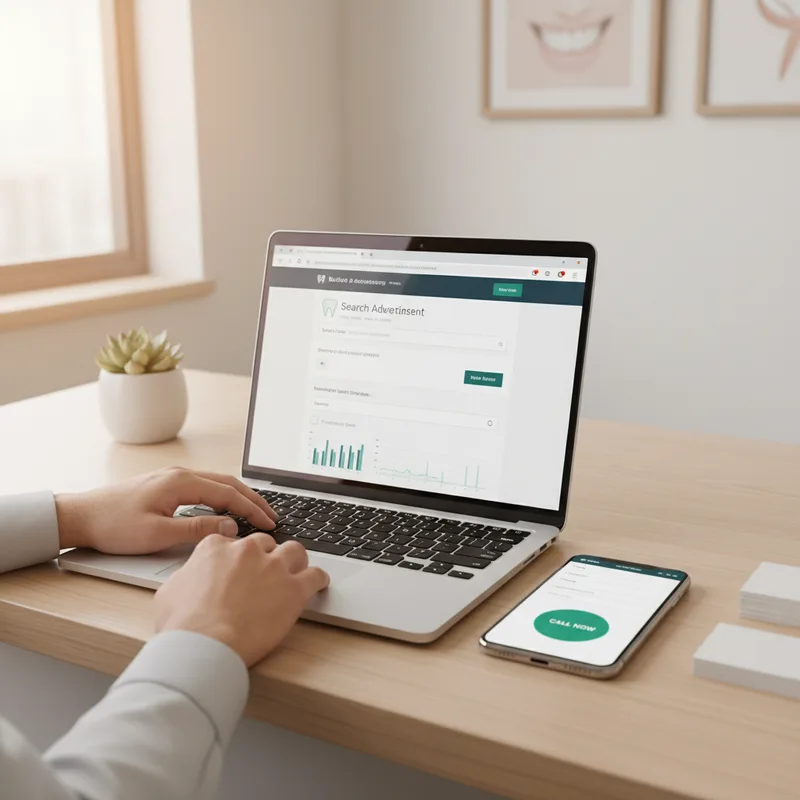
Work through these steps in order:
- Choose intent-rich keywords. "Emergency dentist [city]" signals someone ready to book. "What causes tooth pain" signals a reader, not a patient. Bid on the first, blog about the second.
- Match the ad to the search. Someone searching "Invisalign cost" should land on an Invisalign pricing page, not your homepage. Relevance lifts quality score and lowers your cost per click.
- Build a dedicated landing page. Mobile-friendly, one clear call to action, a click-to-call button near the top. Speed counts here; a slow page bleeds conversions, as our website speed guide explains.
- Turn on call tracking. You cannot improve what you cannot measure. Track which keywords produce calls, not just clicks.
- Add negative keywords. Block terms like "dental school," "free," or "jobs" so you stop paying for searchers who will never book.
The landing page deserves extra attention. Dental landing pages convert around 10 percent on average, per Unbounce, but a generic homepage often does a fraction of that. If your booking flow is clunky, fix it before raising budgets. Our guide on turning visitors into appointments covers the specifics.
Don't overlook the ad copy itself. Strong dental ads name the procedure, the neighborhood, and a reason to act now, then use extensions to add a click-to-call button, location, and review stars. Those extensions take up more space on the results page and give a mobile searcher an instant way to reach you. Small detail, measurable lift.
What mistakes drain dental PPC budgets?
The fastest way to waste dental PPC budget is to send paid traffic to a slow homepage, leave phones unanswered, and never review the search terms report. These three errors quietly drain thousands a month, and most practices commit at least one without realizing it.
Sending every click to the homepage
A homepage answers ten questions at once. A landing page answers one. When someone clicks an implant ad and lands on a page about your whole practice, they hunt for the next step and many leave. Match the page to the promise.
Ignoring the search terms report
Broad match keywords trigger your ads on searches you never intended. Without weekly review and negative keywords, you can pay for "dental assistant salary" or "tooth diagram." Pull the search terms report often. The patterns there fund your next round of cuts.
Letting calls go to voicemail
This is the costliest mistake because it hides. The dashboard shows clicks and impressions climbing, so the campaign looks healthy. Meanwhile the phone rings during a busy hygiene block and nobody picks up. Pair paid search with solid phone systems and after-hours coverage so a paid call never dies in voicemail. Speed of response matters: the faster someone answers, the more paid calls turn into booked visits.
PPC vs SEO for dentists: which should you fund?
PPC for dentists buys immediate visibility, while SEO builds a slower, compounding asset that keeps working after you stop paying. The honest answer for most growing practices is both, with the mix shifting as organic rankings mature. They solve different problems on different timelines.

Paid search is a faucet. Turn it on, traffic flows; turn it off, it stops. Organic search is a well you dig once. It takes months to reach water, but then it produces without a per-click charge. Moz lays out how organic ranking compounds in its beginner's guide to SEO, and the same site structure that helps ads helps rankings, as our SEO structure guide shows.
| Factor | PPC | SEO |
|---|---|---|
| Time to results | Days | 3 to 6 months |
| Cost model | Per click, ongoing | Upfront effort, then compounds |
| Traffic when you stop paying | Drops to zero | Largely persists |
A practical sequence works well. Fund PPC for the patients you need this quarter, invest in SEO so next year leans less on paid clicks, and let trust signals like reviews support both. The BrightLocal consumer review survey shows how heavily searchers weigh reviews before they ever click an ad or a listing.
Conclusion
The number that matters in PPC for dentists is not clicks or impressions. It is cost per booked patient. A campaign that looks busy on the dashboard can still lose money if the calls go unanswered or the landing page stalls.
So start small and instrument everything from the first day. Track calls, watch the search terms report each week, and make sure every paid call reaches a human or a capable assistant. Get that loop tight, then scale the budget against proven numbers rather than hope.
Ready to make paid search pay? Have your call handling and tracking reviewed before you raise a single bid.
Turn paid clicks into booked patients
See how DentalBase manages dental PPC and answers every call so your ad spend ends in appointments.
Book a Free Demo →Want more practice growth guides and tools?
Browse Resources →Sources & References
Frequently Asked Questions
PPC for dentists is worth it when you can answer the calls it generates and track what each booking costs. Paid search drives about 35 percent of dentist traffic, but with conversion near 2 percent, unanswered calls quickly erase the return.
Most practices spend $1,500 to $5,000 per month on dental PPC, plus management fees. With dental keywords at $6 to $8 per click, a $2,000 budget buys roughly 250 to 330 clicks before any management cost.
A workable cost per new patient from PPC for dentists usually lands between $50 and $200, depending on the procedure. A new implant or Invisalign patient justifies far more spend than a routine cleaning does.
Dental PPC can produce calls within days of launch, unlike SEO. Reliable performance data takes about 30 to 90 days, the window needed to gather enough clicks and conversions to trim wasted spend.
If you need patients this month, start with PPC for the immediate visibility. Run SEO alongside it so organic rankings can carry the load later, since paid clicks stop the moment the budget does.
Most underperforming dental PPC traces back to three causes: broad keywords drawing the wrong searchers, a slow landing page, and missed phone calls. Fixing call handling alone often recovers a large share of lost spend.
Was this article helpful?
Written by
DentalBase Team
Expert dental industry content from the DentalBase team. We provide insights on practice management, marketing, compliance, and growth strategies for dental professionals.