Dental Front Desk Staffing Crisis: How AI Fills the Gap
Dental front desk staffing is in crisis. See how AI receptionists handle calls, reduce hiring pressure, and keep your schedule full around the clock.
Share:
Table of contents
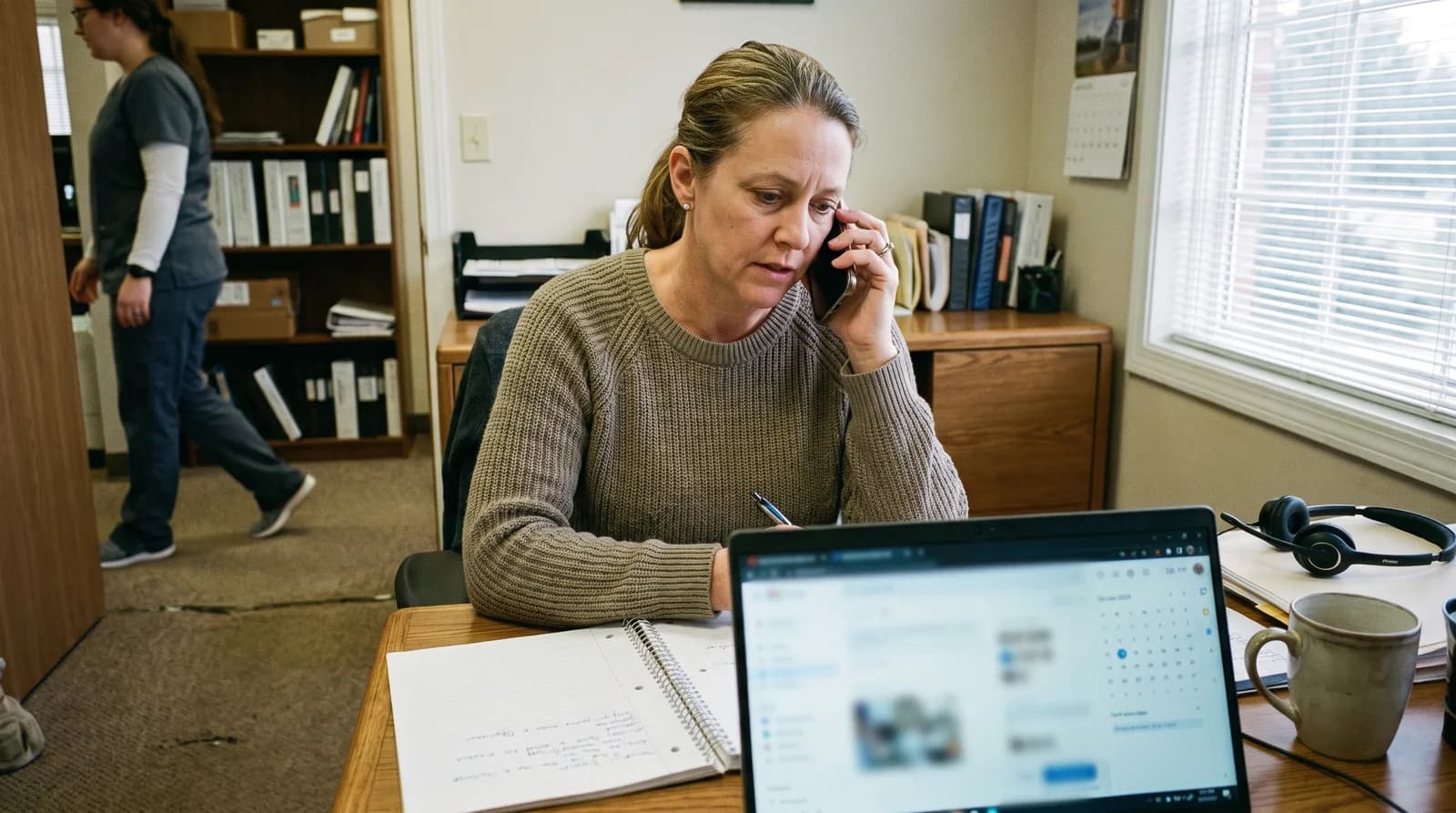
Dental front desk staffing has become one of the biggest operational headaches in dentistry. You post a job listing, wait weeks for qualified candidates, and the few people who show up often leave within six months. Practices increasingly close that gap with dental practice growth services instead of another hire. Meanwhile, the phone doesn't stop. The short answer for most offices is a hybrid front desk, where an AI receptionist covers the calls a thin team cannot. According to ADA Practice Transitions data, 38% of new patient calls go unanswered during business hours. That's not a scheduling hiccup. It's revenue disappearing before anyone sits in a chair.
The problem isn't going away. Demand for dental support staff keeps climbing, as the BLS occupational outlook for dental support roles documents, while the supply of qualified administrative candidates can't keep pace. Practices are trapped in a cycle of hiring, training, losing, and starting over.
This article breaks down why hiring is so hard right now, what it's really costing your practice, and how AI is changing the equation. You'll see where automation fits, where humans remain essential, and how to build a front desk model that doesn't collapse every time someone puts in their two weeks.
Why Is Dental Front Desk Staffing So Hard Right Now?
The dental industry is caught between rising demand for administrative talent and a labor market that can't deliver. Front desk roles require insurance knowledge, scheduling expertise, and patient communication skills, yet wages often trail what candidates can earn in remote positions with less pressure and better flexibility.
What Does the Staffing Squeeze Look Like Day to Day?
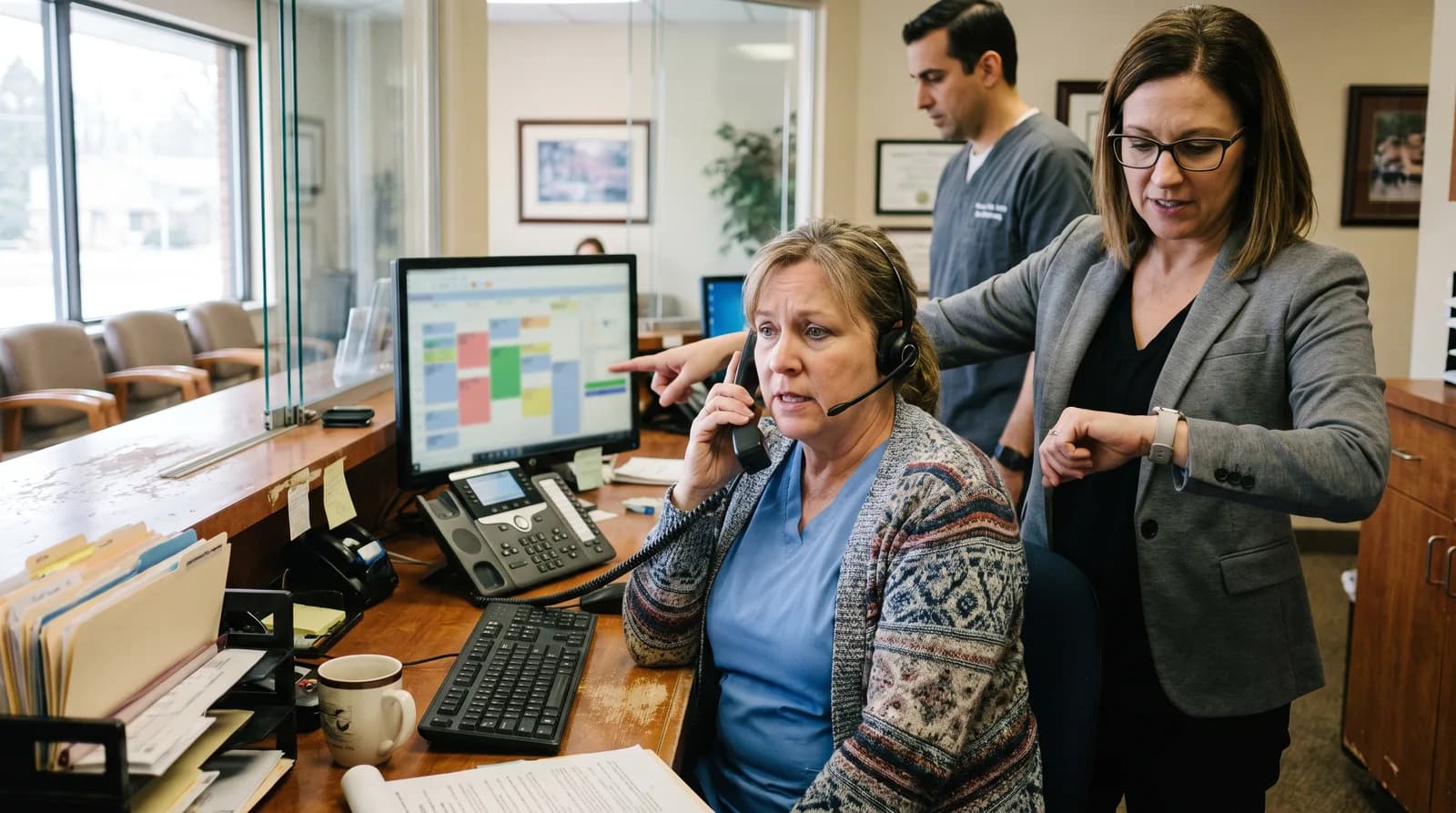
Picture a three-operatory practice. Your front desk team handles check-ins, insurance verification, treatment plan follow-ups, and phone calls. That's two or three people on a good day. One quits. The remaining staff absorb an impossible workload. Burnout follows fast. Then someone else leaves.
Remote customer service positions now compete directly with dental admin work. Dental front desk pay sits in the same band as general receptionist work, according to BLS receptionist data. That same person can answer calls for an insurance company from home at similar pay, with no commute and no frustrated patients in the waiting room. Hard to blame them for choosing comfort.
How Long Does It Take to Train a New Hire?
Training makes everything worse. It takes months to get a new hire proficient with your PMS, insurance workflows, and office protocols. That's a long stretch of reduced efficiency. And there's no guarantee they'll stay past their first anniversary.
Here's what separates this from past staffing crunches: the structural factors aren't temporary. An aging workforce, rising cost of living, and a permanent shift toward remote work mean dental front desk staffing won't get easier just because you bump wages by a dollar or two. Practices that rely entirely on human hiring are running uphill.
Related: Already losing calls? Here's how to get those patients back. → How to Recover Missed Dental Calls: Complete Guide
What Does Poor Front Desk Coverage Actually Cost?
Every unanswered call represents more than a scheduling gap. When nobody picks up, most patients simply contact another practice, according to Weave Communications. The average practice misses 15-20 calls per week, according to Dental Economics, so the lost production adds up alarmingly fast.
How Does a Missed Call Waste Marketing Spend?
Think about it this way. Your marketing budget drives phone calls. Your front desk converts those calls into appointments. When staffing gaps mean the phone rings six times and hits voicemail, you've paid to generate a lead that never converts. Forbes reports that 80% of callers who reach voicemail won't leave a message. They won't call back either. They just dial the next practice on the list.
What Are the Hidden Costs of Missed Calls?
The hidden costs run deeper. Existing patients who can't reach you for rescheduling or questions start looking elsewhere too. ADA data indicates that 20-30% of patients become inactive within 18 months without consistent follow-up. Short-staffed front desks can't make recall calls, confirm appointments, or follow up on incomplete treatment plans. Those patients drift away quietly, and you may never know why.
Then there's turnover itself. Recruiting, interviewing, onboarding, and training a single front desk hire carries real cost once you count job postings, management time, and productivity loss during ramp-up. If you're replacing someone every eight months, that expense hits before you've recovered from the last cycle. It compounds. And it's exhausting.
Related: Wondering where your marketing dollars actually go? → What a $3,000/Month Marketing Spend Actually Produces
How Is AI Changing Dental Front Desk Operations?
AI tools now handle many of the repetitive, high-volume tasks that overwhelm front desk teams daily. From answering patient calls to booking appointments and sending recall reminders, dental front desk automation removes the bottleneck without removing the human touch where it matters most.
The shift started with chatbots and online booking widgets. Those helped, but they didn't solve the phone problem. Most dental patients still call. And when they call, they expect a real-time conversation. Not a phone tree. Not a voicemail box.
Why Phone Coverage Was the Hardest Gap to Close
That's where AI receptionists come in. Tools like DentiVoice AI Receptionist use conversational AI trained specifically on dental workflows. They answer calls, check availability in your PMS (whether that's Dentrix, Open Dental, Eaglesoft, or Curve Dental), and book or reschedule appointments in real time. No hold music. No missed opportunities.
How Fast Are Dental Practices Adopting AI?
Here's the thing: 73% of dental practices plan to adopt AI tools by 2027, according to Dental Economics. Early adopters are already seeing returns. After-hours calls represent 27% of total patient call volume per the same source. An AI receptionist handles a call at 2 AM exactly the same way it handles one at 2 PM. Your staff doesn't have to.
The technology isn't replacing your front desk team. It's covering the gaps they physically can't fill: lunch breaks, sick days, vacation weeks, and the predictable flood of Monday morning calls that overwhelm even a fully staffed office. Big difference between replacing people and protecting them from burnout.
Never Miss Another Patient Call
DentiVoice answers every call, books appointments in your PMS, and follows up with patients who need rescheduling, all without adding headcount.
Learn About DentiVoice →What Can an AI Dental Receptionist Actually Handle?
A well-built AI receptionist manages inbound calls, appointment scheduling, rescheduling and cancellations, new patient intake, after-hours call answering, and outbound follow-up tasks like recall reminders and missed appointment outreach. It works directly inside your practice management software.
Let's break this down by category.
Inbound Call Handling
- Answers every call instantly, including after-hours and weekends
- Routes urgent calls to on-call staff based on your specific triage protocols
- Captures new patient information: name, insurance, reason for visit
- Responds to common questions about office hours, services, and accepted insurance plans
Appointment Management
- Books appointments by checking real-time PMS availability
- Reschedules or cancels existing appointments without staff involvement
- Fills cancellation gaps by contacting patients on your waitlist automatically
Outbound Communication
- Calls patients who missed appointments to reschedule
- Reaches out to inactive patients for reactivation campaigns
- Sends post-treatment follow-up calls and recall reminders via phone
How Is This Different from an Answering Service?
The difference between this and a basic answering service is integration. An answering service takes a message. An AI receptionist completes the task. Patients who call at 8 PM on a Tuesday get their appointment booked right then, not a promise that someone might call back tomorrow morning. See our full AI receptionist vs answering service breakdown for a side-by-side look at cost and booking accuracy.
There's a reputation angle too. According to BrightLocal's research, 98% of people read local reviews before choosing a business, and 88% are more likely to use a business whose owner responds to all reviews. When patients can actually reach your office and get their needs met immediately, that shows up in your online ratings. When they can't, that shows up too. Accessibility shapes perception.
Related: Not sure what to look for in an AI receptionist? → How to Choose an AI Dental Receptionist: Complete Guide
How Do You Build a Hybrid Front Desk Model with AI?
The most effective approach combines AI automation for high-volume repetitive tasks with human staff for interactions that require empathy, judgment, or clinical knowledge. This hybrid model reduces your dependence on full staffing while keeping the patient experience personal where it counts.

Solving dental front desk staffing starts with triage. Map your front desk workload into two categories: tasks that follow a script and tasks that require thinking. Insurance pre-authorizations, treatment plan talks with hesitant patients, and billing disputes need a human. Answering "what time do you close?" does not.
Which Tasks Go to AI and Which Stay Human?
A practical split looks like this:
| AI handles | Human staff handles |
|---|---|
| All inbound calls, with routing to staff for complex issues | In-office patient check-in and checkout |
| Appointment booking, rescheduling, and cancellation requests | Insurance verification and claims processing |
| Complete after-hours phone coverage | Treatment plan coordination and financial discussions |
| Outbound recall, reactivation, and missed appointment follow-up | Escalated patient concerns that require judgment calls |
| Answers about hours, insurance, and location | Clinical question triage that goes beyond scheduling |
How to Roll Out the Hybrid Model
- Pull 30 days of phone data and separate scripted calls from calls that need judgment.
- Turn AI coverage on for after-hours and overflow first, so nothing in daytime workflow breaks.
- Connect the AI to your PMS and confirm it books, reschedules, and cancels against live availability.
- Hand outbound recall and reactivation to the AI once inbound is stable.
- Review call logs monthly and automate any task your team keeps repeating.
What Changes for Your Team After the Split?
With this split, a practice that previously needed three front desk employees might run smoothly with two, plus AI coverage. That doesn't mean you fire anyone. It means when someone leaves, you don't panic.
Worth noting: reactivating an existing patient costs 5-7 times less than acquiring a new one, according to Harvard Business Review. AI outbound calling handles patient reactivation at scale. That's work your short-staffed front desk was never going to get to between check-ins, insurance forms, and ringing phones. It just sat undone. Email marketing returns $44 for every $1 spent, according to DMA figures compiled in HubSpot's email marketing benchmarks, so pairing AI phone outreach with automated email campaigns creates a follow-up system that actually runs consistently.
Ready to Automate Your Front Desk Workflows?
See how practices are combining AI phone coverage with their existing staff to reduce burnout and capture more patients.
Read the Automation Guide →The break-even point moves with local wages. In high cost-of-living corridors, front-desk salary and benefits sit above the national average, so every hour the phone pulls staff off in-person care costs more. Our ROI walkthrough for Maryland dental practices runs that math for the DC-Baltimore market, including the payer mix that makes plan questions so time-consuming there.
The same high-cost-of-living math applies in New York; the New York dental AI receptionist guide compares AI subscription pricing against hourly front-desk staffing there.
Is AI the Right Investment for Your Practice?
For most practices struggling with dental front desk staffing challenges, AI represents a lower-risk, lower-cost alternative to continuous hiring cycles. The break-even point is often just a few recovered patient calls per month, making it one of the fastest-returning investments available in practice operations today.

What Does the Break-Even Math Look Like?
Do the math. Your practice misses 15-20 calls a week, according to Dental Economics, and 80% of the callers who land in voicemail never leave a message, per Forbes. Recovering even five of those calls a month changes your revenue picture. Most AI receptionist services cost a fraction of a full-time employee's salary and benefits.
If you run a single-provider office, our guide to AI dental receptionists for solo dentists breaks down pricing tiers, HIPAA requirements, and what to check before signing a contract.
What Do You Get Beyond Cost Savings?
But cost savings alone aren't the whole story. Consider these factors:
- Consistency: AI doesn't call in sick, take lunch, or have a bad Monday. Every single call gets the same level of service regardless of time, day, or call volume. That kind of reliability is almost impossible to maintain with human-only staffing.
- Scalability: Opening a second location? AI coverage extends immediately. No hiring cycle required.
- Data: Every call is logged, categorized, and reportable. You can see exactly how many appointments were booked, what questions callers asked, and which marketing channels generated the most phone inquiries. That's intelligence most front desks can't provide manually.
Which Practices Benefit Most from AI Coverage?
The practices that benefit most are those with one to three front desk staff, high call volumes, and any amount of after-hours demand. If you're running a solo practice with one receptionist, you're a single sick day away from a completely dark phone line. That's where dental front desk automation becomes less of a nice-to-have and more of a safety net.
Not every practice needs the same level of AI involvement. Some start with after-hours coverage only. Others go full hybrid on day one. The right answer depends on your call volume, staff stability, and budget. If you want to explore AI receptionist ROI in detail, the numbers are worth running for your specific situation.
What Should You Do About Front Desk Staffing Now?
Start by measuring the gap before you buy anything. Pull 30 days of phone data, count the calls that went unanswered, and price that against a month of AI coverage. Most practices find the decision makes itself once the missed-call number is on paper.
Related: Deciding where AI fits is one piece of a complete dental front desk staffing plan. Read the complete staffing guide for closing the hiring gap →
Why Waiting Out the Labor Market Fails
The staffing crisis isn't a temporary inconvenience you can wait out. It's a structural shift already reshaping how dental practices operate. Waiting for the labor market to self-correct means continuing to lose patients, burn out your remaining team, and pour money into a hiring cycle that never ends.
AI doesn't replace your people. It makes your people viable. Two good staff members supported by an AI receptionist will outperform three overwhelmed employees every time. That's not theory. That's what practices adopting this model are reporting right now.
What Is the First Step to Take This Week?
The most important step you can take today is simple: audit your missed calls. Pull your phone system data for the last 30 days. If you're losing more than five potential patients per week to unanswered calls, the return on AI coverage is already clear. Start there.
Related: Closing this exact gap was the single biggest lever in one practice's growth. the full booking results after one practice closed its front desk staffing gap →
Related: Some of the load your front desk carries is workflow friction the software created. Read which dental practice management software features actually cut front desk workload.
Related: Fixing the staffing gap does not remove the compliance obligations that come with every new hire. Read a dental HIPAA compliance checklist for keeping training consistent through turnover.
See How AI Can Support Your Front Desk
Book a free demo to see how DentiVoice answers calls, books appointments, and follows up with patients automatically.
Book a Free Demo →Want more guides on running a smarter dental practice?
Browse Resources →Sources & References
- ADA Health Policy Institute - Dental Practice Statistics
- Bureau of Labor Statistics - Dental Assistants Occupational Outlook
- Bureau of Labor Statistics - Receptionists and Information Clerks
- BrightLocal - Local Consumer Review Survey
- HubSpot - Email Marketing Statistics and Benchmarks
- Dental Economics - Practice Management Coverage
Frequently Asked Questions
No. AI handles repetitive, high-volume tasks like call answering, scheduling, and recall reminders. Human staff are still needed for in-office check-ins, insurance claims, treatment plan discussions, and complex patient interactions. The stronger approach is a hybrid model where AI supports your existing team rather than replacing them.
Every hire carries recruiting, onboarding, and lost-productivity cost, and the training period runs for months before someone is fully proficient. When employees leave within a year, practices absorb that cost repeatedly for a single position, on top of the calls missed while the seat sits empty.
AI receptionists answer new patient inquiries, book and reschedule appointments, respond to common questions about hours and insurance, handle after-hours calls, and make outbound calls for recall reminders and missed appointment follow-ups. They integrate directly with major PMS platforms like Dentrix, Open Dental, and Eaglesoft.
Patients get immediate answers instead of voicemail or long hold times. Calls are handled consistently at any hour. Practices using AI phone coverage often see stronger review scores because fewer patients experience the frustration of unreturned calls or scheduling delays.
Most AI receptionist services cost considerably less than a full-time employee's salary and benefits. Since the average practice misses 15-20 calls a week according to Dental Economics, recovering only a handful of those calls each month covers the cost of coverage.
Setup typically takes one to two weeks, including PMS integration, call routing configuration, and training the AI on your office protocols. That is considerably faster than hiring and training a new front desk employee, which takes months to reach full proficiency.
Leading AI receptionist platforms integrate with major dental PMS systems including Dentrix, Open Dental, Eaglesoft, and Curve Dental. Integration allows the AI to check real-time schedule availability, book appointments, and update patient records directly within your existing software.
Was this article helpful?
Written by
Dentalbase Team
The Dentalbase Team is a collective of dental marketing experts, AI developers, and practice management consultants dedicated to helping dental practices thrive in the digital age.