Dental AI Receptionist vs Answering Service: 2026 Guide
Compare a dental AI receptionist vs answering service on cost, availability, and booking accuracy. See which option fits your practice.
Share:
Table of contents
Choosing between a dental AI receptionist vs answering service is one of the more practical decisions you'll face this year. Your front desk team is already stretched thin. Between check-ins, insurance questions, and a phone that won't stop ringing during the 10 AM rush, calls slip through. A 2024 ADA survey found that 38% of new patient calls go unanswered during business hours. That's not a staffing problem you can hire your way out of forever.
This guide breaks down how AI receptionists and traditional answering services actually compare on cost, booking ability, availability, and patient experience. You'll walk away knowing which model fits your practice size, call volume, and growth goals.
What's the Real Difference Between an AI Receptionist and an Answering Service?
A dental AI receptionist vs answering service comparison starts with one core distinction: what happens after the phone rings. AI receptionists are software systems trained on dental workflows that hold full conversations, answer patient questions, and book appointments directly into your practice management system. Answering services employ human agents who follow scripts and take messages.
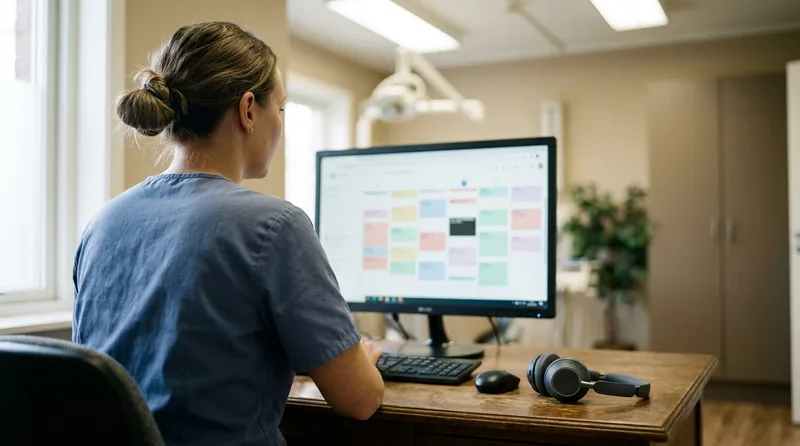
That gap matters more than it sounds. When a new patient calls your practice at 7 PM asking about availability for a cleaning next week, an AI receptionist checks your schedule in Open Dental or Dentrix and confirms the appointment on the spot. The patient hangs up with a booking. An answering service agent writes down the caller's name and number, then passes it to your front desk for a callback the next morning.
Why the Gap Matters for Patient Conversion
Here's the thing. That callback often never converts. According to HubSpot research, 80% of callers who reach voicemail don't leave a message and won't call back. The same psychology applies to "we'll call you back" messages. By morning, that patient has already called another practice. The difference between "booked" and "message taken" is the difference between a $12,000 lifetime patient and a lost lead.
Answering services have been the default for decades because there wasn't another option. Now there is. But that doesn't mean AI is the right fit for every single scenario, which we'll get to.
See How DentiVoice Handles Patient Calls
DentiVoice AI Receptionist answers calls, books into your PMS, and triages urgent requests around the clock.
Learn About DentiVoice →How Do Monthly Costs Compare for a Dental AI Receptionist vs Answering Service?
Cost is where the dental AI receptionist vs answering service debate gets concrete. Traditional answering services charge per minute of talk time, typically $0.75 to $1.50 per minute. Some offer bundled plans starting around $200 per month for a set number of minutes, with overage fees that add up fast during busy weeks.
That pricing model creates a problem. You can't predict your monthly bill with any confidence. A three-provider practice fielding 200 calls a week might stay within budget one month and blow past it the next, especially during back-to-school season or January when patients rush to use new insurance benefits.
AI receptionist platforms generally use flat monthly rates or per-call pricing. The total stays predictable regardless of whether you handle 400 calls or 800. For practices with moderate to high call volume, the math almost always favors AI. Either option usually beats the cost of filling the role through a dental staffing agency, where hourly markups run 30 to 60% on top of the worker's base pay.
Cost Comparison: Answering Service vs AI Receptionist
| Factor | Traditional Answering Service | AI Receptionist |
|---|---|---|
| Pricing model | Per-minute ($0.75-$1.50/min) or bundled plans | Flat monthly rate or per-call |
| Typical monthly cost | $200-$800+/month (variable) | Predictable flat rate |
| Cost at higher volume | Increases with every additional minute | Stays flat or scales gradually |
| Hidden fees | Overage charges, holiday surcharges, setup fees | Typically none |
| Cost per missed conversion | $1,200+ in lost lifetime value per missed booking | Lower risk (books in real time) |
According to Dental Economics, the average patient lifetime value for a general dentist is $12,000 to $15,000. A single missed new patient call costs your practice $1,200 or more. When you frame the cost comparison around conversion, not just monthly fees, the numbers shift dramatically.
Can an Answering Service Actually Book Into Your Practice Software?
This is the question that separates the two models most clearly. Almost no traditional answering service has direct access to your practice management system. They can't see your schedule. They can't check provider availability. They take a message and pass it along.
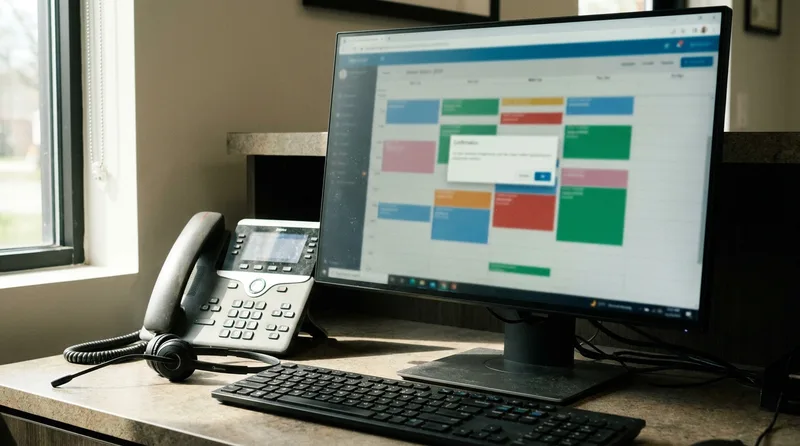
AI receptionists built for dental, like DentiVoice, integrate with systems like Dentrix, Open Dental, Eaglesoft, and Curve Dental. That means the AI reads your open slots, confirms the appointment, and writes it into the schedule while the patient is still on the phone. No callback. No delay. No friction.
Why Speed Wins in Patient Acquisition
Why does this matter so much? Because speed kills in patient acquisition. A prospective patient calling about a toothache at 6 PM on a Tuesday isn't going to wait until Wednesday morning for your front desk to return the call. They're going to Google "dentist near me" and call the next result. Research shows that the average dental practice misses 15 to 20 calls per week. Each one of those is a potential booking walking out the door.
Some answering services are starting to offer "warm transfer" options where the agent transfers the caller to a scheduling tool. But that adds steps, increases hold time, and still doesn't match the simplicity of an AI that handles everything in one conversation.
Related: Learn how AI receptionists connect to your PMS and what to expect during setup. → DentalBase AI Receptionist: Complete Guide
Where Traditional Answering Services Still Make Sense
A fair comparison between these two models has to acknowledge where human agents have an edge. Not every call is a straightforward scheduling request, and some situations benefit from a person on the other end of the line.
Situations Where a Human Agent Still Wins
Complex insurance disputes are one example. When a patient calls upset about a denied claim and wants to talk through their options, a trained human agent can pick up on tone, show empathy in ways that feel personal, and adapt the conversation in real time. AI is getting better at this. Much better. But it's not there yet for every emotional scenario.
Practices in areas with high multilingual demand sometimes prefer answering services that employ native speakers of specific regional dialects. While AI receptionists increasingly support Spanish, Vietnamese, Mandarin, and other languages, the quality varies by platform. If 40% of your patient base speaks a language the AI doesn't cover well, that's a real gap.
That said, the situations where an answering service clearly outperforms AI are narrowing every year. Most routine calls, which make up 80% or more of your volume, don't require a human touch. They require accuracy, speed, and availability. And that's where AI wins.
See How It Works for Your Practice
Book a free demo to hear DentiVoice handle a real patient call scenario with your practice's information.
Book a Free Demo →What Should You Evaluate Before Switching?
If you're considering replacing your answering service with an AI receptionist, or adding one alongside your current setup, you need a clear evaluation checklist. Not all AI platforms are equal, and the wrong choice creates more problems than it solves.
Start with PMS integration. Does the AI connect directly to your scheduling software? If it doesn't book into Dentrix, Open Dental, Eaglesoft, or whatever system you run, you're just getting a fancier message-taker. That's the whole point of switching.
Related: Data security should be on that same checklist, since AI platforms handle more patient information than a traditional answering service does. Data Security and Privacy: How Safe Are AI Reception Tools? →
After-hours coverage is the next filter. After-hours calls represent 27% of total patient call volume, according to Dental Economics. If the AI only runs during business hours, you're still losing a quarter of your opportunities. Make sure the system covers nights, weekends, and holidays without extra charges.
Your Evaluation Checklist
- PMS integration: Confirm direct booking with your specific software, not just "API compatibility."
- HIPAA compliance: Request a Business Associate Agreement and documentation of encryption standards. HIPAA compliance isn't optional for any system handling patient data.
- Call recording and scoring: You need to review and score calls to know if the system is converting.
- Urgent call triage: How does the AI handle a patient calling about severe pain or a knocked-out tooth? Escalation protocols matter.
- Reporting dashboard: Look for data on call volume, booking rate, missed calls, and peak hours. If you can't measure it, you can't improve it.
- Contract terms: Avoid long-term contracts until you've tested. Monthly agreements give you flexibility.
- Onboarding timeline: Typical setup takes one to two weeks for a single-location practice.
The Bureau of Labor Statistics projects dental employment to grow 4% through 2032, but front desk hiring remains one of the hardest roles to fill. That's another reason to evaluate AI now, not because it replaces your team, but because it fills the gaps your team physically can't cover.
How to Run a Side-by-Side Test at Your Practice
Don't take anyone's word for which option is better. Test it. A 30-day side-by-side comparison gives you hard data from your own practice, your own patients, and your own call patterns. No case study or blog post can replace that.

Here's a practical framework. Run your current answering service and an AI receptionist simultaneously for 30 days, then compare the results side by side before committing to either one.
- Keep your existing answering service running as-is during business hours to establish a fair baseline.
- Route after-hours calls and business-hours overflow to the AI receptionist for the same 30-day window.
- Track booking conversion rate (calls that result in a scheduled appointment) for each system separately.
- Log average response time and cost per booked appointment for both systems weekly.
- Ask patients at check-in about their scheduling experience to capture patient satisfaction.
What "Good" Looks Like
A booking conversion rate above 60% on inbound new patient calls is strong. If your answering service converts at 20% (which is common, since most calls become callbacks that never connect), and the AI converts at 55% or higher, that tells you everything. For a practice getting 50 new patient calls a month, that's the difference between 10 booked patients and 27.
Cost per booked appointment is the other metric that matters more than raw monthly cost. If you spend $400 a month on an answering service and book 10 patients, that's $40 per booking. If you spend $350 on an AI receptionist and book 27, that's $13 per booking. Which number do you want?
During the test, pay attention to the types of calls each system handles well and where each one struggles. You might find that AI handles 90% of calls perfectly and the remaining 10% need a human. That's fine. A hybrid model where AI takes the bulk and humans handle exceptions is often the most practical setup.
One more thing. Talk to your front desk team during the test. They're the ones who'll notice whether the AI-booked appointments are accurate, whether patients mention the experience, and whether their workload actually shifts. Their feedback is as valuable as the numbers.
Making the Right Call for Your Practice
Choosing between an AI phone system and a traditional answering service isn't really about technology preference. It's about what happens to the 15-20 calls your practice misses every week and whether those callers become patients or disappear. For most practices, the AI model books more appointments, costs less per conversion, and covers hours that answering services handle inconsistently.
Ready to See the Numbers for Your Practice?
If you're ready to see real numbers, run the 30-day test. It's the only way to know what works for your specific call volume, patient mix, and workflow. And if you want to start with a free demo before committing to a test, DentalBase can walk you through exactly how the AI handles calls for practices like yours.
Ready to Compare for Yourself?
Book a free demo and see how DentiVoice handles your practice's real call scenarios, from new patient bookings to after-hours triage.
Book a Free Demo →Want more guides on growing your dental practice?
Browse Resources →Sources & References
Frequently Asked Questions
In most cases, yes. AI receptionists use flat-rate or per-call pricing that stays predictable as volume grows. Answering services charge per minute, so costs spike during busy periods. A practice handling 200 calls per week will typically spend less on AI than on a per-minute answering service.
Yes, if the AI system integrates with your PMS. Platforms like DentiVoice connect with Dentrix, Open Dental, Eaglesoft, and Curve Dental to book, reschedule, and confirm appointments in real time without staff involvement.
Modern dental AI receptionists use conversational voice technology that sounds natural. Most patients can't distinguish the AI from a trained receptionist. What matters more to patients is getting their question answered and their appointment booked quickly.
Reputable dental AI receptionist platforms are built with HIPAA compliance, including encrypted data transmission, secure call recording, and business associate agreements. Always verify compliance documentation before signing with any vendor.
Quality AI receptionist systems include escalation protocols. If the AI detects a complex situation like a medical emergency or an upset patient, it transfers the call to a designated staff member or on-call provider immediately.
Some practices run both during a transition period. A 30-day side-by-side test lets you compare booking conversion rates, patient satisfaction, and cost per appointment before fully switching. Most practices that test both end up choosing one system.
Setup typically takes one to two weeks. This includes PMS integration, call flow configuration, training the AI on your practice's specific services and scheduling rules, and testing before going live with patients.
Was this article helpful?
Written by
DentalBase Team
Expert dental industry content from the DentalBase team. We provide insights on practice management, marketing, compliance, and growth strategies for dental professionals.