AI Receptionist for Dental Practices in Maryland (2026)
An AI receptionist for dental practices in Maryland: commuter-hour calls, multilingual booking, FEDVIP and Healthy Smiles, plus two-party recording law.
Share:
Table of contents
An AI receptionist for dental practices in Maryland has to fit a market unlike most others. Four things shape it: the DC commuter belt, a language-diverse population, a heavy federal-employee insurance mix, and a strict two-party call-recording law. The generic pitch of "answer more calls" misses what matters here, which is why our dental marketing and front-office services get configured market by market. A Bethesda practice serving federal commuters has a different call pattern than a Salisbury practice on the Eastern Shore. Specialty matters too: a Bethesda orthodontic office juggling multi-phase treatment plans needs an AI receptionist built around orthodontic scheduling, not a generic call-answering setup. For the complete picture of how the DentalBase AI receptionist works across a practice, see our complete guide to the DentalBase AI receptionist.
The baseline problem is the same one every practice faces. Roughly 38% of new patient calls go unanswered during business hours, per ADA Practice Transitions data, and most of those callers dial the next name on Google. What differs in Maryland is when those calls arrive and what language they're in. The plans they carry and the recording rules differ too. This guide works through each of those. Then it covers the ROI math you can run on your own numbers.
How does the DC commuter belt change call timing for Maryland practices?
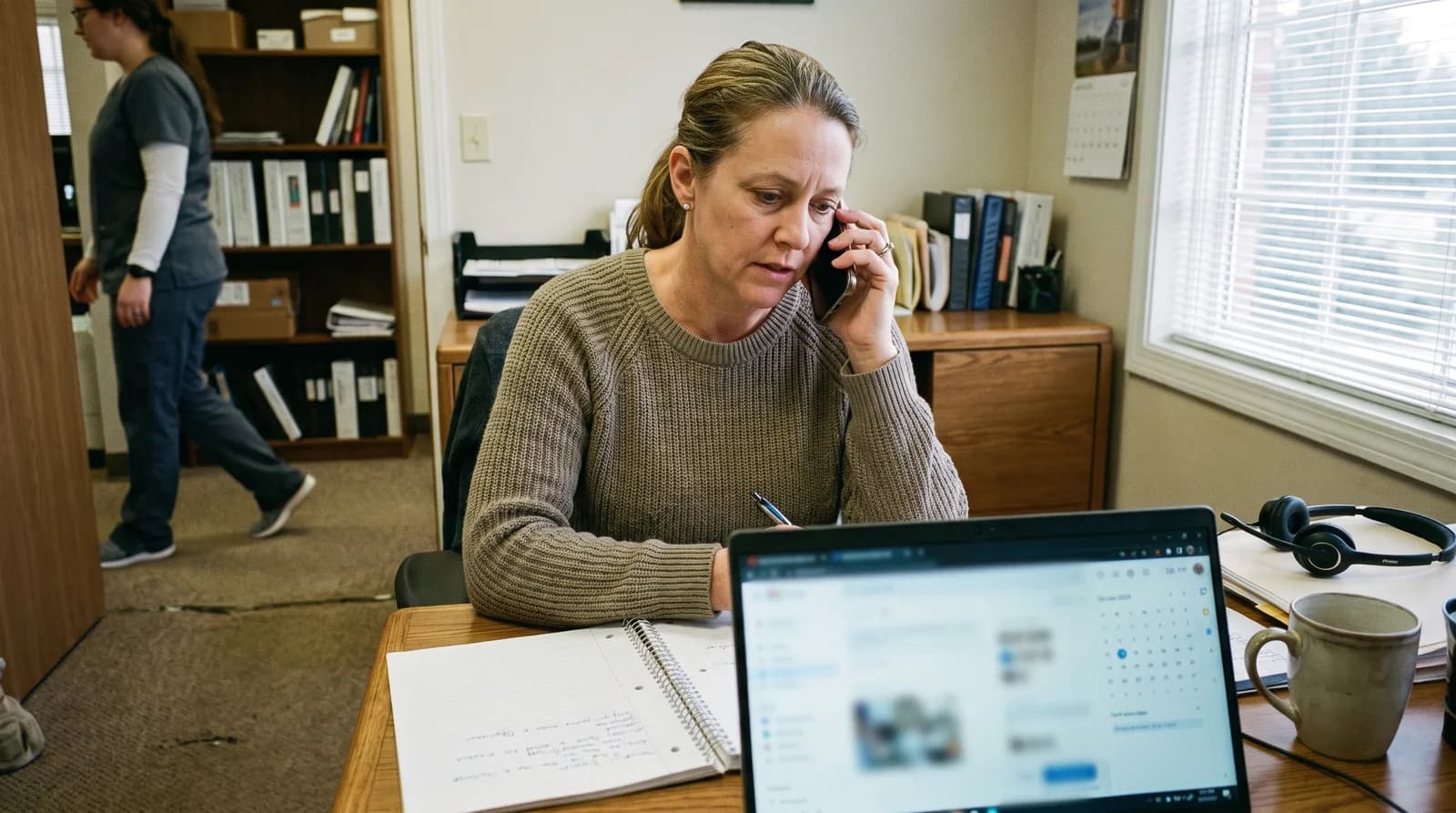
Maryland's largest population centers sit in the DC commuter belt, where many patients leave home before 8 AM and get back after 7 PM. That pushes a large share of patient calls outside normal front-desk hours, so the practices that answer early-morning and evening calls capture patients the rest miss.
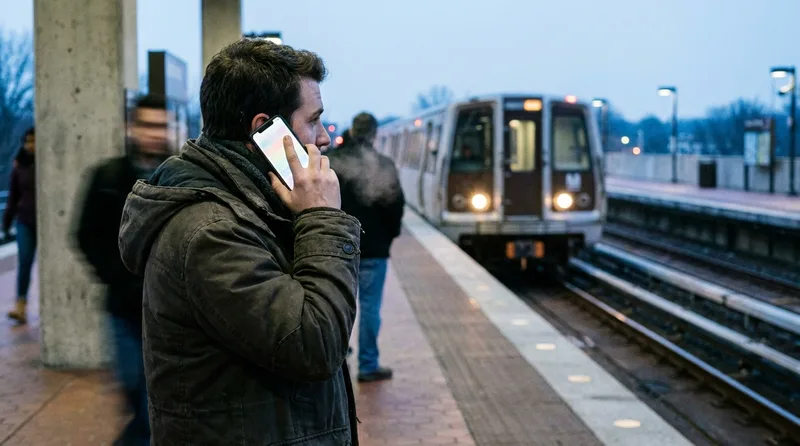
Montgomery County and Prince George's County send tens of thousands of commuters into DC and Northern Virginia each weekday. A patient stuck on the Red Line or sitting on I-270 isn't calling at 2 PM. They call at 7:15 AM before the train, or at 6:45 PM on the way home. By then the front desk has often gone quiet. After-hours calls already make up about 27% of total patient call volume nationally, per Dental Economics. A commuter-heavy market skews that higher.
When Maryland patients actually call
Relative call volume across a commuter weekday. The peaks fall outside a 9-to-5 front desk.
Shaded daytime hours = front desk staffed (9-5)
6a | 7a | 9a | 12p | 2p | 4p | 5p | 7p | 8p | 9p |
Off-hours peak (7a, 7p) Early / late shoulder During staffed hours
Illustrative pattern for a Maryland commuter market. Exact volumes vary by practice and location.
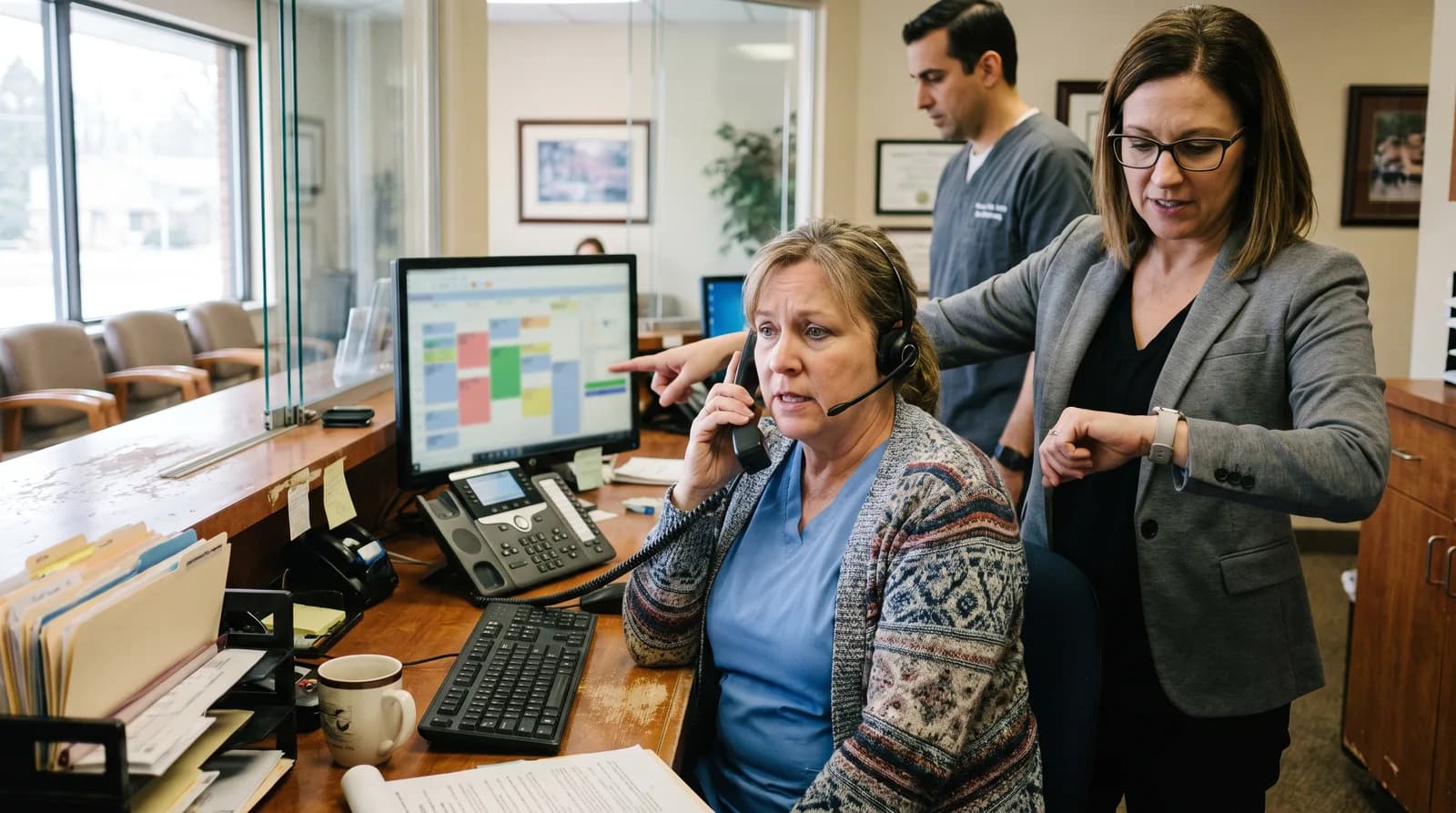
The damage compounds at the front desk. The average caller hangs up after roughly 90 seconds on hold, per Marchex data. A single receptionist juggling check-ins and insurance verification can't catch a 7 AM ring. An AI receptionist answers on the first ring at any hour. It books the appointment and texts a confirmation. The commuter who calls from the platform is booked before the train arrives.
Catch the early-morning and evening calls your front desk misses
DentiVoice answers and books Maryland patient calls around the commuter schedule, not just 9 to 5.
Explore the AI Receptionist →Related: For the full playbook on covering nights and weekends without burning out staff → After Hours Dental Phone Coverage Without Staff Burnout
Related: Commuter-hour searches are usually spoken into a phone or car assistant before the call comes in. Read the voice search SEO guide for dental practices →
What languages do Maryland dental practices need an AI receptionist to handle?
Maryland is one of the most linguistically diverse states in the country, so an AI receptionist that only books in English leaves patients on the table. Spanish is the clear priority in Prince George's and parts of Montgomery County, with notable Amharic, Korean, and Chinese-speaking communities across the DC and Baltimore metros.
The booking flow matters more than a translated greeting. A patient who hears a Spanish hello but then gets pushed back into English to confirm insurance or pick a time often gives up. The AI should detect the caller's language in the first few seconds. From there it runs the whole conversation in that language: greeting, intake, plan questions, scheduling, and confirmation. Per Zocdoc, 77% of patients want online booking capability, and a spoken booking flow serves the same expectation over the phone.
Where the demand concentrates
The language map roughly follows the geography. A few patterns Maryland practices see:
- Prince George's County: Large Spanish-speaking population, plus significant West African and Caribbean communities.
- Montgomery County: One of the most diverse counties in the US, with Spanish, Amharic, Chinese, and Korean all common.
- Howard County: Strong Korean and Chinese-speaking communities around Columbia and Ellicott City.
- Baltimore metro: Growing Spanish-speaking population in areas like Highlandtown and Dundalk.
A practice that books smoothly in a patient's first language earns referrals inside tight-knit communities. English-only competitors rarely reach those patients at all. It shows up in reviews too, since 98% of people read local reviews before choosing a business.
How should an AI receptionist handle Maryland's insurance and Medicaid mix?
Maryland's payer mix leans heavily on federal-employee plans and a sizable Medicaid dental program. So an AI receptionist for dental practices in Maryland needs to answer plan questions during the call, not promise a callback. Federal Employees Dental and Vision Insurance Program coverage and Maryland Healthy Smiles both come up constantly at front desks here.
The DC region has one of the highest concentrations of federal workers in the country. Many carry FEDVIP dental plans through carriers your front desk verifies all day. On the public side, Maryland Healthy Smiles is the state's Medicaid dental benefit. Those callers ask whether you accept it before anything else. An AI receptionist can answer "yes, we take that" on the spot. It can also route a complex coordination-of-benefits question to staff, which keeps both groups from hanging up.
The deferral trap is real. When the answer to "do you take my plan?" is "we'll check and call you back," a meaningful share of those patients never get the callback. They book elsewhere instead. Handling the routine version in real time adds the most value. Flag only the genuinely complex cases for a human. We cover this use case in our breakdown of using an AI receptionist for dental insurance calls. It's a step up from a message-taking dental virtual receptionist.
Answer FEDVIP and Healthy Smiles questions on the first call
See how DentalBase verifies plans and books Maryland patients without the callback gap.
Book a Free Demo →Does an AI receptionist meet HIPAA and Maryland's two-party recording law?
Yes, if it is configured for it. HIPAA requires a signed Business Associate Agreement and encrypted call data. Maryland adds a strict twist on top: it is a two-party consent state. Every party must agree before a call is recorded, so an AI receptionist that records calls in Maryland must get consent first.

This is the rule that catches out-of-state vendors. Most states are one-party consent. There, one participant can record without telling the other. Maryland is an all-party consent state under its Wiretapping and Electronic Surveillance Act (Courts and Judicial Proceedings, Title 10). Recording a private call there without everyone's consent can be charged as a felony. A dental practice can't quietly record patient calls for "quality and training" the way a Florida or Texas office can.
Most states One-party consent One person on the call can record it. The patient need not be told. AI can record by default | Maryland Two-party consent Every party must agree before recording. Violations can be a felony. AI must capture consent first |
What to require: a recording disclosure played at the start of every call, plus stored proof of consent. Only a minority of states apply this all-party rule, and Maryland is one of them. | |
Maryland's recording law is stricter than the one-party rule many out-of-state vendors are built for.
What that means for your vendor checklist
Put these questions to any vendor before you sign:
- Recording consent: Does the AI play a clear recording disclosure and capture consent at the start of every call?
- Business Associate Agreement: Will they sign one before any patient data flows through the system?
- Encryption and retention: Are recordings and transcripts encrypted, and can you set how long they're kept?
- Maryland records law: Do they treat call data under the Confidentiality of Medical Records Act, not as generic call-center logs?
Get the answers in writing. A vendor that treats Maryland's recording law as an afterthought exposes your practice to real liability. The same privacy discipline should extend to your website and patient forms. We cover that in our guide to HIPAA dental website compliance.
What is the ROI math for an AI receptionist for dental practices in Maryland?
The ROI of an AI receptionist comes down to one comparison: recovered appointment revenue versus the monthly fee. In Maryland's high cost-of-living metros, where front-desk wages and new-patient values both run above the national average, that math tends to favor the AI quickly.
Run it with your own figures rather than a vendor's slide. Three inputs decide it:
- Missed calls per week: The average practice misses 15 to 20 calls weekly, and 80% of callers who reach voicemail never call back, per Forbes.
- New-patient value: In affluent Montgomery and Howard County practices, a single new patient's first-year value can run well into the hundreds or thousands. Implant and cosmetic cases push it higher.
- Your front-desk cost: Salary plus benefits in the DC-Baltimore corridor sit above the US average. Every hour the phone pulls staff off in-person care has a real price.
Put numbers to it. Say you recover two or three new patients a week that you were losing to voicemail. The recovered production typically exceeds a monthly subscription. That's the comparison that matters, not the sticker price alone. Before you compare quotes, get clear on what your current setup costs, staff time included. Our guide to dental office phone systems walks through the questions to ask, and our breakdown of dental software hidden fees covers the charges vendors bury.
If you're a single-provider practice weighing this decision, our AI dental receptionist guide for solo dentists walks through feature priorities and typical monthly costs in more detail.
| ROI input | What to measure | Why Maryland tilts it |
|---|---|---|
| Missed calls | Calls per week with no answer | Commuter hours push volume off-peak |
| Patient value | First-year value of a new patient | Affluent counties support higher-value cases |
| Staff cost | Front-desk salary plus benefits | DC-Baltimore wages run above US average |
Demand isn't the constraint here. Per Pew Research, 71% of people looking for a dentist run a search before scheduling. Most of them start with a phone call or a local search, and the CDC's oral health resources track how routine that care has become. Capturing those calls is one of the cheapest growth levers a Maryland practice has. The wider case for that spend sits in our overview of how AI call handling translates into patient retention.
How do Maryland's major markets differ in AI requirements?
Maryland's dental markets aren't interchangeable, so an AI receptionist should be configured to the practice's location. A Montgomery County office and an Eastern Shore office face different patients, languages, and call patterns, and the setup should reflect that.
How to tune the AI by Maryland market
| Montgomery | FEDVIPMultilingualHigh-value cases |
| Prince George's | Spanish-firstHealthy Smiles |
| Baltimore metro | Mixed plansGrowing Spanish |
| Howard | Korean / ChineseResearch-heavy |
| Eastern Shore | Thin staffingAfter-hours / overflow |
The same AI receptionist, configured differently for each Maryland market's patients and plans.
Here's how the main markets break down:
- Montgomery County (Bethesda, Rockville, Silver Spring): Affluent, heavily federal, multilingual, with strong demand for cosmetic and implant cases. The AI needs polished multilingual handling and detailed consultation flows.
- Prince George's County: Diverse and Spanish-forward, with large West African and Caribbean communities. Spanish-first booking and Medicaid Healthy Smiles handling matter most here.
- Baltimore metro: Mixed urban and suburban market with a wide insurance range, from commercial plans to Medicaid. The AI must flex across plan types and a growing Spanish-speaking population.
- Howard County (Columbia, Ellicott City): High-income, strong Korean and Chinese communities, value-conscious families researching before they book. Multilingual flows and clear procedure detail convert here.
- Eastern Shore and rural Maryland (Salisbury, Cambridge): Smaller practices with thin front-desk coverage. One missed-staff day can mean a day of missed calls. After-hours and overflow coverage carry the most weight.
The thread across all of them is the same. The calls that matter most arrive when your front desk is stretched thinnest. They come in a language your team may not speak, carrying a plan that needs an answer now. An AI receptionist for dental practices in Maryland closes that gap. Phone coverage also feeds local search, since a booked call is the outcome those searches are meant to produce, a point HubSpot covers in its local SEO research. Routine dental visits sit inside broader health outcomes, which the National Institute of Dental and Craniofacial Research documents in its public data.
Related: Any AI receptionist handling patient calls needs the same safeguards regardless of state. Read this dental HIPAA compliance checklist for evaluating any AI receptionist vendor.
AI reception built for Maryland dental practices
DentalBase answers commuter-hour calls, books in multiple languages, handles FEDVIP and Healthy Smiles questions, and records calls with consent under Maryland law.
Browse Practice Growth Guides →Sources & References
Frequently Asked Questions
Montgomery and Prince George's County patients commute into DC, so many calls land before 8 AM or after 7 PM. An AI receptionist answers those off-peak calls and books patients your front desk would otherwise miss.
Only with consent. Maryland is a two-party consent state under its Wiretapping and Electronic Surveillance Act, so the AI must disclose recording and capture every caller's consent before taping. Recording without it can be a felony.
Spanish is the priority in Prince George's and parts of Montgomery County, with notable Amharic, Korean, and Chinese-speaking communities statewide. The AI should detect the language early and run the whole booking flow in it.
A capable system answers routine plan questions during the call, including federal-employee FEDVIP coverage and Maryland Healthy Smiles Medicaid. It books eligible callers immediately and routes complex coordination-of-benefits cases to staff.
Compare recovered appointment revenue to the monthly fee. Use your missed calls per week, your average new-patient value, and your front-desk cost. In Maryland's high-wage, affluent metros, recovered patients usually outweigh the subscription quickly.
Was this article helpful?
Written by
DentalBase Team
Expert dental industry content from the DentalBase team. We provide insights on practice management, marketing, compliance, and growth strategies for dental professionals.