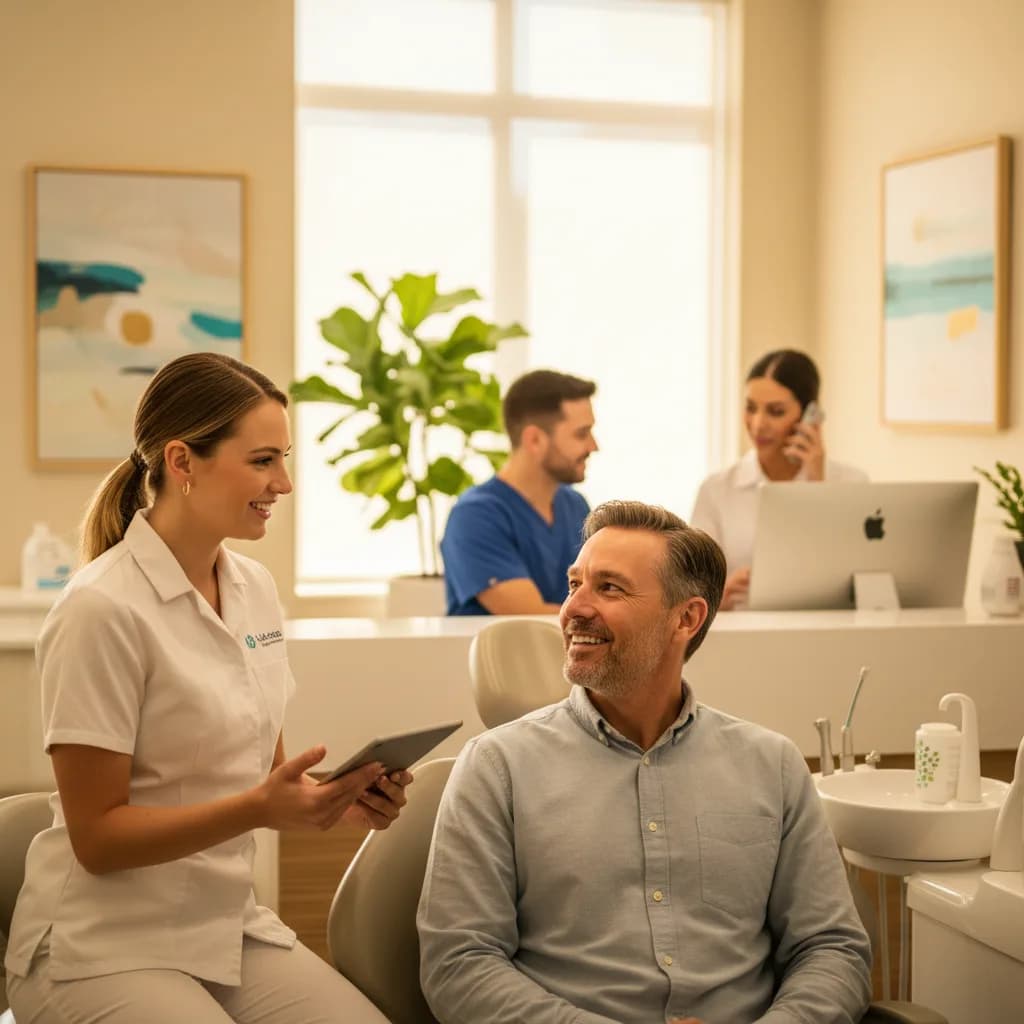
How to Improve Dental Patient Communication at Every Touchpoint
Improve dental patient communication across phone, text, email, and in-office. Fixes for the five touchpoints where most practices lose patients.
Share:
Table of contents
The fastest way to improve dental patient communication is to fix the five touchpoints where patients actually interact with your practice: the first phone call, appointment confirmations, the in-office experience, post-visit follow-up, and recall outreach. Most practices focus on adding new communication channels (texting, email campaigns, social media) before fixing the basics. A practice that launches an email newsletter while 38% of inbound calls go unanswered is building a second floor on a house with no foundation. Fix the phone first. Then confirmations. Then post-visit. Then recall. Each fix compounds because patients who have a great experience at one touchpoint are more likely to engage at the next one.
This guide covers how to improve dental patient communication at all five touchpoints with specific, implementable changes ranked by impact: what to fix first, what each improvement costs, and how to measure whether the change is working. According to BrightLocal, 98% of consumers expect responsive communication from local businesses. Patients don't compare your practice to other dental offices. They compare it to every business they interact with: their bank, their gym, their favorite restaurant. The communication standard is set by the best experience in their life, not the best experience in dentistry. According to the ADA, patient communication quality is the strongest predictor of practice loyalty and referral behavior.
How Do You Fix the First Phone Call (Touchpoint 1)?
The phone call is where you improve dental patient communication with the highest-impact single change because it's the first impression and the moment the patient decides to book or call someone else.
| Phone Problem | Impact | Fix | Cost of Fix |
|---|---|---|---|
| 38% of calls unanswered | $3,000-8,000/mo lost revenue | AI reception | $300-1,000/mo |
| Hold times over 30 seconds | 40% of callers hang up | AI handles overflow | Included in AI platform |
| After-hours calls to voicemail | 100% of after-hours lost | 24/7 AI coverage | Included in AI platform |
| Insurance unknown at booking | 30-40% lower booking rate | Real-time verification | Included in AI platform |
- Deploy AI reception (answers 100% of calls): The single highest-ROI communication improvement. AI answers within 2 rings, collects patient information conversationally, verifies insurance in real time, confirms coverage details, and books the appointment directly into your PMS. The patient hangs up booked and knowing their cost rather than leaving a voicemail and waiting for a callback that may never come. See our call handling guide.
- Script the first 30 seconds: Whether staff or AI answers, the first 30 seconds set the tone. Name the practice, welcome the caller by name if recognized, and immediately ask how you can help rather than putting them on hold or asking them to "please hold." Patients calling with dental pain or anxiety need to hear competence and warmth in the first sentence, not a hold message.
- Offer specific appointment times, not "we'll call you back": A caller who hears "I have Tuesday at 2pm or Wednesday at 10am" books immediately. A caller who hears "someone will call you back to schedule" has a 50-70% chance of never following through because they'll get busy and call somewhere else first. AI offers real-time availability from your PMS schedule during the call.
Fix the phone first. Everything else follows.
DentalBase AI reception answers every call, verifies insurance in real time, and books directly into your PMS. No voicemail, no hold times, no callbacks needed.
Book a Free Demo →How Do You Fix Appointment Confirmations (Touchpoint 2)?
Confirmations are where most practices lose 15-20% of booked patients to no-shows because the communication between booking and visit is either absent or generic.
- Three-touchpoint automated cascade: Email 7 days before (appointment details + pre-visit instructions + verified insurance cost), SMS 48 hours before ("Reply C to confirm, R to reschedule"), AI phone call morning-of for unconfirmed patients. This cascade produces 85-95% confirmation rates versus 60-75% from manual-only reminders. The 20-30% improvement eliminates 40-50% of no-shows. At $300 average production per appointment, recovering 10 weekly no-shows saves $150,000 annually. See our reminders guide.
- Include financial transparency in confirmations: The #1 reason patients cancel or no-show is financial anxiety about unknown costs. Confirmations that include "Your cleaning is covered at 100% by [insurance]. No out-of-pocket cost expected" reduce cancellations 15-25% because the financial uncertainty is removed before the visit. This requires verification integration feeding cost data into the reminder system.
- Two-way communication in every touchpoint: Every confirmation message should let the patient respond: reschedule, ask a question, or flag a concern. One-way messages ("Your appointment is tomorrow") don't catch the patient who needs to change the time. Two-way messages ("Reply R to reschedule") convert potential no-shows into rescheduled appointments that keep the production on the books. See our no-show prevention guide.
How Do You Fix Post-Visit Follow-Up (Touchpoint 3)?
Post-visit is where you improve dental patient communication in ways that drive reviews, referrals, and treatment acceptance for recommended procedures the patient didn't complete same-day.
- Automated post-visit check-in (2-4 hours after): SMS asking "How was your visit today?" with a satisfaction scale. Happy patients (4-5 stars) are directed to leave a Google review. Unhappy patients (1-3 stars) are directed to a private feedback form where the office can address concerns before they become public reviews. This produces 20-30 reviews monthly versus 5-10 from manual asking. See our review collection guide.
- Post-procedure care instructions (immediate): After extractions, fillings, crowns, and other procedures, patients receive SMS care instructions specific to their procedure within 30 minutes of checkout. "After your extraction today: bite on gauze for 30 minutes, avoid straws for 48 hours, take ibuprofen as needed." This reduces post-procedure phone calls by 40-50% (fewer "is this normal?" calls) and demonstrates care that patients mention in reviews.
- Treatment plan follow-up (48-72 hours): For patients who had treatment recommended but not completed same-day (crowns, implants, orthodontics), an automated follow-up addresses common objections: "Dr. [Name] recommended a crown for tooth #14 during your visit Tuesday. Your insurance covers 50% of the cost. Would you like to schedule? Here are available times." Proactive follow-up recovers 15-25% of unscheduled treatment plans that would otherwise require months of staff phone tag. Connect to your cancellation reduction strategy.
Related: See the complete communication automation system. → Dental Patient Communication Automation: The Complete System
What Do Effective Dental Patient Communications Look Like?
Dental patient communications span every touchpoint between your practice and a patient: the first phone call, every confirmation message, the in-office conversation, post-visit follow-up, recall outreach, and reactivation messages for lapsed patients. Most practices have some of these but not all, and the gaps are where patients quietly decide not to return.
The difference between practices with strong retention and practices with revolving-door attrition usually isn't clinical quality. It's the consistency and warmth of every communication between visits. A patient who receives a same-day care instruction text, a two-day treatment follow-up, and a proactive recall reminder at one month doesn't experience gaps. A patient who gets none of those experiences absence, and absence gets filled by a competitor advertising on Google.
According to ADA Health Policy Institute research, practices that maintain regular proactive contact between visits see measurably higher patient retention and recall compliance than those that communicate only at appointment time. Dental patient communications are the mechanism that creates consistent engagement, not just during clinical visits.
What Makes Dental Patient Communications Feel Personal?
Personalization in dental patient communications doesn't require writing each message by hand. It requires using the data you already have: the patient's name, their procedure, their insurance coverage, and the date of their last visit. An automated message that says "Hi Sarah, following up on your crown placement Tuesday, how is it feeling?" is more personal than a generic "How was your visit?" The procedure-specific reference signals that the practice pays attention.
Three elements produce personal-feeling communications at scale: name and procedure context in every message, timing tied to the patient's actual visit rather than batch sends on a fixed schedule, and two-way channels that let the patient respond. Practices that master all three stop feeling like a database to their patients and start feeling like a team that remembers them. For more on how this connects to long-term loyalty, see the guide on the dental patient experience that drives retention.
What Tone Should Dental Patient Communications Use?
The tone should match what the patient is experiencing at that moment. Pre-visit communications should be reassuring and logistically clear, reducing anxiety about cost, scheduling, and what to expect. Post-visit communications should feel warm and checking-in rather than transactional. Recall messages should feel like a gentle reminder from someone who cares. Reactivation messages should acknowledge the gap without blame and make returning easy.
The tone test for every message
Ask: if a real person on your front desk sent this, would it feel strange or cold? If yes, the message is too automated. Warm, specific, and brief is the standard for every patient-facing communication your practice sends.
How Do You Fix Recall and Reactivation (Touchpoints 4-5)?
Recall and reactivation are where practices silently lose 30-40% of their patient base because overdue patients don't receive consistent outreach.
- Automated recall cascade (overdue 1-6 months): SMS at 1 month overdue, email at 2 months with scheduling link, AI phone call at 3 months offering specific appointment times. The cascade intensifies because each month of inactivity increases the probability of permanent loss. Recall compliance improves from 40-60% (manual) to 70-85% (automated). At 500 overdue patients recovering an additional 125-175 at $200-400 per hygiene visit, that's $25,000-70,000 annually in recovered production. See our recall gap guide.
- Reactivation for 12+ month lapsed patients: Patients who missed recall entirely and haven't visited in over a year need a different approach. AI reactivation sends personalized messages acknowledging the gap with scheduling links, then AI phone calls to non-responders. Contact rate: 40-60% (versus 5-10% manual cold calling). Recovery rate: 10-15% of lapsed patients return. At 500 lapsed patients recovering 50-75 at $800-1,500 lifetime value: $40,000-112,000 annually.
- Exit surveys for patients who don't return: Patients who don't respond to recall or reactivation after 3 months of outreach should receive a final message: "We noticed you haven't scheduled a visit. We'd love to know why so we can improve. Was it: scheduling convenience, insurance changes, moved away, or something else?" The responses reveal whether you have a communication problem, a service problem, or a natural attrition pattern. This data improves all five touchpoints.
Which Tools Support Dental Patient Communications at Scale?
The right tool stack for dental patient communications depends on practice size and the touchpoints you need to automate. Three categories of tools handle the full communication stack, and most practices need all three working together rather than one platform trying to do everything.
| Communication Layer | What It Handles | Key Capability |
|---|---|---|
| AI Reception | Phone calls, after-hours, overflow | Books directly into PMS, verifies insurance in real time |
| Automated Messaging | SMS/email confirmations, recalls, post-visit | Two-way channels, procedure-specific content |
| PMS Integration | Data sync, treatment plans, patient history | Personalization without manual data entry |
| Review Management | Post-visit review requests, satisfaction gates | Routes happy patients to Google, unhappy to private form |
The critical requirement for any dental patient communications platform is native PMS integration. A tool that doesn't connect to Dentrix, Eaglesoft, or Open Dental can't personalize messages with procedure data, can't offer real-time appointment availability, and can't close the loop between patient response and calendar. According to ADA practice management resources, practices with integrated patient communication systems report higher satisfaction scores and lower front-desk administrative burden than practices using disconnected point solutions.
Adults who receive consistent communication from their dental provider are significantly more likely to maintain regular recall visits, according to research from the National Institute of Dental and Craniofacial Research. The communication itself creates the behavior, not just the reminder. See the full breakdown of the best dental follow-up channel for each situation to understand how to sequence these tools effectively.
How Do You Measure Communication Improvement Across All Touchpoints?
Five metrics tracked monthly prove whether efforts to improve dental patient communication are producing measurable results.
- Phone answer rate (target: 95-100%): The foundational metric because everything starts with the call. Track weekly. Pre-AI baseline is typically 62% (38% missed). Post-AI target is 95-100%. If answer rate doesn't improve within 7 days of deploying AI, there's a configuration or routing issue. See our ROI tracking guide.
- No-show rate (target: under 5%): Measures confirmation effectiveness. Pre-automation baseline: 15-20%. Post-automation target: under 5%. The 10-15% reduction recovers $75,000-150,000 annually for most practices. If confirmation rate is 90% but no-shows remain above 10%, investigate day-of factors (transportation, anxiety, financial). See our no-show reduction guide.
- Review velocity (target: 20-30/month): Measures post-visit follow-up effectiveness. According to Moz, review velocity is a top local ranking factor. Pre-automation: 5-10/month. Post-automation: 20-30/month. Track through GA4 and your review platform.
- Recall compliance (target: 70-85%): Measures recall outreach effectiveness. Pre-automation: 40-60%. Post-automation: 70-85%. Track monthly. Improvement should be visible within 90 days of launching automated recall.
- Patient retention rate (target: 85%+ annual): The ultimate metric. What percentage of active patients return within 18 months? Pre-improvement baseline: typically 60-70%. Post-improvement target: 85%+. This metric moves slowly (6-12 months to show meaningful change) but represents the compound effect of all five touchpoints working together. For the exact formula and how to interpret your number against industry benchmarks, see how to calculate your dental patient retention rate. Compliance with HIPAA applies to all communication data. Connect to your spend breakdown, marketing strategy, social media, and email marketing.
How Should Dental Practices Handle In-Office Patient Communication?
The in-office visit is the one communication touchpoint that can't be automated, and it's often the one practices take for granted. The front desk greeting, the handoff from reception to clinical, the dentist's language when presenting a treatment plan, and the checkout conversation all shape whether the patient books the next appointment or leaves uncertain.
According to CDC oral health data, only about 65% of U.S. adults visited a dentist in the past year, with cost concerns and a lack of perceived urgency cited as leading barriers, both of which effective in-office dental patient communications directly address through clear treatment rationale and insurance transparency. In-office communication is the highest-leverage non-automated touchpoint a practice can improve.
How Should Dentists Present Treatment Plans to Patients?
Treatment plan presentation is where dental patient communications directly affect case acceptance. Three practices consistently improve acceptance rates:
- Lead with the clinical reason, not the cost: "This tooth has decay reaching the nerve, which means a root canal now prevents an extraction later" is more motivating than the procedure name and price. Patients accept treatment they understand.
- Give two choices, not one: "We can schedule this in two weeks or handle it today if you have time" converts better than "you'll need to schedule." Offering a decision makes the patient an active participant rather than a recipient of instructions.
- Confirm insurance coverage before they leave the chair: Every patient who walks out not knowing their out-of-pocket cost for recommended treatment is less likely to schedule it. Real-time insurance verification at checkout removes this barrier. See why this matters for the dental patient first impression.
According to HubSpot research on service communication, businesses that confirm next steps before a customer leaves see significantly higher follow-through rates than those that leave the next action to the customer to initiate. Dental treatment plan follow-through follows the same pattern.
Fix every touchpoint from one platform
DentalBase improves patient communication across all five touchpoints: AI phone, automated confirmations, post-visit follow-up, recall outreach, and reactivation from one integrated platform.
Book a Free Demo →Explore more guides and tools for dental practice growth.
Browse Resources →Sources & References
Frequently Asked Questions
Fix the phone first. 38% of calls go unanswered. AI reception answering 100% of calls produces $3,000-8,000/month in recovered revenue and is the foundation for every other communication improvement. No other change produces as much ROI as answering the phone.
In priority order: first phone call (AI reception), appointment confirmations (three-touchpoint automated cascade), post-visit follow-up (reviews, care instructions, treatment follow-up), recall outreach (automated cascade at 1/2/3 months), and reactivation (12+ month lapsed patients).
Three-touchpoint cascade: email at 7 days, SMS at 48 hours, AI call morning-of. Produces 85-95% confirmation versus 60-75% manual. Including verified insurance costs reduces cancellations an additional 15-25% by eliminating financial anxiety before the visit.
Three automated messages: satisfaction survey with review gate at 2-4 hours (producing 20-30 reviews/month), procedure-specific care instructions within 30 minutes (reducing post-op calls 40-50%), and treatment plan follow-up at 48-72 hours (recovering 15-25% of unscheduled plans).
Automated cascade: SMS at 1 month overdue, email at 2 months, AI phone call at 3 months. Compliance improves from 40-60% to 70-85%. At 500 overdue patients recovering 125-175 at $200-400 per visit: $25,000-70,000 annually.
Five monthly metrics: phone answer rate (target 95-100%), no-show rate (under 5%), review velocity (20-30/month), recall compliance (70-85%), and patient retention rate (85%+ annual). Each measures a specific touchpoint's effectiveness.
Patients don't benchmark against other dental offices. They compare to every business they interact with (banking apps, restaurant reservations, gym scheduling). The communication standard is set by the best experience in their life, making responsive, automated communication essential.
Phone: $36,000-96,000/year recovered. Confirmations: $75,000-150,000 from reduced no-shows. Post-visit: $30,000-80,000 from reviews and treatment acceptance. Recall+reactivation: $65,000-182,000. Total: $206,000-508,000 annually for a typical practice.
Dental patient communications are all the messages and interactions between a practice and its patients across the care journey: phone calls, appointment confirmations, in-office conversations, post-visit follow-ups, recall outreach, and reactivation messages. Effective dental patient communications are consistent, procedure-specific, and delivered through channels the patient responds to.
Three layers: AI reception for phone calls and after-hours (books directly into PMS, verifies insurance in real time), automated messaging for SMS/email confirmations, recalls, and post-visit follow-ups, and native PMS integration for Dentrix, Eaglesoft, or Open Dental. PMS integration is the critical requirement, without it, messages can't be personalized with procedure data or real-time availability.
Lead with the clinical reason before the cost, offer two scheduling choices rather than leaving the next step to the patient, and confirm insurance coverage at checkout before the patient leaves. All three practices reduce the probability that a recommended treatment goes unscheduled and improve case acceptance without pressure.
Was this article helpful?
Written by
Dentalbase Team
The Dentalbase Team is a collective of dental marketing experts, AI developers, and practice management consultants dedicated to helping dental practices thrive in the digital age.