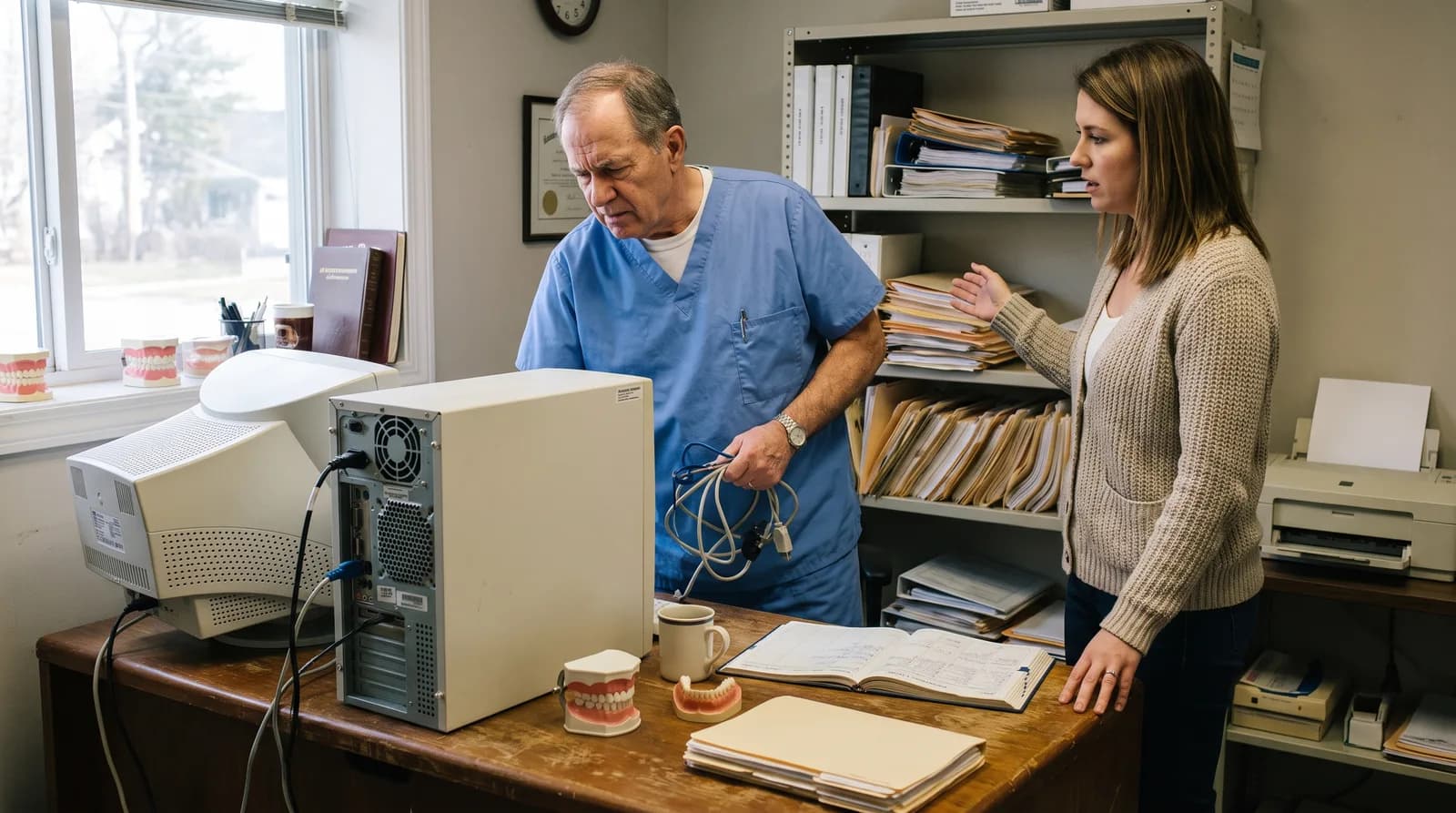
Legacy Dental Practice Technology: Why Owners Wait
Legacy dental practice technology isn't owner denial, it's switching-cost math. Why practices delay, what triggers a change, and the cost of waiting.
Share:
Table of contents
Every owner I talk to knows their practice management system is dated. Almost none of them have switched it yet. That gap is not a mystery once you run the actual numbers behind legacy dental practice technology, and it is not the story of stubborn owners refusing to modernize.
I still run parts of my own practice on systems I would not call cutting-edge. That is not an accident. It is math. Before you assume you are behind, it helps to look at the real switching-cost equation most owners are quietly running, the same one we walk practices through across our services every week.
What Counts as Legacy Dental Practice Technology, and Why Does It Stick Around?
Legacy dental practice technology is any core system, a scheduler, a chart, a billing tool, that has fallen behind current options but still runs the practice daily. It sticks around because switching costs almost always outweigh staying costs, at least at first. That math flips eventually, just slower than vendors claim.
Contract lock-in
Most practice management contracts run multi-year terms with early termination fees. Walking away mid-contract means paying twice: once for the system you are leaving, once for the one replacing it. Some vendors quietly extend this lock-in through hardware leases or data-export fees that never make it into the original sales conversation.
Training and change cost
Every staff member has to relearn scheduling, charting, and billing workflows. That is real, measurable lost production during the transition, not a soft "adjustment period" line item. Staffing shortages make this worse. With dental employment growth projected by the Bureau of Labor Statistics outpacing the available labor pool, few practices have the slack to pull a team member off the schedule for a week of retraining.
Unclear ROI
A new system's benefits are often described in vague efficiency language. Owners cannot approve a five-figure decision on "it'll be smoother." They need a number, and most sales conversations do not offer one. Ask a vendor for a specific, dollar-denominated case study from a practice your size, and watch how often the answer gets vague again.
| Delay factor | What it actually costs | Why it stalls the decision |
|---|---|---|
| Contract lock-in | Early termination fees, dual payments during overlap | Forces a wait, even if the owner is ready now |
| Training and change cost | Lost production during the learning curve | Hard to estimate, easy to overweight |
| Unclear ROI | Opportunity cost of staying, rarely quantified | No number to compare against the switching cost |
Related: Integration quality with your existing system is usually the real decision factor, not the feature list. See how PMS integration actually works →
What Does the Real Switching-Cost Math Look Like?
The two columns most owners never both fill in
Run the comparison as two columns: the fully loaded cost of switching against the fully loaded cost of staying. Most owners only ever calculate the first column, which is exactly why staying looks cheaper than it is.
Take a hypothetical three-provider practice as a worked example, with stated assumptions rather than precision. Assume two weeks of reduced scheduling efficiency during transition, a flat migration fee, and a week of overtime for the office manager handling data cleanup. That is the switching column. It is visible, itemized, and easy to say no to. A finance-minded owner can build that spreadsheet in an afternoon, and most do exactly that before ever picking up the phone with a vendor.
The staying column rarely gets the same treatment. Only 26% of practices currently offer online scheduling, according to Dental Economics, despite 77% of patients wanting that capability, per Zocdoc research. That gap is not free. It shows up as booked competitors and after-hours callers who go elsewhere, and almost nobody puts a dollar figure on it until well after the fact.
Add the cost of a single missed new patient call, which runs $1,200 or more in lifetime value according to Dental Economics, and the "staying is safe" column stops looking so safe. Multiply that by 15 to 20 missed calls a week, the average for most practices, and a full year of staying put quietly outweighs almost any migration invoice. The mechanics of a specific migration are covered elsewhere in detail (our Dental Software Migration Cost breakdown walks the line-item math). This is about why the delay happens in the first place, not the invoice itself.
Here is the part most owners skip: staying-column costs compound monthly, while switching-column costs are one-time. A spreadsheet that only shows one side of that timeline will always favor staying, even when staying is the more expensive choice over an eighteen-month horizon.
Why the comparison tilts toward staying by default
- Switching costs are one-time and easy to itemize in an afternoon
- Staying costs compound monthly and rarely get the same spreadsheet treatment
- A missed call alone can run $1,200 or more in lifetime patient value, multiplied weekly
Are You Actually Ready to Evaluate a Switch?
Check what is true today.
Two or fewer checked means you are probably not ready yet, and that is a reasonable place to be.
What Actually Triggers a Technology Upgrade?
The trigger is almost never "we read about a better system." It is a specific, forced moment where the old system fails at something the practice cannot work around anymore.
The moments that actually force a decision
- A new hire cannot be trained fast enough on a system nobody else remembers how to use properly
- A compliance or security scare exposes a real gap the old system cannot close, particularly around infection control and data-handling standards CDC guidance addresses
- Growth outpaces the system's capacity, and double-booking or scheduling errors become routine
- A high-profile competitor visibly offers something (online booking, faster response) the practice cannot match
Notice what is missing from that list: a sales pitch. The same pattern shows up across dental AI adoption broadly, where practices move when a specific operational pain crosses a threshold, not when awareness of a tool reaches some critical mass.
Related: Growth outpacing your system often shows up first as a scheduling capacity problem, not a software complaint. See where growth-related capacity gaps show up →
What Compounds While You Wait?
Waiting is not neutral. Three costs compound quietly in the background while an owner puts off the decision, and none of them show up on a monthly P&L line labeled "cost of old software."
Missed-call cost creep
The average practice misses 15 to 20 calls a week, according to Dental Economics. Phone capacity limits get worse, not better, as a practice grows on an outdated system, since call volume rises faster than an aging setup can absorb it. What looks like a manageable gap at 50 calls a week becomes a serious revenue leak at 150.
Staff frustration and turnover
Front desk and clinical staff notice when their tools are the bottleneck. That frustration shows up in turnover long before it shows up in a formal complaint, and turnover is expensive to replace, especially with front desk bandwidth already stretched thin in most practices today. Recruiting and onboarding a replacement typically costs several weeks of reduced productivity on top of the original gap.
Competitive gap widening
Every practice that adopts online scheduling, automated recall, or AI receptionist coverage widens the convenience gap. ADA Health Policy Institute research on patient preferences consistently shows convenience ranking high in how patients choose and stay with a provider. Patients notice which practice picks up the phone at 7pm and which one does not, and they rarely mention it before they simply stop calling back.
Staying on Old Systems Is Often the Rational Choice, Until It Isn't
I want to defend something unpopular here. Staying on an old system for longer than feels comfortable is often the financially correct decision, not a failure of judgment. Switching costs are real, and rushing a migration to chase a trend usually costs more than the trend is worth.
The problem is not that owners wait. It is that "wait" quietly becomes "never revisit," long after the original reasons for waiting stopped applying. A system that was the right call three years ago can be the wrong call today, and nobody re-runs the math to check.
- Set a specific date to re-run the switching-cost comparison, not an open-ended "someday"
- Track the compounding costs above (missed calls, turnover, competitive gap) even while staying put
- Treat the decision as reversible math, not a one-time verdict made years ago
| Signal | What it usually means | Recommended response |
|---|---|---|
| Rising missed-call volume | Current system or staffing cannot absorb growth | Re-run the switching-cost comparison now |
| New hire struggles with training | System complexity or documentation gap | Flag as a real switching trigger, not a one-off |
| Patient requests for online booking | Convenience gap versus competitors | Pilot one function before a full rebuild |
Start With the Highest-Pain Function
If missed calls are your biggest bleeding, DentiVoice covers overflow and after-hours without touching your core system.
Explore AI Receptionist →How Can You Evaluate a New System Without Committing to a Full Rebuild?
Why a narrow pilot beats a full rebuild
You do not have to replace everything at once to test whether a new approach earns its cost. Piloting one function first is lower-risk and gives you real data instead of a vendor's projection.
That same logic explains why teledentistry adoption has stayed intentionally narrow instead of becoming a full practice-management overhaul. It is a low-switching-cost pilot, not a wholesale replacement.
If a phone-and-schedule mismatch is part of what is holding an old system in place, does DentiVoice sync with your practice management software covers what a modern PMS connection actually needs to do.
Start with the highest-pain function, not the flashiest one. If missed calls are the visible bleeding, pilot an AI receptionist or answering solution before touching your full practice management system. Most of the objections owners raise at this stage are answerable with a narrow pilot, run for 30 to 60 days with a clear before-and-after number to compare.
The same logic applies outside the phone system. If your website is the visible legacy problem, a slow, dated site is measurable in its own right. Page speed research from Moz ties load time directly to visitor drop-off, and 57% of practices are already looking to redesign their websites, according to Dental Economics. An outdated site is not just a cosmetic issue. It is quietly costing new patient inquiries before anyone answers the phone.
What a 30 to 60 day pilot looks like
- Start with the highest-pain function, not the flashiest one
- Set a clear before-and-after number to compare, not a vendor's projection
- Expand what works; walk away from what does not, at a fraction of a full migration's cost
If the pilot works, expand it. If it does not, you have lost far less than a full system migration would have cost, and you have real data instead of a guess for the next evaluation.
Where Does This Leave Practices Heading Into 2027?
The bottom line
Expect the gap between "aware of better technology" and "running better technology" to persist for most practices, not close suddenly. The practices that move first will keep being the ones with a specific, measurable pain, not the ones with the newest reading list.
We built DentalBase around that reality rather than around the assumption that owners simply need more information about what is available. If a narrow, specific pain point is what is holding your practice back, a short conversation is usually more useful than another feature comparison chart.
Legacy dental practice technology is not a discipline problem. It is a math problem that changes over time without anyone re-running the numbers. Practices with online scheduling see 24% fewer no-shows, according to Dental Economics, a reminder that the cost of legacy systems is not abstract. The practices that switch at the right moment are not smarter, they are just the ones who checked the math again instead of assuming last year's answer still holds.
Run the Numbers on Your Own Practice
Book a free demo and we will help you compare the real cost of staying against the real cost of switching.
Book a Free Demo →See What a Narrow Pilot Actually Looks Like
Browse practical guides on evaluating new practice technology without a full rebuild.
Browse Resources →Sources & References
Frequently Asked Questions
Switching costs, including contract lock-in, staff training time, and unclear ROI, usually outweigh the visible cost of staying put. That makes delay the financially rational choice for longer than most owners expect, at least until the pain changes.
A specific, forced moment, not general awareness. Common triggers include a new hire who can't learn the old system fast enough, a compliance scare, or growth that outpaces the system's scheduling capacity.
Not automatically. Delay can be the correct financial call. The risk is letting 'wait' quietly become 'never revisit,' since missed-call costs and staff turnover compound the longer an outdated system stays in place.
Pilot the single highest-pain function first, such as an AI receptionist for missed calls, over a 30 to 60 day window. That produces real before-and-after data instead of relying on a vendor's projected results.
Compare fully loaded switching costs, contract fees, training time, and lost production, against the fully loaded cost of staying, including missed calls and lost patients. Most owners only calculate the switching side of that comparison.
Was this article helpful?

Written by
Dr. Muhammad Abdel-rahim DMD
Muhammad Abdel-rahim, DMD, is a dentist and implantologist at Peterborough Family Dental & Implant Center with a passion for blending clinical excellence, leadership, and innovation. He believes dentistry extends beyond restoring smiles to building trust, confidence, and sustainable systems that help patients and teams thrive. With experience leading and scaling dental practices, Dr. Abdel-rahim brings a strategic mindset to patient care and practice growth. He is particularly interested in communication, critical thinking, and the thoughtful application of artificial intelligence to improve clinical outcomes, workflows, and the overall patient experience.