Dental Online Reputation Risks Every Practice Should Avoid
Eight dental online reputation risks to avoid, from HIPAA reply violations to fake review penalties, with the prevention step for each.
Share:
Table of contents
Dental online reputation risks are the mistakes that quietly drag down your rating, your local rankings, and your new patient calls. The two most severe are HIPAA violations in review replies and purchased reviews. No amount of dental marketing can offset them once they hit.
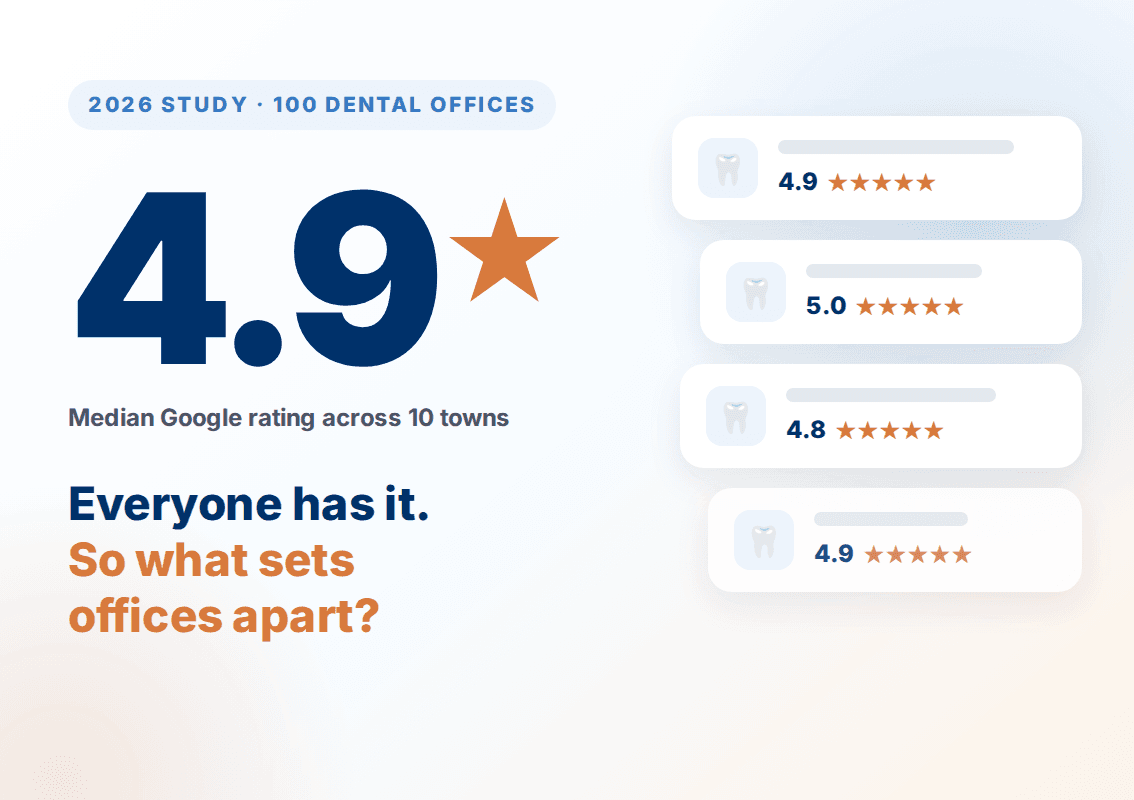
A rating slide from 4.5 to 3.9 stars rarely happens overnight. It builds across ignored reviews, careless replies, and neglected listings, and by the time you notice, prospective patients have already chosen someone else. According to BrightLocal's 2026 survey, 97% of consumers read reviews for local businesses, and 68% will only use a business rated four stars or higher. That makes reputation damage a patient acquisition problem, not a branding one.
This guide ranks the eight risks by severity, shows what triggers each one, and gives you the prevention step for every risk. For the proactive strategy, see our reputation management strategy guide.
What Are the Eight Dental Online Reputation Risks Ranked by Severity?
The eight dental online reputation risks, ranked from most to least severe, are HIPAA violations in review responses, purchased reviews, a neglected Google Business Profile, unanswered negative reviews, review gating, inconsistent NAP data, low review velocity, and emotional staff replies. Severity reflects how fast each one hurts your rating and how hard recovery is.
| Risk | Severity | Main Consequence |
|---|---|---|
| 1. HIPAA violation in review response | Critical | Federal penalties and viral brand damage |
| 2. Purchased/fake reviews detected | Critical | Mass review removal, possible listing suspension, and FTC exposure |
| 3. Neglected Google Business Profile | High | Lower local visibility and an inactive-looking listing |
| 4. Unanswered negative reviews | High | Prospective patients assume the complaint is valid |
| 5. Review gating violation | Medium-High | Review removal and a platform policy violation |
| 6. Inconsistent NAP across directories | Medium | Weaker local ranking signals |
| 7. Low review velocity versus competitors | Medium | Competitors overtake you in the Map Pack |
| 8. Staff responding emotionally to critics | Medium | Public disputes and accidental HIPAA disclosures |
Risks 1 and 2 are existential because they involve legal consequences (HIPAA fines) or platform penalties (mass review removal and potential listing suspension). Risks 3-5 are high-impact operational failures that erode your position over months. Risks 6-8 are competitive weaknesses that allow competitors to outrank you. All eight are preventable. See our Google reviews guide.
Stay ahead of all eight reputation risks
DentalBase's reputation management helps you request reviews ethically, monitor your listings, and respond to feedback consistently, so small problems don't turn into rating drops.
Book a Free Demo →What Are the Critical-Severity Risks (1-2) and How Do You Prevent Them?
The two critical dental online reputation risks are HIPAA violations in review responses and purchased or incentivized reviews. You prevent them with approved reply guidelines and one designated responder, and with organic post-visit review requests. Both carry legal or platform penalties that go well beyond a lower star rating.
According to the ADA, a North Carolina dental practice paid a $50,000 civil penalty for replying to a patient's negative review with details of the patient's care. Medical Economics reports that a Dallas practice paid $10,000 in 2019 after answering a Yelp reviewer with her treatment plan and costs. HHS's January 2026 inflation adjustment sets civil penalties at $145 to $73,011 per violation, rising to $2,190,294 when willful neglect isn't corrected. ADA News advises dentists never to acknowledge that a reviewer was a patient.
- Risk 1: HIPAA violation in review response. Confirming that someone is a patient, referencing their treatment, or sharing any clinical detail in a public review response violates HIPAA, even when the patient shared details first. Beyond fines, the viral screenshot of a dentist exposing patient information in a Google review response creates lasting brand damage. Prevention: Give your team approved reply language that never confirms patient status or treatment, then personalize every reply. Train every staff member who might respond to reviews. Designate one person as the review response owner. See our Dental HIPAA Compliance Checklist.
- Risk 2: Purchased or incentivized reviews detected. Google's algorithm detects fake review patterns: reviews from accounts with no other activity, multiple reviews from the same IP range, sudden spikes in 5-star reviews after a period of inactivity, and reviews containing identical language. When detected, Google removes reviews in bulk (sometimes hundreds at once) and may suspend the listing entirely. Picture a practice dropping from 200 reviews to 80 overnight: it loses its Map Pack position and months of built trust. BrightLocal also notes the FTC's 2024 rule makes buying fake reviews illegal. Prevention: Never purchase reviews from services, never offer incentives (discounts, freebies, contest entries), and never ask employees or family to post reviews. Build reviews organically through automated post-visit requests. See our review collection guide.
What Are the High-Severity Risks (3-5) and How Do You Prevent Them?
The three high-severity risks are a neglected Google Business Profile, unanswered negative reviews, and review gating. Prevent them with weekly profile updates, HIPAA-safe replies within 48 hours, and one identical review request for every patient.
- Risk 3: Neglected Google Business Profile. A GBP with outdated hours, no recent photos, no video, unanswered questions, and months between posts signals an inactive practice. Google's algorithm favors active, regularly updated profiles, so neglected ones tend to lose Map Pack ground. Prevention: Update GBP weekly (post, add photos, respond to questions). Refresh office photos and video quarterly. Verify hours during holidays. Assign one staff member as GBP owner. See our dental videos guide for GBP video.
- Risk 4: Unanswered negative reviews. A 1-star review with no practice response tells prospective patients three things: the practice doesn't care about feedback, the complaint is probably valid, and they'll receive the same treatment. According to BrightLocal, 80% of consumers are likely to use a business that responds to all of its reviews. Prevention: Respond to every review within 48 hours using HIPAA-compliant language, and personalize each reply, because BrightLocal found 50% of consumers are put off by templated responses. Acknowledge the concern, express empathy, and invite offline resolution. The response isn't for the reviewer. It's for the hundreds of prospective patients who will read it. See our negative review response guide.
- Risk 5: Review gating violation. Google prohibits practices from selectively asking only happy patients for reviews while discouraging unhappy patients. A system that asks for a rating first and only directs 4-5 star patients to Google while directing 1-3 star patients elsewhere is technically review gating. Google can remove reviews generated through gating systems. Prevention: Ask every patient for feedback. Offer a private feedback option to everyone, next to the same public review link. The distinction between compliant and non-compliant gating is subtle: asking patients to rate you privately and then directing them based on the rating is gating. Sending everyone the same review link and separately collecting private feedback is not. Configure your automated system carefully.
Related: Catching a complaint early is the cheapest way to avoid risks 4 and 8. How to Handle Negative Dental Feedback Before It Goes Public →
What Are the Medium-Severity Risks (6-8) and How Do You Prevent Them?
The three medium-severity risks are inconsistent NAP listings, low review velocity, and emotional staff replies. You prevent them with quarterly directory audits, automated review requests, and one designated responder. None causes a sudden crisis, but together they let competitors pass you in local search.
- Risk 6: Inconsistent NAP across directories. Name, address, and phone number discrepancies between your GBP, website, Yelp, Healthgrades, and other directories confuse Google's trust signals. A practice listed as "Bright Smiles Dental" on Google but "Bright Smiles Dental LLC" on Yelp with a different phone number on Healthgrades has weakened citation consistency. Prevention: Audit your top 20 directory listings quarterly, as HubSpot's local SEO guide recommends. Ensure name, address, phone, and hours match exactly across all platforms. Use the same phone number on every listing (including tracking numbers that forward to the main line). See our SEO guide for citation building and our multi-location SEO guide for DSO citation management.
- Risk 7: Low review velocity versus competitors. Picture a nearby competitor gaining 25 new reviews a month while you gain 5. The gap compounds, and recency matters: according to BrightLocal, 74% of consumers only care about reviews written in the last three months, and 47% won't use a business with fewer than 20 reviews. Prevention: Send automated post-visit review requests to every patient so reviews arrive steadily. Monitor competitor velocity monthly and adjust your collection efforts if the gap widens. The velocity race is ongoing because competitors are also collecting. See our reviews and SEO guide.
- Risk 8: Staff responding emotionally to negative reviews. A frustrated staff member who responds to a 1-star review with "This patient was rude and never paid their bill" creates a viral disaster. The response feels justified in the moment but reads as petty and unprofessional to every prospective patient who sees it. Emotional responses often include HIPAA violations because anger overrides compliance training. Prevention: Only the designated review response owner responds to reviews. All responses use approved templates. Negative reviews get a short cooling-off period before any reply is drafted, and every reply goes live within 48 hours. Never respond immediately while emotions are elevated. See our reputation management guide.
How Do You Monitor for These Risks Proactively?
Monitor on a fixed cadence: daily review alerts, a weekly rating check, a monthly competitor comparison, and a quarterly audit of every platform. This rhythm catches negative reviews within hours and exposes slower problems, like falling review velocity or NAP drift, before they cost you rankings or patients.

- Daily: New review alerts. Set up Google notifications for new reviews. Check within 4 hours. Any review below 3 stars gets immediate attention (private outreach to the reviewer plus a response drafted within 24 hours). The 4-hour window prevents negative reviews from sitting unanswered during peak browsing hours when prospective patients are reading them.
- Weekly: Rating trend check. Track your overall rating and this week's average rating. A weekly average below 4.0 (even if the overall is 4.6) signals a cluster of negative reviews that needs investigation. Three negative reviews in one week is a pattern worth diagnosing: is it an operational issue, a specific provider, or a coincidence?
- Monthly: Competitor comparison and velocity check. Compare your review count, velocity, and rating to top 3 competitors. Track the gap month over month. If any competitor's velocity exceeds yours by 2x, investigate their collection method and increase your own efforts. Compare negative review themes between your practice and competitors to identify positioning opportunities.
- Quarterly: Full reputation audit. Check all 5 platforms for unanswered reviews, outdated information, NAP consistency, and GBP completeness. Review the response template library for any new scenarios that need templates. Review your private feedback data too: if complaints about the same issue are increasing, there's an operational problem to fix. Missed calls can turn into bad reviews as well. If your practice is among those where 38% of calls go unanswered, some of those patients may say so online, and an AI receptionist can answer every call.
What Should You Do If One of These Risks Has Already Hit Your Practice?
Act in order: contain the problem, document what happened, and repair the public record. For a HIPAA slip, that means editing the reply and calling your privacy officer. For fake or gated reviews, it means stopping the practice that caused them and reporting suspicious reviews to Google.
- Contain it. Edit or remove any reply that exposes patient information, and pause any review request that gates by rating or offers an incentive.
- Document it. Record what was posted, when, by whom, and what you changed. Your privacy officer and attorney will need that timeline.
- Get a compliance read. Ask your privacy officer or a healthcare attorney whether a disclosure must be handled as a reportable breach under HIPAA. Don't guess.
- Repair the record. Answer affected reviews in general, HIPAA-safe terms. Even a false review doesn't lift HIPAA limits, as a 2025 Michigan Dental Association Journal legal column hosted by the ADA notes. Report fake reviews to the platform and keep collecting honest ones.
- Close the gap. Retrain staff, name one review response owner, and add the missing check to your quarterly audit.
Most dental online reputation risks don't arrive as a single crisis. They build through small lapses: a reply nobody reviewed, a profile nobody updated, a review request that skipped half your patients.
Pick one person this week to own your reviews, give them the response guidelines, and put the quarterly audit on the calendar. That one step closes the gaps behind HIPAA slips, unanswered reviews, and emotional replies at the same time.
Protect your reputation before it costs you patients
DentalBase's reputation management helps you collect reviews ethically, monitor your listings, and respond consistently, while an AI receptionist answers the calls that would otherwise go to voicemail.
Book a Free Demo →Explore more guides and tools for dental practice growth.
Keep building your growth plan with our guides to tracking marketing ROI, what your marketing spend actually produces, your overall dental marketing strategy, social media, and email marketing.
Browse Resources →Sources & References
- BrightLocal - Local Consumer Review Survey 2026
- ADA - Protect your practice's reputation: managing online reviews
- ADA News - 5 best practices for responding to online reviews
- HubSpot - Everything you need to know about local SEO
- Journal of the Michigan Dental Association - Dentistry and the Law (ADA Commons)
Frequently Asked Questions
The biggest dental online reputation risks are HIPAA violations in review replies and purchased or incentivized reviews. Both can bring legal penalties or mass review removal. Next come a neglected Google Business Profile, unanswered negative reviews, review gating, inconsistent NAP data, low review velocity, and emotional staff replies.
The practice can face civil penalties from HHS. Its 2026 inflation adjustment sets them at $145 to $73,011 per violation, and a North Carolina dental practice paid $50,000 for replying to a negative review with patient details. Any confirmation of patient status or treatment in a public reply is a risk.
Google can remove the reviews in bulk and may suspend the listing. A practice that dropped from 200 reviews to 80 overnight would lose Map Pack position and months of trust. BrightLocal also notes the FTC's 2024 rule makes buying fake reviews illegal, with fines for businesses caught.
Review gating means selectively directing only happy patients to Google while routing unhappy patients elsewhere. Google prohibits this and can remove reviews generated through gating systems. The compliant approach: send every patient the same review link and collect private feedback through a separate channel.
A profile with outdated hours, no recent photos, and unanswered questions signals an inactive practice, and it tends to lose ground in the Map Pack to profiles that stay current. Weekly updates, fresh photos, and quick answers to questions keep your listing active and trustworthy to patients.
According to BrightLocal, 80% of consumers are likely to use a business that responds to all of its reviews, and 42% are unlikely to use one that never replies. Your response also speaks to every prospective patient who reads the exchange, not just the original reviewer.
Yes, if the reply stays general. Don't confirm the reviewer is a patient, mention treatment, or share any detail, even if the patient shared it first. Thank them, state your standards in general terms, and invite them to contact the office offline.
Fix the two critical risks first: make sure no reply can expose patient information, and stop any purchased or incentivized reviews. Then keep your Google Business Profile current, answer every review within 48 hours, and send the same review request to every patient.
Was this article helpful?
Written by
DentalBase Team
Expert dental industry content from the DentalBase team. We provide insights on practice management, marketing, compliance, and growth strategies for dental professionals.