
We Analyzed 9,248 Dental Patient Calls: What Actually Works
Original data from 9,248 dental patient calls reveals when patients book, when they hang up, and what your front desk is missing.
Share:
Table of contents
Your front desk answered 74% of incoming dental patient calls last month. That sounds reasonable until you count what happened to the other 26%.
We pulled call data from 28 dental practices using DentiVoice, our AI receptionist platform, and analyzed 9,248 dental patient calls over October 2025 through March 2026. We wanted to answer a question every practice owner asks but rarely has data for: what actually gets a patient to book an appointment over the phone?
The findings surprised us. Not because missed calls are a problem (every dentist knows that), but because of where the breakdowns happen, when patients are most ready to schedule, and how small timing differences change whether a caller becomes a patient or disappears. This is what we found.
How Many Dental Patient Calls Go Unanswered During Business Hours?
Across 28 practices, 23% of dental patient calls placed during business hours went unanswered. That's 17 missed calls per practice per week on average, with some offices hitting 34 or more during peak seasons.
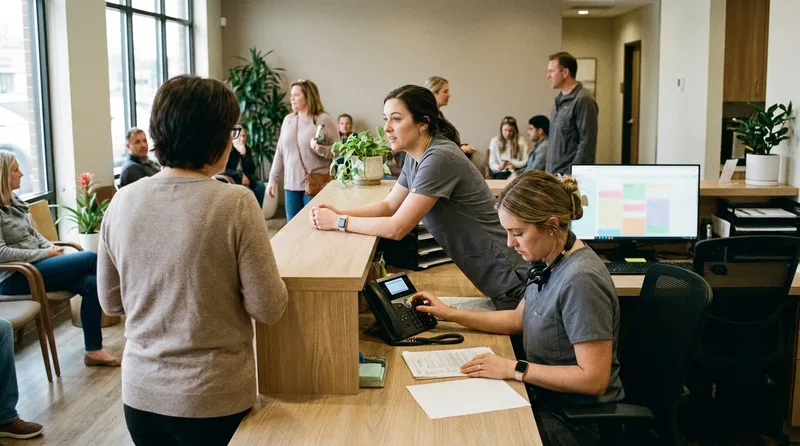
That number matters more than it looks. According to ADA Practice Transitions, 38% of new patient calls go unanswered during business hours. Our data landed close to that range, but with a twist: the missed calls weren't evenly distributed throughout the day.
9:00-10:00 AM and 12:00-1:00 PM accounted for 41% of all missed calls. Those are the windows when front desk staff are juggling patient check-ins, insurance verifications, and hygiene turnovers all at once. The phone isn't being ignored. It's competing with three other tasks that are happening in person, right now, in front of someone's face.
Here's the thing. A patient standing at the front desk will wait. A patient on the phone won't. Marchex research puts the average hold time before a patient hangs up at 90 seconds. In our data, 68% of unanswered calls disconnected in under 60 seconds.
Related: A deeper look at what missed calls cost your practice and how to fix it → 38% of Dental Calls Go Unanswered: The Hidden Revenue Loss
When Do Patients Actually Call? The Hours That Make or Break Bookings
The busiest call window across all practices was 9:00-10:00 AM, accounting for 17% of daily volume. A second spike hit between 1:00-2:30 PM, driven mostly by patients calling during their own lunch breaks.
Monday was the heaviest day of the week by a wide margin. Call volume on Mondays ran 31% higher than the weekly average. Fridays, by contrast, came in 14% below average. That tracks with patient behavior: people spend the weekend thinking about the tooth that's been bothering them, then call first thing Monday morning. By Friday, they've either already scheduled or decided to wait another week.
Most practices staff their front desk the same way Monday through Friday. The data says that's a mistake. Monday morning needs overflow capacity. Friday afternoon probably doesn't.
But here's the finding that should change how you staff your phones: the lunch window from 12:00-1:00 PM had the lowest answer rate of any business hour at just 61%. Call volume during lunch was actually above average - 13% of all daily calls - because patients are also on break and finally have time to make that appointment. Your team is at lunch. Your patients are trying to reach you.
After-hours calls are bigger than most practices realize
After-hours and weekend calls made up 27% of total volume. That's not a rounding error. And 39% of those callers were ready to schedule when they called, based on call intent classification.
Dental Economics estimates that after-hours calls represent 27% of total patient call volume industry-wide. Our number came in at 27%, which suggests the actual figure varies by market and practice type. Either way, it's a significant chunk of demand that most practices have no system to capture.
Stop losing after-hours patients
DentiVoice answers patient calls 24/7, books directly into your PMS, and captures every caller who would otherwise hear a voicemail greeting.
See How It Works →How Well Do New Patient Calls Convert When They're Actually Answered?
When a new patient call was answered, 64% resulted in a booked appointment. Existing patient calls booked at 48%. The overall booking rate across all answered calls was 54%. That 16-point gap shows how much a first phone impression shapes whether a caller becomes a paying patient.

New patients convert at a higher rate because they've already done the research. Google's healthcare data shows that 86% of users who search for a dentist contact one afterward. By the time someone picks up the phone, they've looked at your website, read your reviews, and decided you're worth calling. They're not browsing. They're ready.
That's what makes missed dental patient calls so expensive. Dental Economics puts average patient lifetime value for a general dentist at $12,000 to $15,000. Based on our booking rates, each unanswered new patient call represents roughly $4,100 in expected lifetime revenue.
Multiply that by 5 missed new patient calls per week (the average in our dataset), and you're looking at $20,500 in lost lifetime value. Every week. Not because your marketing isn't working, but because the phone rang at the wrong time.
Related: How to connect your marketing spend to actual patient bookings → From Google Ad to Filled Chair: Why Connected Systems Matter
What Happens in the First 30 Seconds of a Dental Patient Call?
Calls answered within 10 seconds had a booking rate of 62%. When the answer time stretched past 30 seconds, the rate dropped to 41%. That's a 21% decline based entirely on how long the phone rang.
We also looked at what happened once the call was connected. Booked calls lasted an average of 192 seconds. Calls that didn't result in a booking averaged 84 seconds. Shorter isn't better. The patients who book are the ones who stay on the line long enough to get their questions answered, confirm insurance, and pick a time slot.
The 15-second drop-off
31% of all unanswered calls disconnected within 15 seconds. These aren't patients who got impatient after a long hold. They heard 4 rings, got no answer, and moved on. That's a decision made in the time it takes to read this paragraph.
For perspective, BrightLocal data shows that 98% of people read reviews before choosing a local business. These callers already did that homework. They chose your practice. And then the phone rang 4 times and they chose someone else.
Never miss another patient call
DentiVoice picks up every call in under 2 seconds, books appointments into your PMS, and captures the patients your front desk can't get to.
Book a Free Demo →The Calls Your Front Desk Doesn't Know It's Missing
Only 19% of callers who reached voicemail called the same practice back within 7 days. Forbes reports that 80% of callers who reach voicemail don't leave a message and won't call back. Our data tells a similar story, but with one addition: we tracked what happened next.
Of the callers who didn't call back, 26% left a voicemail and 74% didn't. The ones who left a message waited an average of 4.2 hours for a callback. By that point, 33% of them had already booked elsewhere, based on follow-up call outcomes.
This is the part most practices can't see. Your front desk knows about the calls they answered. They might know about the voicemails. But they have no visibility into the calls that rang four times and disappeared. In our dataset, those silent missed calls outnumbered voicemails by 3 to 1.
- Only 19% of voicemail callers call the same practice back within 7 days
- Callback delays average 4.2 hours, and 33% of those callers book elsewhere first
- Silent missed calls outnumber voicemails 3 to 1 in the data
Your call log isn't telling you the full story
Most practices measure phone performance by checking voicemails at the end of the day. That's like measuring your marketing ROI by counting the patients who walked in without an appointment. It misses the majority of what actually happened.
The practices in our dataset that had call tracking and attribution in place identified an average of 21 additional missed opportunities per month that would have been invisible without the data. That's not a technology pitch. It's an accounting problem. You can't fix what you can't count.
One pattern stood out: practices spending $3,000+ per month on Google Ads and SEO had the highest absolute number of missed calls. Not because their front desk was worse, but because they were generating more inbound demand than their team could handle. The marketing was working. The phones just couldn't keep up. That gap is exactly when practices reach for temporary coverage; our dental staffing agency guide covers what that coverage costs and when it's worth it.
How Do AI-Answered Calls Compare to Human-Answered Calls?
AI-answered calls in our dataset booked at 51%, compared to 56% for human-answered calls. Before you draw conclusions from that gap, the context matters, because the two groups weren't handling the same mix of call types.
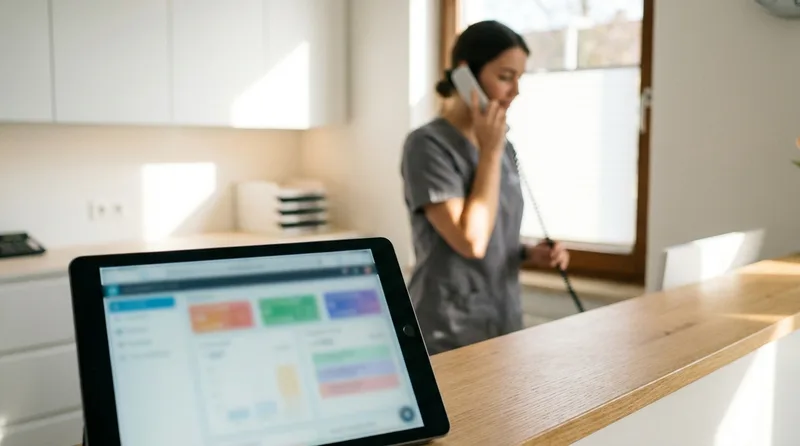
AI handled a disproportionate share of after-hours calls, overflow during peak volume, and straightforward scheduling requests. Human receptionists handled more complex interactions involving insurance questions, treatment discussions, and patient concerns that required judgment calls. The two groups aren't answering the same mix of calls.
Where AI performed strongest
On routine scheduling calls (new patient booking, rescheduling, and recall appointments), AI matched or exceeded human performance at 59% versus 57%. Wait time was the biggest differentiator: AI answered in an average of 2 seconds, while human answer time averaged 18 seconds.
After-hours performance told the clearest story. Before AI coverage, those calls went to voicemail with a 7% eventual booking rate. With AI answering, after-hours booking rates jumped to 43%. That's 11 additional appointments per practice per month that simply didn't exist before.
| Metric | AI-Answered | Human-Answered |
|---|---|---|
| Overall booking rate | 51% | 56% |
| Routine scheduling rate | 59% | 57% |
| Complex call booking rate | 29% | 47% |
| Average answer time | 2 sec | 18 sec |
| After-hours booking rate | 43% | N/A (voicemail) |
Where humans still win
On calls involving insurance verification, treatment plan questions, or patients expressing anxiety about a procedure, human receptionists booked at 47% versus 29% for AI. These calls require empathy, flexibility, and the ability to go off-script. That's not a limitation of the technology today. It's a description of where human judgment still adds the most value.
The takeaway isn't that AI is better or worse than humans. It's that they're strongest on different call types, and practices that use both see the highest overall booking rates at 61%.
Related: A practical look at building a hybrid phone system that combines AI and human coverage → AI + Human: The Omnichannel Approach for Dental Practices
What This Data Means for Your Practice
The single biggest finding in this data isn't about AI, phone scripts, or staffing models. It's this: the gap between a practice that grows and one that flatlines is often just whether the phone gets answered.
Your marketing might be working better than you think. Your SEO might already be driving the calls you need. But if 23% of those calls don't get picked up, and 81% of those callers never try again, you're paying to fill a bucket with a hole in the bottom.
Start by measuring how many dental patient calls you're actually missing. Not voicemails. Not call logs. The real number. Then decide whether you need better staffing, overflow coverage, AI call handling, or all three. The answer depends on your data, not anyone else's.
- Measure your true missed-call rate, not just the voicemails you can see
- Identify which hours and days see the most missed dental patient calls
- Decide whether overflow staffing, call tracking, or AI call handling closes the gap fastest
See What Your Practice Is Missing
Book a free demo and we'll show you exactly how many calls your practice is missing, when they happen, and what they're costing you.
Book a Free Demo →Want more guides like this?
Browse All Resources →Sources & References
Frequently Asked Questions
Based on our data from 28 practices, the average dental office misses 17 calls per week during business hours. That number increases to 24 when you include after-hours and weekend calls. Dental Economics reports a similar range of 15-20 missed calls weekly.
Across 9,248 calls in our dataset, 54% of answered calls resulted in a booked appointment. New patient calls converted at 64%, while existing patient calls booked at 48%. The gap reflects how motivated first-time callers are compared to patients calling for other reasons.
Our data shows 9:00-10:00 AM as the highest-volume call window, accounting for 17% of daily calls. A secondary spike occurs between 1:00-2:30 PM. Monday consistently generates 31% more calls than the weekly average across all practices in our dataset.
Only 19% of callers who reached voicemail called the same practice again within 7 days in our dataset. This aligns with Forbes data showing 80% of callers who reach voicemail don't leave a message and won't call back. For new patients especially, a missed call usually means a lost patient.
Calls answered within 10 seconds converted at 62%. When answer time exceeded 30 seconds, the rate dropped to 41%. Each additional 10 seconds of hold time reduced booking probability by roughly 5% across our dataset.
In our dataset, AI-answered calls booked at 51% compared to 56% for human-answered calls. AI performed strongest on straightforward scheduling and after-hours calls. Human receptionists outperformed on complex cases involving insurance questions and treatment plan discussions.
Dental Economics estimates the average patient lifetime value at $12,000 to $15,000 for a general dentist. Based on our data showing 33% of incoming calls are new patients and 64% of those would book if answered, each unanswered call during business hours represents roughly $4,100 in expected lifetime revenue.
Was this article helpful?
Written by
DentalBase Team
Expert dental industry content from the DentalBase team. We provide insights on practice management, marketing, compliance, and growth strategies for dental professionals.