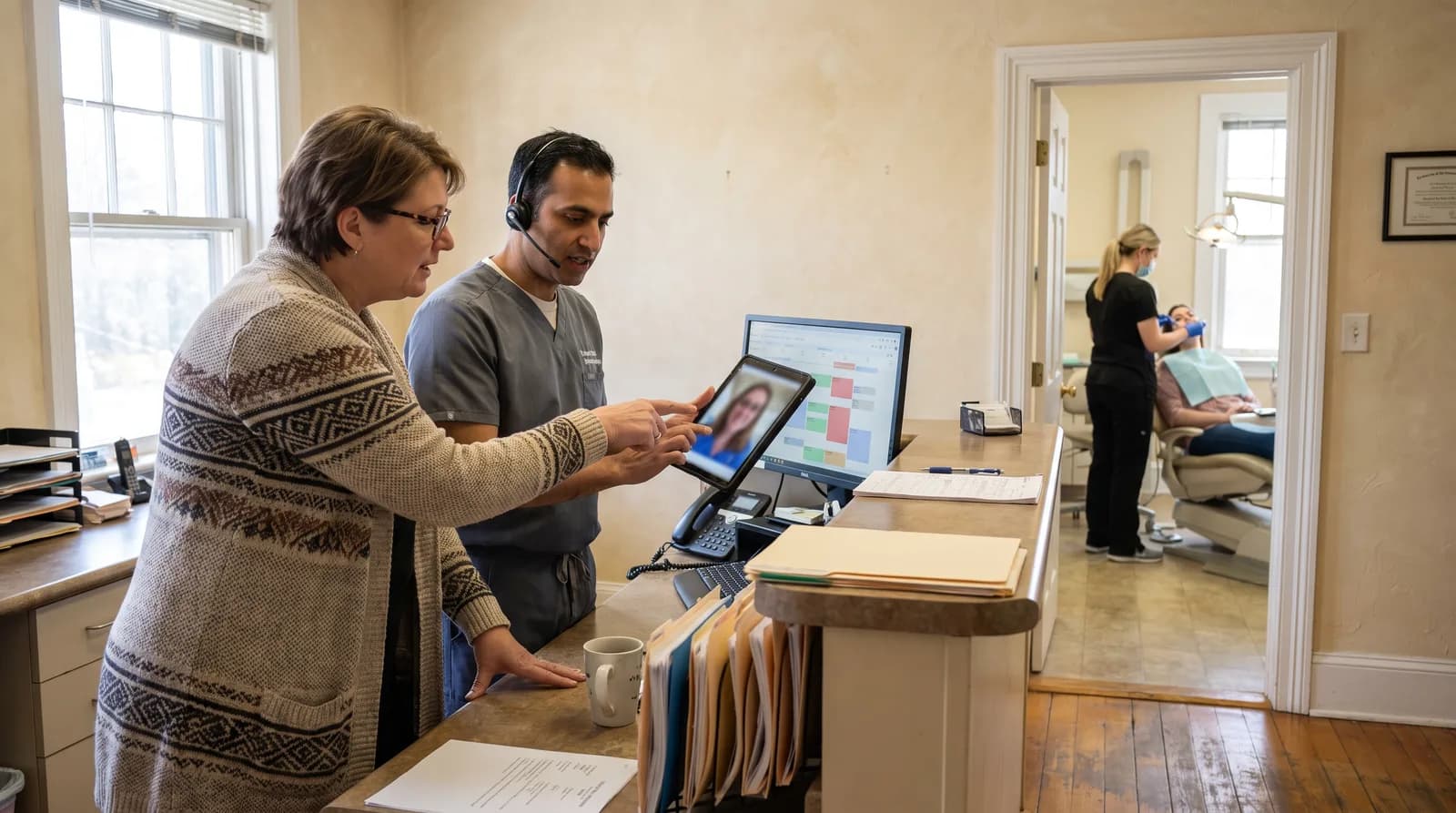
Virtual Dental Receptionist: How It Works in Practice
Learn how virtual dental receptionists work in practice with cost analysis, compliance requirements, and real case studies for dental offices.
Share:
Table of contents
Why Are Dental Practices Turning to Virtual Receptionists?
Dental practices across the United States face persistent staffing challenges. Many report ongoing difficulty finding and keeping qualified front desk personnel. High turnover rates and increasing labor costs strain many dental practice owners. The need for specialized knowledge in dental billing and scheduling also drives change. This includes growing adoption of virtual dental receptionists supporting front office operations.
40-60%
Typical reduction in front-office staffing costs when practices replace in-house reception with virtual services, based on the cost comparisons covered later in this guide.
The rise of virtual reception models has become a practical response to these challenges. A virtual receptionist operates remotely to manage patient communications and appointment scheduling. They also handle insurance verification and administrative tasks once requiring on-site staff. The model has gained significant traction across the industry, with a growing number of dental practices now using some form of virtual reception support.
This guide examines how these services function in real-world practice settings. Through case studies, cost analyses, and compliance considerations, readers gain a clear understanding. They learn implementation strategies and operational workflows for virtual reception services. The guide explains practical implications for integrating these services into their dental practice operations. Practices weighing this shift alongside other dental marketing and technology services can build a more complete front-office strategy.
What Is a Virtual Dental Receptionist?
Definition and Scope
A virtual dental receptionist is a remote professional or an AI-powered system. It manages front office operations for dental practices without being physically present. These services include both human-operated and technology-driven solutions. Each is designed to handle administrative and patient-facing responsibilities. These responsibilities are typically managed by in-house reception staff.
How Virtual Reception Operates
Virtual reception services operate through cloud-based practice management systems and VoIP phone networks. Secure communication platforms support operations and comply with healthcare regulations. The scope of services typically includes appointment scheduling and patient intake. It also covers insurance verification and payment processing. Basic patient education addresses procedures and policies.

The key distinction from traditional staffing models lies in the delivery method. Core functions themselves do not change at all in this model. Virtual receptionists access patient management systems remotely and communicate with patients. They use designated practice phone numbers and coordinate with on-site clinical staff. This coordination occurs through secure messaging platforms used by the practice. This approach allows practices to maintain professional patient interactions consistently. It also reduces overhead costs and staffing complexity for practices overall.
Implementation by Practice Size
Implementation varies significantly based on practice size and needs. Single-location practices might use a shared virtual receptionist service for overflow calls. Meanwhile, multi-location practices often employ dedicated virtual teams. These teams manage extensive front office operations across all sites.
Core Functions of a Virtual Dental Receptionist
Administrative and Patient-Facing Tasks
These professionals perform a wide range of administrative functions. These functions mirror traditional front desk responsibilities. Primary tasks include appointment scheduling and rescheduling, and managing practice calendars. They also process new patient registrations and maintain accurate patient records within practice management systems.
- Answering incoming calls and routing urgent issues to on-site staff
- Scheduling, rescheduling, and confirming patient appointments
- Verifying insurance benefits before scheduled visits
- Processing payments and setting up basic payment plans
- Updating patient records in the practice management system
Patient communication responsibilities encompass answering incoming calls and providing information about services and policies. They include handling for scheduled patient visits. They also involve managing patient inquiries about treatment plans or billing. Many virtual receptionists conduct pre-appointment insurance verification before patient visits, a workflow covered in more depth in this guide to automated dental insurance verification. This ensures coverage details are confirmed prior to each scheduled appointment.
Financial and Administrative Duties
Financial administrative duties typically include processing payments over the phone. They also involve setting up payment plans and sending billing inquiries to insurance companies. These duties also cover handling basic accounts receivable functions. However, complex billing disputes or detailed insurance negotiations often require escalation. They are typically handled by on-site staff or specialized billing departments.
Integration Requirements and Staff Training
The effectiveness of these functions depends heavily on integration with existing practice management software. It also depends on clear protocols for handling various patient scenarios. Successful implementations establish detailed workflows for common situations and emergency procedures. They also define escalation pathways when virtual staff need support from on-site personnel.
Training requirements vary significantly between human and AI-based virtual receptionists. Human staff typically require 2-4 weeks of practice-specific training. This training covers procedures, insurance requirements, and patient management protocols.
How Much Does a Virtual Dental Receptionist Cost?
Typical Pricing Ranges in the U.S.
Pricing for this kind of service varies significantly by service type and hours of coverage. Functionality requirements also influence overall pricing levels for these services. Human-based virtual reception services typically range from $8-15 per hour. This pricing applies to basic answering services. Full-service virtual reception with scheduling and administrative functions costs $15-25 per hour. Practices comparing providers can find additional planning tools in the DentalBase resource library.
AI-powered virtual receptionist solutions generally operate on subscription-based pricing models. Small practices typically pay $200-800 per month for these services. Enterprise, multi-location practices often cost $1,000-3,000 monthly. These systems often include unlimited call handling, basic scheduling integration, and patient communication features.
| Service Type | Typical Cost | Billing Model |
|---|---|---|
| Human-based (basic answering) | $8-15/hour | Hourly |
| Human-based (full-service) | $15-25/hour | Hourly |
| AI-powered (small practice) | $200-800/month | Subscription |
| AI-powered (enterprise/multi-location) | $1,000-3,000/month | Subscription |
| In-house full-time receptionist | $35,000-45,000/year | Salary (excludes benefits) |
Cost Comparison: Virtual vs. In-House Staffing
Cost comparison analysis shows virtual reception typically costs 40-60% less overall. This comparison includes equivalent full-time on-site staff and all related costs. Those costs include salary, benefits, training, and employee turnover expenses. A full-time receptionist in most U.S. markets costs $35,000-45,000 annually. This figure excludes benefits, which increase total employment costs significantly. Comparable virtual reception services range from $15,000-25,000 annually on average.
Additional considerations include setup fees ($200-500), integration costs with existing practice management systems ($300-1,000), and potential phone system modifications. Many providers offer month-to-month contracts, though annual agreements often provide 10-20% discounts.
Return on investment typically becomes positive within 3-6 months for practices handling 50+ patient calls weekly, with larger practices seeing faster payback periods due to scale efficiencies and reduced recruitment costs.
How Do AI-Based and Human Virtual Receptionists Compare?
Key Differences in Capabilities
The choice between AI-powered and human virtual dental receptionists involves significant functional and operational differences. AI-based systems, such as a dedicated AI receptionist service, excel at handling routine, predictable interactions such as appointment scheduling, basic information requests, and standard patient intake procedures. These systems operate 24/7, provide consistent responses, and can handle multiple simultaneous calls without quality degradation.
Human virtual receptionists demonstrate superior performance in complex situations requiring empathy, problem-solving, and nuanced communication. They effectively manage upset patients, handle insurance complications, and provide personalized service that builds patient relationships. Human staff also adapt quickly to practice policy changes and can make judgment calls in unusual situations.
| Feature | AI Virtual Receptionist | Human Virtual Receptionist |
|---|---|---|
| Cost per month | $200-800 | $1,200-2,000 |
| Availability | 24/7 | Business hours + extended |
| Complex problem solving | Limited | High |
| Emotional intelligence | Basic | High |
| Setup time | 1-2 weeks | 3-4 weeks |
| Scalability | Unlimited | Limited by staff |
Hybrid Approaches and Choosing the Right Fit
Hybrid approaches are increasingly common, combining AI for initial call routing and basic scheduling with human backup for complex situations. This model provides cost efficiency while maintaining service quality for challenging patient interactions.
Practices handling primarily routine appointments and straightforward patient communications often find AI solutions sufficient, while practices with complex treatment planning, extensive insurance coordination, or sensitive patient populations typically benefit from human virtual reception services.
Compliance, HIPAA, and Data Security
Handling Protected Health Information
Compliance requirements represent the most critical consideration when implementing this kind of service. The Health Insurance Portability and Accountability Act (HIPAA) mandates specific protections for protected health information (PHI), applying equally to virtual and on-site staff handling patient data.
Business Associate Agreements and Technical Safeguards
Business Associate Agreements (BAAs) are legally required for any virtual reception service that accesses, stores, or transmits PHI. These agreements establish liability, security requirements, and breach notification procedures. Reputable virtual reception providers offer thorough BAAs and maintain HIPAA compliance certifications, but practices remain ultimately responsible for ensuring compliance.
Technical safeguards include end-to-end encryption for all communications, secure VPN connections for system access, and multi-factor authentication for user accounts. Virtual reception services must implement administrative safeguards including staff training on privacy requirements, access controls limiting PHI exposure to necessary personnel, and documented security policies.

Physical safeguards require virtual staff to work in secure environments with restricted access to workstations and patient information. Many providers operate from dedicated facilities with controlled access, while others allow remote work under strict security protocols.
Ongoing Compliance and Breach Response
Regular security audits, vulnerability assessments, and staff training updates are essential components of ongoing compliance. HIPAA violation fines for small healthcare practices can range from the tens of thousands to hundreds of thousands of dollars depending on severity, making proper vendor selection and compliance verification essential for practice protection. A full breakdown of requirements is available in this dental HIPAA compliance checklist.
Breach response procedures must be established before implementation, including notification timelines, investigation protocols, and patient communication requirements.
How Does a Virtual Receptionist Integrate With Practice Software?
Practice Management System Compatibility
Successful implementation of this system depends heavily on smooth integration with existing practice management systems (PMS). Most established PMS platforms including Dentrix, Eaglesoft, Open Dental, and Curve support remote access configurations that enable virtual reception services.
API integration capabilities allow virtual reception systems to directly access scheduling modules, patient records, and communication tools within practice management software. This direct integration eliminates double data entry, reduces errors, and enables real-time appointment management. However, integration complexity varies significantly between different PMS platforms and virtual service providers.
Cloud-based practice management systems generally offer superior virtual reception compatibility compared to server-based legacy systems. Cloud platforms typically include built-in remote access features, automatic security updates, and standardized API connections that simplify virtual service integration.
Technical requirements include reliable high-speed internet connections, VoIP phone systems compatible with call forwarding and routing, and secure remote access protocols. Many practices require phone system modifications to enable smooth call transfer between virtual and on-site staff.
Setup typically involves configuring user accounts with appropriate access permissions, establishing secure communication channels, and testing integration functionality across all required systems. Most implementations require 1-2 weeks of technical setup and staff training to ensure smooth operations.
- Select a virtual reception provider compatible with the practice's PMS
- Sign a Business Associate Agreement covering PHI handling
- Configure user accounts, call routing, and secure access permissions
- Run a pilot period before full rollout to on-site staff
Patient Experience and Practice Operations
Applying the 80/20 Rule to Front Desk Work
The 80/20 rule, or Pareto Principle, proves particularly relevant in dental front office operations, where approximately 80% of patient interactions involve routine, standardized tasks while 20% require complex problem-solving or personalized attention. Understanding this distribution helps practices optimize virtual receptionist implementation.
Routine interactions that virtual receptionists handle effectively include appointment scheduling, confirmation calls, basic practice information, payment processing, and insurance verification. These standardized tasks represent the majority of front desk workload and are ideally suited for virtual management.
Complex interactions requiring on-site staff attention include emergency situations, detailed treatment plan discussions, insurance disputes, patient complaints, and new patient consultations requiring physical paperwork or signatures. These interactions, while representing only 20% of volume, significantly impact patient satisfaction and practice reputation.
Optimal virtual reception implementation focuses virtual staff on the 80% of routine tasks while maintaining clear escalation procedures for complex situations. This approach maximizes cost efficiency while preserving service quality for challenging patient needs.
Patient satisfaction surveys from practices using virtual reception services show 85-90% approval ratings when patients receive consistent, professional service for routine needs and smooth transfer to knowledgeable on-site staff for complex issues. The key lies in transparent communication about service delivery and setting appropriate patient expectations. For more on how patients respond to this model, see this guide to virtual receptionists and patient trust.
Real-World Use Cases in Dental Practices
Case Scenario: Small vs Multi-Location Practice
Small Practice Case Study: Dr. Martinez operates a single-location family dental practice in suburban Phoenix, handling 150 patient appointments weekly. Before implementing virtual reception, the practice employed two part-time front desk staff costing $55,000 annually including benefits. High turnover required constant recruitment and training.
Dr. Martinez implemented a hybrid virtual reception model, utilizing AI for after-hours calls and appointment scheduling, with human virtual backup during peak hours. The annual cost decreased to $28,000, while patient satisfaction increased due to 24/7 appointment availability and reduced wait times for phone responses.
Multi-Location Case Study: Regional Dental Group operates four locations across metro Dallas, previously employing 12 front desk staff across all sites. Inconsistent patient experiences and high administrative costs prompted virtual reception implementation.
The group implemented dedicated human virtual reception teams for each location, maintaining personalized service while centralizing training and quality control. Total front office costs decreased by 45% while standardizing patient communication protocols across all locations. Call abandonment rates dropped from 18% to 3%, and appointment booking increased 25% due to improved phone accessibility.
Both cases demonstrate that successful virtual reception implementation requires careful analysis of practice-specific needs, patient demographics, and operational workflows. The key success factor involves maintaining or improving patient experience while achieving operational efficiency and cost reduction.
| Metric | Dr. Martinez (Small Practice) | Regional Dental Group (Multi-Location) |
|---|---|---|
| Setting | Single location, suburban Phoenix, ~150 appointments/week | 4 locations across metro Dallas |
| Prior staffing | 2 part-time staff, $55,000/year | 12 front desk staff across all sites |
| Reception model | Hybrid: AI for after-hours, human backup at peak times | Dedicated human virtual teams per location |
| Annual cost after | $28,000/year | Reduced 45% overall |
| Call abandonment | Not reported | Dropped from 18% to 3% |
| Appointment bookings | Not reported | Increased 25% |
Limitations and Operational Challenges
Virtual dental receptionist services, while beneficial, present several operational limitations that practices must address. Technology dependencies create vulnerability to internet outages, software failures, or communication system disruptions that can significantly impact patient access and appointment management.
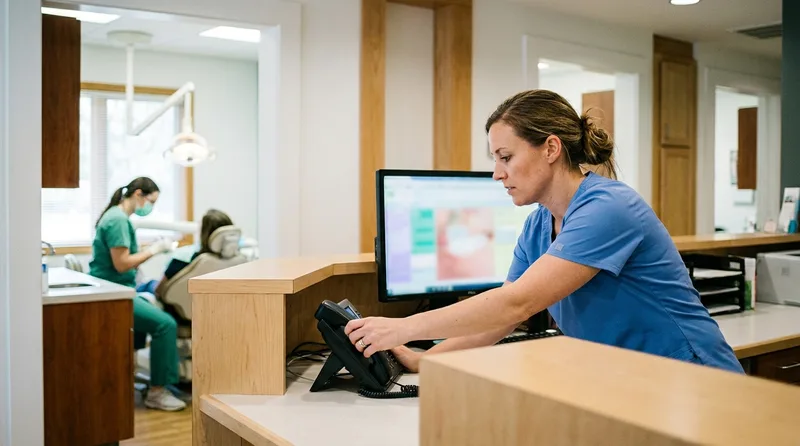
Complex clinical situations often exceed virtual reception capabilities, requiring immediate escalation to on-site staff. Emergency appointments, detailed insurance pre-authorization requests, and sensitive patient communications may experience delays when virtual staff lack immediate access to clinical personnel.
Patient preference variations show that some patients, particularly older demographics, prefer in-person interactions for scheduling and financial discussions. Practices must maintain flexibility to accommodate these preferences while maximizing virtual efficiency.
Training and quality control present ongoing challenges, particularly with human virtual reception services. Ensuring consistent practice-specific knowledge, policy updates, and service quality requires structured management and regular performance monitoring.
Success with this model requires thorough backup procedures, clear escalation protocols, and ongoing performance evaluation to address these limitations effectively. Practices weighing AI against human options can also compare approaches in this AI receptionist vs. answering service comparison.
Is a Virtual Dental Receptionist Right for Your Practice?
Virtual dental receptionist services represent a practical solution to the staffing challenges facing dental practices across the United States. Through careful implementation, practices can achieve significant cost reductions while maintaining or improving patient service quality.
Key Findings From Real-World Implementations
Key findings from real-world implementations demonstrate that virtual reception works most effectively when practices focus virtual staff on routine tasks while maintaining clear escalation procedures for complex patient needs. The 80/20 rule proves particularly valuable in optimizing this division of responsibilities.
Cost Savings and ROI Timeline
Cost analysis shows consistent savings of 40-60% compared to traditional staffing models, with return on investment typically achieved within 3-6 months for practices handling adequate call volumes. However, success depends heavily on proper technology integration, HIPAA compliance, and realistic expectation setting.
Is Virtual Reception the Right Fit?
This approach may be appropriate for practices experiencing staffing difficulties, seeking cost reduction, or requiring extended patient accessibility hours. Practices with highly complex patient populations or those requiring extensive in-person interaction may benefit from hybrid approaches rather than complete virtual solutions.
Is Virtual Reception a Good Fit? Quick Self-Check
Check any that apply to your practice.
Checking two or more suggests virtual reception is worth evaluating for your practice.
Next Steps for Evaluation
Next steps for evaluation include assessing current front office costs and efficiency, reviewing practice management system compatibility, and contacting virtual reception providers for detailed proposals. Careful vendor selection focusing on HIPAA compliance, integration capabilities, and service quality ensures successful implementation.
Practices considering virtual reception should start with limited pilot programs, allowing gradual expansion as comfort levels and operational efficiency improve. This measured approach minimizes disruption while maximizing the benefits of this approach.
See how DentiVoice handles calls and scheduling for a dental practice like yours.
Book a Free DemoSources & References
Frequently Asked Questions
Virtual dental receptionist costs typically range from $300 to $2,000 per month depending on the service type. AI-based solutions generally run $300-$800 monthly, while human virtual receptionists cost $800-$2,000 or more. Per-hour billing usually runs $15-25 per hour. Most practices save 40-60% compared to hiring in-house staff.
Dental AI receptionist services typically cost $300 to $800 per month for most practices. Basic appointment scheduling plans start around $200-400 monthly, while full-featured solutions with call handling and integrations range $500-800 or more. Setup fees, when they apply, usually run $100-500 for initial configuration.
The 80/20 rule in dentistry holds that 80% of a practice's revenue typically comes from 20% of its patients, helping practices focus retention efforts on their most valuable patients. The same principle applies operationally: roughly 80% of scheduling and administrative tasks can be automated through a virtual receptionist, freeing staff for higher-value patient interactions.
Dental practices should look for HIPAA compliance, integration with their practice management software, 24/7 availability, and clear escalation paths for complex calls. A good fit handles routine scheduling and patient questions accurately, while transferring emergencies and complicated billing issues to on-site staff without delay.
Was this article helpful?
Written by
Dentalbase Team
The Dentalbase Team is a collective of dental marketing experts, AI developers, and practice management consultants dedicated to helping dental practices thrive in the digital age.