Dentist Google Ratings 2026: Reviews, Rankings, and Patient Trends From 100 Offices
We analyzed dentist Google ratings for 100 offices in 10 suburbs. Nearly all rate 4.9, a few hold most reviews, and most close by 5:30 pm.
Share:
Table of contents
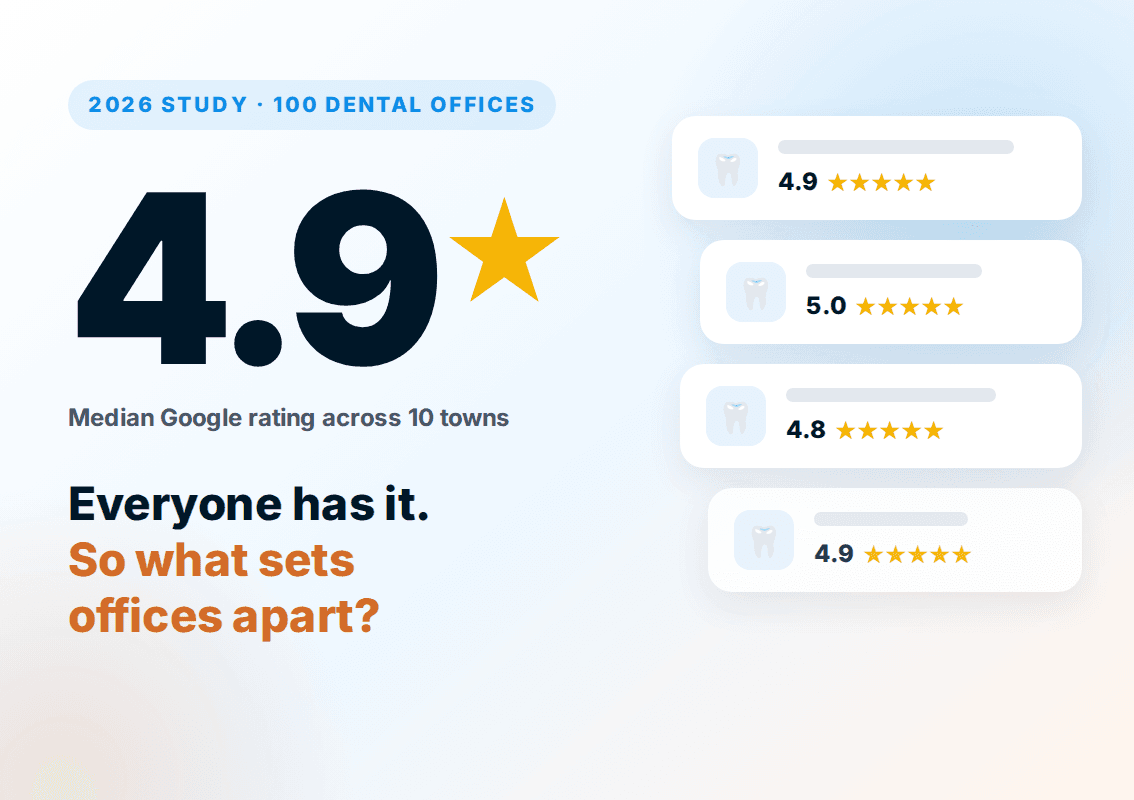
We analyzed dentist Google ratings, reviews, and profiles for 100 offices across 10 suburbs, the same signals our dental marketing services work on every day. The first finding was hard to miss: nearly every office looks the same. Eighty of the 100 had 4.8 stars or higher, and the median rating was 4.9.
The short answer is that star ratings no longer separate dental offices. Review volume does, and it's concentrated in a few offices per town. Meanwhile, most offices close before the end of the typical workday, and few are open on Friday afternoons, evenings, or weekends, when many patients are free to call.
Below you'll find the numbers behind each finding, what patients praise and complain about in their reviews, and what an office with fewer reviews can do to compete. Each gap comes with a practical fix you can start this month.
How did we study dentist Google ratings across 10 towns?
We pulled dentist Google ratings and the public Business Profiles of the top 10 results for "dentist" in 10 suburbs, 100 offices in total, in October 2026. For each office we recorded its star rating, review count, weekly hours, search position, and the review excerpts Google displays.
Google profiles analyzed
100
Suburbs in 10 states
10
Total Google reviews
53,683
Median star rating
4.9
We chose suburbs in ten different states, so no single region would skew the results:
- Wylie, Texas, and Gilbert, Arizona
- Peachtree City, Georgia, and Mount Pleasant, South Carolina
- Franklin, Tennessee, and Apex, North Carolina
- Westfield, Indiana, and Maple Grove, Minnesota
- Castle Rock, Colorado, and Lehi, Utah
We added two layers. First, we searched "family dentist" in each town, which surfaced 38 more local offices that hadn't made the top 10. Second, we read and coded all 500 review excerpts Google displayed, five per office, by theme. We don't name any office, because the goal is to show patterns, not to rank practices. Two small data notes: one office in the Gilbert results lists a Mesa address, and one profile's Friday hours contained an apparent typo, which we read as closing at 4 pm.
Tip: Search for your own office the way patients do: on a phone, signed out of Google, from a few blocks away. Results at your front desk can look different.
Who ran this study, and why?
The DentalBase team ran it. DentalBase is a dental-only growth company that pairs done-for-you marketing with DentiVoice, our AI receptionist. We ran the study to see what patients actually see when they search for a dentist, using public data rather than our own clients' numbers.
Our day-to-day work touches every step of that path: the Google profile, the reviews, the website, and the call that follows. We wanted an outside-in benchmark any practice owner could hold their own office against, so we spread the study across ten states and kept every office anonymous. The one practice we name, Willow Family Dentistry, appears with results from its published case study.
Why do most dentist Google ratings sit at 4.9?
There's no single cause, but the result is clear: ratings have bunched at the top. In our sample, 80 of the 100 offices were rated 4.8 or higher, 30 had a perfect 5.0, and only 7 fell below 4.5, so dentist Google ratings barely separated one office from the next.
How the 100 offices were rated
Picture a patient comparing three nearby offices rated 4.8, 4.9, and 5.0. That tenth of a star tells her almost nothing. So she reads the reviews themselves. Patients clearly do read them. The 2026 BrightLocal Local Consumer Review Survey found that 97% of consumers read reviews for local businesses, and its headline finding was that star ratings keep rising across the board.
What does she look at instead? Two things the stars hide: how many people have reviewed the office, and what those people actually wrote. Both are covered below.
Tip: Stop asking patients for "five stars." Ask them to mention what they came in for and how the visit felt. Detailed reviews persuade more than a perfect average.
Who gets the most Google reviews in a town?
A small group of offices. Across our 10 towns, the three most-reviewed offices held 52% of all reviews on average, while the bottom five shared just 28%. The single most-reviewed office typically had about seven times as many reviews as the least-reviewed one.
Share of each town's Google reviews held by its top offices
Some towns were extreme. In Castle Rock, the leading office had 1,039 reviews while another page-one office had 20. In Lehi, the gap ran from 1,550 to 38. Ten of the 100 offices had passed 1,000 Google reviews, while the median office had about 460.
Review count sits right next to the stars in Google's results, so a patient sees it instantly. BrightLocal's 2026 survey notes that the number of reviews, how recent they are, and how quickly the owner responds all affect trust.
Counts like that build over years of steady asking, not a single campaign. That's good news for smaller offices: the gap closes with a habit, not a budget. Our guide to {a(L2['guide'], 'getting more dental Google reviews')} covers the full playbook.
Tip: Make the review request part of checkout. Text a direct review link the same day, while the visit is still fresh in the patient's mind.
Related: Once a patient does call, the conversation decides whether they book. We studied what works on those calls. We Analyzed 9,248 Dental Patient Calls →
Does having the most reviews put you first on Google?
Not necessarily. The most-reviewed office appeared first in only 4 of our 10 towns, and in two towns it sat seventh. Google's own guidance on local results names three factors: relevance, distance from the searcher, and prominence. Reviews feed into prominence, but they aren't everything.
Where the most-reviewed office appeared in Google's place results
One caution: these are Google's place search results, run once from one location, not the exact map pack every patient sees. Treat this as a strong signal, not a ranking formula.
Expert surveys point the same way. BrightLocal's summary of the 2026 Local Search Ranking Factors survey of about 50 local SEO experts puts Google Business Profile signals at about 32% of what drives local pack rankings, the largest single group.
Relevance is the part you control most. That means accurate categories, every service listed, current hours, and a website that clearly describes the practice. Google's guide to local business structured data explains how to give search engines your hours, location, and contact details in a format they can read reliably.
Tip: Check your primary Business Profile category today. If it isn't the main service you want to be found for, such as Dentist, fix that before anything else.
Are dentist Google ratings lower outside the top 10?
No. Dentist Google ratings were just as strong outside the top 10. The 38 local offices that appeared for "family dentist" but missed the top 10 for "dentist" had the same median rating, 4.9, and 84% were rated 4.8 or higher. Nine had more than 500 reviews, and three had more than 900.
Top 10 offices vs. local offices just outside it
The bigger surprise was how much one word matters. Of the 98 local results for "family dentist," only 50 also appeared in the top 10 for "dentist." Change the search slightly and about half the offices change too. Whitespark's 2026 ranking factors survey ranks the primary Business Profile category as the single most important local factor, which helps explain why: Google is matching the words in the search to how each office describes itself.
The second search also exposed basic profile problems. Two offices had duplicate Google listings at the same address, and one of those duplicates claimed the office was open 24 hours a day. Seven "family dentist" results came from neighboring towns, which means a nearby competitor can take a local slot.
The takeaway for an office outside the top 10: you probably don't have a reputation problem. You have a relevance problem, and that is usually the faster one to fix.
Tip: Search five versions of your service, such as family dentist, emergency dentist, and dentist near me, and note where you appear. Then search your office name to catch duplicate listings.
When are dental offices open compared to when patients call?
Mostly during standard working hours. At 5:30 pm on a typical weekday, only 13 to 20 of the 100 offices we studied were still open. On Friday at 3:30 pm, just 36 were open, and only 15 opened at all on Saturday.
How many of the 100 offices are open, by day and hour
Closed all day Friday
24
Open on Saturday
15
Open on Sunday
3
Open past 6 pm on any weekday
16
Mornings are well covered, and 41 offices opened before 8 am at least one day a week. But after 5 pm the grid empties fast. Friday is the weakest weekday: 24 offices were closed all day, and the median office was open 41 hours a week in total.
That's a problem because demand doesn't stop at 5. A February 2026 Peerlogic analysis of 4,280 calls across 26 dental practices, reported by Aibrify, found that roughly 30% of calls arrived outside normal operating hours. A patient who calls on Friday at 4 pm and reaches a closed office has an easy alternative: the next result on the list.
Hours can affect visibility too. Search Engine Land reported that Google's Search Liaison confirmed "openness" has become a stronger local ranking signal for non-navigational searches, while advising businesses not to list hours they don't keep. In other words, list your real hours accurately, and don't fake 24/7 availability.
You don't have to staff evenings to fix this. You have to answer them. Compare your options in our guide to AI receptionists vs. answering services, and make sure your voicemail at least gives callers a clear next step.
Tip: Never list hours you don't keep. Instead, keep Friday and holiday hours accurate, and set up an after-hours answer so evening callers can still book.
Answer the patients who call after 5 pm
DentiVoice picks up every call, evenings and weekends included, and books new patients straight into your schedule.
See how DentiVoice works →What do patients praise in 5-star dental reviews?
Clear explanations, more than anything else. We coded all 500 review excerpts by theme, and 24% praised a dentist or hygienist for explaining things clearly. Pain-free or gentle care came next at 13%, followed by easing dental anxiety at 11% and same-day or emergency help at 10%.
What 500 dental Google review excerpts praised
Here's what sat behind each theme:
- Clear explanations: showing patients their X-rays, walking through options, and explaining costs before treatment. This was the most praised behavior in the sample.
- Pain-free care: painless numbing and a gentle hygienist came up again and again.
- Dental anxiety: reviewers often opened by saying they dread the dentist, then described being put at ease.
- Same-day help: getting seen quickly for a broken tooth or sudden pain. Lehi's results included two emergency-focused offices, which lifted this number.
- No pressure: 31 excerpts specifically praised an office for not pushing extra treatment.
A few notes on method. One excerpt could count toward more than one theme. General praise for friendly staff was so common that we didn't track it separately. One reviewer coded every excerpt, and Google chooses which excerpts to show, so treat these as a strong sample rather than a full census. Still, the lesson is clear: your patients are already writing your marketing for you.
That's exactly what happened at Willow Family Dentistry in Wylie, Texas. Dr. Esther Jeong's ads were rebuilt around keywords from her own Google reviews, aimed at patients looking for gentle, anxiety-free care. New patient numbers tripled in six months. Read the Willow Family Dentistry case study, and see our guide to dental branding that attracts the right patients for how to find your own version.
Tip: Pull the three phrases patients use most in your reviews and use them, word for word, in your website headline and your ads.
What shows up in the negative dental reviews?
Money and the front desk, not the dentistry. Only 33 of the 500 excerpts were critical. Of those, 15 were about billing surprises or pressure toward extra treatment, and 11 were about scheduling, phones, or front desk communication. Just 5 complained about the dental work itself.
What the 33 critical excerpts were about
That's worth sitting with. Most of these complaints start at the front desk, not the chair. A patient who felt surprised by a bill will often write about it, even if the clinical care was good.
Three habits prevent most of them:
- Give a written estimate before any treatment beyond a routine cleaning, including what insurance is expected to cover.
- Explain why you recommend a deep cleaning, with the X-rays or measurements on screen. In our sample, the same topic split both ways: pressure drove complaints, while being shown the evidence earned praise.
- Reply to every negative review within a few days, calmly and without patient details, as in our guide to {a(L2['neg'], 'responding to negative Google reviews')}. BrightLocal's 2026 survey lists how quickly the owner responds among the things that affect trust.
Tip: Before any treatment beyond a cleaning, hand over a written estimate and ask, "Does this match what you expected?" Concerns surface in the chair, not in a review.
How can a dentist with fewer reviews still stand out?
By being complete, specific, and reachable. Because review count alone didn't decide who appeared first, an office with 200 reviews can compete with a neighbor at 1,000 by filling out every profile field, earning reviews that mention specific services, and answering when patients call.
Focus on four things:
- Specific reviews: ask patients to mention the service they received, such as an implant or a crown.
- A complete profile: the right primary category, every service, holiday hours, and real photos.
- A website that matches: the same name, address, and phone number everywhere, plus pages for each main service. Google's SEO Starter Guide covers the basics.
- Reachability: a live answer, or at least a way to book, when the profile says you're closed.
Your Google profile is often the first thing a patient sees, before your website. Our guide to how patients choose a dental office online walks through the full path from search to booking.
Tip: Add a few new photos of your real team and office every month, so your profile always looks current and active.
What should you fix first beyond your dentist Google ratings?
Look past your dentist Google ratings and start with reachability, then review volume, then profile detail. Answering after-hours calls captures patients you're losing today, a weekly review habit builds the count that patients see, and a complete profile helps Google match you to more searches.
| What we found | What it means for patients | First fix |
|---|---|---|
| 80% rated 4.8 or higher | Stars don't help them choose | Earn reviews that name specific services |
| Top 3 offices hold 52% of reviews | The leaders look like the safe pick | Ask every satisfied patient, every week |
| Most-reviewed office first in only 4 of 10 towns | Reviews alone don't win the top spot | Complete every profile field and category |
| Fewer than 1 in 5 open at 5:30 pm | Evening searchers can't reach anyone | Answer after-hours calls and offer booking |
| Negative reviews center on money surprises | Trust breaks at the front desk | Written estimates before treatment |
Want to see where you stand? This takes about 15 minutes:
- Search "dentist" plus your town on your phone and note where you appear.
- Count the reviews of the three offices above you, and compare with yours.
- Check your listed hours against when patients actually call.
- Read your last 10 reviews. Do they mention specific services, or just "great experience"?
Repeat this check every quarter and track your dentist Google ratings and review counts over time.
Tip: Put a recurring 15-minute block on your calendar each quarter to rerun these checks, and write down the numbers so you can see the trend.
After studying the dentist Google ratings and reviews of 100 offices, the lesson was simple. When everyone has 4.9 stars, patients decide on what's underneath: how many people vouched for you, what they said, and whether anyone answers when they reach out.
Pick one thing from this article and start this week. For most offices, that's asking every patient for a review and answering the phone after 5 pm.
See how your Google profile compares to your town
We will run the same analysis on your office and your nine closest competitors, then show you what to fix first.
Book a Free Demo →Explore more guides and tools for dental practice growth.
Browse Resources →Sources & References
Frequently Asked Questions
Most offices now sit at the top of the scale. In our study of 100 dental Google profiles, 80 were rated 4.8 or higher and the median was 4.9. A rating below 4.5 stands out negatively, but above 4.8, review count and content matter more.
There's no fixed number, but context matters. In our 10 towns, the median page-one office had about 460 reviews, and ten offices had passed 1,000. Compare your count with the three offices that appear above you for your own town.
Not on their own. The most-reviewed office ranked first in only 4 of our 10 towns. Google's local results weigh relevance and distance alongside prominence, so a complete, specific profile can outrank a competitor with more reviews.
Ask consistently, right after the visit, ideally by text with a direct link. Invite patients to mention the service they received, such as a crown or cleaning. Steady weekly requests build volume more reliably than occasional campaigns.
Yes. Reply calmly within a few days, thank the patient, and invite them to call the office, without sharing any patient details. BrightLocal's 2026 survey found that how quickly an owner responds is one of the factors that affects consumer trust.
Clear explanations. In our coding of 500 review excerpts, 24% praised a dentist or hygienist for explaining things clearly, ahead of pain-free care at 13% and easing dental anxiety at 11%. Critical excerpts were rare, at 7%, and mostly about billing or the front desk.
We studied the top 10 Google results for "dentist" in Wylie, Peachtree City, Franklin, Westfield, Apex, Castle Rock, Lehi, Mount Pleasant, Maple Grove, and Gilbert. Individual offices are not named in the findings.
Was this article helpful?
Written by
DentalBase Team
Expert dental industry content from the DentalBase team. We provide insights on practice management, marketing, compliance, and growth strategies for dental professionals.