Dental Branding Strategies That Attract the Right Patients
Dental branding strategies for practice owners: how to pick a position, build a brand identity, fix the patient experience, and measure what works.
Share:
Table of contents
Dental branding strategies decide what a patient believes about your practice before they ever meet you. Two offices on the same street can run the same ads, charge similar fees, and still fill their chairs at very different rates. Usually the gap is brand, not budget. Closing that gap is what our dental marketing services are built for.
According to Pew Research, 71% of people looking for a dentist run a search before scheduling. That search is where your brand earns a click or gets skipped. Most owners treat branding as a design task and hand it to whoever built the logo. That's the wrong department.
This guide covers positioning, identity, patient experience, consistency, and measurement. You'll get a process you can run in a weekend, a table matching brand priorities to your practice stage, and the numbers that prove whether any of it worked. The order matters more than the polish.
What is dental branding, and why is it more than a logo?
Dental branding is the sum of impressions a patient forms about your practice: what you stand for, who you serve, and what a visit feels like. A logo is one small piece. Branding is the promise you make, and marketing is how often you repeat it.
Brand is only one input in that judgment call, your website, search visibility, and reviews all shape it too. This breakdown of how patients choose a dental office online maps the full set of signals a prospective patient weighs before they book.
The small signals patients judge you on
Think about the last time you chose a restaurant in an unfamiliar city. You didn't compare ingredient lists. You looked at photos, read a few reviews, and made a gut call in under a minute. Patients choose dentists the same way, only with higher stakes and more anxiety.
That gut call is built from small signals. Whether the phone gets answered. Whether the website loads on a phone. Whether the photos show real people or stock models in impossibly white coats. HubSpot's branding research makes the same point across industries: consistency in those signals is what builds recognition, not the mark itself.
So before you commission new colors, write down what your practice actually promises. One sentence. If your team can't repeat it from memory, patients will never hear it.
How do you find your practice's brand position?
Your brand position is the specific patient problem you solve better than nearby practices. Finding it takes three inputs: the cases you want more of, the patients who already refer you, and the gap your competitors leave open. Write it as one defensible sentence.
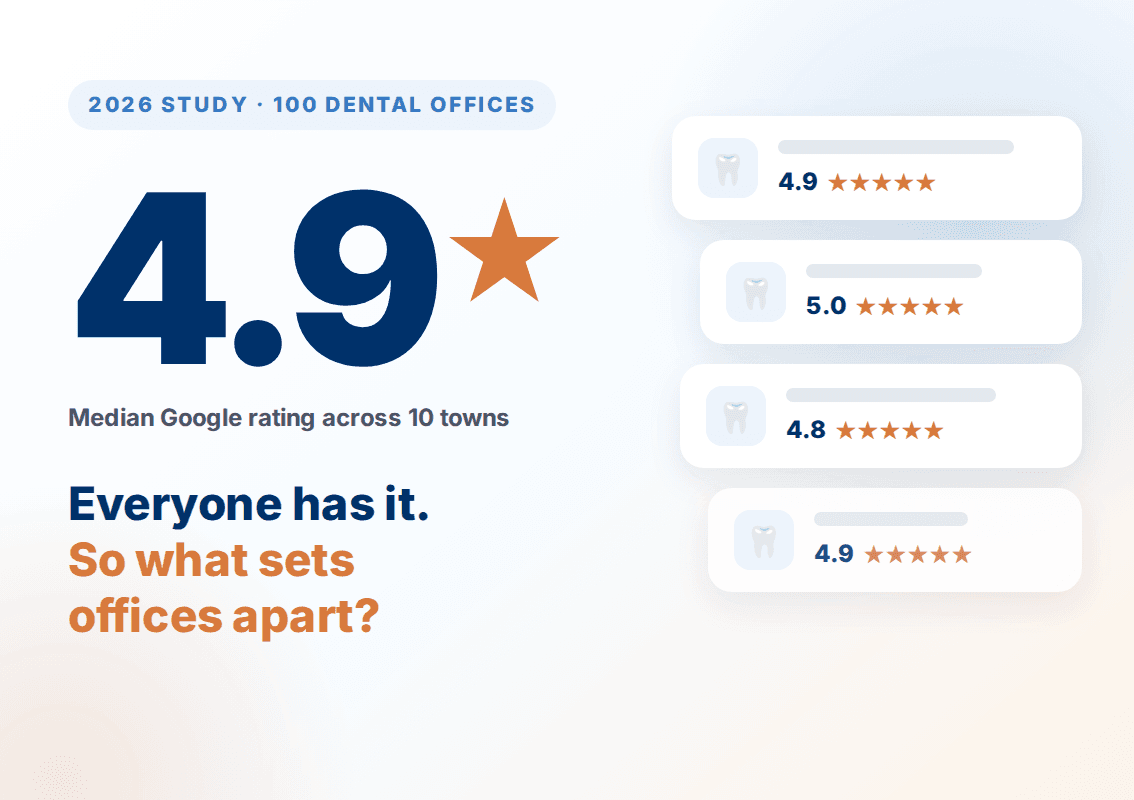
Most practices skip this and jump to aesthetics. The result is a beautiful site that says nothing. Generic claims like gentle, caring, and family friendly appear on thousands of dental websites, which means they carry no information at all.
A five step process to find your position
Run this in order:
- Pull your production report and rank procedures by profit and enjoyment. The overlap is your target case mix.
- Call five patients who referred someone last year. Ask what they tell friends about you. Their words are better than anything you'd write.
- Audit three competitors within a five mile radius. Note what each one claims. Look for the unclaimed space.
- Name one patient group you'll serve better than anyone: anxious adults, busy parents, implant cases, teens in orthodontic treatment.
- Write the promise in a sentence a front desk team member can say on the phone without reading it.
The ADA's practice management resources cover the operational side of this well. The uncomfortable part is choosing, because a position only works if it excludes someone.
Not sure which position your search presence already signals?
A search visibility audit shows which patient intent your practice currently ranks for, and which competitors own the rest.
See dental SEO →What are the core parts of a dental brand identity?
A dental brand identity has four working parts: the promise, the voice, the visual system, and the proof. The promise says who you serve. Voice controls how you sound. The visual system makes you recognizable. Proof, meaning reviews and results, is what makes patients believe the other three.
Practices tend to over-invest in the visual system and under-invest in proof. Effective dental branding strategies weight proof heaviest. That's backwards for most offices. A polished palette with eleven reviews loses to plain design with four hundred reviews almost every time.
What belongs in each of the four parts
Here's what each part should include:
- Promise: one sentence, plus three supporting claims you can actually deliver on Tuesday morning.
- Voice: a short list of words you use and words you avoid. Most dental sites read like insurance paperwork. Yours doesn't have to.
- Visual system: logo, two brand colors, one type family, and a photography rule. Real team photos beat stock every time.
- Proof: review volume, before and after cases where permitted, patient stories, and clinical credentials.
Document all four in one page. Not a forty page brand book nobody opens. One page your team and every vendor can follow.
How should your website carry the brand?
Your website is where branding either converts or leaks. It has to answer three questions in the first screen: who this practice is for, what it does, and how to book. Everything else on the page is secondary to those three answers.
Mobile decides most of this. Dental branding strategies that look sharp on a monitor and cramped on a phone lose the patient before the promise lands. Google data puts 62% of all dental-related searches on mobile devices, so the desktop version of your homepage is effectively a preview nobody sees. Test on a phone, on cellular data, from outside your office network.
Three website fixes that carry the most weight
Three fixes carry most of the weight. Put your position in the headline instead of your practice name, since patients already know they're on a dental site. Show the dentist's face above the fold, because people book with people. And put a real phone number and booking link in the sticky header, not buried on a contact page.
Voice queries change the wording, too. Patients asking a phone for a dentist speak in full questions, which is a different content problem than typed search. That's covered in our guide to voice search SEO for dental practices.
Related: Design decisions and brand decisions get made together, and publishing consistently is how a position becomes recognizable. Read how to start a dental blog →
Which dental branding strategies fit a startup versus an established practice?
Brand priorities change with practice stage. A startup needs to become known for one thing. An established multi-provider office needs to keep one promise consistent across every operatory. Spending on the wrong stage priority is the most common way branding money gets wasted.
The table below maps where to spend first at each stage, and what to leave alone until later.
| Practice stage | Brand priority | Where to spend first | What to skip |
|---|---|---|---|
| Startup, year 0-2 | Get known for one thing | Website, photography, phone coverage | Custom illustration, brand video |
| Growing, 2-7 years | Shift case mix toward target work | Service pages, review systems, staff scripts | Full logo redesign |
| Established, multi-provider | Keep the promise consistent across providers | Brand guidelines, onboarding, internal training | Chasing every new channel |
| Acquiring or merging | Protect the equity you bought | Patient communication, signage transition | Instant name change |
Why repositioning gets harder as you grow
Stage also changes your patience level. A startup can reposition in a month because almost nobody knows the old message. A practice with 4,000 active patients cannot, since the brand already lives in their heads and their referrals.
We break the campaign side of this down further in our guide to dental marketing strategies by practice stage.
How do your team and phone experience shape the brand?
Your phone is the highest stakes brand touchpoint you own. A patient who hears a warm, competent voice within three rings has already decided you're organized. One who reaches voicemail assumes the opposite, and most of them never call back to find out.
The numbers are unforgiving here. ADA Practice Transitions data shows 38% of new patient calls go unanswered during business hours. Forbes reports that 80% of callers who reach voicemail don't leave a message and won't call back. Dental Economics puts average patient lifetime value between $12,000 and $15,000, so each of those calls carries real weight.
What front desk brand consistency requires
Brand consistency at the front desk comes down to a few repeatable things:
- A greeting that names the practice and the person answering, every time.
- One sentence that restates your position naturally, not as a script recital.
- A defined path for anxious or urgent callers, since those are usually your highest value cases.
- Coverage for lunch, evenings, and weekends, when a lot of patients actually call.
Worth reading alongside this: the real cost of missed calls for a dental practice usually surprises owners more than any marketing invoice.
Every unanswered call is a brand impression you didn't get to make
DentiVoice answers calls in your practice voice, books into your PMS, and covers evenings and weekends without adding front desk headcount.
See the AI receptionist →What do reviews do to a dental brand?
Reviews are the proof layer of your brand, and they now carry more weight than anything you say about yourself. According to BrightLocal, 98% of people read local reviews before choosing a business. Volume, recency, and how you respond all shape the impression.

Response matters more than most owners expect. BrightLocal's consumer review survey found that 88% of people are likely to use a business whose owner responds to all reviews. A calm, specific reply to a negative review often reads better to prospects than a wall of five star ratings with no owner voice.
How to run reviews as a system
Treat reviews as a system, not a favor you ask when things are slow. Pick the moment of request, usually right after a completed treatment that went well. Automate the ask. Assign one person to respond within 48 hours. Never argue clinical details in public, and never mention specifics that could identify a patient.
Your Google listing is where most of this gets read. Our guide to Google Business Profile for dentists covers the listing side in detail.
How do you keep branding consistent across every channel?
Consistency means a patient meets the same practice on Google, Instagram, your website, and the phone. Inconsistency is the most common branding failure in dentistry, and it rarely comes from bad intent. It comes from five different people making small decisions without a shared reference.
Dental branding strategies fail from drift far more often than from bad design. Channel drift shows up in predictable places. The website says advanced implant care while the social feed posts birthday cakes. The Google listing has old hours. The intake form asks for information the confirmation email already collected. Each gap is small. Together they read as disorganized.
A quarterly consistency check you can run in an hour
A quarterly consistency check takes about an hour:
- Search your practice name and read the first screen as a stranger would.
- Compare the name, address, hours, and phone across your website, Google listing, and social profiles.
- Read your last ten social posts against your position statement. Cut what doesn't support it.
- Call your own office from an unknown number and listen to the whole experience.
Dental Economics reports that 97% of surveyed dentists use Facebook as their main social platform, which makes it the most likely place for drift. Our dental social media marketing guide covers how to keep that channel on message.
How do you measure whether dental branding strategies are working?
Measure branding with demand signals, not engagement metrics. The four that matter are brand-name search volume, direct traffic, referral share of new patients, and case mix. Likes and followers tell you almost nothing about whether patients trust you enough to book.

Brand search volume is the cleanest early indicator. When people search your practice name instead of dentist near me, your brand is doing the work. Track it monthly in Google Search Console. Direct traffic tells a similar story, since it means people typed you in rather than discovering you. For the full scorecard, including review cadence and retention benchmarks, see our guide to measuring dental brand building success.
Why referral share and case mix matter most
Referral share is the slowest and most honest measure. Ask every new patient how they heard about you and log it consistently. When referral share climbs, existing patients are repeating your message, which is what a working brand actually produces. Case mix closes the loop: if you positioned around implants and your implant consults are flat after nine months, the message isn't landing.
Structured data helps machines read your brand correctly, too. Google's local business structured data documentation shows how to mark up your name, hours, and location so listings and AI answers stay accurate. That matters more each year, as covered in our guide to AI search for dentists.
Which branding mistakes cost practices patients?
The costliest dental branding mistakes are all versions of the same error: trying to appeal to everyone. Generic positioning, stock photography, and vague promises make a practice invisible rather than safe. Patients remember specifics, and they book the practice that seems built for them.
Five branding mistakes that repeat
Five patterns show up repeatedly:
- Claiming every service equally. A homepage listing eighteen services signals a general store, not expertise.
- Stock photos of models. Patients recognize them instantly. Real team photos convert better even when the lighting is imperfect.
- Rebranding the logo while ignoring the phone. New colors don't fix a caller who waits ninety seconds on hold.
- Copying the practice down the street. If your differentiator is also theirs, neither of you has one.
- Changing the message every quarter. Brands compound. Restarting resets the compounding to zero.
Dental Economics has documented this pattern across practice marketing for years: the practices that grow are usually the ones that picked a lane and stayed in it long enough for the market to notice.
Where should you start this month?
Pick the position first. Everything else in dental branding strategies is downstream of that one decision, and no amount of design or ad spend compensates for a promise nobody can repeat.
Write your one sentence this week. Say it out loud to three team members and ask what it means to them. If you get three different answers, the sentence isn't finished. If you get one, put it in your website headline, your phone greeting, and your next ten social posts, then leave it alone for a year.
How you'll know it worked
Then measure. Brand-name searches and referral share will tell you within two quarters whether the market heard you.
See what a consistent brand looks like in practice
DentalBase connects your website, search presence, ads, and phone coverage so patients hear one message at every step.
Book a Free Demo →Explore more guides and tools for dental practice growth.
Browse Resources →Sources & References
Frequently Asked Questions
Start with positioning, then build identity around it. A new practice should pick one underserved patient group, write a single-sentence brand promise, and apply it to the website, signage, and phone script before spending on ads. Consistency beats polish in year one.
Branding is what your practice stands for. Marketing is how often people hear it. Branding decides your message, tone, visual identity, and patient experience. Marketing buys attention through search, ads, and social. Weak branding makes marketing expensive because every click has to work harder.
Expect six to twelve months for measurable movement. Brand-name searches and direct traffic usually shift first, often within a quarter. Referral share and case mix take longer because they depend on patients repeating your message to friends and family.
Rebrand when your message no longer matches your services, patients, or fees. If patients arrive with wrong expectations, that is a branding problem. If the right patients simply are not finding you, that is a visibility problem and marketing fixes it faster.
Most practices spend more on identity design than on the experience that proves it. Budget for the website, photography, and staff training together. WordStream puts digital patient acquisition at $150 to $300 per patient, so experience gaps get expensive quickly.
Yes, and usually on personality. DSOs standardize to scale, which limits how specific their message can be. A solo practice can name its patient type, show the same dentist in every photo, and answer its own phone. That specificity is hard to copy.
Claiming to serve everyone. Generic messaging like gentle, caring, and family friendly appears on thousands of dental sites, so it signals nothing. Practices that name a specific patient problem and solve it visibly get remembered by the patients they actually want.
Was this article helpful?
Written by
DentalBase Team
Expert dental industry content from the DentalBase team. We provide insights on practice management, marketing, compliance, and growth strategies for dental professionals.