
10 Fixes for Dental Patients Who Ghost After the Consult
Patients who ghost after the consult are rarely gone for good. See ten fixes, from presentation changes to AI follow-up, that recover the cases.
Share:
Table of contents
Patients who ghost after the consult represent some of the most frustrating lost revenue a dental practice sees. The exam happened. The treatment plan got presented. Then the calls and texts simply stop getting answered, and the case never converts into a start. Ghosted consults are one of the clearest drags on a practice's dental patient retention rate, and closing that leak pays off well beyond the cases you recover this month.
Most patients who ghost are not actually gone. They are stuck, usually on cost, timing, or a lingering question they felt awkward asking out loud in the exam room. A handful of specific follow-up fixes recover a meaningful share of these cases. If your practice works with DentalBase's practice growth services, tools like DentiVoice can help carry the follow-up load consistently.
This guide covers ten fixes for patients who ghost after the consult, from presentation changes to structured follow-up sequences.
Why do patients ghost after a consult instead of just saying no?
What's Really Behind the Silence
Patients ghost instead of saying no because declining feels socially awkward, and silence feels easier in the moment than an uncomfortable conversation. Very few patients who go quiet have firmly decided against treatment. Most are simply avoiding a conversation they do not know how to start.
- Cost concerns they feel awkward admitting out loud during the visit.
- Timing hesitation about scheduling around work or family commitments.
- An unanswered question they did not think to ask in the room.
- General decision fatigue after a visit with a lot of new information.
This distinction matters for how a practice follows up. A patient avoiding an awkward conversation responds well to a low-pressure check-in that makes it easy to ask a question or raise a concern. The same patient responds poorly to a follow-up that feels like a sales push. That kind of message confirms the exact discomfort that caused the silence in the first place.
Getting the Follow-Up Tone Right
Key insight: Frame every follow-up around removing a barrier, not closing a sale. That single shift in tone often determines whether a patient re-engages or stays quiet.
Frame every follow-up around removing a barrier, not closing a sale. A message that says "wanted to check if you had any questions" invites a response far more easily than one that says "just following up on scheduling," even though both are asking the same underlying thing.
Does the treatment plan presentation itself affect ghosting rates?
Why Same-Visit Resolution Matters
Yes, a presentation that ends with "we'll follow up with pricing" produces far more ghosting than one that resolves cost and next steps in the same visit. Momentum matters here. A patient who leaves with an open question has time to talk themselves out of the decision before anyone follows up.
Present financing options and a rough cost range during the same visit as the treatment plan, rather than mailing a quote afterward. Our treatment plan presentation scripts are built specifically around closing this exact gap before the patient ever leaves the building.
What This Looks Like in Practice
A patient who leaves with a same-visit scan, a clear number, and a next appointment already on the calendar has far less room to drift into silence than one who leaves with a promise to "send something over."

Want scripts built for closing the gap on the spot?
Our treatment plan presentation prompts help resolve pricing and next steps before the patient leaves.
See the Presentation Scripts →How soon should the first follow-up happen after a silent consult?
The 48-Hour Window
The first follow-up should happen within 48 hours of the consult, while the visit and the treatment plan are still fresh in the patient's mind. Waiting a full week to check in gives the patient's hesitation time to calcify into a firm no by default.
A short, low-pressure message asking if they have any questions about the treatment plan works better this early than a hard call to schedule. The goal at this stage is simply to keep the conversation open, not to close the case on the first touch.
Choosing the Right Channel for the First Touch
The window after a consult where a short, low-pressure check-in keeps the conversation open, before hesitation calcifies into a default no.
A text often works better than a call for this specific touch. It gives the patient room to respond on their own schedule.
Putting someone on the spot during a live conversation they may not be ready for rarely helps. A simple, friendly line works better here than anything that reads like a script, and it costs nothing extra to send.
What should a structured follow-up sequence actually look like?
The Multi-Channel Mix
A structured sequence spaces three to four touches over two to three weeks, mixing a call, a text, and an email. That mix beats one aggressive call followed by silence. Each touch should offer something new, a different question or a different piece of information, rather than repeating the same ask.
Space the touches roughly a week apart after the initial 48-hour check-in, and vary the channel each time. A patient who ignores a call may respond to a text, and one final email summarizing the treatment plan and financing options often works well as the last touch in the sequence.
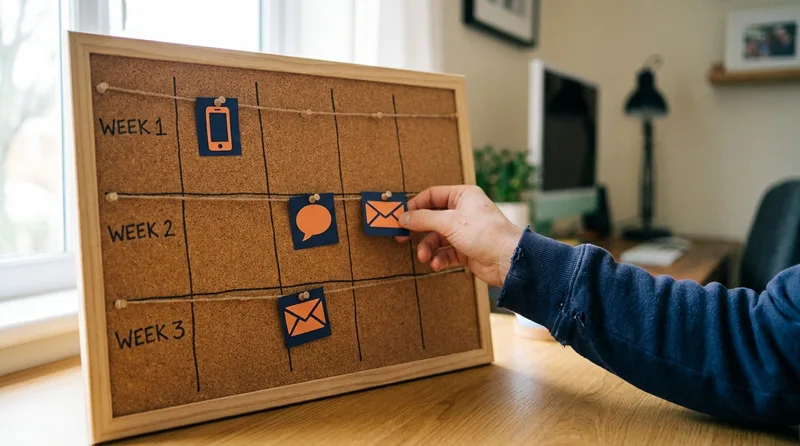
Sample Sequence Timeline
| Day | Channel | Purpose |
|---|---|---|
| Day 2 | Text or call | Low-pressure check-in, keep it open |
| Day 9 | Text | Mention financing with a specific figure |
| Day 16 | Summarize plan, offer to answer questions | |
| Day 21 | Call | Final personal touch before revisiting later |
Keeping the Team Consistent
Write the sequence down in advance. Every team member should follow the same structure, rather than improvising a new approach for each patient who goes quiet.
Consistency in the sequence itself matters almost as much as the content of any individual message. A written sequence also makes it easy to train a new hire on exactly what to send and when.
Related: The same follow-up logic applies to routine visits, with the results modeled out. Read how a four-touch reminder sequence changed a practice's no-show rate →
Does financing information change whether a patient reschedules?
Why Cost Is the Silent Objection
Yes, mentioning specific financing options in a follow-up message meaningfully increases response rates. Cost is the single most common unspoken reason behind a silent consult. A patient unsure how to afford a $3,000 treatment plan often goes quiet rather than admitting the concern out loud.
Giving Patients a Specific Number
Include a specific monthly payment figure, not just a mention that financing exists, in at least one follow-up touch. Our guide to in-house dental payment plans covers how to structure an option worth mentioning in exactly this kind of follow-up.
A concrete number like "around $85 a month with approved credit" gives a hesitant patient something specific to react to. That is far easier to respond to than a vague statement that financing exists, which most patients simply skip over without a second thought.
Want follow-up handled consistently without relying on memory?
DentiVoice can run a structured follow-up call sequence for every unconverted consult automatically.
See AI Receptionist →Should follow-up come from the doctor or the treatment coordinator?
When the Coordinator Handles It
A treatment coordinator handles most of the follow-up sequence well. A brief personal touch from the doctor on one specific message meaningfully increases response rates for higher-value cases. The doctor's involvement signals that the case genuinely matters, which a templated text alone cannot convey.
When to Bring In the Doctor
Reserve the doctor's direct involvement for cases above a certain value threshold, rather than every single follow-up, since doctor time is the most limited resource in the sequence. A short, personal voicemail or text from the doctor on a high-value case often breaks through silence that three coordinator touches did not.
Set a clear dollar threshold with the team in advance. That way, everyone knows which cases warrant pulling the doctor in, without a judgment call every single time a consult goes quiet.
A threshold around implant or full-mouth case value works well as a starting point for most general practices. Adjust it once the team sees how the pattern plays out over a few months.
| Who Follows Up | Best Used For |
|---|---|
| Treatment coordinator | Most of the sequence, every case |
| Doctor | One personal touch on higher-value cases above a set threshold |
How many follow-up attempts are worth making before letting go?
The Diminishing Returns Point
Four to five attempts across two to three weeks captures the large majority of patients who were going to respond at all. Pushing well past that point produces diminishing returns for the time invested. A sixth or seventh attempt rarely changes an outcome that five did not.
Keeping a Revisit List
Log every case that goes fully unanswered after the full sequence, and revisit it again in three to six months rather than continuing to push indefinitely. Circumstances change, and a patient who went quiet due to a temporary financial concern may be ready to move forward months later.
Keep this revisit list separate from active follow-up, so it does not get mixed in with fresh consults that still deserve the full, immediate sequence rather than a delayed check-in. A simple tag or separate list in the scheduling system keeps the two groups from blending together over time.
Related: In-house financing often removes the exact hesitation that causes a patient to go quiet. See our in-house payment plans guide →
Does a personalized message outperform a generic template?
Why Specificity Wins
Yes, referencing something specific from the actual consult, the exact tooth discussed or a concern the patient raised out loud, outperforms a generic "just checking in" message by a wide margin. Specificity signals that a real person remembers the conversation, not just a template running on a schedule.
HubSpot's marketing benchmark data consistently shows personalized outreach outperforming generic templates across nearly every industry, and the same pattern holds for a dental follow-up sequence. A single specific detail costs almost nothing to add and noticeably changes the response rate.
Building the Habit of Capturing Details
Train the team to jot down one specific note from every consult, the tooth, the concern, the question the patient asked, so that detail is ready to use whenever the follow-up sequence starts. BrightLocal's consumer research found that trust weighs heavily in how patients engage with a business, and a specific, remembered detail builds exactly that kind of trust in a follow-up message.
| Generic Message | Personalized Message |
|---|---|
| "Just checking in on your treatment plan." | "Wanted to follow up on that lower left molar we discussed." |
What data should a practice track to improve ghosting recovery over time?
The Three Metrics to Track
Track consult-to-start conversion rate, average time to response, and which specific touch in the sequence recovered the case. This data reveals which fixes are actually working, rather than which ones simply feel like they should. A practice that never tracks this repeats the same weak sequence indefinitely.
Turning Data Into Action
Three metrics worth tracking:
- Consult-to-start conversion rate
- Average time to response
- Which specific touch in the sequence recovered the case
ADA Health Policy Institute data on practice economics reinforces why this tracking matters financially, since a single recovered high-value case often justifies the entire follow-up system's cost for the year. Review this data quarterly and adjust the sequence based on what the numbers actually show.
Google's own guidance on response consistency in a customer service context notes that steady, measured follow-up outperforms sporadic effort.
That same pattern tends to hold for dental consult recovery specifically. It becomes visible once a practice actually looks at its own numbers over a full quarter, rather than judging a single slow week.
How Does DentiVoice Help Recover Patients Who Ghost After the Consult?
How DentiVoice Fits Into the Sequence
DentiVoice can run a consistent follow-up call sequence for every unconverted consult, without depending on a busy front desk to remember each one manually. Consistency is exactly where most manual follow-up systems break down, usually after the first week or two of good intentions.
Moz's research on consistency over time makes a related point in a different context: steady, repeatable effort outperforms sporadic bursts, and a follow-up sequence works the same way. Our piece on AI receptionist features dental offices actually use daily covers the broader system DentiVoice fits into for cases beyond just the ones that went quiet after a consult.
Handing this task to a consistent system frees the treatment coordinator to focus on the higher-value, more personal touches, like the doctor voicemail, rather than spending the bulk of their week on routine reminder calls.
The Ten Fixes at a Glance
Patients who ghost after the consult are rarely gone for good. Most are simply stuck on a question or a cost concern they never voiced out loud, and a structured, specific, consistently run follow-up sequence recovers a meaningful share of them.
- Understand that silence usually means stuck, not a firm no.
- Resolve pricing and next steps during the consult itself, not after.
- Follow up within 48 hours while the visit is still fresh.
- Build a structured, multi-channel sequence over two to three weeks.
- Mention a specific financing figure in at least one touch.
- Reserve doctor involvement for higher-value cases specifically.
- Cap the sequence at four to five attempts, then revisit later.
- Personalize at least one message with a real detail from the visit.
- Track conversion rate and response time to improve the sequence over time.
- Use consistent call coverage like DentiVoice to run the sequence reliably.
Where to Start This Week
Start with the presentation fix and the 48-hour follow-up, since both are free to implement and address the two most common causes of a silent consult.
Related: Patients with unscheduled treatment belong in their own recall tier, worked by phone. See how to tier and work unscheduled treatment follow-up →
See How DentiVoice Runs Follow-Up Automatically
Book a free demo to see how consistent call coverage recovers cases that would otherwise go quiet.
Book a Free Demo →Want more practice management guides like this one?
Browse Resources →Sources & References
Frequently Asked Questions
Most patients who go quiet are stuck on cost, timing, or an unanswered question, not firmly decided against treatment. Declining feels socially awkward, so silence often feels easier than an uncomfortable conversation.
Within 48 hours of the consult, while the visit and treatment plan are still fresh. Waiting a full week gives the patient's hesitation time to calcify into a default no.
Yes, a specific monthly payment figure gives a hesitant patient something concrete to react to. Cost is the single most common unspoken reason a patient goes quiet after a consult.
Four to five attempts across two to three weeks captures the large majority of patients who were going to respond at all. Log unanswered cases and revisit them again in three to six months instead of pushing indefinitely.
Reserve the doctor's direct involvement for higher-value cases, since doctor time is limited. A short, personal message from the doctor often breaks through silence that a few coordinator touches did not.
Yes, DentiVoice can run a consistent follow-up sequence for every unconverted consult without depending on a busy front desk to remember each one. Consistency is where most manual follow-up systems break down.
Was this article helpful?
Written by
DentalBase Team
Expert dental industry content from the DentalBase team. We provide insights on practice management, marketing, compliance, and growth strategies for dental professionals.