Dental Treatment Plan Presentation Prompts Guide (2026)
Copy-paste dental treatment plan presentation prompts that turn clinical notes into plain-language explanations patients actually follow.
Share:
Table of contents
Dental treatment plan presentation prompts turn a page of clinical shorthand into something a patient can actually read on the drive home. Most practices write treatment plans for insurance and charting, not for the person who has to decide whether to say yes, and that gap is where DentalBase's full marketing and communication services come in. That gap is where cases stall.
A three-provider practice with 40 new patients a month might present 25 to 30 treatment plans in that same window. If even a third of those patients delay because they did not fully understand the sequencing or the "why," that is real production sitting on the shelf. It is the same time crunch behind most front-desk gaps. The stakes are real: average patient lifetime value for a general dentist runs $12,000 to $15,000, according to Dental Economics, and one unclear treatment plan can put that relationship at risk before it starts.
This guide gives you copy-paste prompts for explaining single procedures, multi-phase plans, and cost comparisons in plain language, plus the guardrails to keep patient data out of any AI tool you use.
What Are Dental Treatment Plan Presentation Prompts?
Dental treatment plan presentation prompts are written instructions you give an AI tool to convert clinical notes into a patient-facing explanation. You supply the procedure, the reasoning, and the tone, and the tool returns text ready to hand over, print, or read aloud.
Why Plain-Language Clarity Matters
The CDC's oral health program makes the same point about general patient materials: clarity drives follow-through more reliably than volume of information. The National Institute of Dental and Craniofacial Research publishes similar plain-language patient resources for the same reason. Think of a prompt as a template with variables. The role stays fixed ("write for a nervous adult patient"), the constraints stay fixed (no jargon, sixth-grade reading level, no diagnosis claims), and only the clinical details change from patient to patient. Once you have a working prompt, reusing it takes seconds instead of ten minutes of manual rewriting per case.
The Four Elements Every Prompt Needs
The best prompts name four things explicitly: who is reading it, what procedure or plan is involved, why it is being recommended, and what format the output should take. Skip any one of those and the output tends to read like a form letter.
- Role: who the explanation is written for (anxious first-time patient, parent of a pediatric patient, patient comparing two options)
- Clinical input: the procedure, tooth number or area, and the clinical reasoning in shorthand
- Constraints: reading level, length, tone, and what to avoid (no guarantees, no diagnosis language)
- Output format: paragraph for a handout, short message for text or email, or a comparison table for multi-option cases
Why Use AI Prompts to Explain Treatment Plans?
AI prompts save time on the repetitive part of patient communication: translating clinical language into plain English. They do not replace the conversation. They give the treatment coordinator a strong first draft to personalize instead of a blank page.

The Research Behind Patient Understanding
According to research summarized by the ADA Health Policy Institute, patients who understand the reasoning behind a recommendation are more likely to move forward with it than patients who only receive a list of procedures and costs. A generic explanation does not build that understanding. A specific one does.
Time Saved Per Treatment Plan
Adoption is already moving in this direction across the industry: 73% of dental practices plan to adopt AI tools by 2027, according to Dental Economics. Here is the practical case. A treatment coordinator handling 15 to 20 new plans a week does not have time to write a custom explanation for each one from scratch. A prompt template cuts that down to a two-minute edit: paste the clinical shorthand, adjust the tone for the patient, and send.
| Method | Time per plan | Consistency |
|---|---|---|
| Writing from scratch | 10-15 minutes | Varies by staff member and mood |
| Reusing a static handout | 2 minutes | Consistent, but not personalized |
| AI prompt template | 2-4 minutes | Consistent structure, personalized detail |
What Prompt Structure Actually Works for Treatment Plan Explanations?
The structure that works follows four parts every time: assign a role, supply context, set constraints, and specify the output format. Skipping the constraints step is the single biggest reason AI-written patient explanations sound stiff or generic.
The Role-Context-Constraints-Format Method
Start every prompt the same way: "You are writing a plain-language explanation for a dental patient." Then add the specific procedure, the clinical reason it is recommended, and any relevant history in shorthand. Close with format instructions: length, reading level, and whether it is a handout, a text message, or spoken script for chairside use. General guidance on structuring prompts this way, role first and format last, lines up with Moz's guide to structuring content clearly, even though that resource was not written for dentistry specifically.
A Base Template You Can Reuse
Here is a base template you can adapt for almost any procedure:
- Role: "Write for a [adult patient / parent of a pediatric patient / patient weighing two options]."
- Context: "The recommended treatment is [procedure] for [tooth or area] because [clinical reasoning]."
- Constraints: "Use plain language at a sixth-grade reading level. No guarantees of outcome. Keep it under 200 words."
- Format: "Write it as [a printed handout / a text message / a script the front desk can read aloud]."
Prompt: Explaining a Single Procedure to an Anxious Patient
Use this prompt when one procedure needs a calm, reassuring explanation for a patient who has expressed dental anxiety. It leads with what to expect, not just the clinical justification, because anxious patients respond better to process clarity than to reasoning alone.
The Prompt
Copy this prompt directly. Both ChatGPT and Google's Gemini handle it well, since the instructions rely on plain formatting rather than any tool-specific feature.
"You are writing a plain-language explanation for a dental patient who has told the office they feel nervous about dental visits. The recommended treatment is [procedure] for [tooth or area] because [clinical reasoning]. Explain what will happen step by step, what sensations to expect, and what comfort options are available. Do not use clinical jargon. Keep the tone calm and specific. Limit it to 180 words."
Reusing This Template Without It Going Stale
Swap the bracketed details for the actual case and the output reads like something a person wrote, not a form letter. If the same anxious-patient template gets reused across dozens of cases, review it every few months so it does not drift into repetitive phrasing.
Prompt: Presenting a Multi-Phase or Full-Mouth Treatment Plan
Multi-phase plans need a prompt that explains sequencing, not just procedures. Patients delay phased treatment most often because they do not understand why phase two has to wait for phase one, so the prompt should answer that directly.
The Prompt
Use this version for plans with three or more phases:
"You are writing a plain-language summary of a multi-phase dental treatment plan. The phases are: [list each phase with the procedure and timing]. Explain why the phases happen in this order and what happens if a patient skips or delays a phase. Use short paragraphs, one per phase. Keep the total length under 300 words and avoid guaranteeing outcomes."
Why Patients Need the Whole Roadmap at Once
A patient managing $12,000 to $15,000 in lifetime dental spend, which is close to the average patient lifetime value a general dentist sees, benefits from seeing the whole roadmap at once rather than hearing about each phase in isolation during separate visits.
Related: Front desk teams juggling these explanations alongside daily scheduling can pull ready-made scripts from our ChatGPT prompts for dental front desk teams →
Prompt: Turning Clinical Notes Into a Plain-Language Summary
This prompt takes shorthand chart notes and produces a patient summary without ever including identifying information. Type the clinical facts only. No names, no chart numbers, no dates of birth.

The Prompt
"Rewrite the following clinical shorthand as a plain-language summary for a patient handout. Do not add any information not present in the notes. Use a sixth-grade reading level, active voice, and short sentences. Notes: [paste de-identified clinical shorthand only, no patient name or chart number]."
Watch for Accidental PHI Leaks
This is the prompt most likely to accidentally leak protected health information if a staff member copies a note directly from the chart. Build a quick habit: strip the header line, the patient name, and the date of birth before pasting anything into a general AI tool.
For teams building broader automation around this kind of workflow, see how other practices handle it in our dental practice automation guide.
Prompt: Comparing Treatment Options Without Steering the Decision
Comparison prompts need one hard rule: present options neutrally. The goal is patient understanding, not a nudge toward the more expensive option, and the writing guidelines here matter as much as the clinical accuracy.
How to Structure a Neutral Comparison
Use this structure when a patient is weighing two or more paths, such as an implant versus a bridge:
- List each option with the procedure name, general timeline, and what maintenance it requires
- State the clinical trade-offs in neutral language, without ranking one as "better"
- Avoid words like best, guaranteed, or risk-free anywhere in the output
- Close with a line inviting questions, not a recommendation
The Prompt
"Write a neutral comparison of [option A] and [option B] for a dental patient. Present both options with their general process, timeline, and maintenance needs. Do not recommend one option over the other or use words like best, guaranteed, or risk-free. End with an invitation for the patient to ask questions at their next visit."
Front desk still fielding the follow-up calls these plans generate?
DentiVoice answers patient questions about scheduling and next steps around the clock, so plan follow-up does not depend on someone picking up the phone.
See DentiVoice →Prompt: Responding to Patient Questions and Hesitation
This prompt drafts a response to a specific patient question or objection about a treatment plan, without inventing new clinical claims. It works best when the treatment coordinator supplies the actual question the patient asked.
Acknowledge Before You Answer
Common triggers include cost concerns, fear of pain, or skepticism about necessity. The prompt should acknowledge the concern directly before answering it, since jumping straight to reassurance can read as dismissive.
The Prompt
"A patient asked the following question about their recommended treatment: [paste question]. Write a response that acknowledges the concern, answers it factually using only [clinical facts you provide], and avoids making guarantees. Keep it under 120 words and end with an offer to discuss further at the next appointment."
Why a Reusable Answer Helps During the Research Window
Almost half of patients, 48% according to research cited by Dental Economics, spend more than two weeks researching before scheduling treatment. A written, reusable answer to their most common objections gives them something to reread during that research window instead of relying on memory from a single chairside conversation.
What Should Never Go Into a Treatment Plan Prompt?
Protected health information should never go into a treatment plan prompt run through a general AI tool. That means no patient names, no chart numbers, no dates of birth, and no identifying details tied to a specific person.
Why General AI Tools Carry Risk
Most general AI tools are not covered under a signed Business Associate Agreement, which is what HIPAA requires before you can safely process patient data through a third-party system. Treat every prompt as if the output could be seen by someone outside the practice, because with a standard consumer account, it might be logged that way.
A Quick Pre-Flight Check
A simple pre-flight check works for most staff: read the prompt back before submitting it and ask whether a stranger could identify the patient from what is written. If the answer is yes, remove that detail first.
- Never include patient names, initials used as identifiers, or chart numbers
- Never include dates of birth, insurance ID numbers, or addresses
- Describe clinical facts generically: "lower left molar" rather than tying it to a specific chart entry
- Use a HIPAA-compliant, business-grade AI tool with a signed agreement if you plan to paste real chart data regularly
How Do These Prompts Fit Into a Case Acceptance Workflow?
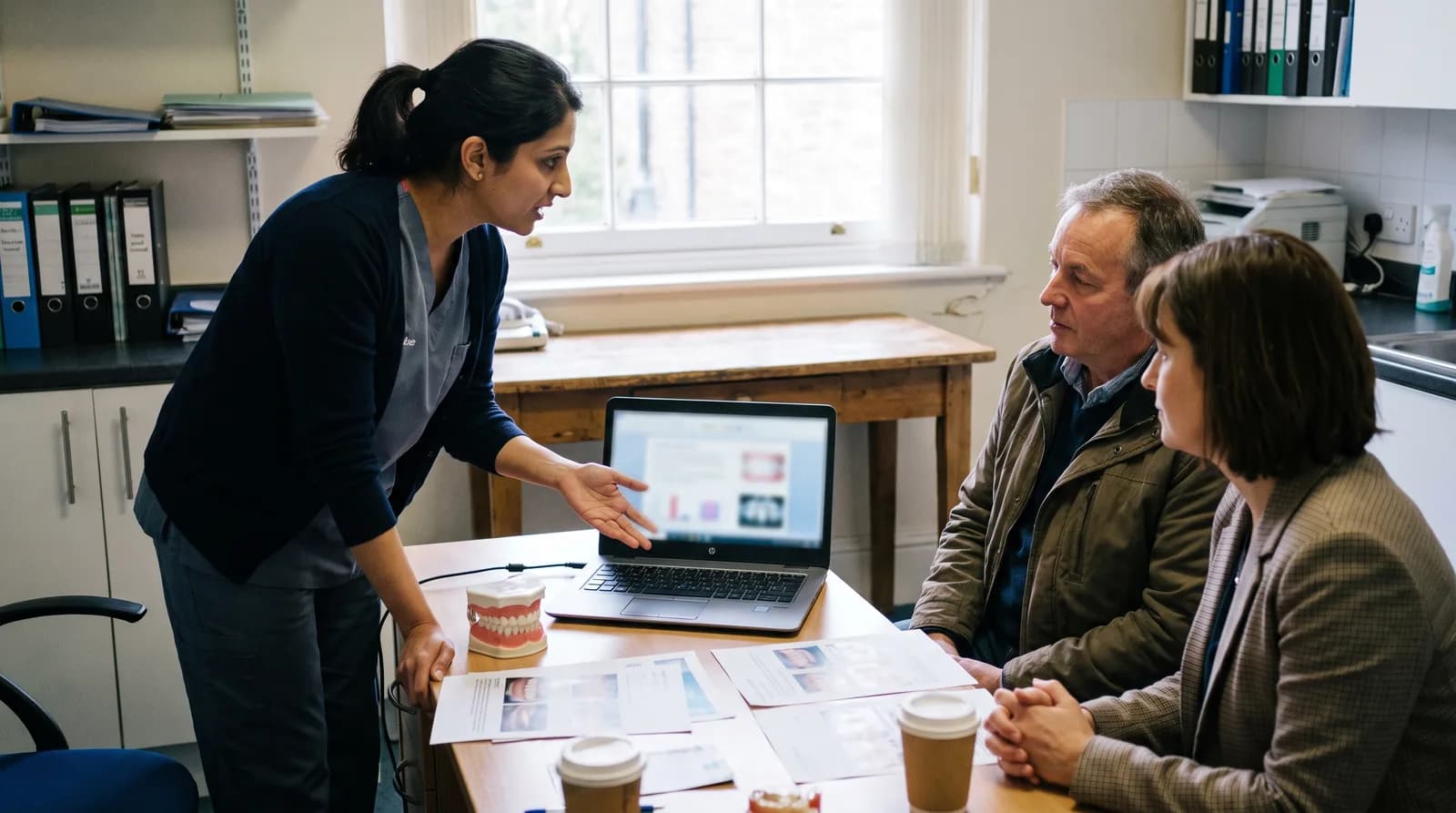
These prompts fit into a case acceptance workflow as the explanation step between diagnosis and financial discussion. They come after the dentist recommends treatment and before the coordinator discusses cost and scheduling, giving the patient a clear "why" before the conversation moves to "how much."

A Typical Workflow Sequence
A typical sequence looks like this: the dentist notes the clinical shorthand during the exam, the coordinator runs it through the prompt while the patient is still in the chair or shortly after, and the resulting summary goes home with the patient as a printed handout or a follow-up text message. That sequencing matters because patients who leave with nothing written down tend to forget the specifics within a day or two. SMS reminders alone cut no-show rates by 38%, per research published in the Journal of Dental Hygiene, so a text-based summary tends to get reread before the follow-up appointment rather than forgotten.
Even a well-delivered plan sometimes gets a quiet non-answer. Our breakdown of why patients disappear after hearing their treatment plan covers what to do when that happens.
Tracking Whether Patients Actually Understood
Practices tracking related metrics can pair this workflow with the follow-up survey questions in our dental patient survey templates to see whether patients felt they understood their plan.
When the plan being explained includes a discount from an in-house membership option, the "how much" part of the conversation gets simpler for the coordinator to deliver. Our overview of membership plan software options breaks down how Kleer, Membersy, and DentalHQ differ on enrollment and billing.
Related: These scripts get easier to use once your fee schedule actually reflects your costs. See how to negotiate dental insurance rates for your practice →
Do These Prompts Replace the Treatment Coordinator?
No, these prompts do not replace the treatment coordinator. They remove the repetitive writing task so the coordinator can spend more time on the parts of the job that require judgment: reading the patient's reaction, answering follow-up questions, and handling the financial conversation.
What Still Requires a Person in the Room
A prompt cannot tell whether a patient is nodding along without actually understanding, or whether hesitation is about cost rather than comprehension. Those signals require a person in the room. The prompt's job ends at producing a clear first draft. Everything after that, including tone adjustments on the fly and reading body language, still belongs to the coordinator. Dentist and hygienist employment is projected to keep growing through the decade, according to the Bureau of Labor Statistics, which means the coordinator role carries an increasing communication load rather than a shrinking one.
Building This Into Broader Team Training
Front desk staff juggling these conversations alongside daily scheduling duties often benefit from broader cross-training. See our front desk cross-training guide for how other practices structure that.
Teams building a library of reusable prompts across departments can also study the Gemini prompts for dentist teams guide, since the same role-context-constraints-format structure applies to scheduling and billing prompts as well.
The single biggest shift with dental treatment plan presentation prompts is not the technology. It is treating patient explanation as a repeatable process instead of something rebuilt from scratch for every case. A coordinator who edits a strong draft in two minutes has more time for the conversation that actually decides whether a patient says yes.
Start with one prompt, the single-procedure template, and run it on your next five treatment plans. Compare how patients respond to a written explanation against your current process before rolling it out practice-wide.
See how DentalBase supports patient communication end to end
From AI-answered calls to follow-up messaging, DentalBase helps practices keep patients informed at every step of a treatment plan.
Book a Free Demo →Want more ready-to-use prompt templates for your practice?
Browse DentalBase Resources →Sources & References
Frequently Asked Questions
No, not directly. Chart notes often contain protected health information, including names, dates of birth, and chart numbers. Strip every identifying detail first, or describe the procedure and clinical reasoning in general terms without any patient-specific data attached.
ChatGPT and Gemini both handle plain-language rewrites well for this task. Gemini has a practical edge if your practice already runs on Google Workspace, since it can reference existing Docs and Sheets templates directly during drafting.
Aim for 150 to 250 words per individual procedure, plus a short combined summary if the plan spans multiple phases. Longer explanations tend to get skimmed rather than read closely, especially on a phone screen.
No, they do not replace signed consent documentation in any way. They support the conversation leading up to it. Use the prompt output as a companion explanation, then complete your standard consent process exactly as before.
Either role can run the prompt, but the treatment coordinator typically owns the follow-up communication afterward. Many practices have the dentist supply the clinical shorthand during the exam, then the coordinator runs the prompt and personalizes the tone.
They help patients understand exactly what they are agreeing to, which does support acceptance over time. That said, price sensitivity and financing options usually matter more for large treatment plans than explanation clarity on its own.
Was this article helpful?
Written by
DentalBase Team
Expert dental industry content from the DentalBase team. We provide insights on practice management, marketing, compliance, and growth strategies for dental professionals.