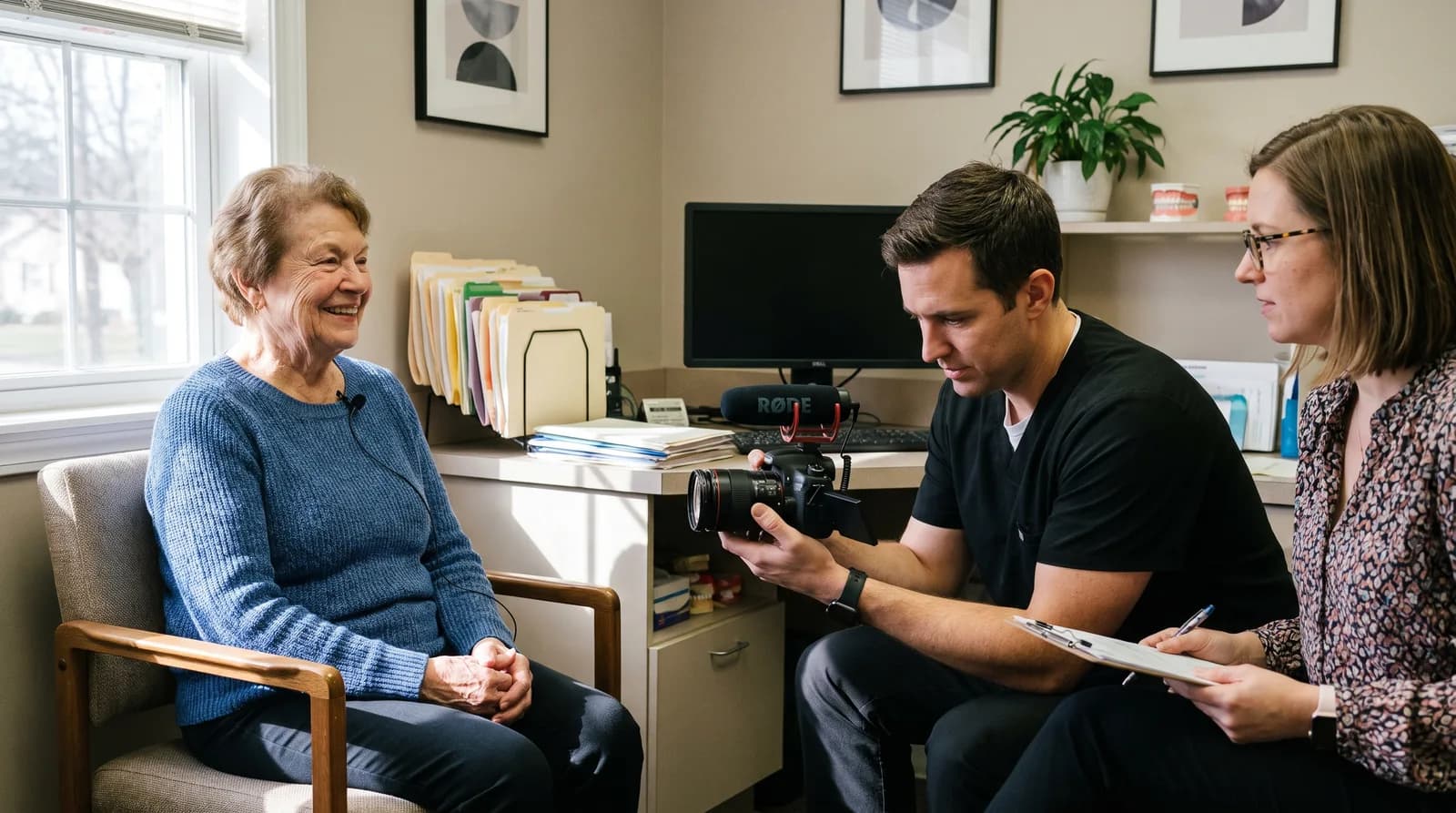
Dental Patient Testimonial Videos: How to Film and Use Them
Dental patient testimonial videos build more trust than written reviews. See how to get consent, film with basic gear, and publish for the most reach.
Share:
Table of contents
Dental patient testimonial videos consistently outperform written reviews for building trust. A real voice and face are harder to fake than a paragraph of text. A single well-filmed testimonial can do more convincing than a dozen five-star ratings sitting on a review page.
Most practices agree testimonial videos work. Few actually produce them on a regular schedule. Filming feels awkward to ask for, technically intimidating, or unclear in terms of what to say once the camera is rolling. If your practice uses DentalBase's video marketing and social media services, a repeatable filming process turns this from an occasional favor into a steady content source.
This guide covers who to ask and what consent you need. It also covers how to run the interview, what equipment matters, and where to publish the finished video for the most reach.
Testimonial videos are one piece of the trust-building puzzle, patients also size up your website and search presence before they call. This overview of how patients choose a dental office online covers the other signals that shape that decision.
Why do testimonial videos convert better than written reviews?
Testimonial videos convert better than written reviews because tone of voice, facial expression, and pacing are hard to fabricate. That makes video feel more credible to a skeptical viewer. A prospective patient reading a review has to take the words at face value. Watching someone speak removes that guesswork.
Video also holds attention longer than text on a landing page or social post. That extra time lets the practice communicate details that actually matter: how the patient felt about their treatment plan, whether front desk staff put them at ease, and what recovery was really like. HubSpot's marketing benchmark data consistently ranks video content above nearly every other format for engagement, and dental practices see the same pattern.
The audience is already primed for it. Software Advice reports that 77% of patients use online reviews when finding a dentist, and PwC Health found that 41% of people say social media content impacts their treatment choice. Dental patient testimonial videos meet both habits at once.
None of this replaces written reviews. It adds a format that reaches people who scroll past text but stop for video, and the two formats work well side by side on the same page.
Related: Testimonials earn the most when they sit inside a full plan with a posting schedule, paid amplification, and booking-based tracking. See how dental social media marketing fits together →
Which patients make the best video testimonial candidates?
Patients who are naturally talkative, recently finished a meaningful course of treatment, and have already left a positive written review make the best video testimonial candidates. Asking a patient who seemed hesitant at any point during treatment usually produces an awkward video that helps no one.
Look specifically for patients who overcame a real obstacle. Dental anxiety, a long-delayed treatment they finally completed, or a cosmetic case that changed how they felt about smiling in photos all make strong stories. These carry more emotional weight than a routine cleaning testimonial, though routine care testimonials still build general trust. Front desk and hygiene staff often notice enthusiastic patients first. Build a habit of flagging good candidates as they come up, rather than trying to remember weeks later who seemed like a good fit.
- Patients who overcame dental anxiety or a long-delayed treatment.
- Cosmetic cases with a clear before-and-after emotional story.
- Long-term patients who can speak to consistency of care over years.
Let DentalBase help produce your testimonial videos
Our social media and video marketing services can help plan, film, and publish patient testimonials.
See Social Media Services →What consent do you need before filming a patient testimonial?
A specific, signed video release is required before filming or publishing a patient testimonial, separate from routine treatment consent. Name where the video will appear on the release. A patient comfortable with a website video may feel differently about the same video running as a paid social ad.
Cover the same ground a photo release would: channels, whether the patient is identified by full name, and a clear process for requesting removal later. Treat the consent conversation as a habit, not an afterthought. Ideally the release gets signed before the camera starts rolling, rather than promised verbally and formalized after the fact. Store the signed release with the patient's chart. That keeps the record tied to that specific patient and treatment, and makes it easy to find if a question comes up months later.
If a patient asks for edits or a full removal after publishing, treat that request the same way you would a photo takedown: promptly and without argument.
These video release habits mirror the photo consent and compliance rules for before and after photos, so a practice already following one set is most of the way to the other.
How do you ask a patient to record a testimonial without it feeling forced?
Ask at the moment a patient expresses genuine enthusiasm. Right after a final reveal appointment, or during checkout when they thank the team unprompted, works well. Asking cold, unrelated to any specific positive moment, tends to produce hesitation or a polite decline.
Frame the ask around helping other patients, not around helping the practice's marketing. Try something like: "would you be willing to share your experience on camera? It really helps other people who were nervous about the same treatment." That framing tends to land better than a request that sounds purely promotional. Offer a specific, low-pressure time. Staying five extra minutes after their appointment works better than asking them to schedule a separate visit just for filming, which adds friction most patients will decline. If they hesitate even slightly, offer to let them see the footage before it goes anywhere, which often removes the last bit of reluctance and turns a maybe into a yes.
What questions should you ask during a testimonial video interview?
Ask open-ended questions about the problem the patient had, why they chose your practice, and how they feel now. Yes-or-no questions produce short, unusable answers. A good interview feels like a conversation, not an interrogation.
Strong opening questions include: what brought you in initially, what were you nervous or unsure about, and what would you tell someone else considering the same treatment. Avoid leading questions that put words in the patient's mouth. "Wasn't the staff amazing" produces an answer that sounds coached rather than genuine. Let pauses sit. Some of the best, most natural lines come after a few seconds of the patient thinking through their own answer, so resist the urge to fill silence with another question.
- What brought you in to see us initially?
- What were you nervous or unsure about before treatment?
- How do you feel now, and what changed for you?
- What would you tell someone else considering the same treatment?
The four-step workflow
How a patient testimonial video goes from ask to published
| 1 | Ask Pick a recent, enthusiastic patient and get a signed video release naming every channel you plan to publish on. Consent before camera |
| 2 | Film Smartphone on a tripod, patient near a window, lapel mic clipped on. Run the four questions as a conversation. Audio beats camera specs |
| 3 | Cut Trim to a 60 to 90 second social version and a 3 to 5 minute website version. Never edit words in a way that changes meaning. Two cuts, one shoot |
| 4 | Publish Post to the website, Google Business Profile, Instagram, and Facebook, then reuse the clip in paid social. One story, four placements |
Total hands-on time for one video runs about 30 minutes of filming and an hour of editing.
A finished testimonial video earns its keep through distribution. Working it into a regular posting rhythm is covered in this practical guide to social media marketing for dental practices.
Want to see what video does to patient trust?
Our breakdown of how dental video builds trust and turns viewers into booked appointments.
Read the Video Trust Guide →What equipment do you actually need to film a good testimonial?
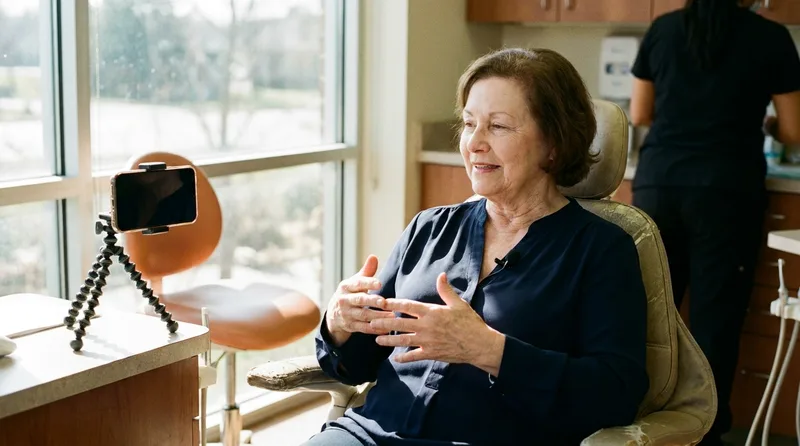
A modern smartphone, a simple lapel microphone, and a window or softbox for lighting cover most of what a testimonial video needs. Expensive camera equipment matters far less than clean audio and flattering, even lighting on the patient's face.
Film in a quiet room away from HVAC noise and hallway traffic. Position the patient facing a window or a simple light source, rather than under a single harsh overhead fixture. A basic tripod keeps the shot steady, which matters more for perceived professionalism than resolution or camera brand. If budget allows one upgrade beyond a smartphone, choose a clip-on lapel microphone. It makes the single biggest difference in how polished the final video feels, since bad audio distracts viewers far more than imperfect video quality ever will.
None of this requires a production budget. A quiet exam room with good window light and a $30 clip mic will outperform a noisy hallway shoot with a professional camera every time.
How long should a dental testimonial video be?
Most testimonial videos work best between 60 and 90 seconds for social media, with a longer 3 to 5 minute version reserved for a dedicated website page. Viewers drop off quickly on social platforms. Website visitors researching a specific procedure will watch longer if the content stays relevant.
Edit ruthlessly. A 10-minute raw interview usually contains only 60 to 90 seconds of genuinely usable, quotable material once you cut pauses, filler words, and tangents. Keep the strongest, most specific line near the beginning of any social cut. That single decision determines whether a viewer keeps watching past the first few seconds or scrolls on to the next post in their feed.
Keep a longer, lightly edited cut of the same interview for the website version, since visitors already reading a treatment page have more patience than someone scrolling a feed. The two lengths serve different jobs. One earns attention in a crowded feed, and the other builds deeper trust for someone already close to deciding.
Where should you publish and promote testimonial videos?
Publish testimonial videos on your website's homepage or a dedicated testimonials page, your Google Business Profile, and your practice's Instagram and Facebook accounts. Each platform reaches a different part of your audience at a different stage of their decision.
Google Business Profile video pairs well with written reviews already on the profile, reinforcing the same trust signal from a different angle. BrightLocal's consumer review research found that 98% of people read local reviews before choosing a business. A video sitting next to those reviews gives a skimming visitor an even faster way to decide. If your practice runs paid social campaigns, a short testimonial clip often outperforms a purely promotional ad, since it reads as more trustworthy in a feed full of ads competing for the same attention. According to Hootsuite, video posts get 48% more engagement than static posts on dental social accounts.
Dental patient testimonial videos usually land first on Facebook. Dental Economics found that 97% of dentists surveyed use Facebook as their main social platform, so the audience and the posting habit already exist. BrightLocal also reports that practices using Google Business Profile posts see 35% more website clicks.

| Platform | Best cut length | What it reinforces |
|---|---|---|
| Website / testimonials page | 3 to 5 minutes | Deeper trust for a visitor already researching |
| Google Business Profile | 60 to 90 seconds | Pairs with existing written reviews |
| Instagram / Facebook | 30 to 60 seconds | Reach and awareness in a scrolling feed |
Related: Honest, specific language matters as much in a video caption as it does in a written review. See dentist review examples →
How do you keep testimonial videos compliant and honest?
Keep testimonial videos compliant by using only your own real patients with documented consent, avoiding clinical claims the patient isn't qualified to make, and captioning the video with the actual procedure performed. Do not script specific clinical claims into a patient's mouth.
Avoid editing a patient's words in a way that changes their meaning, even if the edit makes for a punchier soundbite. This is the same honesty standard covered in our guide to scripting a testimonial video that feels authentic, which stresses letting patients keep their own words instead of a written script. Moz's guide to on-page content makes a related point about video captions: specific, concrete language builds more trust than generic praise, whether a search engine or a patient is doing the evaluating. Trust research from the ADA Health Policy Institute backs this up too, since patients consistently weigh trust and credibility heavily when choosing where to go.
If a patient mentions a specific outcome that sounds unusually dramatic for the procedure shown, ask a follow-up question rather than leaving the claim unqualified in the final cut. A brief, honest caveat protects both the patient's credibility and the practice's.
What Makes Dental Patient Testimonial Videos Actually Convert?
Dental patient testimonial videos convert when the story is specific, the patient is genuinely enthusiastic, and the video sits where a prospective patient is already deciding, such as a procedure landing page or a Google Business Profile. Generic praise placed randomly rarely moves anyone.
Build a small, repeatable system. Flag enthusiastic patients as they come up, keep a simple consent release on hand, and film with clean audio and natural light. Then publish the finished clip everywhere a prospective patient might be researching that same procedure. Google's page experience guidance also rewards fast-loading video, so compress files appropriately rather than embedding a raw, oversized file directly on a landing page where it will slow the whole page down.
Review the system every few months. A process that produces one good testimonial a month compounds into a substantial library within a year, far more valuable than any single elaborate production could be on its own.
Dental patient testimonial videos work because they let a real patient do the convincing a practice cannot do as credibly for itself. That only works when consent is documented, the story is specific, and the finished video actually reaches people who are deciding.
Start small. Identify one enthusiastic patient this month, get a signed release, and film a short, honest testimonial with clean audio. A simple, repeatable process beats an occasional, elaborate production every time.
See How DentalBase Builds Patient Story Content
Book a free demo to see how testimonial videos fit into a full social and website content plan.
Book a Free Demo →Want more marketing guides like this one?
Browse Resources →Sources & References
Frequently Asked Questions
Yes, a specific, signed video release is required before filming or publishing, separate from routine treatment consent forms. The release should name every channel where the video will appear, since a website use and a paid ad are treated differently.
Ask at a moment of genuine enthusiasm, such as right after a final reveal appointment. Frame the request around helping other patients rather than helping the practice's marketing, and offer a specific, low-pressure time to film.
A modern smartphone, a clip-on lapel microphone, and natural window light cover most needs. Clean audio and even lighting matter far more than camera resolution or brand for a polished final result.
Most social cuts work best between 60 and 90 seconds, since viewers drop off quickly on social platforms. A longer 3 to 5 minute version works better on a dedicated website page.
Publish on the website, Google Business Profile, and social accounts like Instagram and Facebook. Each platform reaches a different part of the audience at a different stage of their decision process.
Avoid editing in a way that changes the patient's meaning, even if it creates a punchier soundbite. Caption the video with the actual procedure performed, and never script clinical claims the patient isn't qualified to make.
Was this article helpful?
Written by
DentalBase Team
Expert dental industry content from the DentalBase team. We provide insights on practice management, marketing, compliance, and growth strategies for dental professionals.