
Dental Website Design: What Actually Converts in 2026
Dental website design drives new patients or loses them. Learn what features and costs make a dental practice website actually convert.
Share:
Table of contents
Most dental practices built their websites years ago, added a phone number and a services list, and called it done. That approach no longer holds. Dental website design now shapes whether a practice appears in local search. It also shapes whether patients trust it on a first visit, and whether that visit ends in a booked appointment. A site that loads slowly or buries the booking button is functionally invisible to people searching for a dentist. According to Search Engine Land, AI-powered results are making that competition for visibility even sharper. Design is one half of what converts a visitor; the copywriting side of what actually converts is the other.
According to Dental Economics, 57% of practices are actively considering a redesign. Mobile accounts for 62% of all dental-related searches, per Google. This guide covers what dental website design involves and which features drive measurable results. It also breaks down realistic dental website cost. And it covers how to evaluate whether your current site needs a refresh or a full rebuild.
What does dental website design actually involve?
Dental website design covers every decision shaping a patient's experience, layout, load speed, the booking flow, and page copy. It is not purely visual. A dental practice website has one functional job: turn a visitor into a scheduled appointment without requiring a phone call. It needs to do that fast enough that the visitor does not leave for a competitor nearby.
Core components include information architecture (how services and contact details are organized) and mobile-first layout. They also include page speed, scheduling buttons, trust signals like patient reviews, and technical SEO. Design choices affect all of these areas simultaneously. A visually appealing site that loads slowly or hides the booking button still underperforms. The top dental practice websites treat design and function as the same problem, not separate deliverables.
Page speed on most dental homepages comes down to a single element. Why hero image compression is the highest-ROI website fix in 2026 shows why it outweighs a dozen smaller optimizations combined.
Your website is a major factor, but patients weigh it alongside your reviews, search visibility, and social presence before booking. This guide to how patients choose a dental office online breaks down that fuller decision path.
Why does mobile performance define whether a dental website works?
Mobile performance defines dental website success because 62% of dental-related searches happen on phones, per Google. Google also uses mobile-first indexing, meaning it ranks the mobile version of your site, not the desktop version. A site built for desktop puts most visitors into a frustrating experience they will not push through.
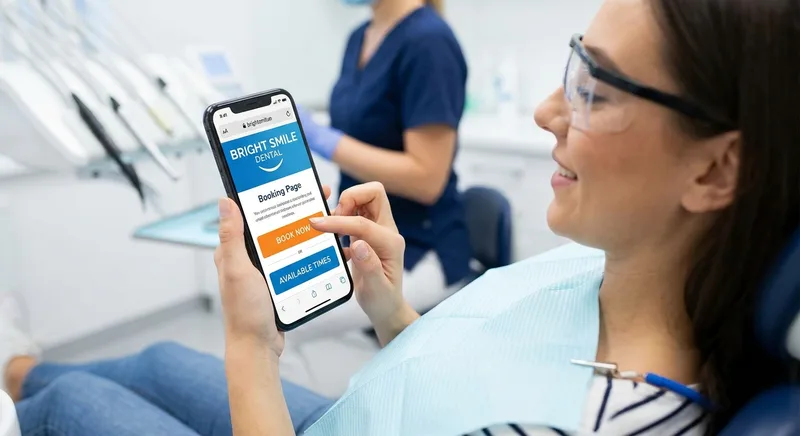
Mobile-first dental website design means buttons sized for thumb taps (44x44px), tap-to-call headers, readable text, and forms with large input fields and auto-complete. Images must be compressed for LTE connections. Google data shows 44% of patients who found healthcare via mobile search scheduled an appointment. Removing friction captures patients already primed to book.
Which features separate high-converting dental websites from average ones?
High-converting dental websites share a specific cluster of features affecting patient conversion and trust, and the gap is rarely aesthetic. It is about whether the site does the functional work of a front desk. That means answering questions, displaying availability, and making it easy to book without a call. Feature decisions determine whether a dental practice website performs.
Feature Comparison: High-Performing vs. Typical Sites
| Feature | High-Performing Site | Typical Site |
|---|---|---|
| Load time | Under 2.5 seconds on mobile | 4-7 seconds; unoptimized images |
| Online scheduling | Integrated, real-time booking | Contact form or phone only |
| Patient photos | Real team and office photos | Generic stock imagery |
| Reviews | Live Google review feed | Absent or static quotes |
| Service pages | Dedicated pages per service with schema | One combined Services page |
| Accessibility | WCAG 2.1 AA compliant | Not tested; unknown compliance |
According to Zocdoc, 77% of patients want online booking capability, yet Dental Economics data shows only 26% of practices currently offer it. Dental Economics also reports practices with online scheduling see 24% fewer no-shows. Automated reminders drive that result, something phone-only booking cannot replicate. That gap is a direct revenue opportunity for any dental practice website that adds real-time scheduling.
How much does a dental website cost in 2026?
Dental website cost depends on the build approach, template, generalist agency, or dental-specific provider, and the differences in outcome are material. A template site can launch for a few hundred dollars. It requires owner time and produces a generic result, without the scheduling integration or SEO structure that drives patient acquisition.
Dental Website Cost Ranges (2026)
- DIY template builders (Squarespace, Wix): $200, $600/year. Lowest cost, most owner time, limited scheduling integration, minimal SEO foundation.
- Generic freelancer or small agency: $1,500, $4,000 upfront, plus $100, $250/month. Faster than DIY, but often lacks dental-specific knowledge on HIPAA forms and patient conversion.
- Dental-specific web provider: $3,000, $10,000 upfront, plus $200, $500/month. Includes scheduling integration, SEO structure, and expertise in what converts dental patients.
- Enterprise / DSO-level custom build: $15,000, $50,000+. Multi-location architecture, PMS integration, and ongoing development capacity.
The ongoing monthly cost is where practices frequently underestimate the total. Hosting, security updates, plugin maintenance, and content changes accumulate. A dental website that goes 18 months without updates develops technical debt. Outdated plugins create security vulnerabilities. Stale content signals to Google that the site isn't maintained, suppressing search rankings. For a side-by-side look at build tiers, see typical 2026 dental website redesign cost ranges.
What dentist website ideas consistently attract new patients?
Dentist website ideas that reliably produce new patients reduce friction and answer questions before a visitor needs to call. Conversion on a dental website is an information problem. Patients who land on your site are already considering a dentist. The site's job is to remove every reason to hesitate before they leave for a competitor.

Website Features With a Proven Conversion Record
Ideas with a consistent track record of results:
- Before-and-after photo galleries, visual proof of outcomes for cosmetic and restorative services reduces hesitation and increases time on page
- Team introduction videos, 30-second clips of the dentist explaining their approach convert anxious patients who wouldn't otherwise call
- Neighborhood-specific location pages, dedicated pages for each service area rank separately for "dentist near [neighborhood]" searches
- Live review integration, pulling Google reviews into the site keeps social proof current; BrightLocal research shows 98% of people read local reviews before choosing a business
- FAQ sections per service, answers to questions like "Does a root canal hurt?" capture long-tail search traffic and reduce pre-appointment anxiety
- Insurance and financing pages, a clear list of accepted plans removes a major barrier; the ADA reports 72% of patients say convenience is a top factor when choosing a dental provider
- New patient landing pages, a dedicated page for new patient specials creates a trackable conversion point that proves ROI on paid search
The common thread: each idea removes a reason for a patient to hesitate or leave. Effective dental website design stacks these elements together. Wherever a patient enters the site, a clear and low-friction path to booking exists.
How should online scheduling be integrated into a dental practice website?
Online scheduling should be integrated as a native feature on a dental practice website, not a redirect to an external form. Patients who click a booking button expect to see available times, select one, and confirm. A third-party page that looks different, or a 24-hour callback requirement, causes many patients to abandon the process before booking.
Key implementation details:
- Real-time availability, patients should see actual open slots, not submit a request and wait
- New vs. returning patient flows, different intake needs should route separately from the start
- Mobile-native form design, tap-friendly date pickers, auto-complete on contact fields, clear confirmation screen
- Automated confirmation and reminders, immediate email confirmation and text reminders at 48 and 24 hours
- HIPAA-compliant data handling, any form collecting patient information must use encrypted transmission and storage

The 24% no-show reduction Dental Economics attributes to online scheduling is driven primarily by automated reminders. A patient who books online and receives two text reminders is significantly less likely to forget than one who called a receptionist. For context on how scheduling connects to patient retention, see the dental patient experience guide. It covers the full appointment flow from initial booking through follow-up.
For high-value procedures like implants, a slow or clunky booking flow costs more than average, see our breakdown of the website architecture mistakes that specifically cost implant cases.
Ready to see a dental website built for conversion?
DentalBase builds dental practice websites with integrated scheduling, local SEO structure, and real-patient photography workflows. Book a free demo to see the approach in action.
Book a Free DemoWhat SEO structure does a dental website need to rank in local search?
A dental website needs a specific technical and content structure to rank in local search. That goes well beyond placing your city name on the homepage. Google's local algorithm weighs relevance (does the page match the search?), distance (practice location), and prominence (how established it appears). Your dental practice website directly controls relevance through content architecture and page structure.
For a closer look at how URLs, internal links, and schema tags work together, see our guide on building a site structure that ranks.
Core SEO Elements for Local Dental Rankings
The SEO elements that matter most for local dental website ranking:
- Local schema markup, structured data telling Google your NAP, hours, insurances, and service area in machine-readable format
- Dedicated service pages, a separate page for implants, Invisalign, emergency dental, and whitening lets each rank for its own search terms independently
- Location-specific content, mentioning neighborhoods and local references signals geographic relevance to Google's crawler
- Core Web Vitals, Google's page experience metrics (Largest Contentful Paint, Cumulative Layout Shift, Interaction to Next Paint) directly affect rankings
- Google Business Profile alignment, NAP on the website must match GBP exactly; discrepancies suppress local search rankings
Once that structure is in place, the next question is which keyword goes on which page. Our guide to keywords for a dental website maps homepage, service page, blog, and location page keywords to the pages that should carry them.
According to Google, 71% of people looking for a dentist search before scheduling. A well-structured dental website captures that traffic at the moment of intent. For the full ranking strategy, GBP optimization, citation building, and link acquisition, see the dental SEO guide. It covers what practice owners are doing to rank in 2026. If that work is going to an outside team, this guide to evaluating dental SEO services and their monthly deliverables covers what to require in the contract.
Related: Conversion gains build on a design foundation that's already up to date. Explore our full 2026 design and pricing guide →
Related: The same structure decides whether an assistant can read your practice details aloud. Learn what voice search SEO requires from a dental website →
How do you evaluate whether your dental website needs a redesign?
A dental website needs a redesign when it consistently fails the tests patients apply in the first 10 seconds. Most owners don't recognize their site is failing because they see it as familiar rather than through a new patient's eyes. The signals are mostly objective, any practice owner can assess them without a developer.
Dental Website Redesign Checklist
Run this checklist on your current site:
Seeing the decisions on a live site is easier than reading a checklist. Our anatomy of a working dental practice site walks through Willow Family Dentistry layer by layer, from its seven service pages to the insurance page that sits ahead of the booking decision.
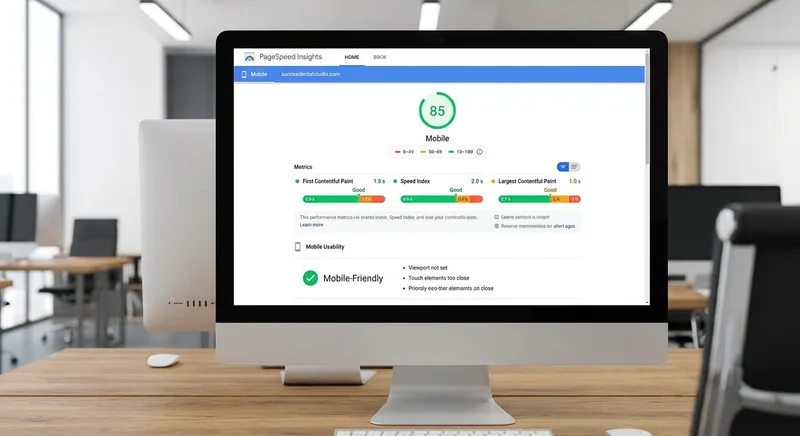
- Load speed: Test at Google PageSpeed Insights. A mobile score below 70 is a problem; below 50 is urgent. Consumers expect sites to load in 3 seconds or less per Google.
- Mobile rendering: Open your site on your phone. Can you see a phone number and booking option without scrolling? If not, most patients cannot either.
- Online scheduling: Can a patient pick a time and confirm without calling? If not, you're losing the 77% of patients who want that option (Zocdoc).
- Review visibility: Are patient reviews visible on the homepage or service pages? If absent, you're missing a primary trust signal for first-time visitors.
- Photography: Are photos of your actual team and office, or generic stock images? Real photos consistently outperform stock on conversion metrics.
- Last content update: When was a page last refreshed? Google favors actively maintained sites over stagnant ones.
Three or more failures signal that a redesign would produce measurable returns, lower bounce rates, more scheduling completions, and improved local search position. The dental marketing guide covers how to sequence a website rebuild with other growth channels. That way, the investment is supported by traffic from day one.
What accessibility standards apply to dental practice websites?
Dental practice websites are subject to Americans with Disabilities Act standards, and legal exposure from non-compliance has grown steadily. A dental website that fails WCAG 2.1 AA requirements can face demand letters from patients who cannot access content. Beyond legal risk, accessibility directly improves the experience for the 26% of US adults living with some form of disability.
WCAG 2.1 AA Requirements for Dental Websites
The requirements most relevant to a dental practice website:
- Alt text on all images, screen readers need descriptive text for every image, including team photos and before-and-after galleries
- Color contrast ratios, text must meet a 4.5:1 contrast ratio against its background; light gray text on white consistently fails this threshold
- Keyboard navigation, all interactive elements (menus, forms, scheduling buttons) must be reachable with a keyboard alone
- Form labels, every input field on contact and scheduling forms needs a visible, programmatically associated label
- Video captions, team introduction videos and any other video content must include captions for deaf and hard-of-hearing visitors
- Readable font sizes, body text at 16px minimum; layout must not break when users increase browser font size
The ADA provides patient access guidance applicable to dental practice digital properties. A dental website built to WCAG 2.1 AA also lays groundwork for HIPAA-conscious data handling on forms. Both frameworks prioritize deliberate design choices that protect patient access and privacy.
How does dental website design connect to your overall marketing strategy?
Dental website design is the conversion layer of the entire marketing strategy. Every ad, social post, and referral eventually lands on the website. A high-performing dental practice website turns that traffic into booked appointments; a weak one wastes the spend behind every other channel. The site is not a standalone asset; it determines whether everything else delivers a return.
What the site needs to do first also depends on the practice's stage: a startup needs a fast page with a working booking path, while a multi-location group needs location pages that stay consistent without going generic. Marketing priorities by stage of practice growth breaks down that progression.

How Website Design Impacts Each Marketing Channel
How a well-designed dental website amplifies each marketing channel:
- SEO:Dental SEO services build traffic, but organic visitors convert at 3.5% (WordStream) only when the landing experience matches search intent, a page that loads slowly or lacks scheduling drops that rate sharply
- Paid search: Dental keywords cost $6, $8 per click (Google Ads Benchmarks); a landing page that doesn't convert burns that budget without producing patients
- Social media: Patients who see your practice through social media management often visit the website before deciding, 41% of people say digital content influences their treatment choice, per PwC Health
- Referrals: Word-of-mouth referrals now almost always involve a website check; a dated site erodes the trust the referral created before the patient calls
- Reviews: Patients checking Google reviews frequently click through to the website immediately after, the site must sustain the confidence the reviews built
The online marketing guide for dentists covers how to align dental website design with the full channel strategy so each investment reinforces the others. Fix the website first. Every dollar of ad spend flows through it. A poorly converting site means every other channel underperforms regardless of budget. The DentalBase resources library includes checklists that help practice owners sequence digital investments based on current performance.
Related: These exact booking-flow fixes were part of a larger practice-wide turnaround. the case study behind these booking-flow conversion fixes →
See how DentalBase builds dental websites that convert
Mobile-first design, integrated scheduling, and local SEO structure, book a free demo to see the approach in action.
Book a Free DemoBrowse ResourcesSources & References
Frequently Asked Questions
Dental website cost typically ranges from $3,000 to $10,000 for a professionally designed site, plus $150, $500 per month for hosting, maintenance, and updates. Template-based builders run lower upfront but often require more owner time and limit custom functionality like integrated scheduling.
Every dental practice website should include online scheduling, a mobile-optimized layout, clear service descriptions, patient reviews, an easy-to-find phone number, and fast load speeds. HIPAA-compliant contact forms and accessibility compliance (ADA/WCAG 2.1) are also non-negotiable for most practices.
Most dental websites benefit from a full redesign every 3-5 years, or sooner if load times are slow, the design looks dated, or the site lacks mobile optimization and online scheduling. Minor content updates should happen continuously.
Google ranks dental websites based on page speed, mobile usability, structured data markup, local content relevance, and backlink authority. A technically clean dental practice website with location-specific service pages and consistent NAP data across directories has a strong ranking foundation.
Yes, practice owners can build a site using platforms like Squarespace or Wix, but the result usually lacks speed optimization, structured data, and scheduling integration that a professionally built dental website provides. DIY sites cost less upfront but typically underperform on search and conversion.
Was this article helpful?
Written by
DentalBase Team
Expert dental industry content from the DentalBase team. We provide insights on practice management, marketing, compliance, and growth strategies for dental professionals.