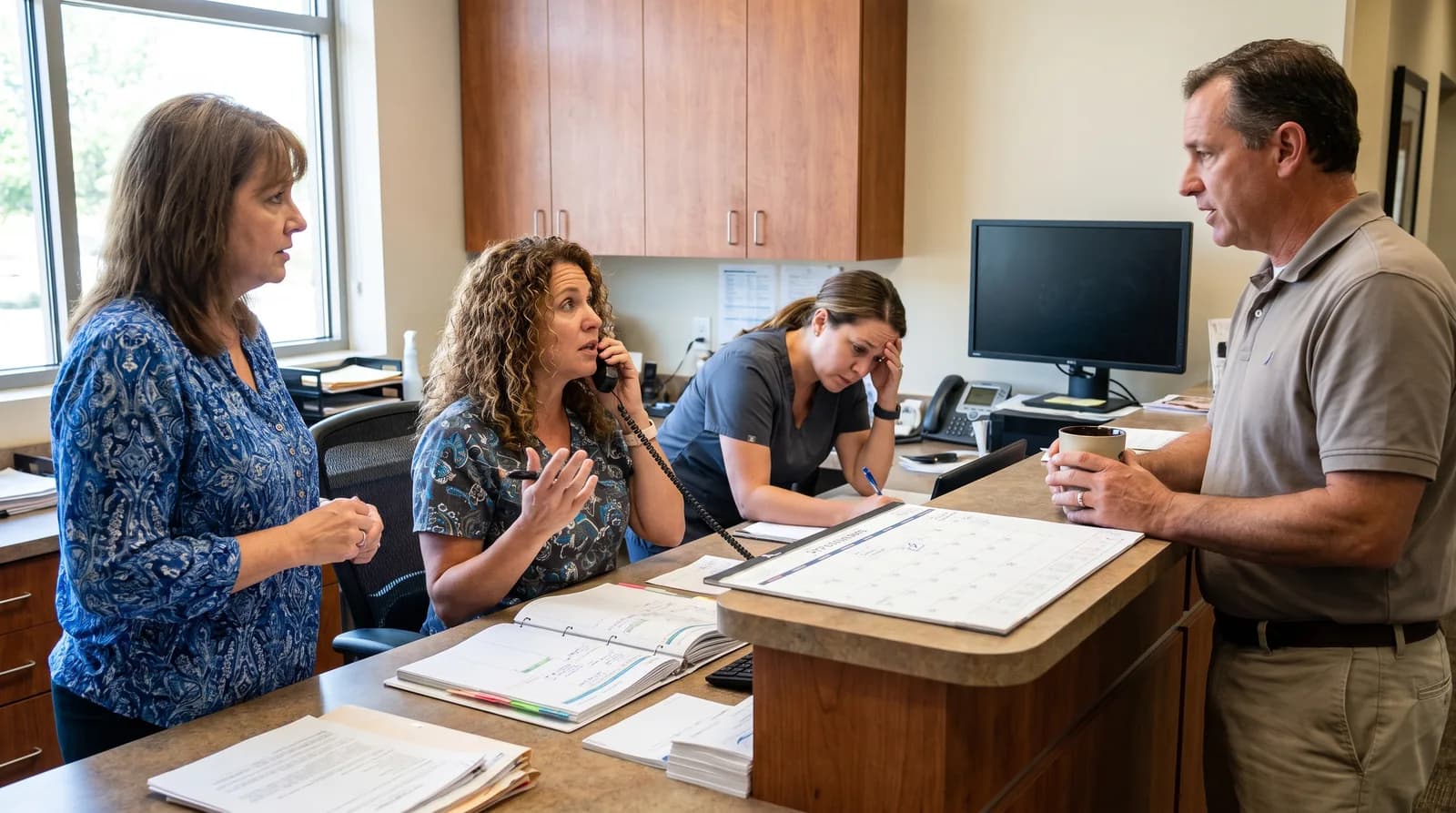
10 Fixes for a Dental Front Desk Team Drowning in No-Shows
A team drowning in no-shows can turn things around fast. See ten fixes, from reminder timing to AI confirmation, that recover lost chair time.
Share:
Table of contents
A team drowning in no-shows can fix most of the problem with better reminder timing, active confirmation, and a fast recovery workflow for the slots that still go empty. Every missed appointment costs staff time, supply prep, and a slot that could have gone to a patient who actually wanted it. No-shows are also one of the earliest warning signs inside a practice's dental patient retention rate, so tightening this workflow protects more than just today's schedule.
No-shows are not the only way a booked slot disappears. What a missed or after-hours phone call costs in lost production shows the other side of the same revenue leak, before a patient ever makes it onto the schedule.
The frustration compounds fast when it happens week after week. Most no-shows trace back to a small number of causes: forgetting, poor reminder timing, or patients who never felt truly committed to the appointment in the first place. If your practice works with DentalBase's practice growth services, DentiVoice can help close several of these gaps directly through consistent reminders and fast rebooking.
This guide covers ten fixes for a team drowning in no-shows, from reminder timing to confirmation policy.
Why do dental patients no-show even after booking an appointment?
Patients no-show most often because they simply forgot, not because they decided against the visit. A booking made weeks in advance is easy to lose track of without a strong reminder system in place.
A smaller share of no-shows come from patients who never felt fully committed at booking, often scheduled quickly over the phone without much thought. These two causes need different fixes, and lumping them together wastes effort on the wrong one.
Track the stated reason for every no-show for a month before assuming which cause dominates. Most practices are surprised by what the real pattern shows once they start recording it.
Ask the patient directly on the next call, without judgment, why they missed the visit. The honest answer, more often than not, is simply that the appointment slipped their mind entirely.
- Forgetting is the single largest driver, especially for bookings made weeks in advance.
- Poor reminder timing that arrives too early to be useful on the actual day.
- Low commitment at booking, often from a rushed phone scheduling call.
Does reminder timing actually reduce no-show rates?
Yes, reminder timing matters more than most practices realize. A single reminder sent a week out does little to prevent a forgotten appointment, since most patients need a nudge closer to the actual day to keep the visit top of mind.
SMS appointment reminders reduce no-show rates by roughly 38%, according to research from Imperial College London. A two-touch sequence, one reminder several days out and a second the evening before, catches both the planner and the patient who simply forgot.
Automated recall and reminder systems can also increase overall patient return rates by 25 to 40%, according to Dental Economics research. That reflects the same underlying pattern: consistent, well-timed contact changes behavior more than a single message ever could.
Related: Orthodontic offices see a version of this same pattern, just spread across an 18 to 30 month treatment arc instead of a single missed cleaning. See the orthodontic side of automated recall →
A third touch, sent the morning of, catches the small remaining group who missed both earlier messages entirely. This layered approach costs almost nothing beyond the initial setup of the sequence itself.
Want reminders and confirmations handled consistently?
DentiVoice can run a multi-touch reminder sequence for every booked appointment automatically.
See AI Receptionist →Related: Reminder timing is easier to judge against a worked example. Compare your timing against a four-touch reminder case study →
Should a practice require confirmation, not just send a reminder?
Yes, requiring an active confirmation, a tap or a reply, surfaces at-risk appointments early. That is enough time to fill the slot if the patient does not respond. A reminder tells the patient. A confirmation tells the practice something back.
Set a clear cutoff, such as 24 hours before the appointment, after which an unconfirmed slot gets offered to a waitlist. This turns a silent no-show into a recoverable gap instead of a surprise empty chair the next morning.
Make the confirmation itself effortless: a single tap or a one-word reply. Any friction in the process reduces how many patients actually respond in time to matter.
An unconfirmed appointment is not automatically a lost one. Treat it as a flag worth a follow-up call, not an assumption that the patient has already decided not to come. A brief personal call often clears up the confusion in under a minute, and it gives the front desk a chance to catch a genuine scheduling conflict before it turns into an empty chair.
The same "don't assume it's a no" principle applies to patients who go quiet right after a consult. See ten fixes for consults that never got a response.
How does same-day communication reduce no-shows?
A morning-of text or call catches a meaningful share of patients who would otherwise simply not show up. The appointment is fresh in mind, but still early enough to act on any last-minute concern.
HubSpot's marketing benchmark data consistently shows SMS getting opened within minutes for most recipients. That makes same-day text the fastest way to catch a patient before they forget to leave the house.
Keep the same-day message short and specific. Name the time and confirm the address, rather than sending a generic reminder that blends in with every other notification on their phone.
A quick, friendly tone works better here than a formal one. The goal is a gentle nudge, not a notice that feels like it is checking up on the patient. Something as simple as "see you at 2pm today" often does the job better than a longer, more formal message, and it takes the front desk seconds to send once the template exists.
For ready-made wording, our ChatGPT prompts for no-show and reschedule texts cover the same-day nudge, the second-attempt reschedule message, and the short-call fill-in text the front desk can send as-is.
Does a no-show fee actually change patient behavior?
A no-show fee can reduce repeat offenses from habitual no-shows. It rarely recovers the specific lost slot, though, and can damage goodwill with a patient who had a genuine emergency. A graduated policy tends to work better than a blanket fee.
Waive the fee for a first offense, communicate the policy clearly at booking, and apply it consistently after a second no-show within a defined window. This balances discouraging habitual no-shows against alienating a generally reliable patient who had one bad morning.
Put the policy in writing at booking, not as a verbal mention easily forgotten. A patient who sees the terms clearly upfront rarely disputes a fee applied fairly and consistently later.
| Offense | Typical policy | Why it works |
|---|---|---|
| First no-show | Waive the fee, send a friendly note | Preserves goodwill for a one-time lapse |
| Second no-show | Apply the stated fee | Signals the policy is real, not just a threat |
| Repeat pattern | Require prepayment or a deposit to rebook | Filters out consistently unreliable scheduling |
Want help building a fair no-show policy?
DentalBase can help design a graduated policy that protects revenue without alienating good patients.
See DentalBase Services →How quickly should a no-show slot get worked to recover it?
Work a no-show slot the moment it becomes clear the patient is not coming. Same-day openings fill dramatically faster within that early window than they do later in the day. Waiting until end of day almost guarantees the slot goes unfilled.
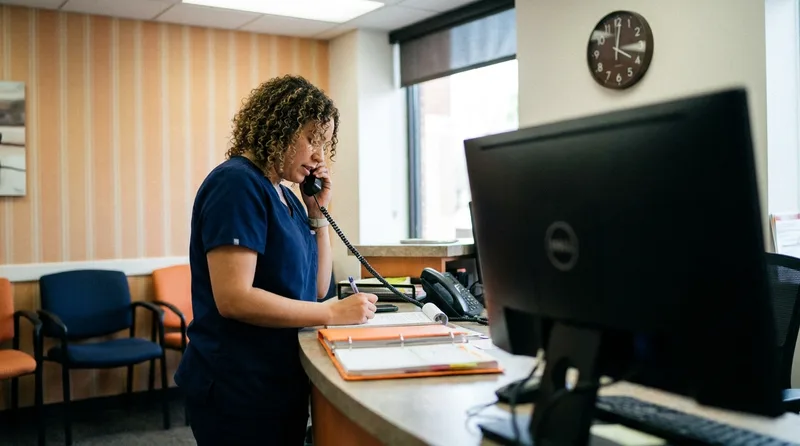
Keep a short-notice waitlist ready to text or call immediately, rather than starting from scratch each time. This single habit recovers more chair time than most of the other fixes on this list combined.
Build the list the same way as a cancellation waitlist, since the two share almost identical mechanics. A patient willing to come in on short notice for one is usually willing to do the same for the other.
Recall patients due soon and living close to the practice are especially good candidates for this list. They already have a reason to come in, with little added friction in doing so today instead of next week.
Does patient trust in the practice affect no-show rates?
Yes, patients who trust and feel connected to a practice show up more reliably than those who see the relationship as purely transactional. A patient who feels like just a number on a schedule has less incentive to prioritize the appointment.
BrightLocal's consumer research found that trust and convenience weigh heavily in how patients engage with a business. That same trust factor extends to whether a booked patient actually follows through and shows up.
A practice with strong, visible patient relationships tends to see a lower baseline no-show rate. A practice where most patients feel like an anonymous slot on a calendar sees the opposite.
Small habits build this trust over time. A genuine question at checkout, a follow-up note after a procedure, or remembering a detail from their last visit all count.
Related: Same-day cancellations and no-shows share several of the same recovery fixes. See our missed call solution guide →
What role does scheduling convenience play in no-show rates?
Appointments booked far in advance, with little flexibility to reschedule, show up as no-shows more often. Appointments booked closer to the visit, with an easy rebooking option, show up far less often. Rigid scheduling quietly increases the no-show rate over time.
ADA Health Policy Institute data shows 72% of patients rank convenience as a top factor in their care decisions. That extends naturally to whether they follow through on a booking that no longer feels convenient by the time it arrives.
Offer an easy self-service way to reschedule rather than requiring a phone call during business hours. Removing that friction keeps a shifting schedule from turning into a silent no-show instead.
A simple text-to-reschedule option lets a patient reply with a preferred new time. This removes the barrier of having to call during a workday when many patients simply cannot. This one change alone often converts a would-be no-show into a same-day reschedule instead.
What data should a practice track to reduce no-shows over time?
Track no-show rate by day of week, time of day, and appointment type. Averaging everything together hides which specific slot pattern is actually driving the problem. A Monday morning slot often behaves very differently than a Thursday afternoon one.
Google's own guidance on response consistency notes that steady, measured tracking outperforms reacting to isolated incidents. That pattern holds just as well for no-shows as it does for any other operational metric.
Review this data monthly with the full front desk team, not just leadership. Everyone should understand which specific pattern actually needs attention, rather than guessing based on how the last bad week felt.
A pattern that only shows up on Monday mornings might point toward weekend forgetting, rather than a general reminder problem. That distinction changes which fix on this list matters most. Adjust the reminder cadence specifically around whichever pattern the data actually shows, and revisit the numbers again after a full quarter to confirm the fix is actually holding.
Split hygiene recall out of that average as well. A practice-wide number treats a lapsed cleaning and a missed crown seat as the same event, and they are not. Here is why recall no-shows deserve their own metric and their own cadence.
Does the day or time of an appointment change no-show risk?
Yes, Monday mornings, the slot right after a holiday, and the first appointment of the day consistently run higher no-show rates than a Wednesday afternoon slot. Treating every time slot the same wastes reminder effort where it is least needed.
The pattern shows up across most practices for a simple reason: weekend routines disrupt the memory cues that keep an appointment top of mind. A patient who booked three weeks ago is more likely to forget a Monday 8 a.m. visit than a midweek one they scheduled around an existing routine.
Once the data from the previous fix identifies these higher-risk windows, add a third reminder touch specifically for them, or require confirmation a full 48 hours out instead of the standard 24. The goal is matching reminder intensity to actual risk, not applying the same light touch everywhere.
- Monday and post-holiday mornings warrant an extra reminder touch.
- First appointment of the day benefits from a same-day call, not just a text.
- New patient bookings made far in advance carry higher risk than existing patient recall visits.
Does overbooking high-risk time slots help offset no-shows?
Controlled overbooking of specifically high-risk slots, not the whole schedule, can offset predictable no-show loss without overwhelming the practice on days when everyone actually shows. Blanket overbooking across every slot creates the opposite problem: overcrowding when attendance is good.
This only works when it is targeted using the exact data pulled from tracking no-show patterns by day, time, and appointment type. A practice that knows its Monday 8 a.m. slot runs a 20% no-show rate can deliberately double-book that specific slot, while leaving a reliable Wednesday afternoon slot untouched.
Scheduling software with built-in no-show risk scoring, the kind covered in DentalBase's comparison of dental AI receptionist tools, can automate this targeting instead of relying on a front desk manager's memory of which slots run risky. Start conservative, overbook only the single highest-risk slot type, and expand only if the data supports it after a month of tracking results, adjusting the specific slot targeted as the pattern shifts over time.
How Does DentiVoice Help a Team Drowning in No-Shows?
DentiVoice can run a consistent, multi-touch reminder and confirmation sequence for every booked appointment. It never depends on a busy front desk to remember each one manually. Consistency is exactly where most manual reminder systems break down after the first few weeks.
Moz's research on consistency over time makes a related point in a different context. Steady, repeatable effort outperforms sporadic bursts, and a reminder system works the same way.
It also handles same-day rebooking calls for any confirmed no-show, closing the loop without staff having to scramble mid-morning. Freeing the front desk from this specific task lets them focus on patients already in the building.
A team drowning in no-shows rarely has one single fix. Reminder timing, active confirmation, fee policy, and fast slot recovery all address a different piece of the same underlying pattern.
- Track the real reason behind every no-show for at least a month.
- Send a two-touch reminder sequence, not just one message a week out.
- Require active confirmation, not a passive reminder alone.
- Send a same-day text or call as the final catch before the visit.
- Use a graduated no-show fee policy, not a blanket charge.
- Work a no-show slot immediately using a ready short-notice waitlist.
- Build genuine patient trust, since it correlates with reliability.
- Offer flexible rebooking so a stale appointment can move easily.
- Track no-show rate by day, time, and appointment type, then target extra reminders or careful overbooking at the riskiest slots.
- Use consistent reminder coverage like DentiVoice to run the system reliably.
Start with the reminder timing and confirmation fixes, since both are free to implement and address the two most common causes of a no-show.
Related: Tiering the overdue list is what keeps recall from becoming another impossible task. Build a tiered dental patient recall system your front desk can actually work →
See How DentiVoice Reduces No-Shows Automatically
Book a free demo to see reminder, confirmation, and rebooking workflows built into one system.
Book a Free Demo →Want more practice management guides like this one?
Browse Resources →Sources & References
Frequently Asked Questions
Most no-shows happen because the patient simply forgot, not because they decided against the visit. A booking made weeks in advance is easy to lose track of without a strong reminder system.
Yes, SMS appointment reminders reduce no-show rates by roughly 38%, according to research from Imperial College London. A two-touch sequence, several days out and the evening before, catches the widest range of patients.
Yes, an active confirmation like a tap or short reply surfaces at-risk appointments early enough to offer the slot to a waitlist. A passive reminder alone does not tell the practice anything back.
A graduated fee policy, waiving the first offense and applying it after a second no-show, reduces repeat offenses without alienating a generally reliable patient. A blanket fee applied to every situation tends to work less well.
As soon as it becomes clear the patient is not coming, since same-day openings fill dramatically faster within that early window. A ready short-notice waitlist recovers far more slots than starting from scratch each time.
Yes, DentiVoice can run a consistent reminder and confirmation sequence for every booked appointment without depending on a busy front desk. It also handles same-day rebooking calls for any confirmed no-show.
Yes, Monday mornings, post-holiday slots, and the first appointment of the day consistently run higher no-show rates. Adding an extra reminder touch or a stricter confirmation cutoff for those specific windows targets the effort where it matters most.
Only in a targeted way, overbooking just the specific slots the data shows run high no-show risk. Blanket overbooking across the whole schedule risks overcrowding on the days when every patient actually shows up.
Was this article helpful?
Written by
DentalBase Team
Expert dental industry content from the DentalBase team. We provide insights on practice management, marketing, compliance, and growth strategies for dental professionals.