Can DentiVoice Really Book Appointments Without Mistakes?
DentiVoice really can book appointments without the mistakes that quietly creep into a busy front desk's schedule. See exactly how it works.
Share:
Table of contents
DentiVoice really can book appointments without the mistakes that quietly creep into a busy front desk's schedule, from double bookings to a provider assigned the wrong appointment type. These errors are common, but rarely deliberate. We cover this and more in our complete guide to the DentalBase AI receptionist.
This piece looks specifically at how booking accuracy works, not just that it works. If your practice works with DentalBase's practice growth services, this level of accuracy is often what practices notice first once the system is live.
This guide covers how DentiVoice avoids common scheduling mistakes and what that actually looks like day to day.
What kinds of booking mistakes happen most at a busy front desk?
Common Types of Scheduling Errors
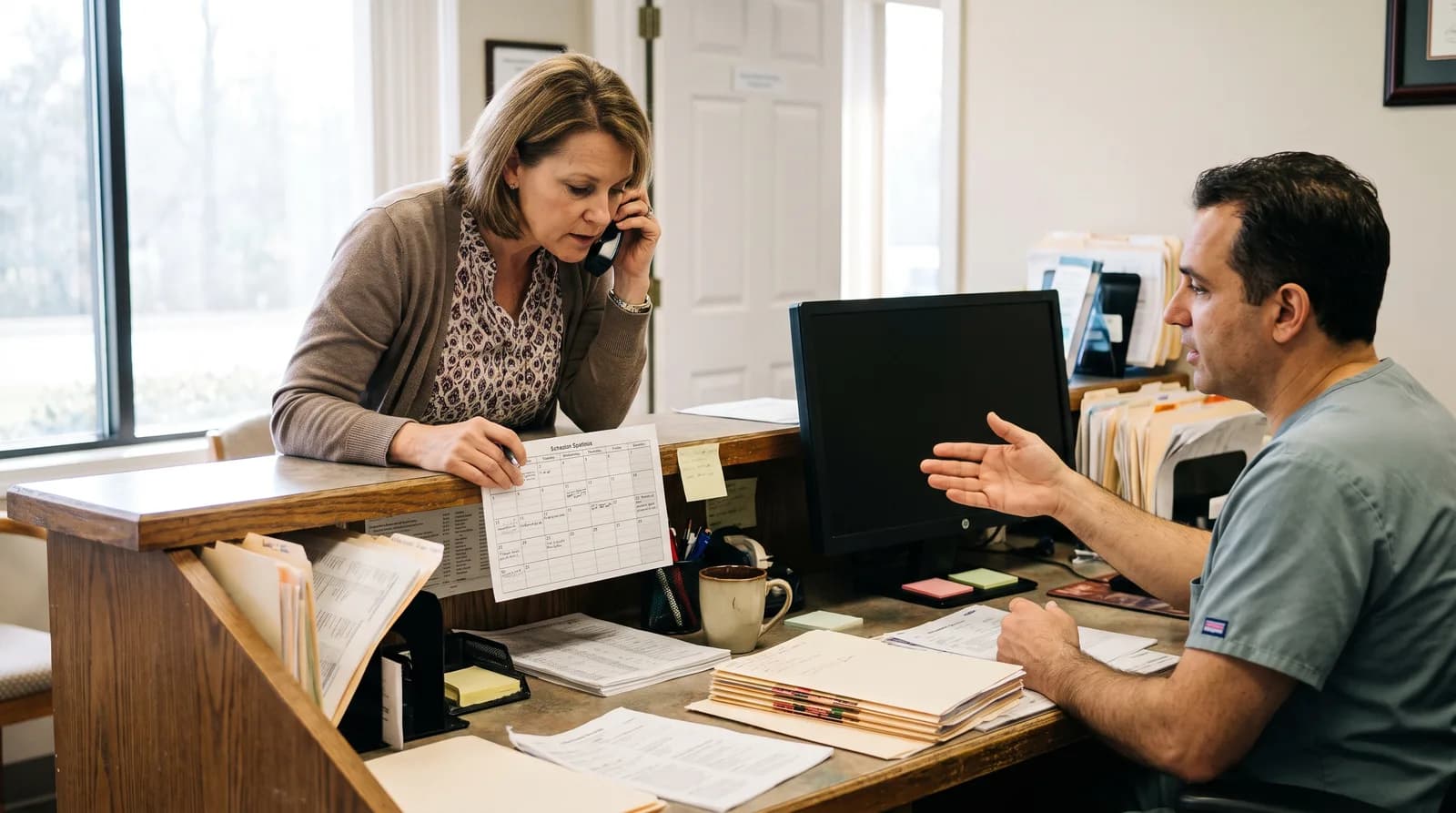
Double bookings, wrong appointment types, and incorrect provider assignments are among the most common mistakes, usually happening during a rushed moment rather than from any lack of skill or care.
- Double bookings when two patients are placed in the same slot by mistake.
- Wrong appointment type booked, leaving too little or too much time reserved.
- Incorrect provider assignment, especially at a multi-provider practice.
ADA Health Policy Institute data shows 72% of patients rank convenience as a top factor, and a scheduling mistake directly undermines that convenience the moment a patient discovers it.
BrightLocal's consumer research found that trust and reliability weigh heavily in how patients evaluate a business, and a scheduling mistake is exactly the kind of small failure that quietly erodes that trust.
Why These Mistakes Keep Happening
A big part of the pressure starts before any mistake happens. According to ADA Practice Transitions data, 38% of new patient calls go unanswered during business hours, so the front desk is often already stretched thin by the time a booking gets entered.
None of these mistakes are usually the fault of a specific person, but rather the natural result of a busy schedule and a growing number of details to track at once.
Removing that mental load entirely, rather than simply asking a person to be more careful, is what actually changes the error rate over time.
Asking people to simply try harder rarely fixes a structural problem, while removing the underlying source of the mistake actually does.
How does DentiVoice actually check availability before booking?
Real-Time Availability Checks Explained
DentiVoice checks live schedule data in real time before confirming any appointment, rather than working from a static or delayed copy of the calendar that might already be out of date.
This real-time check is what prevents the most common mistake of all: booking a patient into a slot that already has someone else in it because the schedule was not checked at the actual moment of booking.
A delayed or cached copy of the calendar is exactly what causes this problem for a human scheduler juggling multiple channels, and it is exactly what a real-time check avoids entirely.
What Real-Time Checking Prevents
- Double-booked slots caused by an outdated calendar view
- Overlapping appointments booked across different phone lines or channels
- Gaps that reopen the moment a cancellation isn't reflected instantly
Practices with online scheduling see 24% fewer no-shows, according to Dental Economics. That gap shows how much booking accuracy affects what actually happens on appointment day.

Matching Appointment Type to Actual Need
The system also confirms the correct appointment type and duration based on what the patient described needing, rather than defaulting to a generic slot length that may not fit the actual visit.
A cleaning booked as a shorter checkup, for example, quietly creates a scheduling conflict later that day once the actual visit runs longer than the slot allowed.
This attention to appointment type is one of the more subtle mistakes a rushed human scheduler makes, and it is exactly the kind of detail DentiVoice checks every single time.
A properly sized appointment slot protects the rest of the day's schedule too, since a booking that runs too short quietly creates delays for every patient after it.
A single mis-sized slot early in the day can cascade into delays for every subsequent appointment, which is why this specific detail matters more than it might initially seem.
Getting the appointment type right sometimes means recognizing when a virtual visit fits the described symptom better than a chair appointment at all, freeing that slot for a patient who actually needs it.
Want to see booking accuracy in action?
Book a demo to see how DentiVoice checks availability, type, and provider every time.
Book a Free Demo →Does DentiVoice reduce the risk of assigning the wrong provider?
How Provider Matching Rules Work
Yes, DentiVoice matches appointments to the correct provider based on rules the practice sets, whether that means a specific dentist, a hygienist, or whichever provider handles a particular procedure at that specific practice.
HubSpot's marketing benchmark data consistently shows that accuracy in service delivery correlates strongly with patient satisfaction, and correct provider assignment is a direct example of that accuracy in practice.
Why Multi-Provider Practices Benefit Most
- Different providers often handle overlapping but distinct procedures
- Hygienists and dentists may need separate scheduling rules
- A wrong-provider booking usually forces a full reschedule once caught
At a multi-provider practice, this matters especially, since a patient booked with the wrong provider often has to be rescheduled entirely once the mistake is caught later.
This is one of the clearest examples of how DentiVoice can book appointments without the specific mistake that costs both the practice and the patient real time later on.
Reactivating a patient who cancels after a scheduling mix-up costs 5 to 7 times more than the original booking would have. That figure comes from Harvard Business Review research on retention economics.
Multi-provider scheduling is often where the most complex rules live, since different providers may handle overlapping but slightly different sets of procedures.
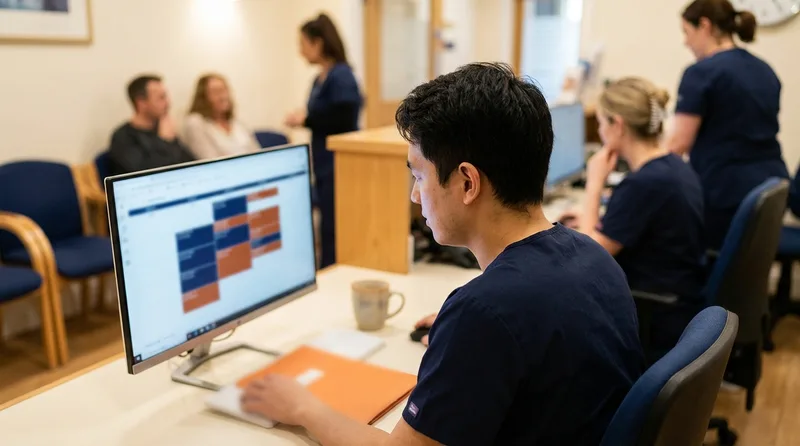
Catching this at the point of booking, rather than discovering it the day of the appointment, avoids the disruption and awkwardness of a last-minute correction.
A last-minute provider swap also affects the provider's own schedule, not just the patient's, so catching this early protects everyone's day, not just one appointment. Roughly 20 to 30% of new patients become inactive within 18 months without deliberate retention effort, according to industry estimates, and a poor first scheduling experience is one contributing factor worth avoiding.
Can DentiVoice confirm insurance details are correct at booking?
How Insurance Checks Happen During Booking
Yes, DentiVoice can confirm basic insurance information at the time of booking. Any mismatch gets flagged early rather than surfacing as a surprise once the patient arrives for their visit.
Google's own guidance on user experience emphasizes catching friction early rather than late. That principle applies directly to catching an insurance mismatch during booking instead of at check-in.
What This Does and Doesn't Replace
- Missing or outdated insurance details on file
- A plan that doesn't match what the practice accepts
- Coverage information the practice hasn't verified yet
This does not replace a full verification process. It does reduce the number of avoidable surprises that would otherwise show up only once the patient is already in the chair.
Fewer surprises at check-in also means a smoother morning for the front desk, since fewer appointments require an awkward, unplanned conversation about coverage.
This is a small detail on its own, but it compounds meaningfully across a full day of appointments where even one avoided conversation frees up real time.
The average cost to acquire a new dental patient through digital channels runs $150 to $300, according to WordStream. That is part of why catching a preventable insurance surprise before the visit protects that investment.
Multiply that saved time across an entire week of appointments, and the cumulative benefit becomes far more significant than any single avoided conversation on its own. Missed or miscounted details at booking can cost a practice over $1,200 in lifetime patient value per instance, according to ADA-cited estimates, which reflects how much a small early catch can actually protect.
How does DentiVoice handle a patient requesting a specific time?
Offering Real Alternatives Instead of a Single Slot
DentiVoice checks the requested time against real availability and offers the closest actual options if that exact slot is unavailable. It never defaults to whatever slot happens to be easiest to book.
This is the same underlying real-time check described earlier, just applied to a specific patient preference rather than a default scheduling decision made on their behalf.
Moz's guide to user experience covers how offering relevant alternatives, rather than a single rigid option, improves outcomes broadly. That pattern applies directly to scheduling conversations as well.
This keeps the booking process feeling responsive to the patient's actual preference. It never forces them into whatever slot is fastest for the system to fill. That same offer-a-few-options approach is exactly what works when a front desk tries to pre-book a patient's second visit before they leave, not just a new patient's first one.
Why Flexibility Reduces No-Shows
- Patients get options closest to their actual preference
- A workable time is easier to commit to and remember
- Fewer forced compromises mean fewer last-minute cancellations
SMS appointment reminders paired with a time the patient actually chose reduce no-show rates by 38%, according to a Journal of Dental Hygiene study. That reinforces how much the original scheduling experience matters. Booking accuracy reduces missed visits, though it never eliminates them, so pair it with how to recover a slot after a patient does not show.
A patient who feels genuinely accommodated during booking is also more likely to actually show up for the appointment they scheduled.
A time that actually fits someone's schedule, rather than one they reluctantly accepted, is simply easier to keep once the day of the appointment arrives.
This connects directly back to why DentiVoice can book appointments without the friction that often leads a patient to cancel or simply not show up at all.
Want fewer scheduling errors without adding staff?
See how DentiVoice checks live availability before confirming every appointment.
See AI Receptionist →What data should a practice track to confirm booking accuracy?
Metrics Worth Watching Closely
Track double-booking incidents, appointment type mismatches, and provider reassignment requests. A drop in all three numbers after adoption confirms the system is actually preventing the mistakes it was meant to catch, giving the practice a clear, measurable sense of the return.
How Often to Review the Numbers
Review this data during the first few months specifically. That period reveals whether the configuration matches how the practice actually schedules appointments day to day.
Any early mismatch is usually a quick configuration fix rather than a sign the underlying approach needs to change.
Most practices settle into a stable, accurate configuration within the first month, once the initial mapping has had a chance to be tested against real calls.
Real call volume tends to surface edge cases that were not obvious during the initial planning conversation, which is a normal part of any new system settling in properly.
Working through these edge cases early, rather than ignoring them, is what turns an initially rough configuration into one that runs smoothly for months afterward.
| Metric | What it reveals |
|---|---|
| Double-booking incidents | Whether real-time availability checks are actually working |
| Appointment type mismatches | Whether booked visits match the time actually needed |
| Provider reassignment requests | Whether patients are being matched to the correct provider |
Only 26% of practices currently offer online scheduling, according to Dental Economics. Tracking these numbers early can put a practice ahead of most competitors instead of playing catch-up.
Related: Booking accuracy pairs naturally with fixing gaps in front desk bandwidth. See our front desk bandwidth guide →
How Do You Book Appointments Without Mistakes Using DentiVoice?
Mapping Your Practice's Rules First
The best approach starts with mapping current scheduling rules, provider assignments, and appointment types into the system. DentiVoice then books exactly the way the practice already intends to schedule patients from day one.
DentalBase can help with this mapping directly, so the accuracy shows up from the very first appointment booked rather than needing weeks of correction afterward for the whole team.
This upfront investment in mapping is what separates a system that books appointments without mistakes from the very start, versus one that needs weeks of trial and error to get right.
That same mapping process extends beyond scheduling rules to the AI's tone, scripting, and triage decisions. Our guide on customizing dental voice AI to your practice's communication philosophy walks through what that deeper configuration looks like.
What Changes Once the System Goes Live
A well-mapped system also makes future adjustments easier, since the underlying rules are already documented clearly rather than existing only in someone's memory. This documentation also helps onboard a new front desk hire faster, since the scheduling logic exists in writing rather than in one person's head.
Average patient lifetime value for a general dentist runs $12,000 to $15,000, according to Dental Economics. Those stakes are why upfront mapping is worth the time it takes.
Most practices find this mapping process itself takes less time than expected, since the underlying scheduling rules already exist, they just need to be documented clearly.
For a broader look at cost, HIPAA compliance, and what else to evaluate, see our guide to AI dental receptionists for solo dentists.
DentiVoice really can book appointments without the mistakes that quietly slip into a busy schedule. The system checks live availability, appointment type, and provider assignment every single time, without the rush that causes most human error.
- Double bookings, wrong appointment types, and provider mix-ups are the most common mistakes.
- Real-time availability checks prevent the most frequent scheduling error of all.
- Provider assignment follows rules the practice sets, reducing costly reschedules.
- Basic insurance details get flagged early rather than surfacing at check-in.
- Patients receive relevant alternative times rather than a single rigid option.
- Track double bookings, mismatches, and reassignments to confirm accuracy.
Start by reviewing how often these specific mistakes happen today, since that number is the clearest baseline for measuring the improvement afterward.
See Error-Free Booking in Action
Book a free demo to see how DentiVoice checks availability, type, and provider on every call.
Book a Free Demo →Want to explore more DentiVoice features?
Browse Resources →Sources & References
Frequently Asked Questions
Yes, DentiVoice checks live availability, appointment type, and provider assignment every time it books, without the rush that causes most human scheduling errors at a busy front desk each day.
DentiVoice checks live schedule data in real time before confirming any appointment, rather than working from a static or delayed copy of the calendar that might already be outdated by the time of booking.
Yes, DentiVoice matches appointments to the correct provider based on rules the practice sets, whether that means a specific dentist, hygienist, or whoever handles a particular procedure at that practice.
Yes, DentiVoice can confirm basic insurance information at booking, flagging any mismatch early rather than letting it surface as a surprise once the patient arrives for the actual appointment that day.
DentiVoice checks the requested time against real availability and offers the closest actual alternatives, rather than defaulting to whatever slot happens to be easiest for the system to fill quickly.
Track double-booking incidents, appointment type mismatches, and provider reassignment requests. A drop in all three after adoption confirms the system is preventing the mistakes it was specifically meant to catch.
Was this article helpful?
Written by
DentalBase Team
Expert dental industry content from the DentalBase team. We provide insights on practice management, marketing, compliance, and growth strategies for dental professionals.