
How DentiVoice Answers Every Dental Call, Day or Night
DentiVoice answers every dental call, day or night, so a practice never loses a patient because nobody was available to pick up.
Share:
Table of contents
DentiVoice answers every dental call, day or night, so a practice never loses a patient simply because nobody was available to pick up the phone. Missed calls are one of the most common and most expensive gaps in dental practice growth. If you're weighing this against the bigger picture, our full guide to AI receptionists for dental practices covers pricing, integrations, and what to expect.
This piece explains how DentiVoice handles round-the-clock answering specifically, from a busy weekday afternoon to a call that comes in well after the office has closed. If your practice works with DentalBase's practice growth services, this capability is often the first thing practices notice once it is in place.
This guide covers how 24/7 answering actually works, what it sounds like to a caller, and where it fits into a broader growth plan.
Why does answering every call actually matter for a dental practice?
Every missed call represents a patient who may simply call the next practice on their list instead of trying again later, since most people expect an answer on the first attempt.
Which calls slip through most often?
- After-hours calls that go straight to voicemail and are never returned quickly.
- Overflow calls during peak hours when the front desk is already occupied.
- Lunch-hour calls that arrive when nobody is available to answer at all.
Voicemail is usually where all three of those gaps end up. For the mechanics of how AI reception cuts down missed calls and voicemail overflow, see the full breakdown of what happens once those calls stop going unanswered.
What does a missed call actually cost a practice?
ADA Health Policy Institute data shows 72% of patients rank convenience as a top factor in their care decisions, and answering the phone promptly is one of the most direct ways to deliver that convenience. Missed or miscounted calls alone can cost a practice over $1,200 in lifetime patient value per instance, according to ADA-cited estimates, which underscores how much a single missed call can quietly cost.
The scale of the problem shows up in the raw numbers too. According to Dental Economics, the average dental practice misses 15 to 20 calls every week, and ADA Practice Transitions data puts the miss rate even higher: 38% of new patient calls go unanswered during business hours. Weave Communications research adds a blunt follow-on point: if a call goes unanswered, most patients simply contact another practice instead of trying again.
A missed call is rarely a one-time loss either, since that same patient often represents years of future visits, cleanings, and referrals the practice never gets the chance to earn.
DentiVoice closes this specific gap by making sure the phone is always answered, regardless of what time it rings or how busy the front desk happens to be at that moment.
DentiVoice answers every dental call precisely because that consistency is what turns a missed opportunity into a booked appointment, not a one-time fix but an ongoing habit built into the system itself.
Related: 24/7 call answering is one of the clearest examples of a trend worth real budget going into next year. Read the full 2027 dental marketing trends breakdown →
What happens when DentiVoice answers every dental call after hours?
DentiVoice answers the call exactly as a live receptionist would, gathering the reason for the call, checking availability, and either booking an appointment or capturing the details for a callback the next morning.
How does a typical after-hours call unfold?
- Gathers the reason for the call so nothing gets lost between the caller and the schedule.
- Checks real availability against the practice's actual calendar, not a generic slot.
- Books the appointment directly or captures full callback details for the next morning.
The conversation covers the same ground a human receptionist would, working through the same questions in roughly the same order a patient already expects from a scheduling call.
The caller is never routed to a generic voicemail box that leaves them uncertain whether anyone will actually call back, which is often what causes a patient to simply hang up and call elsewhere instead.
That uncertainty is often the real reason a missed call becomes a lost patient, not the missed call itself but the lack of any clear next step afterward.
For a caller with a genuine clinical question rather than a scheduling need, the clear next step is often a virtual triage visit the next morning, rather than waiting for the first available chair opening.
After-hours calling, by the numbers
27%
of total patient call volume happens after hours (Dental Economics)
15, 20
calls the average practice misses every week (Dental Economics)
80%
of voicemail callers never leave a message or call back (Forbes)
What happens in a true emergency?
For a genuine emergency, DentiVoice can follow the specific escalation rules a practice sets, whether that means texting the on-call dentist or providing guidance until the office reopens.
This means a patient dealing with sudden pain at night still gets a clear, useful response rather than an automated message with no real next step.
This means a call at 9 p.m. gets the same quality of response as a call at 9 a.m., which is not something a human-only front desk can realistically promise.
Patients researching or calling a dental practice do not necessarily limit that search to business hours, and a system that answers consistently captures demand a traditional front desk simply cannot cover alone.

Staffing a live receptionist around the clock is rarely practical for most practices, which is exactly the gap this kind of always-on coverage is designed to fill.
Want to see how DentiVoice handles calls for your practice?
Book a demo to hear real call examples and see the setup process.
Book a Free Demo →How does DentiVoice handle a busy moment during regular hours?
DentiVoice picks up overflow calls the moment the front desk is already on another line, so a patient calling during a busy stretch never simply hears ringing until they give up and hang up.
Why does response speed matter so much?
- Lunch-hour coverage when the entire front desk may be away from the phones at once.
- Morning rush when several patients call to confirm or reschedule the same appointments.
- Multiple lines ringing during insurance season or after a marketing campaign drives a spike in calls.
Patience runs out faster than most practices expect. Marchex research puts the average hold time before a patient hangs up at just 90 seconds, and Forbes data shows 80% of callers who land in voicemail never leave a message or call back at all.
HubSpot's marketing benchmark data consistently shows that response speed correlates strongly with conversion. A call answered on the first ring converts at a meaningfully higher rate than one left ringing.
The front desk stays focused on the patient physically in front of them, while DentiVoice handles the caller who would otherwise be stuck waiting or hitting voicemail during that same busy window.
This overflow handling is often where practices notice the clearest, fastest return, since lunch hours and peak morning call volume are exactly when missed calls happen most. BrightLocal's consumer research found that convenience and responsiveness weigh heavily in how patients evaluate a business, reinforcing why this specific window matters so much.
A practice that closes this specific gap often notices the difference within the first few weeks, since overflow calls are usually frequent enough to show up quickly in the data.
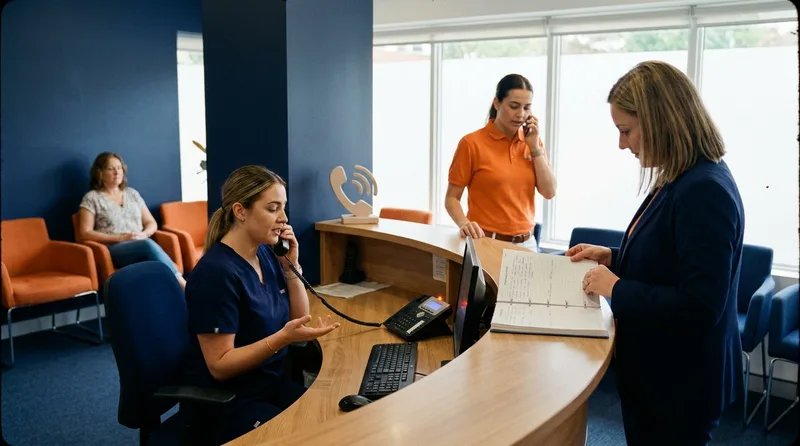
Does DentiVoice sound noticeably different from a live receptionist?
Most callers do not notice a meaningful difference in a typical scheduling or information call. DentiVoice is built to hold a natural, conversational exchange rather than following a rigid script.
Moz's guide to user experience covers how natural, low-friction interactions consistently outperform rigid, scripted ones. DentiVoice is built around this same principle directly for phone conversations.
How is the system configured to match a specific practice?
The system is configured with the practice's own tone, terminology, and specific policies. It reflects how that particular practice actually talks to patients rather than sounding generic.
- Tone and pacing that match how the front desk already greets and reassures patients.
- Practice-specific terminology for procedures, insurance questions, and scheduling policies.
- Escalation phrasing so a handoff to a live team member feels seamless, not abrupt.
Two practices using the exact same underlying technology can sound noticeably different to their callers, precisely because each configuration reflects that specific practice's own voice and approach.
How do practices verify call quality?
Practices can review real call transcripts and recordings, which makes it easy to confirm the experience actually matches what they expect a patient to hear.
Most practices review a handful of these transcripts during setup, then check back periodically once the system has been running for a while.
This kind of ongoing visibility builds confidence with the team over time, since anyone can listen to a real example rather than simply trusting a description of how the system works.
This transparency also makes it simple to adjust tone or specific phrasing over time, rather than treating the initial setup as a fixed, unchangeable configuration.
Can a practice control which types of calls DentiVoice handles?
Yes, a practice sets the specific rules for what DentiVoice handles directly versus what gets escalated to a live team member. Sensitive or complex calls still reach a human when that makes more sense.
Google's own guidance on user experience emphasizes matching the response to the actual need. That principle applies directly to deciding which calls a system like this should take versus route elsewhere.
Which calls get handled directly versus escalated?
Routine scheduling, rescheduling, and general questions are typically handled directly. Clinical questions or unusual situations can be routed to the team based on rules the practice defines upfront.
- Handled directly: new appointment requests, rescheduling, office hours, and insurance basics.
- Escalated to the team: clinical symptoms, billing disputes, and anything the practice flags as sensitive.
This flexibility means the system adapts to how a specific practice actually wants calls handled. It never forces a one-size-fits-all approach onto every single call that comes in.
A larger multi-provider practice, for example, might route more calls to a live team than a smaller single-dentist office would, and both configurations are equally valid starting points.
That flexibility comes from configuration, not guesswork. For a closer look at how those rules get set to match a specific office's tone and triage priorities, see our guide to building a customized dental voice AI around your practice's own philosophy.
How do these rules evolve over time?
Practices can adjust these rules over time as well, refining which calls get escalated based on what actually works once the system has been live for a while.
This kind of ongoing tuning is part of why the setup process rarely feels final, since a practice's own preferences often sharpen after seeing a few weeks of real calls.
Want to reduce missed calls without adding staff?
See how DentiVoice answers every call so your team stays focused on patients in the office.
See AI Receptionist →Answering every call also means answering it in the right language and under the right state rules. Both vary by market, and both decide whether a caller books or hangs up. Our guide to an AI receptionist for dental practices in Maryland covers multilingual booking, federal-employee and Medicaid plan questions, and the state's recording-consent requirement.
What data should a practice track to see 24/7 answering working?
Which three numbers matter most?
Track total calls answered outside normal business hours, appointments booked from those specific calls, and average time to pick up during peak hours. These numbers reveal the direct impact of always-on answering.
How often should a practice review this data?
Review this data monthly alongside overall new patient numbers. A rising after-hours booking count is one of the clearest signs this capability is actually converting missed opportunities into real patients.
A steady or growing number here over several months confirms the system is working as intended, not just occasionally catching a stray call that would have otherwise been missed.
These same three numbers also make it easy to demonstrate the value of this capability to anyone on the team who was initially skeptical about adopting it.
| Metric | What it reveals |
|---|---|
| After-hours calls answered | Volume of demand that previously went straight to voicemail |
| Bookings from after-hours calls | Whether that answered volume converts into real appointments |
| Average pickup time during peak hours | Whether overflow handling is closing the busy-hour gap |
Related: Missed calls are one of the clearest signs a front desk is stretched thin. See our front desk bandwidth guide →
How Do You Actually Get Started With 24/7 Call Answering?
Getting started involves reviewing current call volume and missed-call patterns first. From there, DentiVoice is configured around the specific hours, escalation rules, and tone a practice already uses with patients.
What happens after the system goes live?
DentalBase can help with this setup directly, so the system reflects how a specific practice actually operates from the very first call it ever answers.
Most practices find the setup process itself takes far less time than expected, since much of the configuration draws directly on information the practice already has on hand.
Once live, the system continues improving as staff review transcripts and adjust rules, so the setup is really the beginning of an ongoing relationship rather than a single fixed configuration that never changes.
DentiVoice answers every dental call, day or night, closing one of the most common and expensive gaps in how a practice grows. A missed call rarely announces itself as a loss, but the pattern shows up clearly once tracked.
- Every missed call risks losing a patient to a competitor who does answer.
- After-hours calls receive the same quality of response as calls during business hours.
- Overflow during busy periods gets picked up without adding to a strained front desk.
- The system is configured to match a specific practice's tone and policies.
- Practices control which calls get handled directly versus escalated to a person.
- Track after-hours volume and bookings to see the direct impact over time.
Start by reviewing current missed-call volume, since that number alone often reveals how much opportunity 24/7 answering could realistically recover.
Solo practitioners weighing this decision can find pricing tiers, HIPAA questions to ask, and feature priorities in our AI dental receptionist guide for solo dentists.
See DentiVoice Answer Calls Around the Clock
Book a free demo to see exactly how DentiVoice handles calls day and night.
Book a Free Demo →Want to explore more DentiVoice features?
Browse Resources →Sources & References
Frequently Asked Questions
DentiVoice answers the call exactly as a live receptionist would, gathering the reason for the call and either booking an appointment or capturing details for a callback. Emergencies follow rules the practice sets.
Most callers do not notice a meaningful difference in a typical call, since DentiVoice holds a natural, conversational exchange configured with the practice's own tone and specific policies rather than a generic script.
Yes, DentiVoice picks up overflow calls the moment the front desk is on another line, so a patient never simply hears ringing until they give up and hang up during a busy stretch.
Yes, a practice sets specific rules for what gets handled directly versus escalated to a live team member. Routine scheduling is typically handled directly while unusual situations route to the team.
DentiVoice follows the specific escalation rules a practice sets, whether that means texting the on-call dentist or providing guidance until the office reopens, rather than leaving the caller with no clear next step.
Track total calls answered outside business hours, appointments booked from those calls, and average pickup time during peak hours. A rising after-hours booking count signals the capability is converting missed opportunities.
Was this article helpful?
Written by
DentalBase Team
Expert dental industry content from the DentalBase team. We provide insights on practice management, marketing, compliance, and growth strategies for dental professionals.