
DentalX AI and the Dental Software Landscape Explained
See where DentalX AI fits among dental billing, EHR, scheduling, and IT support tools, and how to evaluate the full software stack.
Share:
Table of contents
DentalX AI keeps showing up in searches when practice owners look for AI dental software, right alongside a dozen billing, scheduling, and patient communication tools promising to fix the same problems. DentalBase's full range of services covers a different slice of that stack, the marketing and patient communication side, which is exactly where the confusion usually starts. Practices researching DentalX AI often end up comparing five or six separate systems at once: billing, EHR, scheduling, insurance claims, and IT support, each with its own vendor and its own learning curve.
Here's the problem. Most software searches start with a brand name, but the real decision is about categories. A tool that automates phone calls still leaves you needing a system for insurance claims. One that fixes scheduling still needs someone answering the phone after 6pm.
This guide breaks down what DentalX AI and similar products actually do, walks through the software categories dental offices run alongside them, and gives you a framework for deciding what belongs in your practice.
What Is DentalX AI?
DentalX AI is a branded AI dental software product that U.S. dental offices search for while comparing automated front-desk and practice management tools. It sits in the same category as AI receptionist and practice-technology platforms, built to handle tasks like patient communication or scheduling automatically.

Products branded around "AI" have multiplied fast in dental software. According to Dental Economics, 73% of dental practices plan to adopt AI tools by 2027, which means the number of "X AI" products competing for a practice's attention will only grow. The label tells you almost nothing about what a tool actually does day to day. Two products can both call themselves AI dental software while solving completely different problems: one might handle inbound calls, another might just flag no-show risk in a report.
Before you evaluate DentalX AI or any similarly named product, ask what specific task it automates, whether it connects to your existing practice management software, and whether pricing is published or requires a sales call to find out.
What Categories of Dental Software Actually Exist?
Dental office software splits into roughly six categories: practice management or EHR, billing and accounting, patient communication and scheduling, insurance claims processing, IT support, and payment plan or contract systems. Most practices run tools from at least four of these categories at once.
Confusing these categories is the most common mistake practice owners make when shopping for "dental software." A scheduling app doesn't process claims. A billing platform doesn't answer your phones. Choosing between them starts with understanding what each one is actually built to do, the same way Moz's guide to search fundamentals treats ranking factors as separate, specific mechanisms rather than one big black box.
- Practice management / EHR: patient charts, treatment plans, imaging
- Billing and accounting: invoicing, reimbursement tracking, reporting
- Patient communication and scheduling: reminders, online booking, call handling
- Insurance claims processing: eligibility checks, claim submission, denials
- IT support: networking, HIPAA-compliant data storage, hardware
- Payment plans and contracts: in-house financing, membership billing
Map your practice against this list before comparing any single vendor. If you can't name which category a tool falls into, you can't judge whether it duplicates something you already own.
Dental Billing and Accounting Software
Dental billing software manages invoicing, insurance reimbursement tracking, and financial reporting for a practice. A dental billing company can run this work as an outsourced service instead of software your staff operates directly, which matters for smaller offices without a dedicated billing coordinator.
Reimbursement is where most billing headaches start. Claims get denied for coding errors, missing attachments, or eligibility mismatches, and every denial adds days to your cash cycle. Some practices handle billing entirely in-house with dedicated software. Others hire a dental billing company that specializes in resubmissions and appeals, trading a monthly fee for faster collections. Neither approach is inherently better; it depends on staff bandwidth and claim volume.
A three-provider practice submitting 150 claims a week needs a different billing setup than a solo dentist submitting 20. Match the tool, or the outsourced service, to your actual claim volume rather than picking whatever a sales rep pitches hardest.
How Does Dental Insurance Claims Processing Software Work?
Dental insurance claims processing software checks patient eligibility, submits claims electronically to payers, and tracks reimbursement status until payment lands. It replaces manual claim entry and phone-based eligibility checks with automated verification and status tracking.
The biggest time cost in claims work isn't submission, it's follow-up. A claim that gets kicked back for a missing X-ray or wrong procedure code can sit unresolved for weeks if nobody catches it early. Automated verification tools flag eligibility problems before the appointment even happens, which cuts denials at the source rather than fixing them after the fact. For a deeper walkthrough of how this process works end to end, see this guide to automated dental insurance verification.
Look for claims software that integrates with your existing PMS rather than requiring double data entry. Manual re-keying is where most claim errors originate in the first place. A denied claim resubmitted within a week gets paid far more often than one that sits untouched for a month, so speed matters as much as accuracy here.
Dental Patient Communication and Online Scheduling Tools
Dental patient communication software handles appointment reminders, recall messages, and two-way texting, while online scheduling tools let patients book appointments without calling the office. Together, these systems reduce no-shows and free up front-desk staff from repetitive phone work.
The gap between what patients want and what practices offer here is wide. 77% of patients want online booking capability, according to Zocdoc data, yet only 26% of practices currently offer online scheduling, per Dental Economics. That gap is a lost-patient problem, not just a convenience problem. Practices that added online scheduling saw 24% fewer no-shows, and separately, ADA Health Policy Institute research shows that 38% of new patient calls go unanswered during business hours. A caller who can't get through and can't book online usually just calls the next practice on the list. Trust follows the same pattern: BrightLocal's consumer review research finds that most patients read local reviews before choosing a business, so a bad scheduling experience gets noticed fast.
If missed calls are part of the problem, that's a different tool than a scheduling app. DentiVoice, DentalBase's AI receptionist, answers and books calls automatically instead of routing them to voicemail.
Missed calls cost more than a scheduling app can fix.
DentiVoice answers patient calls, books appointments in your PMS, and handles rescheduling around the clock.
See How It Works →Is Free or Cheap Dental Practice Management Software Worth It?
Free dental practice management software can work for a solo practice with light claim volume and no multi-provider scheduling needs, but it usually trades a lower price for weaker reporting, fewer integrations, and slower support. Cheapest isn't the same as the right fit.
The real cost of "free" software often shows up in staff time. A tool with no automated claims checking might save $200 a month on paper, then cost your billing coordinator three extra hours a week chasing denials manually. Before searching for the cheapest dental software, calculate what a feature gap will cost in hours, not just dollars. A full 36-month cost comparison, including the hidden costs free tiers tend to leave out, is worth running before you commit to any plan.
If you're searching "dental software management near me," you're likely looking for local implementation support rather than the software itself. Ask any vendor, free or paid, whether onboarding and data migration are included or billed separately.
Related: A full breakdown of cloud versus server costs and a 90-day evaluation plan is available in our practice management software guide Read the full guide →
What Is Dental EHR Software and Why Does It Matter?
Dental EHR software stores patient charts, treatment histories, imaging, and clinical notes in a single digital record. It's the backbone of dental clinic management, since billing, scheduling, and claims tools all pull data from whatever EHR or PMS a practice runs.
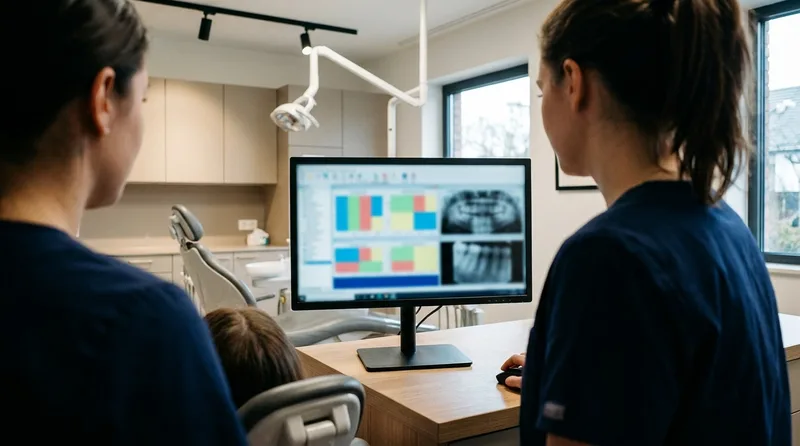
This is where integration becomes the deciding factor, not features. If you already run practice management software such as Open Dental or Curve Dental, any new billing or communication tool needs to sync cleanly with that system or you'll end up re-entering the same patient data twice. That duplication is where most software rollouts quietly fail, not at launch but three months in when staff start skipping the extra data entry step.
Before adding any new tool to your stack, confirm the integration exists today, not on a roadmap. "Coming soon" integrations have a way of staying that way for a year or more. Ask the vendor for a reference practice using the exact integration you need, not a general customer list.
In-House Payment Plans and Patient Contract Systems
In-house payment plan software lets a dental office finance treatment directly with patients instead of routing them through a third-party lender, using a dental patient contract system to track payment schedules and balances automatically.
Offering in-house financing can convert treatment-plan hesitation into a scheduled procedure, especially for larger cases like implants or full-mouth reconstruction where sticker shock stalls a decision. Without contract software, though, tracking who owes what and when becomes a spreadsheet nightmare fast. A patient contract system automates the payment schedule, sends reminders, and flags missed payments before they turn into a collections problem.
Not every practice needs this. If your patient base rarely needs financing beyond insurance, a full in-house payment system may be overhead you don't need yet. Weigh setup time against how often large treatment plans actually come up in your schedule before committing to a new contract system.
Do Dental Offices Need Dedicated IT Support?
Yes, most dental offices need some form of dedicated IT support because HIPAA-compliant data storage, networked imaging equipment, and multiple integrated software systems all require maintenance that front-desk staff aren't trained to handle.
Dental IT support covers more than fixing a slow computer. It means keeping patient data encrypted and backed up, managing network access across operatories, and troubleshooting when your PMS, billing software, and scheduling tool stop talking to each other. Staffing this internally is expensive for a small practice; BLS occupational data shows how tight the broader dental support labor market already is, which is why many offices contract dedicated dental business support services instead of hiring a full-time IT employee. Front desk turnover compounds the problem, since a trained staff member leaving often means the practice loses whoever understood how all these systems fit together.
Ask any IT support provider how quickly they respond when your imaging system goes down mid-appointment. That response time matters more than the monthly rate.
How Does DentalX AI Compare to Other Dental Software Categories?
DentalX AI, like most AI-branded dental tools, automates a narrow slice of practice work rather than replacing the full software stack. It should be evaluated against the single category it competes in, not treated as an all-in-one replacement for billing, EHR, or claims software.
This is the same comparison DentalBase has run against other AI-labeled competitors. Our DentalBase versus Dentina AI comparison breaks down PMS integration specifics for one such head-to-head. The pattern holds broadly: a tool's "AI" label says nothing about its scope. Search behavior is shifting too. According to Search Engine Land, AI Overviews now appear in more than 60% of all searches, and Google's own SEO starter guide emphasizes structured, specific content over vague claims, which is exactly the standard any AI dental product should be judged against: what does it specifically do, for whom, and at what integration cost.
- Ask which single category the tool competes in (billing, scheduling, EHR, or communication).
- Confirm what practice management systems it integrates with today.
- Request pricing in writing before a demo call, not after.
Choosing the Right Mix of Apps for Your Practice
The right mix of dental apps for dentists covers practice management, billing, patient communication, and IT support without duplicating functions across tools. There's no single most popular dental software that fits every practice; the right stack depends on provider count, claim volume, and patient communication needs.

Practices searching for "help with dental office software" are usually trying to fix one specific pain point, like missed calls or slow reimbursement, not looking to replace their entire stack. Start there. Identify the one category causing the most daily friction, fix it, then move to the next category rather than replacing everything at once.
| Category | Primary Job | Common Vendors |
|---|---|---|
| PMS / EHR | Charts, imaging, treatment plans | Dentrix, Open Dental, Eaglesoft, Curve Dental |
| Billing / Claims | Reimbursement, denials, reporting | Dedicated billing software or outsourced billing companies |
| Patient Communication | Calls, reminders, online booking | DentiVoice AI receptionist, scheduling apps |
| IT Support | Network, HIPAA storage, hardware | Managed IT providers, dental business support services |
DentalBase's AI receptionist handles the patient communication row above. It's built to sit alongside your existing PMS and billing tools, not replace them, which is worth remembering the next time an "AI" product promises to do everything at once.
Related: The staffing pressure behind most IT and front-desk gaps is covered in our piece on the dental front desk staffing crisis Read the staffing breakdown →
Bringing It Together
DentalX AI is worth researching, but only as one piece of a much bigger software decision. The practices that end up frustrated with their tech stack usually bought based on a brand name, not a category, and discovered the gap three months in.
Start by naming your single biggest friction point this month, whether that's missed calls, slow claims, or scheduling gaps, and evaluate one tool against that specific job. Get the integration details in writing before you sign anything, and confirm what happens to your data if you switch vendors later.
Book a free demo to see how DentiVoice handles the patient communication side of that stack while your other software keeps doing its job.
See DentiVoice in Action
Book a free demo and see how AI receptionist coverage fits alongside your existing dental software stack.
Book a Free Demo →Want more guides like this on evaluating dental practice software?
Browse Resources →Sources & References
Frequently Asked Questions
DentalX AI is a branded AI dental software product associated with automating front-desk or practice management tasks. Like most AI-labeled tools, its exact scope varies, so confirm the specific tasks it automates and its PMS integrations before comparing it to other software.
No, DentalX AI and general dental practice management software aren't automatically the same category. Practice management software typically covers charting and scheduling broadly, while AI-branded tools often automate one narrower task, such as call handling or communication.
There's no single cheapest option that fits every practice, since pricing depends on provider count and features included. Free or low-cost tiers often cost more in staff hours through weaker automation, so compare total 36-month cost, not just the sticker price.
Yes, billing and scheduling are typically handled by separate systems, even when they integrate with the same PMS. Billing software manages claims and reimbursement, while scheduling tools handle appointment booking and reminders, and few products do both well.
Dental insurance claims processing software checks patient eligibility, submits claims electronically, and tracks reimbursement status automatically. It reduces manual data entry and catches eligibility problems before an appointment, which cuts denials at the source.
No, DentalBase is an AI-powered marketing and patient communication platform, not a practice management system or clinical charting tool. It's built to integrate with your existing PMS, handling calls and marketing rather than replacing your core software.
Most small dental offices need at least part-time IT support for HIPAA-compliant data storage, networked imaging, and software integrations. Many contract a managed IT provider rather than hiring full time, since in-house IT staff are expensive for smaller practices.
Was this article helpful?
Written by
DentalBase Team
Expert dental industry content from the DentalBase team. We provide insights on practice management, marketing, compliance, and growth strategies for dental professionals.