
How to Hire a Dental Hygienist: A Tight-Market Playbook
How to hire a dental hygienist when nobody applies: pay bands, sourcing channels, working interviews, and a process that beats the office next door.
Share:
Table of contents
Working out how to hire a dental hygienist has become one of the hardest jobs an owner does. The short version: define the schedule and pay band before you post, source through referrals and hygiene programs rather than job boards alone, and respond to every candidate within 48 hours. Postings sit open for months. Candidates confirm an interview, then go quiet. Meanwhile the hygiene column runs at half capacity while the marketing that fills your schedule keeps sending patients toward a chair nobody is sitting in.
This playbook covers the parts of how to hire a dental hygienist that you actually control: reading the market honestly, writing a posting hygienists respond to, sourcing beyond the big job boards, running a working interview that tells you something, and keeping the person once they sign. If you also need patient demand and phone coverage to hold steady while you're short-staffed, that side of the gap needs its own plan.
Why is it so hard to hire a dental hygienist right now?
The shortage is structural, not a reflection of your job ad. Hygiene programs graduate a fixed number of clinicians each year, many experienced hygienists cut back to part-time after 2020, and preventive demand keeps climbing. Dental employment is projected to grow 4% from 2022 to 2032, according to the Bureau of Labor Statistics.
That growth sounds modest until you compare it to how many chairs are already sitting empty. Every practice within driving distance is recruiting from the same small pool of licensed RDHs. Some of them aren't looking at all. They already have a schedule they like, a commute they tolerate, and a doctor who leaves them alone.
Who you are really competing against
So you're rarely competing for unemployed candidates. You're competing for someone else's hygienist, which changes what your offer has to do. It has to beat a known, comfortable situation, not an empty calendar.
Worth noting: the American Dental Hygienists' Association and most state boards now allow a wider scope of practice than they did a decade ago, which means hospital systems, DSOs, and public health programs recruit the same people you do. Your competition isn't only the office down the road.
Related: The supply side of this problem has its own data and timeline. Read the full breakdown of the hygienist shortage →
What does an open hygiene column actually cost you?
An empty hygiene chair costs far more than the salary you're not paying. You lose the prophy production, the exams attached to those visits, the restorative treatment found during them, and the recall momentum that keeps patients cycling back. One vacant column can quietly erase a month of new patient marketing.
Run the math on your own column
Run the math on your own numbers before you set a pay range. If a full-time hygienist sees eight patients a day at your average hygiene visit value, four days a week, that's roughly 128 appointments a month you're not producing. Then add the doctor exams and the diagnosis that never happened.
Where the losses actually show up
The downstream damage is worse. Average patient lifetime value for a general dentist runs $12,000 to $15,000 according to Dental Economics, so every patient who drifts to another office during your staffing gap takes years of value with them. Practices that let recall slip lose people quietly. About 20% to 30% of patients go inactive within 18 months without follow-up, per the ADA.
- Lost hygiene production. The obvious line, and usually the smallest one.
- Missed diagnosis. Restorative treatment gets found in the hygiene chair. No chair, no findings.
- Recall decay. Patients pushed out four months often don't come back at all.
- Team burnout. Your remaining hygienist absorbs the overflow, then starts browsing job boards herself.
Before you decide what you can afford to pay, price what the vacancy is already costing you every week. Most owners find the gap between those two numbers is smaller than they assumed. Our guide to hygiene schedule capacity shows how to model it against your real recall base.
Short-staffed? Don't let the phone go with it.
When the schedule tightens, the front desk absorbs the pressure first and calls start rolling to voicemail. An AI receptionist keeps every new patient call answered while you recruit.
See how it works →How to hire a dental hygienist: what does the full process look like?
Treat it as a defined process with owners and deadlines, not a posting you refresh when you remember. The practices that fill roles fastest run the same seven steps every time, and they measure how many days each step takes. Speed is the variable most owners underestimate and the one candidates notice first.

The seven steps, in order
- Define the role in writing. Days, hours, column length, assisted or solo, expected patient load, and who covers sterilization.
- Set the pay band before you post. Check local listings and ask your dental society. Guessing costs you weeks.
- Write the posting around the schedule, not around your practice history.
- Post and source in parallel. Job boards alone will not fill this role.
- Screen by phone within 24 hours. Fifteen minutes, three questions, calendar the interview on that call.
- Run a paid working interview. Half a day in your operatory tells you more than an hour of talking.
- Make the offer in writing the same week. Include start date, pay, benefits, and CE.
How to hire a dental hygienist: the two-week timeline
Target dates for each step. Most practices lose candidates between step 4 and step 6.
Define the role
Days, hours, column length, assisted or solo, patient load.
Set the pay band
Local listings within 20 miles plus your dental society survey.
Post and source in parallel
Job boards, team referrals, state RDH groups, hygiene programs.
Phone screen
Fifteen minutes, three questions, book the interview on that call.
Paid working interview
A real half-day in your operatory, with your team watching.
Written offer
Start date, pay, benefits, CE allowance, in writing.
Referral payout and review
Second half of the bonus, plus a formal check-in.
If any step slips more than 48 hours, assume a competing offer is moving faster than yours.
Who owns the timeline
Assign one person to own this timeline. When hiring belongs to everyone, it belongs to nobody, and the office manager who's already covering a short front desk will not chase candidates on her own. Put the steps on a calendar with dates attached.
Your staffing model should also tell you whether a full-time hire is the right answer at all. Some practices need 24 hygiene hours, not 32. Compare your column against the staffing ratios most practices run before you commit to a full-time salary.
Where do dental hygienists actually look for jobs?
Most working hygienists aren't scrolling job boards, because they already have jobs. They hear about openings from classmates, study clubs, supply reps, and private Facebook groups for RDHs in their state. That means passive sourcing matters more than the posting itself, and referrals close faster than applications.
Which channels are worth your time
Job boards still have a role. They're just the slowest channel, and they surface the candidates who are actively unhappy somewhere else, which is a mixed group. Spread your effort across several places at once instead of waiting on Indeed to work.
| Channel | Who you reach | Realistic speed |
|---|---|---|
| Team referrals | Employed hygienists who trust your staff | Fastest, if you pay a bonus |
| State RDH Facebook groups | Local, licensed, semi-passive | Days to weeks |
| Hygiene school outreach | New grads, spring and fall cohorts | Seasonal, plan ahead |
| Temp platforms | Available now, often try-before-hire | Immediate coverage |
| Indeed, ZipRecruiter, LinkedIn | Active job seekers, wide net | Slowest, highest volume |
Pay your team a real referral bonus, and pay it in two parts: half at hire, half at 90 days. Your existing hygienist knows a dozen RDHs from school. She just has no reason to make the call unless you give her one.
Don't skip the schools
New graduates need mentorship and a slightly longer column for the first six months. In exchange you get someone who learns your systems from scratch. Build a standing relationship with the program nearest you, host a tour, and offer to precept. That relationship pays out every graduation cycle.
What should your job posting say, and what should it leave out?
Lead with the schedule, the pay range, and the column length, because those three details decide whether a hygienist reads sentence two. Most dental postings open with a paragraph about the practice's family atmosphere. Candidates skip it. They're scanning for days, dollars, and how many patients they'll see.
What belongs in the posting
Be specific enough that a hygienist can picture her Tuesday. Vague postings attract vague applicants, and they also signal that the practice hasn't defined the role internally. That's a red flag to anyone who has worked somewhere chaotic.
- Exact days and hours. "Mon, Tue, Thu 8 to 5" beats "flexible schedule" every time.
- A real pay range. Postings without one get filtered out by candidates before they're read.
- Column length and daily patient count. A 50-minute column and a 40-minute column are different jobs.
- Assisted hygiene, yes or no. This alone changes who applies.
- Benefits in plain numbers. CE allowance, PTO days, retirement match, license and malpractice coverage.
Phrases worth cutting
Leave out the phrases every posting uses. "Fast-paced environment" reads as understaffed. "Wear many hats" reads as sterilization duty. "Like a family" reads as poor boundaries. None of those cost you anything to remove, and each one quietly costs you applicants.
Related: The same posting and screening structure works for the rest of your clinical team. See the dental assistant hiring guide →
How much should you pay, and what else moves a candidate?
Pay at or slightly above your local median, then compete on the terms money can't fix. Hygienists compare offers on four things at once: hourly rate, hours per week, column length, and whether they'll be respected. Two of those cost you nothing. The ADA Health Policy Institute tracks the workforce data behind these swings.

Setting the pay band
Get your local range from three sources, not one: current listings within 20 miles, your dental society's salary survey, and what your own team says people are being offered. Then decide where in that band you sit and why. Underpaying by two dollars an hour to save $4,000 a year while a chair sits empty is a poor trade.
The terms that close candidates
The non-cash terms often decide it. Dental Economics has covered practice HR trends for years, and the same themes keep surfacing in their human resources coverage: autonomy, scheduling control, and being treated as a clinician rather than a production unit.
- Column length. A 60-minute adult prophy column is a genuine recruiting advantage.
- Assisted hygiene. Fewer solo turnovers, less physical strain, higher production.
- Four-day weeks. Many experienced RDHs will trade dollars for the day off.
- CE and equipment. Ultrasonics that work, loupes, and a real CE budget signal respect.
- Clinical autonomy. Let the hygienist run perio protocol without being second-guessed.
Write down what you're offering in each category before interviews begin. When a candidate asks about the CE allowance and you improvise a number, she hears uncertainty. When you answer in one sentence, she hears a practice that has its operations sorted.
What should you ask in an interview and a working interview?
Ask about specific situations, then watch her work. Interviews reward people who interview well, which is not the same skill as scaling a heavy perio case or handling a nervous patient at 4:40 on a Friday. A paid half-day in your operatory settles questions that conversation can't.
Start with a fifteen-minute phone screen
Keep the phone screen to fifteen minutes and three questions: what schedule are you looking for, what's your ideal column length, and what would make you leave your current office. That last one is the most useful question in dental hiring. It tells you exactly what you'd have to avoid doing.
Questions that actually reveal something
- Walk me through how you'd handle a patient who hasn't been in for three years and has moderate bone loss.
- How do you present perio therapy when the patient expects a cleaning and a lower fee?
- Tell me about a doctor disagreement over a diagnosis. What happened next?
- What does a good day in the hygiene chair look like to you?
Running the working interview
For the working interview, pay the going hourly rate, put a real half-day on the schedule, and tell your team what to watch for. Does she chart clearly? Does she talk to patients like adults? Does she leave the room clean? Ask your assistant and front desk afterward, separately. They see things you don't.
One caution: check licensure and your state board's rules on working interviews before you schedule one, since a few states restrict what an unlicensed-in-state clinician can do on a live patient. Verify the license number yourself rather than taking a screenshot at face value.
How fast does your hiring process need to move?
Fast enough that no candidate waits more than 48 hours for a response. Good hygienists in a tight market hold two or three conversations at once, and the practice that answers first usually wins. Owners lose candidates to their own calendars far more often than to competing pay.
Why speed is also a signal
Here's the thing about speed: it isn't just tactical, it's a signal. A practice that replies in three hours, schedules the working interview for Thursday, and sends a written offer by Friday looks like a practice that runs its schedule the same way. Delay tells the opposite story before she ever sees your operatory.
Service levels worth writing down
Set internal service levels and hold to them. Reply to every applicant within one business day, phone screen within two, working interview within one week, offer within 48 hours of that. Write those four numbers on the wall of your office manager's workspace.
Your four hiring service levels
Post these where your office manager can see them. Candidates notice response time before they notice pay.
1 business day
Reply to every applicant
Even the ones you are passing on.
2 days
Phone screen booked
Fifteen minutes, three questions.
1 week
Working interview scheduled
Paid, half a day, on a normal clinical day.
48 hours
Written offer sent
Pay, start date, benefits, CE.
Your recruiting speed depends on your front desk having time
If your office manager is answering 40 patient calls a day, candidate callbacks slip to tomorrow. DentalBase takes routine call volume off her plate so hiring moves at the speed it needs to.
Book a free demo →How do you keep the hygienist you just hired?
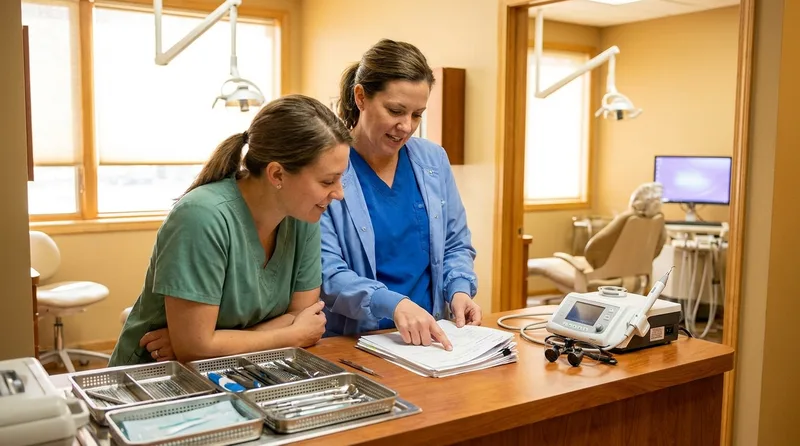
Onboard deliberately for 90 days, because most early departures trace back to week one, not month six. A new hygienist who spends her first morning hunting for instruments and guessing at your perio protocol starts building a story about how this office runs. That story is hard to rewrite later.
The first two weeks
Give her a shortened column for the first two weeks and say so out loud during the offer. Nothing burns goodwill faster than promising a 60-minute column and then booking eight patients on day three because someone called out. Ramp deliberately, then load the schedule.
- Week one: written perio protocol, instrument setup, and a walkthrough of your practice management workflow in Open Dental or Dentrix.
- Week two: shadow one hygiene day, then run a lighter column with a check-in at lunch.
- Day 30: sit down and ask what's slower than it should be. Then fix one of those things.
- Day 90: formal review, referral bonus payout if she came through a team referral, and a conversation about CE.
The onboarding structure here is the hygiene version of a pattern that works across every role you fill. If you are also hiring front desk or assisting staff this year, our broader guide covers how to hire dental staff who actually stay, including interview questions that predict retention.
Keep her column full
Retention also depends on whether her column stays full, which is a scheduling and follow-up problem, not a clinical one. A hygienist watching three cancellations a day will start doubting the job. Tightening confirmations helps: SMS appointment reminders cut no-show rates by 38% according to the Journal of Dental Hygiene, and our breakdown of why patients cancel same day covers the rest.
Your online reputation matters here too. Candidates read the same pages patients do, and 98% of people read local reviews before choosing a business, according to BrightLocal. A review page full of complaints about wait times tells a hygienist what her days will feel like.
What can you do while the position stays open?
Protect capacity and demand in parallel instead of waiting. Temp coverage, expanded-function delegation, and a triaged recall list keep production moving while you recruit. Preventive demand keeps growing, and national oral health data from the NIDCR shows that need isn't slowing down.
Related: Hiring is just one piece of a complete dental front desk staffing plan. See hygienist hiring in context in the complete staffing guide →
Triage recall by risk, not by date
Triage the recall list by risk and value rather than by date. Perio maintenance patients and high-value families come first. Low-risk adults can shift by a few weeks without clinical consequence, and telling them why keeps trust intact.
- Book temp hygienists on your two busiest days, not evenly across the week.
- Shift doctor exams into blocks so a temp isn't waiting on you between patients.
- Extend hours on one day with your remaining hygienist if she wants the hours, and pay accordingly.
- Keep new patient flow steady. Cutting marketing during a gap creates a second hole 90 days later.
The same logic applies on the admin side of an open role. A structured plan for cross-training front desk staff keeps scheduling and check-in moving while you recruit, the same way temp coverage protects the clinical schedule.
Match coverage to when demand actually lands, which is rarely uniform across the week. Our guide to peak hour staffing shows how to read your own demand curve, and phone capacity planning covers the front desk side, where the strain usually shows first.
Answer the phone even when you are short
One last piece of arithmetic. The average practice misses 15 to 20 calls per week, per Dental Economics, and a single missed new patient call carries $1,200 or more in lifetime value. During a staffing gap those numbers climb, because everyone is busier. Answer the phone even when you're short.
Knowing how to hire a dental hygienist in this market rewards preparation over luck. The practices that fill roles in weeks rather than quarters aren't paying dramatically more. They've defined the job, priced it honestly, sourced beyond the job boards, and built a process that moves faster than the office across town.
Pick one step this week. Write the role definition, set the pay band, or call the hygiene program nearest you. Then put a name and a date next to the rest of the steps, and stop letting the vacancy set your schedule.
Keep production steady while you recruit
DentalBase keeps new patient calls answered, recall follow-up running, and your schedule filled while the hygiene chair is between clinicians. See what that looks like in your practice.
Book a Free Demo →Explore more guides and tools for dental practice growth.
Browse Resources →Sources & References
Frequently Asked Questions
Most practices in tight markets need four to twelve weeks from posting to start date. Practices that source through referrals and hygiene schools land closer to four. The biggest delay is usually internal response time, not candidate supply.
Shift from posting to sourcing. Pay your team a referral bonus, post in state RDH Facebook groups, contact the hygiene program nearest you, and use temp platforms as try-before-hire. Working hygienists rarely browse job boards because they already have jobs.
New graduates work well if you can offer a longer column for the first six months and someone to mentor them. You trade ramp-up time for a clinician who learns your protocols from scratch and often stays longer.
Rules vary by state, and a few boards restrict what a clinician not yet licensed in your state can do on live patients. Always pay for the time, verify the license number directly, and check your state board before scheduling.
Response speed. Candidates in a tight market usually hold two or three conversations at once, so the practice that replies first often wins. Set service levels: reply in one business day, screen in two, offer within 48 hours.
Pay at or slightly above your local median, checked against current listings within 20 miles and your dental society's salary survey. Column length, assisted hygiene, and four-day weeks often close candidates that an extra dollar per hour will not.
Onboard deliberately and protect the promises you made. Shortened columns for two weeks, a written perio protocol, working equipment, and a day 30 conversation that fixes one real friction point prevent most early departures.
Was this article helpful?
Written by
DentalBase Team
Expert dental industry content from the DentalBase team. We provide insights on practice management, marketing, compliance, and growth strategies for dental professionals.