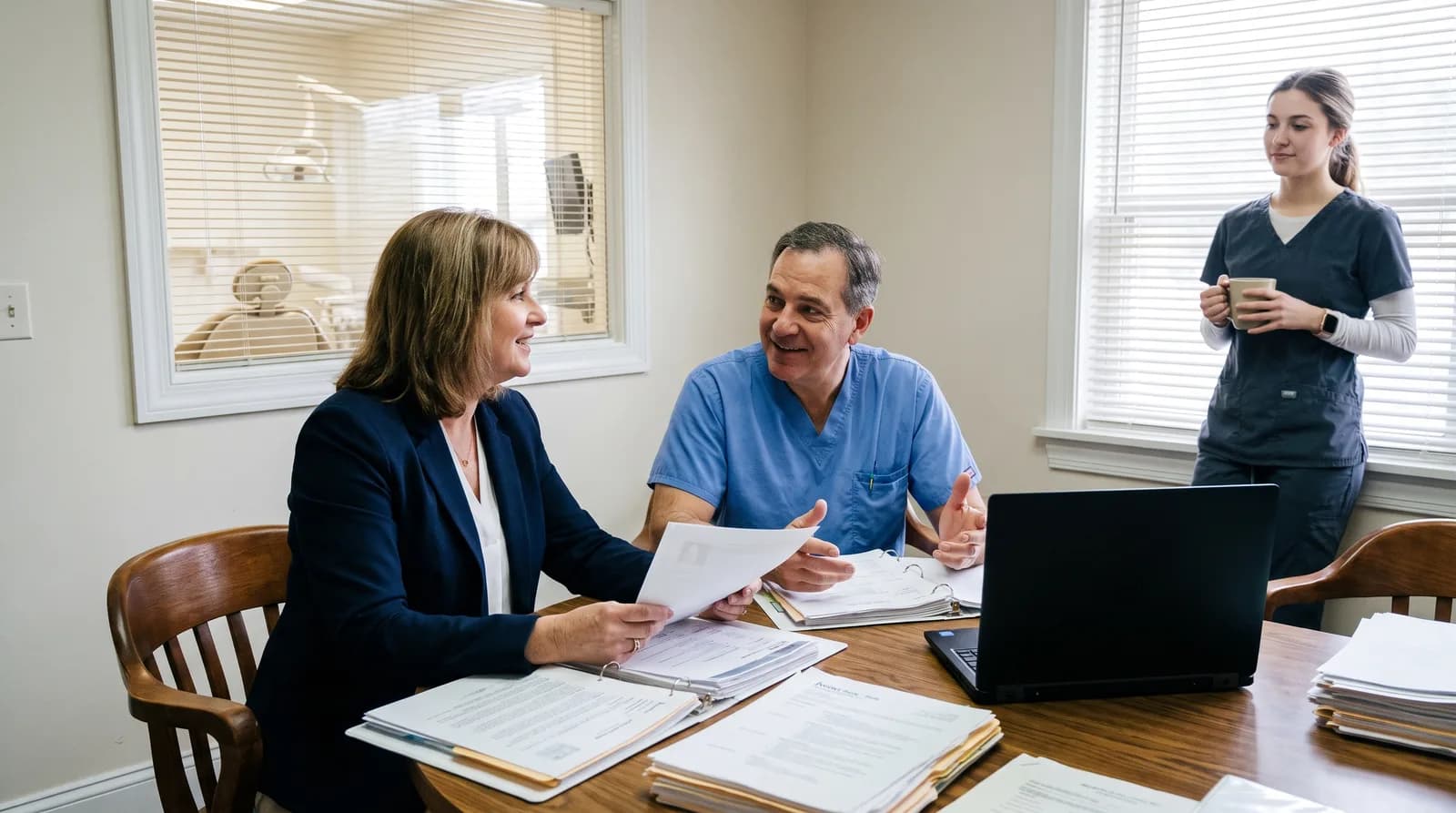
Dental Assistant Hiring: A Complete Practice Owner's Guide
Dental assistant hiring in 2026: where to post ads, what to pay, how roles compare, and when automation eases front desk pressure before you hire.
Share:
Table of contents
Dental assistant hiring has become one of the toughest parts of running a practice in 2026. Dental employment is projected to grow 4% from 2022 to 2032, according to the Bureau of Labor Statistics. More offices are chasing a shrinking pool of trained candidates. If you have posted a dental assistant ad and heard nothing back but crickets, you already know the frustration.
This guide covers where to find candidates and what dental jobs in your office should pay. It also breaks down how a dental assistant differs from a dental hygienist or receptionist, and when automation can ease front desk pressure while you search. Whether you run a solo practice or a multi-location group, treat it as your field reference.
What Does Dental Assistant Hiring Actually Involve in 2026?
Dental assistant hiring means recruiting, screening, and onboarding someone who preps patients, sterilizes instruments, and supports the dentist chairside. Most practices need four to eight weeks between posting a dental assistant ad and a signed offer letter.
That timeline has stretched since 2021. Candidates now compare multiple dental jobs within days, not weeks. A slow interview process costs you the strongest applicants first. A three-provider practice running 200 patient visits a week can't afford a six-week gap between a resignation and a new hire. That's exactly what's happening across the industry. Before you write a job ad, decide whether you're hiring for chairside support, front office coverage, or both. Combining the two roles in one posting usually attracts weaker candidates for either job.
Review your staffing plan alongside DentalBase's full range of dental practice growth services. That way, hiring decisions line up with your patient volume goals instead of just filling an empty chair.
Struggling to keep your front desk staffed?
See how DentiVoice covers calls and scheduling while you search for the right hire.
See AI Receptionist →How Does a Dental Assistant Differ From a Dental Receptionist or Hygienist?
A dental assistant handles chairside clinical support, a dental receptionist manages the front office and phones, and a dental hygienist performs cleanings and periodontal screenings under a state license. Confusing these roles in a job ad is the fastest way to attract the wrong applicants.
Job seekers searching for "dental receptionist job role" or "dental front office" work expect scheduling, insurance verification, and patient check-in duties, not sterilization or chairside prep. Meanwhile, someone searching "dental hygienist careers" already holds or is pursuing a license and won't apply to a listing that reads like an assistant posting. Getting the title and duties right on the ad is a small fix with an outsized effect on applicant quality. It also affects visibility. Google's job search feature relies on structured job posting markup to surface listings, so a career page built around the actual role tends to show up in more searches than a vague one.
| Role | Core Duties | Credential Needed | Typical Fill Time |
|---|---|---|---|
| Dental Assistant | Chairside prep, sterilization, X-rays (with certification) | State-dependent; often on-the-job trained | 4-8 weeks |
| Dental Receptionist / Front Desk | Scheduling, check-in, insurance verification, phones | None required; PMS experience preferred | 3-6 weeks |
| Dental Hygienist | Cleanings, periodontal charting, patient education | Accredited degree plus state license | 8-16 weeks |
Related: If your front desk role keeps stalling growth even when it's fully staffed, the bottleneck may not be headcount at all. Read about dental front desk bandwidth →
Where Should You Post a Dental Assistant Ad to Reach Qualified Candidates?
Post a dental assistant ad on dental-specific job boards first, then general platforms, then your own careers page. Dental-specific boards attract candidates who already understand the certifications and PMS systems your practice uses, cutting screening time roughly in half.
General job boards generate volume, but also more unqualified applications for dental jobs. Applicants there aren't filtering by dental credentials the way they would on a dental-specific board. A well-written ad still performs better everywhere it's posted. Specific, scannable postings with clear duties and pay ranges consistently draw stronger applicants than vague ones. Your own careers page still matters, too. It's where candidates verify you're a real, active practice before applying anywhere else.
Where to List a Dental Assistant Ad
- Dental-specific job boards (best for chairside and hygienist roles)
- Indeed, ZipRecruiter, and other general platforms (best for front desk and entry-level roles)
- Your practice's own careers page and Google Business Profile
- Local dental assisting or hygiene school job boards
- Employee referral incentives, which fill roles faster than any job board
Should You Use a Dental Recruiting Company or Hire In-House?
Dental recruiting companies are worth the cost mainly for hygienist openings or specialist roles sitting vacant for months, not general dental assistant hiring. Their fees typically run 15-25% of first-year salary, which only pencils out when the role is genuinely hard to fill.
For most dental office team openings, in-house hiring is faster and cheaper once you build a repeatable process. That means a written job description, a screening call script, and a defined interview panel. Dental recruiting companies still bring value for practices without a dedicated dental practice manager to run that process. A recruiter absorbs the sourcing and initial screening work. The tradeoff is candidate control. You'll see fewer resumes, but each one is pre-vetted against your criteria.
When a Recruiter Makes Sense
- The role has been open for more than eight weeks with no qualified applicants
- You're hiring a dental hygienist or specialist in a market with a known shortage
- Your practice lacks a practice manager or owner with time to screen candidates
- You're opening a new location and need to staff multiple roles at once
What Does a Dental Front Desk Position Actually Require Day to Day?
A dental office front desk position covers scheduling, insurance verification, patient check-in, and answering phones, usually 60-100 calls per day in a busy practice. The role blends customer service with administrative accuracy, since a scheduling error affects both patient experience and same-day production.
Job seekers browsing "front desk dental jobs" or "dental office front desk job duties" often underestimate the phone volume until they start. A BrightLocal consumer survey found that most patients read reviews before booking. That means your front desk hire is also managing your reputation in real time, not just a calendar.
Typical Dental Front Desk Duties
- Answering and routing incoming patient calls
- Scheduling and confirming appointments
- Verifying insurance eligibility before visits
- Collecting copays and processing payments
- Managing recall and reactivation lists
Most of these duties overlap enough that they can be split across a trained team rather than one person. Our guide to cross-training a dental front desk team breaks down which tasks pair well together.
Front desk stretched thin between hires?
DentiVoice answers calls around the clock and books directly into your PMS, so no shift goes uncovered.
Explore DentiVoice →Why Are Dental Hygienist Openings So Hard to Fill Right Now?
Dental hygienist openings are hard to fill because the role requires an accredited degree and state licensure, which caps the candidate pool far below dental assistant hiring. That structural limit, not a hiring mistake, is the main driver behind long vacancies.
The gap isn't new, but it's worsened. Programs graduate a limited number of hygienists each year. Many also work part-time or across multiple practices instead of full-time at one office, spreading an already thin supply even thinner. The National Institute of Dental and Craniofacial Research tracks these workforce trends alongside broader oral health data. If you're seeing zero qualified applicants after weeks of "dental hygienist wanted" postings, that's consistent with the broader trend. It's not a sign your ad is written poorly.
Understanding why the openings sit empty is only half of it. The practices that still fill them run a defined process with dates attached rather than refreshing a posting each month. Our companion guide covers how to hire a dental hygienist step by step, from the job posting through the 90-day onboarding plan.
Related: We broke down the structural causes and what practice owners are doing about it in detail. Read the full dental hygienist shortage report →
Can You Hire a Remote Dental Assistant for Administrative Work?
A remote dental assistant can handle insurance verification, appointment scheduling, and follow-up calls, but chairside duties like instrument prep and sterilization require being on-site. Most practices treat this as a hybrid arrangement rather than a full replacement for an in-office hire.
Remote roles work best for practices with high call volume but limited office space, or multi-location groups centralizing administrative work across sites. The tasks that translate well remotely overlap heavily with dental receptionist duties: verifying benefits, confirming appointments, and calling patients on recall lists. What doesn't translate is anything requiring physical presence in the treatment room, so a remote dental assistant is really a remote administrative hire wearing a clinical-sounding title.
How Much Does It Cost to Hire and Onboard a Dental Assistant?
Hiring a dental assistant typically costs $300 to $900 once job board fees, background checks, and paid training time are counted. That range widens significantly if you use a dental recruiting company or need to backfill a shift during the search.
A single missed new patient call can cost a practice more than $1,200 in lifetime value, according to industry data. That puts the cost of an empty front desk seat in perspective next to the hiring spend itself. Budgeting for onboarding time, not just the ad and background check, also prevents the common mistake of rushing a new hire onto the floor before they're ready.
| Cost Item | Typical Range |
|---|---|
| Job board posting fees | $0-$250 per listing |
| Background check / drug screen | $40-$80 per candidate |
| Paid onboarding and training time | $200-$600 (first 1-2 weeks) |
| Dental recruiting company fee (if used) | 15-25% of first-year salary |
How Do You Interview and Screen Candidates for a Dental Front Desk Job?
Screen dental front desk candidates with a phone interview focused on scheduling scenarios, then an in-person interview testing PMS familiarity and phone manner. Skipping the phone screen is the most common reason practices waste time on in-person interviews that go nowhere.
Role-play a difficult call during the interview, such as a patient disputing a bill or requesting a same-day emergency slot. How a candidate for a "dental receptionist job near me" search handles that pressure tells you more than any resume line. For dental assistant candidates, ask about sterilization protocol specifics instead of general experience. The details separate someone who worked alongside a hygienist from someone who actually ran the autoclave.
A Simple Screening Sequence
- 15-minute phone screen covering availability, pay expectations, and basic scenario questions
- Skills check: PMS navigation for front desk, sterilization protocol for assistants
- In-person interview with a role-play scenario relevant to the position
- Reference check with at least one prior dental employer
- Working interview or shadow shift before a final offer
Can AI Reduce Your Front Desk Hiring Needs Without Replacing Your Team?
An AI receptionist can absorb overflow calls and after-hours scheduling so your dental office team isn't stretched thin during a hiring gap. It doesn't eliminate the need for in-person staff, though. Think of it as a buffer, not a substitute for your front desk hire.
Practices running a lean team often use AI call handling to cover the gap between a resignation and a new hire. That avoids the missed-call costs mentioned earlier while search continues. This matters most for multi-provider offices. A single dentist call center style overflow line rarely matches patient expectations, but a dental-trained AI system that already knows your scheduling rules can. It's a stopgap and a permanent efficiency layer at once, not an either-or decision against hiring.
Related: Multi-language practices face a specific version of this staffing gap during peak call hours. See how bilingual AI call answering handles it →
Is Your Practice Ready to Hire, or Ready to Automate First?
Check each item that applies to your practice right now.
Three or more checks usually means it's worth automating call coverage while you hire, not instead of hiring.
What Should You Track After You Fill a Dental Jobs Opening?
After filling a role, track time-to-productivity, 90-day retention, and call or scheduling accuracy to confirm the hire is actually working out. Skipping this step is why practices repeat the same bad hiring decisions without noticing a pattern.
Set a 30-60-90 day check-in schedule with clear, written expectations for each stage rather than a vague "let's see how it goes" approach. Front desk turnover is expensive to repeat, and the ADA Health Policy Institute has tracked staffing instability as a recurring pressure point across US practices in its workforce surveys. If a new dental assistant or receptionist isn't hitting benchmarks by day 60, address it directly instead of waiting for the 90-day mark to force a decision.
Related: Matching staffing levels to your real demand curve prevents both under-hiring and overstaffing. See how peak hour staffing works →
Dental assistant hiring will keep being a moving target as long as the candidate pool stays this tight. A clear process shortens the pain every time you're forced to run it. Write job ads that match the actual role. Budget for onboarding time, not just the posting fee. Use call automation to cover gaps instead of pretending they don't exist. The practices filling roles fastest right now aren't necessarily paying the most. They're the ones treating hiring as a repeatable system instead of a fire drill each time someone gives notice.
See How DentiVoice Covers Your Front Desk Between Hires
Book a free demo and see how AI call answering keeps calls covered while you search for the right dental assistant or receptionist.
Book a Free Demo →Want more practice management guides like this one?
Browse the DentalBase Resources library →Sources & References
Frequently Asked Questions
Dental assistant hiring takes four to eight weeks on average, from posting a dental assistant ad to a signed offer. Markets with a hygienist or assistant shortage often stretch past ten weeks, especially for practices requiring X-ray certification.
A dental receptionist job role and a dental front office position are usually the same job with different titles. Both cover scheduling, check-in, insurance verification, and phone coverage rather than clinical chairside work.
Dental recruiting companies are worth it mainly for hygienist openings or specialist roles that sit vacant for months. For general dental assistant ads, in-house posting on job boards usually fills the role faster and cheaper.
A remote dental assistant can handle insurance verification, scheduling, and patient follow-up calls, but chairside duties like instrument prep require being on-site. Most practices treat remote dental assistant work as a hybrid role, not a full replacement.
Dental hygienist openings require an accredited degree and state licensure, which limits the candidate pool far more than dental assistant hiring does. The American Dental Association has tracked this gap widening since 2021 in workforce surveys.
Pay varies by state and certification, but most dental assistant ads that specify a range fill faster than ones that don't. Practices in high cost-of-living markets typically post 10-20% above their regional average to stay competitive.
No, an AI receptionist does not replace front desk staff. It absorbs overflow calls and after-hours scheduling so your existing dental office team isn't stretched thin while you search for the right hire.
Was this article helpful?
Written by
DentalBase Team
Expert dental industry content from the DentalBase team. We provide insights on practice management, marketing, compliance, and growth strategies for dental professionals.